3–6% of Payroll: Sales Leaders' 10 Minute Plan to Budget Training
3–6% of Payroll: Sales Leaders’ 10 Minute Plan to Budget Training

Those ranges track with what Factor 8 and IMPACT report across the training industry. Pick one calculation method below, run your headcount and salary numbers through it, and you’ll have a defensible number by end of day.
TL;DR:
- Sales training budgets typically range from 3% to 6% of salary, with customized programs costing up to $30,000 per team of 20, and multi-month initiatives exceeding $100,000.
- The most significant cost factors include training complexity, travel, content development, and post-training reinforcement, which can push expenses toward the top of the range.
- Three practical budgeting methods are percentage of payroll, a flat per-rep fee, and needs-based tiered planning, suited to team maturity and turnover rates.
- Training expenses should encompass vendor fees, trainer time, LMS licensing, travel, content, and opportunity costs of sales reps pulled from revenue-generating activities.
- Implementing AI roleplay reduces scalable costs, accelerates feedback, and emphasizes skill improvement over attendance, shifting the budget toward licensing and scenario management.
Table of Contents
- Sales Training Cost Benchmarks: What’s Normal to Spend
- Three Ways to Calculate Your Sales Training Budget
- What Belongs in a Sales Training Budget Line by Line
- When to Train and How to Budget for It
- Building the ROI Case Leadership Will Actually Approve
- Sample Sales Training Budget Templates by Team Size
- Why AI Roleplay Changes the Training Budget Math
- A Straight Answer on Where Training Dollars Actually Go
- Budgeting for Reinforcement With Xl Roleplay
- Sources
Sales Training Cost Benchmarks: What’s Normal to Spend
Sales roles run higher. Because reps directly drive revenue, Factor 8’s benchmarks put the realistic range at 3% to 6% of salary for a sales-specific training investment.
Translate that into per-person pricing and the range gets wide fast:
- Self-paced courses or certificate programs: roughly $400 to $4,000 per person, according to IMPACT’s cost breakdown.
- Cohort-based workshops with live facilitation: generally land in the mid-range of that same bracket, closer to $2,000 to $4,000 per rep.
- Customized programs built around your methodology: $15,000 to $30,000 for a team of up to 20 people.
- Multi-month transformation initiatives: $40,000 to $100,000 or more, per The Harris Consulting Group.
Statistic Callout: Sales training investment as a share of salary (3–6%) typically runs a full percentage point or two above general corporate training averages, according to Factor 8 — a gap that reflects how directly rep performance ties to revenue.
Complexity is the biggest cost driver. A team selling a simple product to a familiar buyer needs less than a team navigating multi-stakeholder enterprise deals with six-figure contracts. Travel, custom content development, and post-training reinforcement all push the number toward the top of the range, too.
Three Ways to Calculate Your Sales Training Budget
You don’t need a finance degree to build a credible number. Three methods cover almost every situation, and each one takes about ten minutes to run.
- Percentage of sales payroll. Multiply total sales payroll by 3% to 6%. A team of 15 reps averaging $70,000 base salary has a payroll of $1,050,000. At 4%, that’s a $42,000 annual training budget. This method works best for established teams with a known salary baseline, as noted in The Harris Consulting Group’s budgeting guide.
- Per-rep stipend. Assign a flat dollar amount per rep, say $1,500, and multiply by headcount. Fifteen reps at $1,500 comes to $22,500. This fits fast-growing teams where payroll is a moving target and you’d rather budget by seat.
- Needs-based tiered budgeting. Add onboarding cost, ongoing reinforcement, and manager coaching time as separate line items. New hire onboarding at $2,000 per rep, plus $500 per rep for quarterly reinforcement, plus 20 hours of manager coaching valued at $50/hour, gets you to a number built from actual activity rather than a formula.
Immature teams with high turnover usually do better on the tiered method, because onboarding costs dominate. Mature teams with stable headcount can lean on the percentage-of-payroll method since it scales predictably year over year.
What Belongs in a Sales Training Budget Line by Line
A budget that only lists “training vendor fee” gets challenged in the approval meeting. A complete one accounts for every cost center finance will ask about.
- External vendor or program fees (workshops, certifications, custom content)
- Internal trainer or enablement headcount, prorated by time spent
- Learning management system (LMS) or roleplay platform licensing
- Travel and venue costs for in-person sessions
- Content development time, including custom scenario building
- Measurement tools for tracking skill improvement over time
Pro Tip: Rep opportunity cost is the line item almost everyone forgets. A day of training pulls a rep off the phones, and that lost selling time has a real dollar value. Multiply average daily quota contribution by the number of reps in the room to estimate it, and add that figure to your total ask.
Manager coaching hours and license renewal fees are the other quiet budget-killers. If a manager spends five hours a month coaching off a training rubric, that’s 60 hours a year of loaded management time. Building a scenario library, like the approach outlined in XL Roleplay’s guide to sourcing real-call scenarios, takes real hours too. Budget for it up front instead of discovering it mid-year.
When to Train and How to Budget for It
Spread spend across four recurring touchpoints rather than one big annual event:
- Onboarding for new hires, budgeted per cohort as reps join
- Monthly micro-practice sessions to keep skills sharp between big pushes
- Quarterly sprints tied to new products, pricing, or competitive shifts
- An annual sales kickoff (SKO) for org-wide alignment and larger workshops
Virtual delivery cuts travel and venue costs but shifts more of the budget toward platform licensing and content. In-person sessions cost more per hour but often land better for complex negotiation or objection-handling practice. Time your biggest spend around hiring waves and your SKO date, since that’s when new skill gaps are largest and leadership attention is highest.
Building the ROI Case Leadership Will Actually Approve
Executives don’t approve training budgets. They approve revenue protection and acceleration. Frame your ask around metrics finance already tracks.
- Time to quota (ramp time). If new reps typically take 6 months to hit quota, and training shaves that to 4.5 months, calculate the revenue recovered from those extra six weeks of full productivity.
- Win rate lift. Even a 3 to 5 percentage point improvement in win rate, applied against average deal size, produces a real revenue number finance can model.
- Retention and margin preservation. Reps who feel invested in stay longer, and reps trained on negotiation tactics protect deal margin instead of discounting under pressure. XL Roleplay’s negotiation scenario library is built around exactly this kind of margin defense.
Statistic Callout: Industry research from the TD State of the Industry report consistently finds that manager involvement and reinforcement, not the training event itself, determine whether skill gains stick.
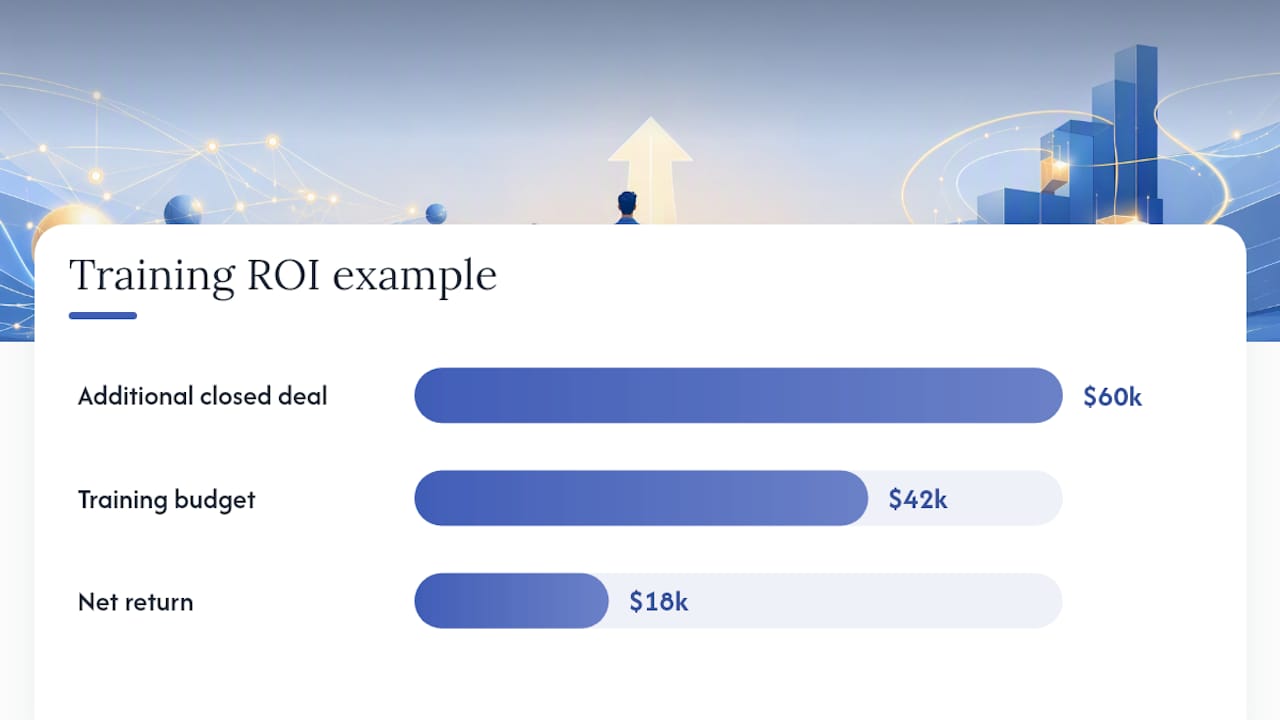
A simple ROI model: (Revenue gain from ramp time + win rate lift + margin preserved) minus (total training cost) equals net return. If a $42,000 budget produces even one additional closed deal worth $60,000, payback happens inside the first quarter. Put that math on one page: ask amount, primary objective, the two or three KPIs you’ll report against, and how you’ll reinforce the training after it ends. That’s the request template leadership actually reads.
Sample Sales Training Budget Templates by Team Size
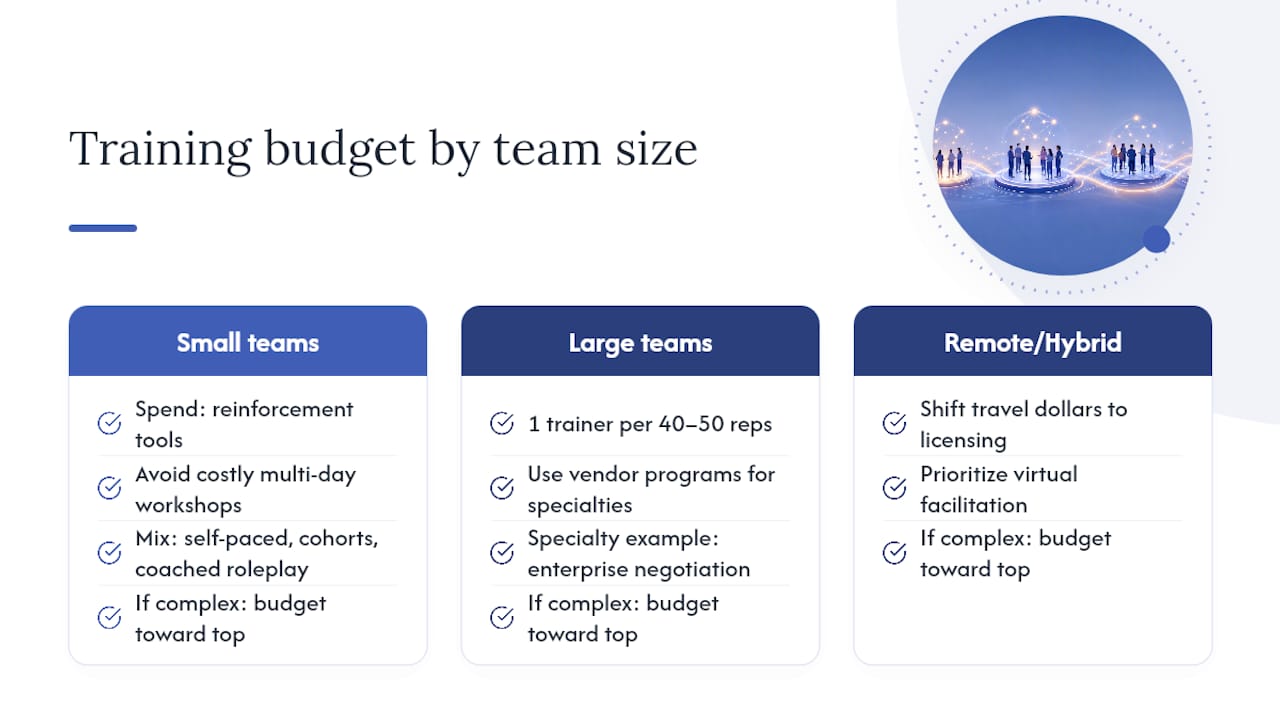
Here’s how the math plays out at three different team sizes, using the percentage-of-payroll method as the baseline.
Small teams should weight spending toward reinforcement tools rather than expensive live workshops. A blended mix of self-paced content, occasional cohort sessions, and coached roleplay tends to outperform repeated multi-day workshops on cost and retention, according to IMPACT’s analysis. Large teams usually need at least one dedicated internal trainer per 40 to 50 reps, supplemented by vendor programs for specialized skills like enterprise negotiation.
Remote or hybrid teams should shift dollars from travel toward platform licensing and virtual facilitation. High-complexity products, meanwhile, justify pushing toward the top of every range, since generic content won’t cover the objections your reps actually hear.
Why AI Roleplay Changes the Training Budget Math
Live workshops and instructor-led roleplay don’t scale. Every repeat session costs the same as the first one. AI-driven roleplay breaks that constraint by letting reps practice objection handling and discovery calls on demand, without booking a manager’s calendar or repeating a facilitator fee.
That shift changes what finance sees on the line item:
- Fewer repeat instructor-led sessions, since reps rehearse independently between live coaching
- Faster feedback loops through scored reports instead of waiting for a manager debrief
- Measurable readiness scores that show skill progress instead of just attendance
- Lower marginal cost per practice hour as usage scales across the team
A Straight Answer on Where Training Dollars Actually Go
Most training budgets fail for one reason: they fund events instead of behavior change. My primary recommendation is simple. Spend less on one-time workshops and more on repeatable practice with built-in measurement. Three mistakes show up constantly: skipping reinforcement, budgeting training but not manager coaching time, and measuring attendance instead of skill lift. Track outcomes, not hours logged.
— Adam
Budgeting for Reinforcement With Xl Roleplay
Once your budget covers onboarding and a kickoff event, the harder question is what funds the practice in between. XL Roleplay fills that gap as a licensed seat cost rather than a per-workshop fee. Reps rehearse live voice and video scenarios against AI buyers built around your own objections and methodology, and managers review scored transcripts instead of sitting in on every call.
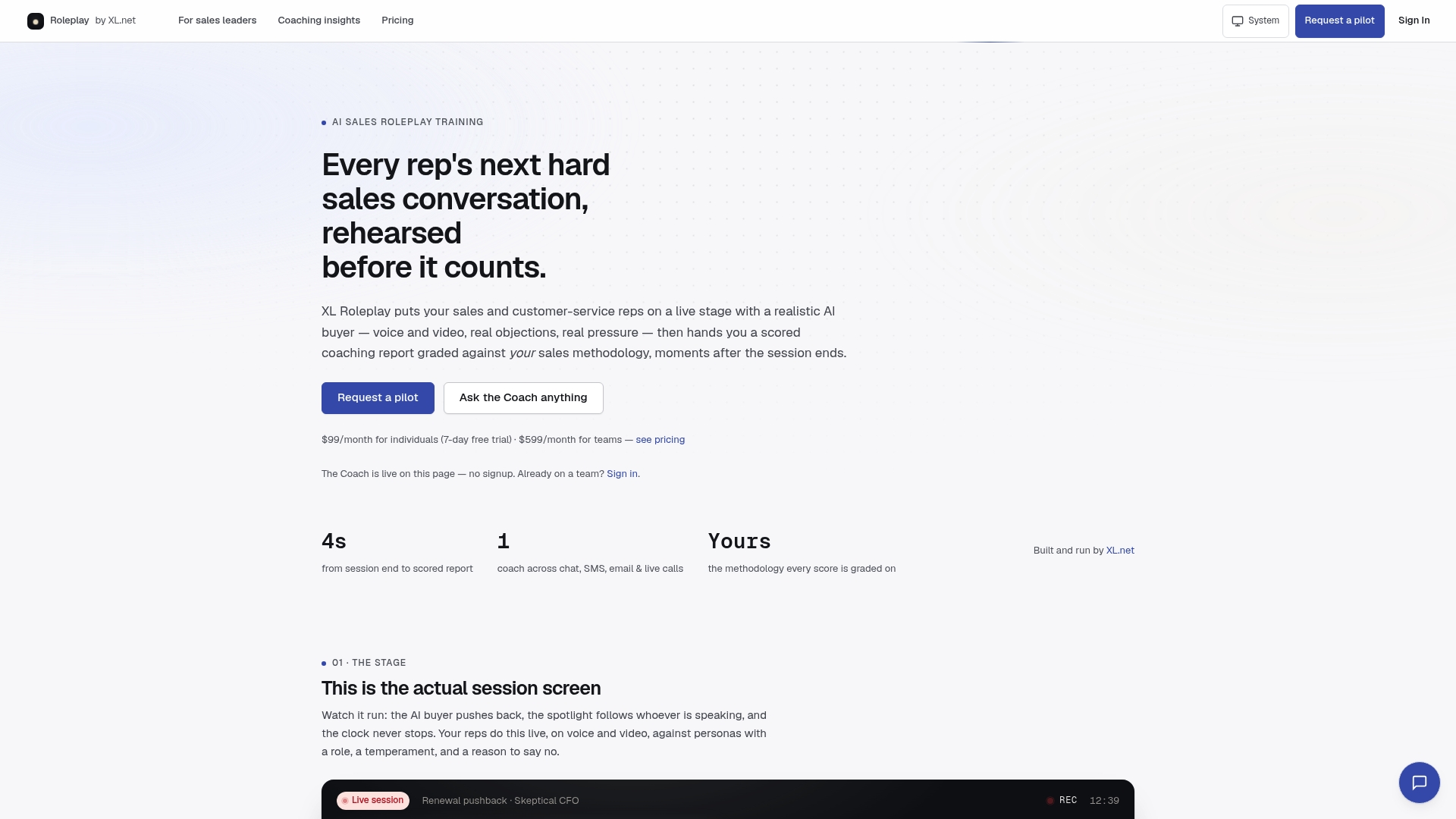
Budget for it the way you’d budget any recurring software line: per-seat licensing, a small allocation of admin time to build or adjust scenarios (see how to run roleplay training reps don’t dread for a starting framework), and a quarterly cadence tied to your reinforcement schedule rather than a one-time event. Teams also budgeting for market-specific skills can look at Spanish for Sales training from Spanish Explorer as a complementary line item. If you’re building next year’s request now, visit the sales leaders page for pricing frameworks and request a demo before you finalize the number.
Sources
- How to Budget for Sales Training | Factor 8
- Sales Training: How Much Does It Cost? | IMPACT
- How Much Does Sales Training Cost in 2026? | The Harris Consulting Group
- TD: State of the Industry report