Sales Training Playbook: Build Plays That Ramp Reps Faster
Sales Training Playbook: Build Plays That Ramp Reps Faster

A sales training playbook is the operating manual that converts ad-hoc selling into repeatable revenue. It captures your best plays, your qualification logic, your objection responses, and your CRM rules in one place so every rep sells the way your top performers already do.
Start here: pick three priority plays (discovery, top objection, close), run a two-week pilot with two AEs, and measure win rate and ramp time against your current baseline. That’s the whole plan. Everything below shows you how to execute it.
TL;DR:
- Reps who use a structured playbook reference it multiple times per week for real-time deal support, not just onboarding.
- A short, testable playbook drives faster adoption than a comprehensive manual that never gets opened.
- Early wins show up in weeks 2–4: fewer deal slippages, shorter discovery calls, and coaching conversations that focus on specific plays instead of vague feedback.
Do these today:
- Name a single playbook owner (not a committee).
- Pull your last 10 closed-won deals and identify the three behaviors that appeared in every one.
- Write one discovery play from those patterns, no longer than one page.
- Schedule a two-week pilot with two AEs and define the KPI you’ll check at the end.
- Block 30 minutes with your top performer to capture their objection responses verbatim.
Table of Contents
- What is a sales playbook, and what exactly is a “play”?
- Why a sales playbook pays off faster than most managers expect
- What to include in every sales playbook
- How to build your sales training playbook step by step
- Sample plays and templates you can adapt right now
- How to roll out the playbook and make it stick
- How to measure whether your playbook is working
- How long does it take to build a playbook, and what does it cost?
- Who owns the playbook, and how do you keep it current?
- How role-play and AI-driven practice turn plays into habits
- Key Takeaways
- The part most playbook guides won’t tell you
- Xl makes your playbook stick through scored AI practice
- Useful sources and further reading
What is a sales playbook, and what exactly is a “play”?
A sales playbook is your team’s operating manual. It documents the ideal customer profile (ICP), qualification criteria, discovery framework, demo flow, objection responses, pricing and discount rules, contract motion, CRM hygiene standards, and the specific plays reps run at each stage. Think of it as the difference between a team that improvises every call and one that runs a system.
A play is a single, repeatable tactic inside that manual. A discovery play is a structured sequence of questions designed to surface pain and qualify budget in one call. An objection play is a two-step response to “we’re already using a competitor.” The playbook is the binder; the play is the page.
The document works as a loop, not a static file. Reps use plays in live deals, managers observe and score performance, feedback surfaces gaps, and the playbook gets updated. Inputs (ICP data, win/loss patterns, top-performer interviews) feed the plays. Plays feed coaching conversations. Coaching conversations feed the next revision. Concise, well-structured playbooks built from real deal patterns are the ones that actually get used.
Why a sales playbook pays off faster than most managers expect
The most direct benefit is ramp time. New AEs who follow a documented process reach quota faster than those who learn by shadowing and trial and error. The second benefit is consistency: when every rep runs the same discovery framework, your pipeline data becomes reliable enough to forecast from.
Here’s what a working playbook does for each role:
- New AEs: Reduces the “figuring it out” phase by giving them a tested script for the first 30 days.
- Experienced reps: Gives them a reference for edge cases (unusual objections, non-standard pricing requests) without having to escalate every time.
- Managers: Shifts one-on-ones from “how did the call go?” to “which play did you run, and where did it break down?” That specificity makes coaching faster and more useful.
- Revenue leaders: Playbook-driven teams produce more consistent stage conversion data, which makes forecasting less of a guessing game.
Statistic: AEs who actively use a well-structured playbook open it 3–10 times per week for real-time deal support, not just during onboarding.
Simpler playbooks drive faster adoption than comprehensive ones. A 15-page document that reps reference daily beats a 60-page manual that sits in a shared drive. The goal is a tool, not a textbook.
What to include in every sales playbook
Every playbook needs the same core sections, though the depth of each will vary by team size and sales motion. The table below maps each component to what you should capture in it.
| Component | What to capture |
|---|---|
| ICP + anti-ICP | Firmographic and behavioral signals that predict a good fit, plus 3–5 disqualifiers |
| Qualification criteria | 3–5 binary ruling questions (budget confirmed? decision-maker engaged? timeline defined?) |
| Discovery framework | Structured question sequence by persona; persona-specific question banks tied to common pain points |
| Demo flow | Three-act structure: confirm pain, show relevant capability, define next step |
| Objection library | Top 10 objections with two tested responses each |
| Pricing and discount rules | Floor pricing, discount approval thresholds, bundling logic |
| Contract motion | Who signs, standard terms, common redlines and approved responses |
| CRM hygiene | Required fields per stage, what “closed-lost” reason codes mean, update frequency |
| Battle cards | Competitive positioning for the two or three rivals you lose to most often |
| KPIs | The metrics that define success at each stage (conversion rate, average deal size, time-in-stage) |
A few template formats worth having ready:
- One-page demo flow: Three sections (pain confirmation, capability proof, next step), each with two to three talking points.
- 10-question discovery bank: Organized by persona, with follow-up probes for each question.
- 10-objection library template: Objection text, root cause, two tested responses, and a “when to escalate” flag.
High-performing teams rarely rely on a single methodology. They hybridize SPIN, Challenger, and MEDDIC, and the playbook specifies when each framework applies. A discovery play for an enterprise deal looks different from one for a mid-market SMB, and the playbook should say so explicitly.
How to build your sales training playbook step by step
The most common mistake is starting with a blank document and trying to write everything at once. Build from evidence, not theory. Wait until your team has closed enough deals to identify real patterns before finalizing any play.

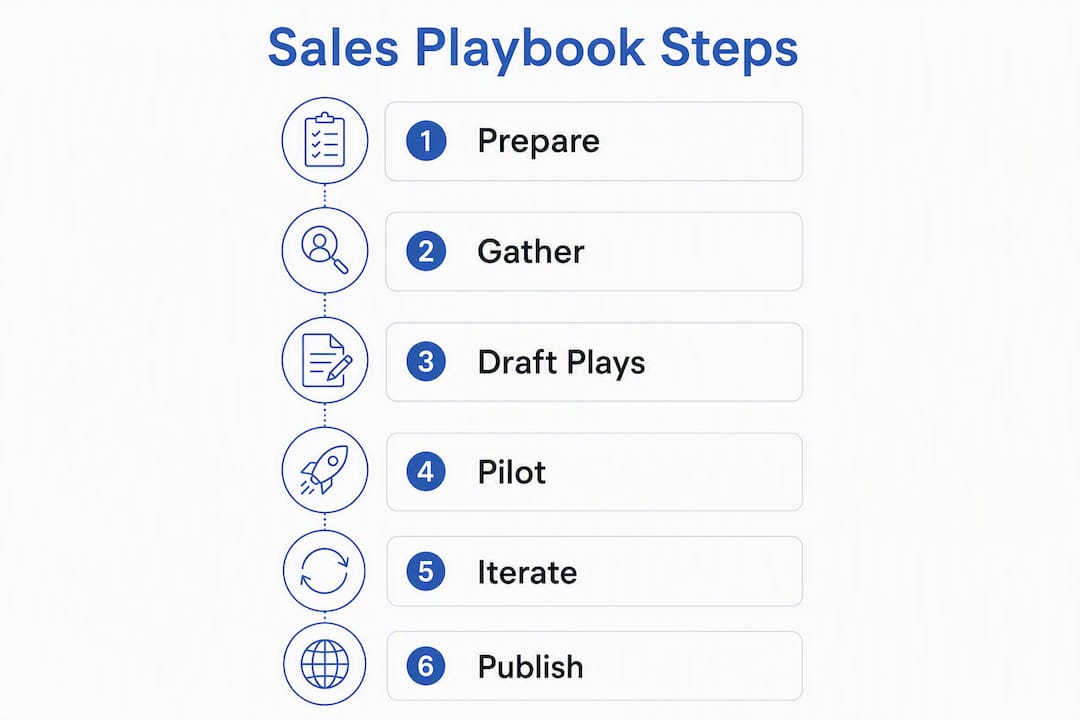
Step 1: Prepare
Assign one owner (an enablement lead or senior AE, not a committee). Identify your data sources: CRM win/loss data, call recordings, and two or three top-performer interviews. Set a six-week build-to-pilot target.
Step 2: Gather
Interview your top two performers. Ask them to walk through their last three closed-won deals play by play. Pull the common behaviors. Cross-reference with your win/loss data to confirm the patterns hold.
Step 3: Draft three priority plays first
Don’t try to write the whole playbook. Pick the three plays that address your biggest current problem: ramp time, win rate, or competitive losses. Write each play on one page.
Step 4: Run a two-week pilot
Select two AEs. Give them the three plays and a simple scorecard. Run the pilot on live deals, not role-play only. At the end of two weeks, review the scorecard data and collect rep feedback.
Step 5: Validate
Before promoting a play to the full team, answer these questions:
- Did reps use it without prompting?
- Did it produce a measurable improvement in the target metric?
- Did both pilot AEs find it clear enough to run without coaching?
- Did it hold up across at least five deals?
If the answer to all four is yes, the play is production-ready.
Step 6: Iterate and publish
Incorporate pilot feedback, update the play, and publish to the full team. Keep the first version under 20 pages. You can always add sections; you can’t un-bury a playbook that’s too long to use.
Pro Tip: The first version of your playbook should feel uncomfortably short. If it’s over 20 pages before the pilot, cut it in half. Reps adopt short documents. They archive long ones.
Sample plays and templates you can adapt right now
These are copy-ready starting points. Adjust the language to match your product, your ICP, and your sales motion.
Discovery call architecture (30-minute call)
- Minutes 0–5: Confirm agenda, set expectations (“I’ll ask a few questions about your current process, then show you something relevant if it fits”).
- Minutes 5–18: Run your discovery sequence. Start with current state (“Walk me through how your team handles X today”), move to impact (“What does that cost you in time or revenue?”), then future state (“What would a fix need to look like?”).
- Minutes 18–25: Confirm pain with a summary statement and check for budget and timeline signals.
- Minutes 25–30: Define the next step explicitly. Never leave a call without a scheduled follow-up.
For gap-selling discovery drills that help reps practice sizing the current vs. future state gap, build a question bank of 10 questions organized by persona. A VP of Sales gets different questions than a frontline manager.
Three-step demo flow
- Pain confirmation: Restate the top two pains from discovery. Get verbal confirmation before showing anything.
- Capability proof: Show only the features that address those two pains. Resist the urge to show everything.
- Next step: End with a clear ask (“Based on what you’ve seen, does it make sense to bring in your CFO for a 20-minute numbers conversation?”).
Objection play: “We’re already using a competitor”
- Response A (probe first): “That’s helpful context. What’s working well with them, and what made you take this call?” Listen for the gap.
- Response B (reframe): “Most of our customers came from that platform. The switch usually happens when [specific pain point]. Is that something you’re running into?”
For negotiation and concession scripts that protect margin, build a separate play that defines your floor price, your first concession offer, and the conditions under which you escalate to a manager.
Re-engagement email template
Subject: Still worth a conversation?
Hi [Name], we spoke [X weeks] ago about [pain point]. A few things have changed on our end that might be relevant. Worth 15 minutes to catch up?
Keep it short. The goal is a reply, not a pitch.
Adapting for seniority levels: Junior reps need more prescriptive scripts with exact language. Senior reps need the framework and the rationale, then room to adapt. Build two versions of each play: a “guided” version with full scripting and a “reference” version with bullet-point prompts.
How to roll out the playbook and make it stick
A playbook that lives in a shared drive is not a playbook. It’s a document. The difference is adoption, and adoption comes from how you roll it out.

| Phase | Timeline | Activities | Success signal |
|---|---|---|---|
| Pilot | Weeks 1–2 | 2 AEs run 3 plays on live deals; daily check-ins | Both AEs use plays without prompting |
| Phased rollout | Weeks 3–6 | Full team onboarding in cohorts of 4–6; live workshops + micro-role-play | 80% of team can run each play in a role-play session |
| Full adoption | Weeks 2–4 | Manager-led deal reviews reference playbook; CRM fields tied to play stages | Playbook referenced in 1:1s and pipeline reviews |
| Ongoing | Monthly/quarterly | Objection refreshes, quarterly full reviews, new-hire onboarding | New hires reach first deal in target ramp window |
Training formats that work:
- Live workshops (90 minutes): Walk through each play, run one live demo, then break into pairs for a 10-minute role-play.
- Micro-role-play sessions (15–20 minutes): One play, one scenario, immediate manager feedback. These work well at the start of weekly team meetings.
- Recorded demos: Top performers record a 5-minute walkthrough of their best discovery call or demo. New hires watch before their first live call.
- Manager-led debriefs: After every significant deal (won or lost), the manager and rep review which plays were used and where they broke down.
Coaching rubric for manager 1:1s:
Use four dimensions: (1) Did the rep follow the play’s structure? (2) Did they adapt appropriately when the buyer deviated? (3) Was the next step clear and scheduled? (4) What one thing would have changed the outcome? Score each 1–3. A rep scoring 1 on structure needs more role-play. A rep scoring 3 on structure but 1 on adaptation is ready for advanced play variants.
Embedding the playbook into daily workflows through regular role-play and structured debriefs is what separates teams that use it from teams that filed it.
Pro Tip: Place the playbook inside the tools reps already use. A link in Salesforce or HubSpot that opens the relevant play from a deal record gets used. A PDF in a shared drive does not.
How to measure whether your playbook is working
Measurement starts before the pilot. Define your baseline metrics before reps run a single play, or you’ll have nothing to compare against.
Core KPIs to track:
- Ramp time: Days from hire to first closed deal (or first quota attainment).
- Win rate by play: Which plays correlate with closed-won outcomes?
- Stage conversion rate: What percentage of deals move from discovery to demo, demo to proposal, proposal to close?
- Average deal size: Does using the pricing play protect margin?
- Time-to-first-value: For customer success alignment, how quickly do new customers reach their first outcome?
Running a play experiment:
- Hypothesis: “Running the three-step demo flow will increase demo-to-proposal conversion by at least 10 percentage points.”
- Metric: Demo-to-proposal conversion rate.
- Sample: 20 demos (10 with the new play, 10 with the current approach).
- Duration: Three weeks.
- Success criteria: New play conversion rate exceeds baseline by the target margin.
If the experiment succeeds, the play goes into the official playbook. If it doesn’t, you revise the hypothesis and run again.
Dashboard fields to track:
- Play used (tag in CRM)
- Stage conversion rate per play
- Rep adherence score (from coaching rubrics)
- Time-in-stage by play
- Win/loss reason codes tied to play usage
Run small experiments continuously. One new play hypothesis per month is a sustainable cadence. Roll confirmed improvements into the playbook at the quarterly review.
How long does it take to build a playbook, and what does it cost?
Realistic expectations prevent the project from stalling. Most teams underestimate the time required for gathering and validation, and overestimate how long the writing takes.
| Phase | Duration | Owner hours | SME/manager hours |
|---|---|---|---|
| Preparation (owner assignment, data pull) | Week 1 | 4–6 hrs | 2 hrs |
| Gathering (interviews, win/loss review) | Weeks 1–2 | — | 4–6 hrs |
| Drafting (3 priority plays) | Weeks 2–3 | 10–12 hrs | 2–4 hrs |
| Pilot (2 AEs, live deals) | Weeks 3–4 | 4–6 hrs (oversight) | 2–3 hrs |
| Validation and revision | Week 5 | 4–6 hrs | 2 hrs |
| Full rollout and training | Weeks 2–4 | — | 4–6 hrs per cohort |
Total owner investment for a first playbook: roughly 36–48 hours over six to eight weeks. Manager time runs 16–24 hours across the same period.
On tooling costs: a basic playbook lives in Google Docs or Notion at no additional cost. Sales enablement platforms (Highspot, Seismic, and similar) add structure and CRM integration but carry subscription costs. For most teams under 20 reps, a well-organized shared document with a clear naming convention is enough to start.
When to build an MVP playbook instead of a full one: If your team is under 10 reps, you’ve closed fewer than 20 deals, or your ICP is still shifting, build a three-play MVP. Expand it after the pilot confirms what’s working. A full build before you have enough deal data produces a theoretical document, not a tested one.
Who owns the playbook, and how do you keep it current?
A playbook without a governance model becomes outdated within 90 days. Pricing changes, new competitors emerge, and the objections that worked last quarter stop working this one.
Ownership model:
- Playbook owner: One person (enablement lead or senior sales manager) who controls the master document, approves changes, and runs quarterly reviews.
- Play contributors: AEs and managers who flag outdated content, submit new objection responses, and report on what’s working in the field.
- Cross-functional reviewers: Marketing (messaging alignment), product (feature accuracy), legal (contract terms), and customer success (post-sale handoff language).
Update schedule:
- Quarterly: Full review of all plays, ICP criteria, and KPIs. Incorporate top-performer tactics from the past quarter.
- Monthly: Refresh the objection library. Pull the top five objections from call recordings and update responses if the current ones aren’t converting.
- Immediate: Any pricing or packaging change goes into the playbook the same day it goes into effect. A rep quoting yesterday’s price is a trust problem.
Governance checklist:
- [ ] Playbook owner named and documented
- [ ] Quarterly review date on the calendar
- [ ] Version number and “last updated” date visible on the cover page
- [ ] Change log maintained (what changed, who approved it, when)
- [ ] New-hire onboarding checklist references the current playbook version
- [ ] CRM fields aligned with current play stages
Quarterly reviews with monthly rapid updates for objections and same-day updates for pricing keep the document trusted. A playbook reps don’t trust is worse than no playbook, because it creates false confidence.
How role-play and AI-driven practice turn plays into habits
A play written in a document is a hypothesis. A play practiced in a simulated conversation is a skill. The gap between the two is where most playbooks fail.
The rationale is straightforward: reps retain procedural knowledge through repetition, not reading. A discovery framework that a rep has run 10 times in practice is available under pressure. One they’ve read twice is not.
Implementation steps for integrating role-play into your playbook rollout:
- Session design: Build one role-play scenario per play. Each scenario should include a buyer persona, a stated pain, and two or three likely objections. Keep sessions to 15–20 minutes.
- Scoring: Use a four-dimension rubric: discovery quality, value framing, objection handling, and next-step clarity. Score each 1–3. Debrief immediately after.
- Manager debriefs: The debrief is where the learning happens. Ask the rep what they would change, then show them the scorecard. Tie every coaching point back to a specific play.
- Frequency: Weekly micro-sessions during the pilot phase, biweekly after full adoption. New hires should complete at least three scored sessions before their first live call.
Sample scoring rubric:
| Dimension | Score 1 | Score 2 | Score 3 |
|---|---|---|---|
| Discovery quality | Skipped key questions | Asked most questions, missed follow-ups | Full sequence, adapted to buyer responses |
| Value framing | Generic benefits | Tied to stated pain | Quantified impact, buyer confirmed |
| Objection handling | Deflected or ignored | Addressed surface objection | Probed root cause, reframed effectively |
| Next-step clarity | No next step defined | Vague follow-up | Specific meeting scheduled with agenda |
Rubric scores feed directly back into play updates. If three reps consistently score 1 on objection handling for the same objection, that play needs a better response, not more practice.
An example of how this works in practice: a team running discovery role-play sessions noticed that reps consistently skipped the “impact” question when buyers gave a long answer to the “current state” question. The play was updated to include a specific prompt (“Before we move on, what does that cost you in [time/revenue/headcount]?”). In the following month’s pilot, discovery-to-demo conversion improved. The fix came from scored practice, not from rewriting the document.
For coaching from transcripts and scorecards, the most useful data is the moment-by-moment breakdown of where a rep deviated from the play and what the buyer’s response was. That’s the raw material for the next play update.
Key Takeaways
A well-built sales training playbook converts your best reps’ instincts into a repeatable system that every rep on your team can run from day one.
| Point | Details |
|---|---|
| Start with three plays | Draft discovery, top objection, and close plays first; pilot before expanding. |
| Keep it short | Early-stage playbooks under 20 pages drive faster adoption than comprehensive manuals. |
| Measure before you pilot | Set baseline KPIs (ramp time, win rate, stage conversion) before the first play runs. |
| Integrate role-play | Reps who practice plays in scored sessions retain and apply them under live deal pressure. |
| Xl for practice and scoring | Xl’s AI-driven role-play platform provides scored coaching reports and transcripts tied to your specific plays, accelerating adoption and surfacing gaps faster than observation alone. |
The part most playbook guides won’t tell you
Most playbook advice focuses on what to include. The harder problem is what to leave out, and when to stop building and start testing.
The teams that get the most out of a playbook are the ones that treat it as a coaching tool first and a documentation project second. When managers use the playbook as the reference point in every deal review (“which play did you run in that discovery call?”), reps start using it before the call, not after. That behavioral shift is the whole game.
Three things that actually work in real rollouts:
- Coach-first updates. The best play revisions come from managers, not writers. When a manager notices the same breakdown across three reps in one week, that’s a play problem, not a rep problem. Fix the play.
- One-page quick-reference cards. Pull the three most-used plays onto a single page. Reps keep it open during calls. It’s not a replacement for the full playbook; it’s the thing they actually use in the moment.
- Evidence-based battle cards. Don’t write competitive positioning from marketing copy. Pull the actual objections reps hear about competitors from call recordings, write responses that address the real concern, and test them before publishing.
The common mistake: building the playbook in isolation and presenting it to the team as a finished product. Reps who weren’t involved in building it don’t trust it. Run the pilot with your most skeptical AE, not your most compliant one. If it works for them, it’ll work for everyone.
Xl makes your playbook stick through scored AI practice
Most playbooks stall at the rollout phase, not the build phase. Reps read the plays once, nod, and go back to doing what they’ve always done. The missing piece is deliberate, scored practice tied directly to the plays you’ve built.
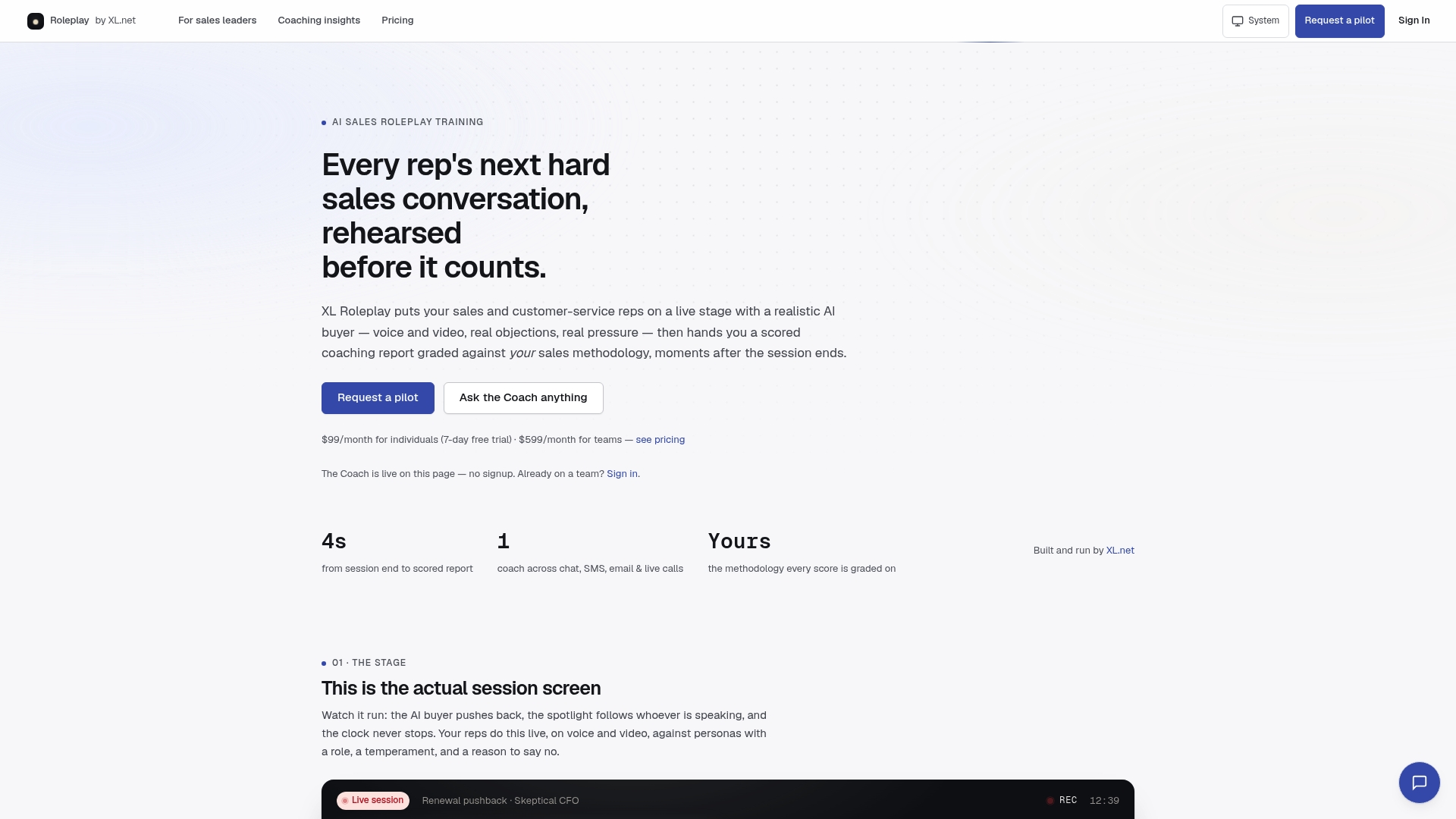
Xl’s AI-driven role-play platform lets reps practice live voice and video conversations with AI buyers who present the exact objections and pressures your playbook is designed to handle. Every session produces a scored coaching report mapped to your specific sales methodology, a full transcript, and a readiness score managers can review before a rep goes live. For sales leaders running a playbook rollout, that means you can see exactly where each rep is deviating from the play and address it in the next debrief, not after a lost deal.
Key outcomes managers see:
- Scored sessions tied to your playbook’s rubric dimensions (discovery, value framing, objection handling, next step)
- Transcripts that show the exact moment a rep deviated from the play
- Readiness scores that tell you who is ready for live deals and who needs another session
- Scenario libraries you can customize to match your ICP, your top objections, and your competitive landscape
Start with a free trial at roleplay.xl.net and run your first scored discovery session before your next team meeting.
Useful sources and further reading
These are the primary sources used throughout this article. Each one offers templates, methodology guidance, or practical frameworks you can apply directly to your playbook build.
- What Is a Sales Playbook? (And How to Write One That AEs Actually Use) — Allston Labs: The most practical guide to playbook structure for B2B SaaS teams. Covers recommended length, update cadence, and when to build vs. wait.
- How to build a sales playbook framework (+ a free template) — Zendesk: Includes a downloadable template and a clear argument for why simpler playbooks drive faster adoption.
- Sales Playbook Template: The Complete B2B Sales Playbook Guide — UpliftGTM: A 12-section template with prioritization guidance for teams that need to fix a specific problem (ramp, win rate, or competitive losses) first.
- Sales playbook template guidance — RevWiser: Strong on interactive components, particularly persona-specific discovery banks and battle cards.
- 6 Sales Playbook Examples for B2B Teams — Salesmotion: Real examples of hybrid methodology plays (SPIN, Challenger, MEDDIC) and when each applies.
- Sales playbook guidance — Shopify: Covers daily workflow integration and role-play cadence for remote and hybrid teams.
- Sales Playbook Guide: Examples & Templates for Success — Salesforce: Governance and update cadence guidance from one of the most widely used CRM platforms.