Scale Sales Coaching in 90–180 Days With Rubrics and AI Roleplay
Scale Sales Coaching in 90–180 Days With Rubrics and AI Roleplay

The best way to scale sales coaching is to combine data-driven prioritization, a short protected 1:1 cadence, manager enablement, and lightweight tools like conversation intelligence and roleplay platforms such as XL Roleplay. Research from the Sales Management Association shows most managers already spend too little time coaching, so the fix is leverage, not more hours.
TL;DR:
- Prioritize coaching efforts on mid-tier reps with measurable skill gaps and deal-stalling pipeline stages, rather than focusing solely on low performers.
- Use short, weekly 1:1s with a structured agenda to build consistent coaching habits and facilitate behavior change through guided questions.
- Scale coaching capacity by certifying managers on a shared rubric, training them on coaching skills, and leveraging tools like conversation intelligence and roleplay platforms.
- Track leading indicators such as discovery quality and activity-to-meeting ratios within 90 days to validate coaching effectiveness before measuring business results.
- Implement a phased pilot and standardize coaching practices across regions, maintaining quality with calibration, shared frameworks, and regular cross-region reviews.
Table of Contents
- Prioritize coaching with data: how to pick who and what to coach first
- Practical 1:1 cadence and a copy-paste agenda managers can use
- Scale manager capability: coach the coaches and adjust structure
- Systems and tools that extend coaching reach
- Measure coaching effectiveness: which leading and lagging metrics to track
- 90 to 180 day roadmap: run a pilot and scale safely
- Operationalizing roleplay and transcript-based coaching: proof points that matter
- Why consistent coaching standards matter more than coaching volume
- Manager enablement and coaching the coaches
- Personalizing coaching at scale without losing consistency
- Integrating sales coaching with broader sales enablement programs
- Keeping coaching quality consistent across teams and regions
- Common mistakes and what actually scales coaching
- How XL Roleplay supports the playbook
- Sources
- FAQ
Prioritize coaching with data: how to pick who and what to coach first
Coaching time is finite, so spend it where deals actually stall. Pull pipeline data to spot stages where opportunities slow down or die, and layer in call-quality or discovery scores where your team tracks them. The instinct to focus only on bottom performers wastes potential: mid-tier reps with a specific, fixable skill gap often return more revenue per coaching hour than reps who are struggling across the board.
Build a simple triage rubric managers can run through in minutes:
- Flag deals stuck past the expected stage duration for immediate review.
- Flag reps showing a repeat skill gap across multiple calls, not a one-off miss.
- Flag high-potential reps close to a breakthrough who need a nudge, not a rescue.
Managers spend a limited amount of time coaching each week, and many believe their sales force receives insufficient coaching, according to Sales Management Association research. That gap is exactly why prioritization matters more than volume. Targeted, data-backed coaching also changes behavior faster than generic training sessions, a point echoed in work on lead nurturing and sales behavior, which stresses that programs succeed when they target observable actions rather than broad awareness building.
Practical 1:1 cadence and a copy-paste agenda managers can use
A weekly or biweekly 30-minute 1:1 works better than sporadic longer sessions, because it protects a habit instead of relying on willpower. Guard the slot on the calendar the same way you would guard a client meeting.
A practical structure, adapted from sales coaching technique research, looks like this:
- Prep check (5 minutes): rep shares what they want feedback on.
- Deal review (10 minutes): walk one or two live opportunities, asking “what’s the buyer’s real objection here?”
- Skill practice (10 minutes): roleplay the toughest moment from a recent call.
- Recap and commitments (3 minutes): one specific behavior to try before the next session.
- Manager note capture (2 minutes): log what was covered so patterns show up over time.
Pro Tip: Ask “what would you do differently on the next call?” instead of telling the rep what to do. It surfaces the actual skill gap faster.
Scale manager capability: coach the coaches and adjust structure
Coaching only scales when managers themselves are trained, not just told to coach more. Start with a shared definition of what good coaching looks like, backed by a rubric everyone uses the same way, so feedback doesn’t vary wildly from one manager to the next. Sales Management Association research found that training managers specifically on coaching skills has roughly double the performance impact of training reps on sales methodology.
- Certify managers on the coaching rubric before they run full caseloads.
- Use skip-level check-ins and peer coaching circles to multiply feedback without adding manager hours.
- Once a manager’s span passes 8 to 10 direct reports, their role tends to shift toward administration, so consider a manager-of-managers layer before that threshold.
A structured coaching certification path helps standardize this shift across a growing team.
Systems and tools that extend coaching reach
Tools don’t replace coaching, they make manager time go further. Conversation intelligence software surfaces the specific moments in a call worth reviewing, cutting the prep time managers spend hunting through recordings. Roleplay platforms standardize practice itself, giving every rep the same objection scenarios and producing a scored report the manager can review instead of sitting in on every rep’s practice session.
- Use conversation intelligence to flag high-leverage call moments and generate transcripts automatically.
- Use roleplay tools to give reps repeatable practice and produce a rubric-based report for manager review.
- Reserve manager time for the judgment calls: reading tone, motivation, and the nuance a transcript can’t capture.
The pattern that works, according to sales coaching technique guidance, is simple: let software handle triage and repetition, let people handle behavioral change.
Measure coaching effectiveness: which leading and lagging metrics to track
Coaching needs proof, or it gets deprioritized the moment the quarter gets busy. Leading indicators move first and tell you whether coaching is working before revenue catches up:
- Discovery quality score on recorded or roleplayed calls.
- Call-quality score from conversation intelligence or manager review.
- Activity-to-meeting ratio for reps receiving coaching versus those who aren’t.
Lagging indicators confirm the business impact: win rate, quota attainment, and deal velocity. Leading indicators like discovery quality often improve before lagging metrics catch up, giving teams a 90-day window to validate a coaching program, per sales coaching technique research. Run a pilot with a baseline period, a comparable control group, and a defined 90-day window before scaling further, an approach also recommended in enablement pricing and pilot design guidance.
90 to 180 day roadmap: run a pilot and scale safely
Rolling coaching out to an entire org at once is how programs collapse under their own weight. A phased approach protects manager bandwidth while still building momentum.
- Days 1 to 60: Define the coaching rubric, set metric baselines, and pick one pilot team or segment.
- Days 60 to 120: Train and certify managers on the rubric, deploy tooling for call triage and practice, and run the weekly cadence without exception.
- Days 120 to 180: Measure leading and lagging indicators against baseline, certify additional managers, and expand the program to the next segment.
Each phase should end with a clear decision point: keep, adjust, or pause before moving to the next team. That discipline is what separates a coaching program that sticks from one that quietly fades after the initial push.
Operationalizing roleplay and transcript-based coaching: proof points that matter
Roleplay works when it produces something a manager can actually review, not just a practice session that disappears once it’s over. A platform like XL Roleplay runs live voice and video sessions against AI buyers built on an organization’s own objections and personas, then scores the session against the company’s actual sales methodology rather than a generic rubric.
- Reps get repeatable practice on discovery and objection handling without waiting for a live deal to test the skill.
- Managers get a transcript linked to the coaching report, so they can jump straight to the moment worth discussing instead of re-listening to an entire call.
- A persistent AI coach with shared memory across sessions means the scenario library and feedback build on prior practice instead of starting over each time.
This is what turns “we should coach more” into a repeatable habit: practical guidance on using transcripts and scorecards for review shows how quickly a manager can find the two minutes of a call that actually need attention.
Why consistent coaching standards matter more than coaching volume
A team where every manager coaches differently isn’t scaling coaching, it’s scaling inconsistency. The fix starts with a written definition of what coaching means at your organization: is it a formal 1:1, a quick call debrief, a deal review, all three? Without that definition, “we coach every week” can mean five very different things across five managers.
Pair the definition with a rubric that scores the same handful of behaviors every time: discovery depth, objection handling, next-step clarity, whatever matters most for your sales motion. The rubric doesn’t need to be complicated. It needs to be used the same way by every manager, every time, so a rep moving from one manager to another doesn’t experience a completely different coaching philosophy.
Sales Management Association research found that deep, targeted coaching to specific behaviors outperforms broad, frequent but unfocused coaching. That finding only holds if “specific behaviors” means the same thing across the team, which is exactly what a shared rubric enforces. Write the definition down, put the rubric in front of every manager, and revisit both quarterly as the team’s skill gaps shift. Standards that live only in a manager’s head aren’t standards, they’re preferences, and preferences don’t scale.
Manager enablement and coaching the coaches
The fastest way to stall a coaching program is to hand managers a new expectation without new skills to meet it. Most sales managers were promoted for selling well, not for coaching well, and those are different skills. Enablement for coaching means training managers on how to ask questions that surface the real problem, how to give feedback that changes behavior instead of just naming what went wrong, and how to run a 1:1 that doesn’t turn into a status update.
Coach-the-coach models add a second layer: someone, often a senior manager or an enablement lead, periodically reviews how a manager coaches, not just how their reps perform. That might mean sitting in on a 1:1, reviewing a roleplay scorecard the manager gave a rep, or running a peer coaching circle where managers critique each other’s approach.
Training managers specifically on coaching has roughly double the performance impact of training reps on sales methodology, a strong argument for where enablement budget should go first. A manager certification path that requires demonstrated coaching skill, not just attendance at a workshop, keeps this from becoming a checkbox exercise.
Personalizing coaching at scale without losing consistency
Standardized rubrics keep coaching fair, but they shouldn’t flatten every rep into the same treatment. A new rep needs different coaching than a five-year veteran plateauing at 80% of quota, even if both are scored against the same discovery and objection-handling criteria.
Segment coaching by need, not just by tenure:
- New reps need frequent, foundational practice on the basics: pitch clarity, objection recognition, discovery structure.
- Mid-tenure reps often need targeted work on one or two specific skill gaps rather than a full curriculum.
- Veteran reps plateauing on quota may need coaching on newer product lines, market shifts, or a bad habit that crept in over time.
The rubric stays constant, but the coaching plan built around it flexes. This is where roleplay scenario libraries help: a manager can assign a new rep the foundational objection scenarios while assigning a veteran rep a scenario built around a specific deal type they’re struggling to close. Building scenarios from real calls rather than generic scripts keeps the practice relevant to what each rep actually faces, which matters more for a personalized plan than for a one-size-fits-all training module.
Integrating sales coaching with broader sales enablement programs
Coaching that runs separately from onboarding, content, and methodology training creates duplicate work and mixed messages. If the enablement team teaches one objection-handling framework and managers coach to a different one, reps get whiplash and neither program gets credit for the improvement.
The fix is treating coaching as the reinforcement layer of enablement, not a separate initiative. Onboarding teaches the methodology, content libraries and battle cards support it in the field, and coaching is where a manager checks whether the rep is actually applying it on live calls. That means the coaching rubric should be built from the same skill framework as onboarding and ongoing training, not invented separately by whoever runs coaching.
Practically, this shows up in shared vocabulary: if enablement calls a skill “needs-based discovery,” coaching sessions should use the same term, not a manager’s personal shorthand. It also shows up in shared data: call scores, roleplay results, and CRM activity should feed one picture of a rep’s development rather than three disconnected systems. A practical approach to roleplay training that ties practice scenarios back to the official methodology is one way to keep the two programs aligned instead of competing for a rep’s attention.

Keeping coaching quality consistent across teams and regions
Coaching quality tends to drift the moment a company grows past one office or one time zone. Different regions face different buyer objections, different managers interpret the rubric their own way, and without a shared review process, quality slowly diverges until “coaching” means something different in each location.
A few practices keep that drift in check. Calibration sessions, where managers from different teams score the same sample call and compare results, catch inconsistent grading before it becomes a habit. A shared scenario library, rather than each region building its own, keeps the skills being practiced aligned even when the local market context differs. Regular manager check-ins from a central enablement function, not just within each region’s chain of command, catch the quiet variation that a rubric alone won’t stop.

Regional flexibility still matters: a team selling into a price-sensitive market needs different objection practice than one selling into an established, brand-loyal base. The standard stays the rubric and the definition of good coaching. The flexibility lives in which scenarios and deals each region prioritizes within that standard, not in the standard itself.
Common mistakes and what actually scales coaching
The biggest mistake is mistaking volume for progress: more 1:1s, more training days, no clearer sense of what changed. Coaching scales through manager capability, a protected cadence, and honest measurement, not more hours on the calendar. Run one pilot team before rolling out company-wide. It will tell you more than any framework.
— Adam
How XL Roleplay supports the playbook
Once your rubric and cadence are set, the bottleneck becomes manager time to review practice and give feedback. A roleplay platform handles the practice layer: reps run live voice and video sessions against AI buyers built on the organization’s own objections, and managers get a scored coaching report tied directly to the call transcript instead of a raw recording to sit through.
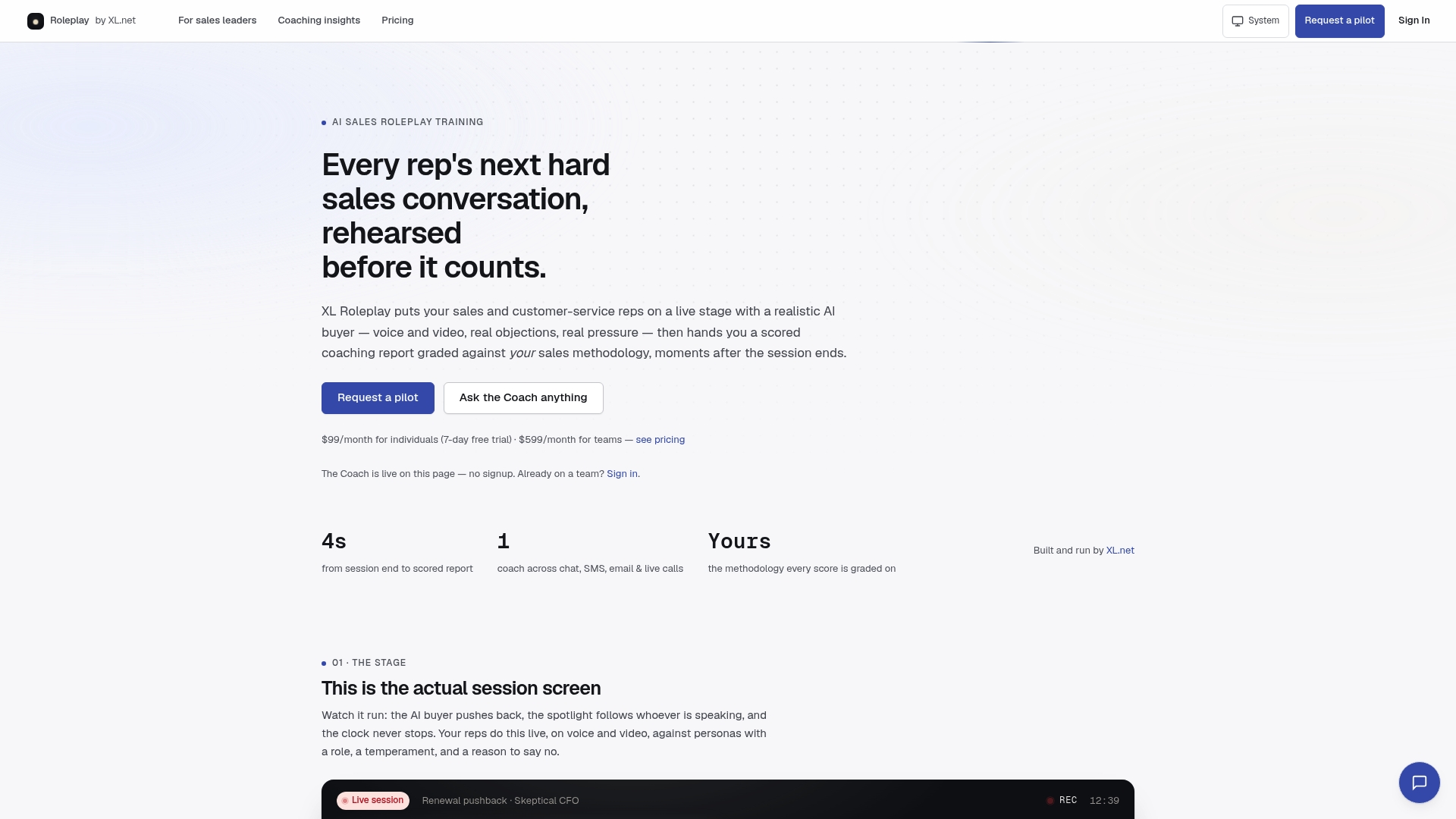
- Reps practice discovery and objection handling on demand, not just when a live deal happens to test the skill.
- Managers review a rubric-based report and jump straight to the transcript moment that needs coaching.
- Scenario libraries and scoring follow your own sales methodology, not a generic script.
If you’re evaluating a roleplay-backed approach for your team, the XL Roleplay pilot is a practical way to test it against a real segment before committing to a wider rollout, and current plan pricing is available for teams ready to move past the pilot stage.
Sources
- Coaching Salespeople to Crush Quota
- Sales coaching techniques
- How Much Does Sales Training Cost? A 2026 Pricing Guide for Enablement Leaders
- Pulse RevOps knowledge base
FAQ
How much does sales coaching typically cost?
Costs vary by program design, but a practical mid-market benchmark for a custom coaching or training program runs roughly $1,300 to $2,600 per participant, with platform licenses commonly priced at moderate monthly rates per user. Roleplay-specific tools like XL Roleplay price separately, with plans starting at $99 per month for individuals.
What is the 70/30 rule in sales?
Definitions of the 70/30 rule vary across sales organizations, and no single source in this article defines a universal version of it. A common informal application is having the rep talk roughly 70% of a coaching conversation while the manager listens and asks guiding questions the remaining 30%, which lines up with the coaching-conversation structure described above.
How much does a scaling up coach cost?
Pricing for executive or “scaling up” business coaches is not covered by the sources used in this article, so no reliable figure can be given here. For sales-specific coaching and training programs, the closest documented benchmark is the $1,300 to $2,600 per participant custom program range.
What are the 5 C’s of coaching?
The “5 C’s of coaching” isn’t defined in the sources this article relies on, and definitions circulating online vary widely without a consistent standard. Rather than repeat an unverified framework, focus on the elements this article does support: a clear coaching definition, a shared rubric, a protected cadence, manager enablement, and measurement against leading and lagging indicators.