The "Send Me Info" Objection: Responses and Role-Play Drills
The “Send Me Info” Objection: Responses and Role-Play Drills

When a prospect says “just send me some info,” don’t argue and don’t blindly attach a brochure. Say yes, then ask one question about what would make the information useful, and offer a specific next step. That keeps the call friendly and tells you whether the prospect is interested or politely getting off the phone. Reps only do this reliably after practicing it out loud, so this guide gives you the responses, the follow-up, and the role-play drills to make it stick.
TL;DR
- Acknowledge the request first. Arguing turns a soft brush-off into a hard no.
- Ask what the prospect hopes to get from the information, then send one tailored resource, not a generic deck.
- A prospect who can’t name anything specific is giving you qualifying data. Treat it that way.
- Attach a next step to everything you send: a short call, a date, a named person.
- Practice with realistic pushback, then score each run against the same rubric so improvement is measurable.
Table of Contents
- Why prospects say “send me info”
- How to respond: a four-step sequence
- Word-for-word responses by situation
- What to send and how to follow up
- Why this objection needs practice, not just a script
- Role-play drills for the “send me info” objection
- How managers can give feedback that changes behavior
- Perspective: why we think this objection is a practice problem
- Practice this objection with XL Roleplay
- Common mistakes to avoid
- Building the habit across a team
- FAQ
- Sources
Why prospects say “send me info”
The phrase has at least four meanings, and your response has to work for all of them because you can’t tell which one you’re hearing in the first three seconds.
- Genuine interest, bad timing. They are busy and want something to read later.
- A polite no. It is the easiest way to end a call without conflict.
- A gatekeeper reflex. They have no authority or context and want to move you along.
- Early curiosity. They are open to the idea but have a question they haven’t voiced.
A rep who treats all four as a “yes” fills the inbox with unread PDFs. A rep who treats all four as a “no” pushes hard and burns the relationship. The skill is a response that lets the prospect show you which one it is.
How to respond: a four-step sequence
1. Acknowledge without arguing
Agreeing to the request keeps the tone friendly and opens a dialogue instead of an argument. PPAI’s guidance on this objection frames acknowledgment as active listening, and that is the right mindset: you are not resisting, you are joining them.
“Happy to. I’ll get something over to you.”
Stop there for a beat. Do not rush to the question.
2. Ask what would make it useful
The same PPAI article suggests questions such as “What are you hoping to get from the info?” or “What would be most helpful to you at this time?” Both are low pressure and both force the prospect to move from a vague gesture to something concrete.
More variations, all in the same spirit:
- “So I don’t bury you in material, which part matters most: pricing, how it works, or results from similar companies?”
- “Is this something you’re evaluating right now, or more for reference?”
- “Who else would need to see it?”
The last one is useful because it surfaces a second stakeholder without sounding like an interrogation.
3. Read the answer
There are three typical outcomes.
- A specific answer. “I need to know if it integrates with our CRM.” You have a real buyer with a real question. Answer it briefly now if you can, and send the one resource that covers it.
- A vague answer. “Oh, just general stuff.” Ask one more clarifying question. Maybe: “What would have to be true for this to be worth a conversation?”
- No answer, or an irritated one. SalesTap suggests that a prospect who cannot name any specific information they need is a strong sign of a non-serious buyer, and that this is valuable qualifying data that protects your team’s time. Take that seriously: you can send a light note and move on without chasing.
4. Attach a next step
Information sent without a next step is a reason for the prospect to do nothing. Close the loop before you hang up:
“I’ll send the two-page overview on integrations this afternoon. If I give you a call Thursday at 10 to see whether it answered your question, is that okay?”
You are not asking for a big meeting. You are asking for permission to follow up, which is far easier to get and sets the expectation that the material will be discussed.
Word-for-word responses by situation
Use these as starting points and adapt the wording to your own voice. Reps who read scripts aloud sound like it, so the goal is to know the logic and say it naturally.
| Situation | What the prospect says | A strong response |
|---|---|---|
| Cold call, no context | “Just email me something.” | “Sure thing. So I send the right piece, what’s the main thing you’d want to find out?” |
| After a short pitch | “Send me some info and I’ll look it over.” | “Happy to. Which part stood out, so I can focus on that?” |
| Gatekeeper | “Send it to the general inbox.” | “Will do. Who should I address it to, so it doesn’t get lost?” |
| Mid-discovery | “Why don’t you put it in a proposal?” | “Glad to. To make it accurate, can I confirm two things first: your timeline and who signs off?” |
| Hard brush-off | “Not interested, just send it.” | “No problem. I’ll send one short note. If it isn’t relevant, ignore it, and I won’t keep calling.” |
Notice what the responses share: they agree, they ask something short, and they never defend the product.
What to send and how to follow up
Send one thing, built for them
A generic brochure gets forwarded and ignored. Send a single resource that answers the question the prospect named: a one-page comparison, a short case study from a similar company, a pricing summary, a two-minute walkthrough. If they never named anything specific, send the one asset that most often moves your own prospects forward.
Write an email that makes replying easy
Keep it short enough to read on a phone.
Subject: The integration overview you asked about
Hi Dana, thanks for taking my call. Attached is the two-page overview on how we connect with your CRM, which was the main question you raised. The part to look at first is the setup section on page 2.
I’ll call Thursday at 10 to see if it covered what you needed. If someone else on your team should see it, tell me who and I’ll tailor it for them.
The pattern is one reference to the call, one attachment, one clear next step, and one easy way to loop in somebody else.
Follow up in layers
- Same day: the email above.
- The agreed call: open with a question, not a pitch. “Did it answer what you were looking for, or is there something else you’re trying to solve?”
- If there is no reply: send a short second note that adds something new, such as a relevant result or a different format, instead of repeating “just checking in.”
If you have used a few touches and heard nothing, close the loop politely and move on. That is a result, not a failure.
Why this objection needs practice, not just a script
Knowing what to say is the easy part. The hard part is staying relaxed when a real person sounds impatient, then listening well enough to choose the right follow-up question. Reps tend to fail in predictable ways under pressure:
- They jump straight to “sure, what’s your email?” and skip the question entirely.
- They ask the question in a way that sounds like a challenge: “What exactly do you need it for?”
- They ask, hear a vague answer, and then give up.
- They over-talk, restarting the pitch to “help” the prospect decide.
Our objection-handling training program guide lays out drills for building these habits in a team. Here is a version focused on this single objection.
Role-play drills for the “send me info” objection
Drill 1: The three-second brush-off
The partner plays a busy prospect and opens with “Just send me something.” The rep has to acknowledge, ask one question, and not exceed 20 seconds. Run it five times in a row. Repetition matters more than polish at this stage.
Drill 2: Same line, four personas
The partner plays four different prospects, each saying the same sentence for a different reason: the genuinely busy buyer, the polite decliner, the gatekeeper, and the curious evaluator. The rep’s job is to adjust after the first answer. Debrief by asking which persona the rep thought they had, and why.
Drill 3: The vague answer
The prospect replies to “What would be most helpful?” with “I don’t know, just general info.” The rep has to try a second question and then decide: send something light, or ask for a short call. There is no single correct answer, but there is a wrong one, which is giving up silently.
Drill 4: Commit to the next step
The prospect agrees to be sent material. The rep must leave the call with a named follow-up time. Score only that: did they get a specific next step or not?
Drill 5: Write the email
After the call, the rep writes the follow-up email in under five minutes using only what was learned on the call. Then the partner reads it as the prospect would, in about ten seconds, and says whether they would reply.
A useful tip for drills 2 and 3: let the person playing the prospect be a bit hard to read. Real prospects don’t signal their intent. A partner who is too agreeable teaches reps nothing.

How managers can give feedback that changes behavior
Role-play feedback goes wrong when it turns into opinions about style. Anchor it to observable behaviors instead.
A simple rubric for this objection:
- Did the rep acknowledge the request without pushback?
- Did they ask one open, low-pressure question?
- Did they listen to the answer and adapt?
- Did they avoid restarting the pitch?
- Did they leave with a specific next step?
Score each from 0 to 2 and keep the scorecard from week to week. Two things happen. Reps see exactly where to improve, and managers see whether the practice is working across the team. Give one piece of feedback per round, not six, and have the rep re-run the call right away to apply it.
A coach who can ask good questions rather than hand out answers makes this feedback land better. If you are developing your team leaders in that skill, this resource on building coaching skills in team leaders is a helpful place to start.
Perspective: why we think this objection is a practice problem
Most teams treat “send me info” as a scripting problem. Write a good rebuttal, share it in a doc, move on. We see it differently. The words are the easy part. What separates reps is whether they can stay calm, ask the question, and adapt when the prospect doesn’t cooperate.
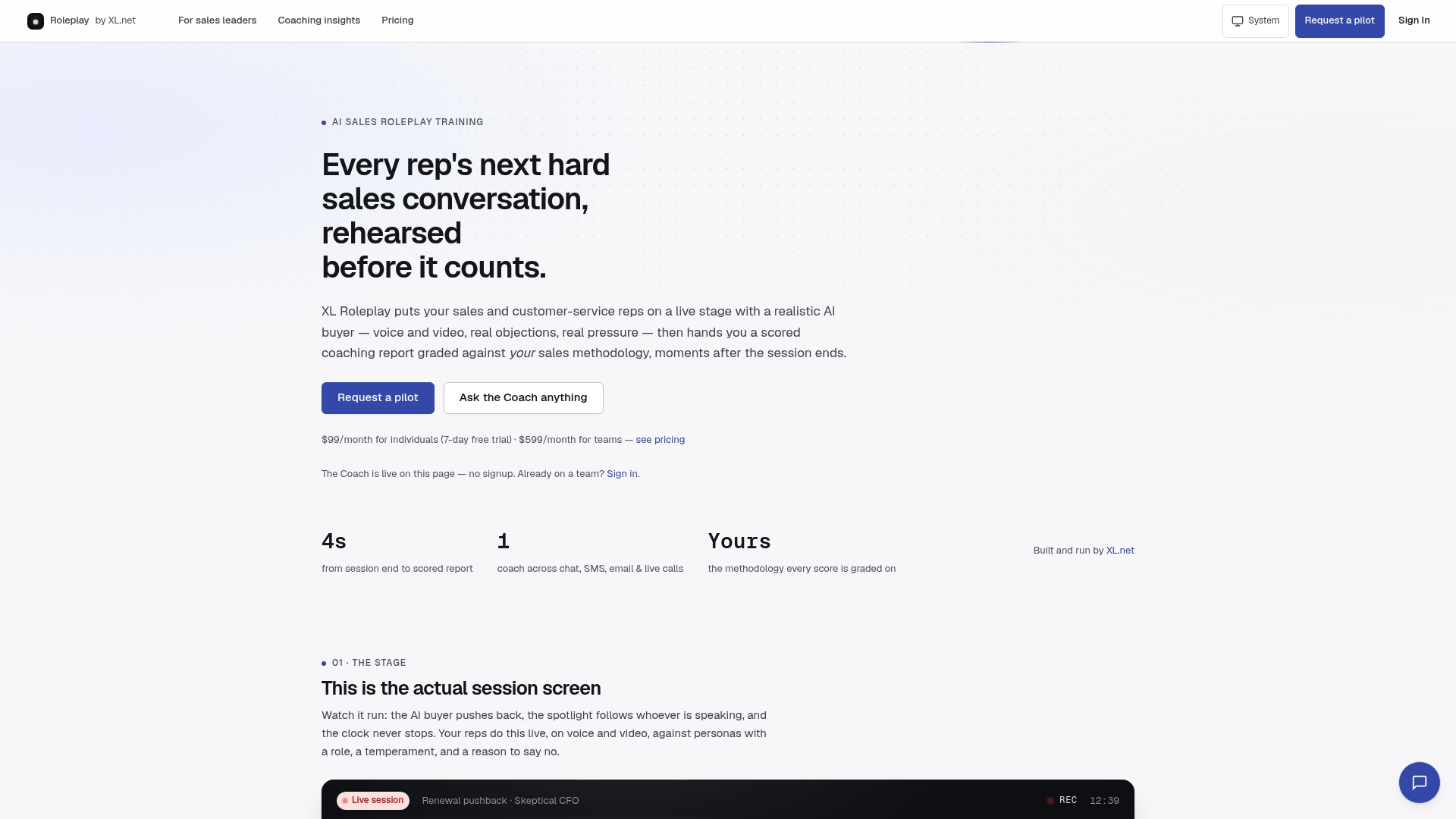
That takes repetition against a buyer who pushes back realistically, and the feedback has to be tied to what was actually said. That is what we built XL Roleplay for: live voice and video sessions with AI buyers that raise typical objections and pressures, followed by a scored coaching report based on your own sales methodology, with a transcript so reps and managers can look at the exact moment a response went right or wrong.
We also think coaching should reflect your playbook, not a generic standard. Your “send me info” response should sound like your company, and the score should measure it that way. When managers can see the evidence in a transcript and a rubric, coaching conversations become specific and the improvement becomes something they can track.
Adam
Practice this objection with XL Roleplay
If you want reps to rehearse this call before they make it for real, XL Roleplay lets them practice live with AI buyers who push back, then review a scored coaching report and transcript. The Individual plan is $99 per month, and the Business plan is $599 per month for teams. Extra seats are $54.95 per month per seat, and extra video is $16.99 per hour. See the details on the pricing page, or ask about the XL Roleplay pilot if you want to try it with a team first.
Common mistakes to avoid
- Sending the full deck. The longer the attachment, the less likely it is to be read.
- Treating a vague request as a commitment. If nothing specific was named, adjust your expectations and your follow-up effort.
- Following up with “just checking in.” Every touch should add something.
- Pushing for a meeting on the first reply. Match the ask to the signal you got.
- Practicing only the opener. The follow-up email and the second call are where the real conversion happens.
For more examples to rehearse, browse our collections of sales conversation examples and sales role-play script examples, and see how AI sales role-play works in practice.
Building the habit across a team
One session does not change behavior. A realistic cadence looks like this:
- Week 1: teach the four-step sequence and run Drill 1 as a group.
- Weeks 2 to 3: run Drills 2 and 3 in pairs or against AI buyers, with short feedback after each round.
- Week 4: run Drills 4 and 5 and compare rubric scores with week 1.
- Ongoing: pull two or three real calls a month, replay the “send me info” moments, and practice the ones that went poorly.
Track two numbers: the share of calls where the rep asks the clarifying question, and the share where a specific next step is set before the call ends. Both are behaviors you can coach, and both are in the rep’s control.
FAQ
How do you respond when a prospect says “send me information” and you’re trying to book an appointment?
Agree to send it, then ask what they hope to get from it so the material is relevant. Use the answer to propose a short follow-up call tied to that specific question. This keeps the conversation going without pressuring them.
Should I always send the information?
Not always, and not blindly. If the prospect names a specific need, send one tailored resource. If they can’t name anything, send something light and set limited follow-up, because that is a signal about their interest level.
What if the prospect refuses to say what they want?
Don’t push harder. Offer a short, easy-to-ignore note and say you’ll check in once. You get qualifying information, and the prospect keeps a good impression of you.
How often should reps practice this objection?
Short, frequent sessions work better than one long workshop. A few repetitions a week for a month, with the same rubric each time, is enough to build a noticeable habit.
What should managers score in a role-play?
Score behaviors: acknowledging, asking one open question, adapting to the answer, not restarting the pitch, and securing a next step. Avoid scoring tone or style on gut feeling.
Sources
- How To Handle The “Send Me Information” Objection, PPAI
- Handle “Send Me More Info”: A 5-Step Framework, SalesTap