Session Transcript Review: How to Turn Practice Calls Into Coaching
Session Transcript Review: How to Turn Practice Calls Into Coaching

A session transcript review means reading the written record of a conversation, scoring it against a fixed rubric, and picking one behavior to coach. It works best on practice sessions, because every rep faces the same kind of buyer and the same objections, so the scores can be compared. In XL Roleplay, each live role-play session produces a transcript and a scored coaching report built on your organization’s own methodology, and managers can review both together.
This guide shows you how to run the review: what to look for, how to score it, and how to turn it into practice that changes the next call.
TL;DR
- A transcript is the evidence. The rubric is the judgment. Score only what the text shows, and attach a quote to every score.
- Read in passes: reconstruct the conversation first, then score the key moments (discovery, objection, close).
- Use one rubric for every rep, built from your sales methodology, so scores are comparable.
- Coach one behavior at a time, using the rep’s exact words and a better alternative.
- Rerun the same moment in practice, then re-score it. That is how you know the coaching worked.
Table of Contents
- What a session transcript is, and what it can show
- How to review a session transcript, step by step
- What to look for in discovery
- What to look for when the buyer objects
- Build a rubric that every reviewer applies the same way
- Turn findings into coaching that sticks
- A weekly rhythm that fits a manager’s calendar
- Common mistakes in transcript review
- Where XL Roleplay fits
- Our perspective on transcript review
- FAQ
- Sources
What a session transcript is, and what it can show
A session transcript is the written version of a conversation, usually with speaker labels and timestamps. A sales call transcript can capture questions and answers, pricing discussions, customer objections, commitments and next steps. It does not judge the call by itself. It gives a manager something searchable to review without sitting through a 45-minute recording.
For a sales or customer service team, a transcript answers practical questions:
- How did the rep open, and did they set an agenda?
- Did they ask questions that uncovered the buyer’s real situation?
- When the buyer pushed back, did the rep understand the concern or jump to a rebuttal?
- Did the call end with a clear next step and an owner?
- Did the rep make a promise they could not keep?
There is a reason to run this on practice sessions rather than only live calls. On a live call, you cannot choose the buyer, and a rep who wins against an easy prospect looks stronger than they are. In a role-play with an AI buyer that raises typical objections and pressures, every rep meets the same test. A weak discovery shows up in the transcript without costing you a real deal.
How to review a session transcript, step by step
Below is a routine that takes 15 to 20 minutes per session once you are used to it. At each step, we note what a reviewer has to do by hand and what XL Roleplay already provides.

Step 1: Read for the story before you score
Start with one pass and no scoring. Reconstruct what the buyer wanted, what constraints they stated, and where the conversation went. Customer service teams often do this with chat records: first understand the customer’s journey, then follow the agent’s reasoning, then check the close. Skipping this pass is how reviewers penalize a rep for something the buyer caused.
In XL Roleplay, the session transcript sits next to the scored coaching report, so you can move between what was said and how it was scored without hunting through recordings.
Step 2: Map the transcript to your rubric
Do not score the conversation as one lump. A rep who is weak at discovery but strong at closing averages out to “fine” if you give one overall mark. Tie each criterion to the part of the conversation where it shows: discovery to the opening questions, objection handling to the moment the buyer pushes back, the close to the last few exchanges.
The rubric should come from your own methodology, whether that is MEDDIC, SPIN, a custom playbook or a service standard. XL Roleplay’s scored coaching reports are tailored to your organization’s methodology, so the criteria reviewers apply in the report are the ones your team already trains on, rather than a generic checklist.
Step 3: Score only what you can quote
The single most useful rule in transcript review is that every score needs a quote. If you cannot point to the line, you do not have evidence. Write “insufficient evidence” instead of guessing.
This also keeps reviewers honest about motive. “The rep did not confirm whether the replacement address was correct” is observable. “The rep did not care” assigns an intention the text cannot prove, and it gives the rep nothing to fix.
A simple scale keeps arguments short. A 0 to 2 scale works well: 0 means the behavior was absent or harmful, 1 means present but incomplete or badly timed, and 2 means clear and effective. A 1 to 10 scale invites debates about whether a call was a 6 or a 7.
Step 4: Check the key moments
The next sections cover what to look for in the moments that matter most.
Step 5: Choose one behavior and write the coaching note
Score everything, but surface little. Pick the lowest-scoring criterion that matters most, name one behavior, and attach two or three quotes. We cover how below.
Step 6: Rerun the moment and re-score
The review is not finished until the rep has practiced the fix. Run the same scenario again, then compare the scores on the same criterion. If the number moved, the coaching worked. If it did not, the behavior was too big, so shrink it.
What to look for in discovery
Discovery is where most weak calls are decided. In the transcript, look for these signals:
| Signal | Strong | Weak |
|---|---|---|
| Question type | Open: “Walk me through how you handle this today.” | Closed: “Do you use a CRM?” |
| Follow-up | The next question builds on the buyer’s last answer | The rep moves to the next item on a list |
| Confirmation | The rep summarizes the situation and invites correction | The rep assumes they understood |
| Business checkpoints | Budget, timeline and decision-maker captured | Left blank |
| Timing of the pitch | Features come after the problem is clear | The pitch starts right after the buyer states a constraint |
That last row is the most telling. If the buyer says legal review is the blocker and the rep immediately describes a feature, the transcript shows discovery that did not happen.
For teams using a methodology, check each element of it. If you train on MEDDIC, ask whether there is quoted evidence for the economic buyer, the decision process and the pain. An empty element is a coaching signal and a pointer to where the rep could have gone deeper.
What to look for when the buyer objects
Objection handling is the second place to read slowly. Record four things:
- The objection type: price, timing, competition, feature fit or trust.
- Whether the rep tested their understanding. After “It costs too much,” a strong rep asks whether the concern is total budget, expected return, or comparison with another option.
- Response quality. Did the rep answer the concern the buyer actually stated, using the buyer’s context, or reach for a generic rebuttal?
- Resolution status. Was the objection resolved, explicitly deferred or left open? A polished answer that never checks whether it landed is incomplete.
A worked example shows the difference. The buyer says they cannot ask three designers to spend another week learning a new tool. The rep answers with a features list and a 10% first-month discount. Two exchanges later the buyer corrects them: price was never the issue, setup time is. The rep reacted to the wrong objection. A review template that scores this kind of exchange would give objection handling a 1 out of 2, with a coaching point to acknowledge the stated concern and ask a clarifying question before offering a remedy.
A stronger version of the same moment looks like this:
Buyer: I can’t ask our three designers to spend another week learning a tool.
Rep: That makes sense. Is it the learning time itself, or the risk that it disrupts a project already in flight?
The rep paraphrases, asks one clarifying question and holds the remedy until the concern is clear. That paraphrase check is a behavior worth keeping and reinforcing.
For customer service teams, the same logic applies to complaints and escalations. Look at accuracy (did the advice match approved policy, with no unsupported promise), ownership (does the customer know who does what next) and resolution (does the stated outcome match the case status). Our articles on handling difficult customers and role-play for customer service go deeper on these situations.
Build a rubric that every reviewer applies the same way
A transcript review is only as fair as the rubric behind it. Three habits keep it consistent.
Use the same criteria for every rep. When all reps are scored on one scorecard, you can see which skill to coach first and compare progress over time. A consistent scorecard typically covers how the rep opened, the discovery questions, listening, product explanation, objection handling, pricing accuracy and the next step, with weights that fit your sales process. A software team may weight needs assessment heavily. A financial services team may weight required disclosures and accuracy.
Keep the list short. Five to seven criteria is enough. More than that and reviewers stop reading the evidence.
Separate technique from outcome. A rep can win a deal with poor technique because the buyer was easy, and lose one with excellent technique. Score the two separately and respond differently:
| Technique | Outcome | What to do |
|---|---|---|
| High | High | Reinforce the specific behavior |
| Low | High | Treat it as a fragile win and find the behavior that would fail against a harder buyer |
| High | Low | Look at qualification, open concerns and next-step quality |
| Low | Low | Pick the smallest consequential behavior and practice it now |
Practice sessions make this table easier to use, because the buyer’s difficulty is held constant and the outcome reflects the rep more than the luck of the draw.
If several managers score, calibrate. Have two reviewers score the same session independently, then discuss any criterion where they differ by more than a point. The goal is that each reviewer can explain why a score is right or wrong, citing the transcript.
Turn findings into coaching that sticks
The findings only matter if the rep changes. Here is how to move from score to behavior.
Use the rep’s exact words
Compare two pieces of feedback. “Your objection handling was weak” gives the rep nowhere to go. “When the customer said ‘I need to think about it,’ you said ‘OK, no problem, I’ll follow up next week.’ Try asking what specifically they want to think through” gives them a line to rehearse. Feedback that guides rather than judges names the moment, the behavior and the alternative.
Pull two or three quotes per coached criterion. Because XL Roleplay’s feedback is transcript-linked for both reps and managers, the quote and the score sit in the same place.
Coach one behavior
Stacking changes prevents any of them from taking hold. A workable conversation fits in 20 minutes:
- Two minutes: the rep says what went well and what they would change.
- Five minutes: play one strong moment and name exactly why it worked.
- Eight minutes: play one moment to improve. Ask “What else could you have said here?” before you suggest anything.
- Three minutes: agree on one behavior to practice, phrased so you can see it in a transcript, such as “restate the objection before answering it.”
- Two minutes: write it down and decide when you will check it.
Opening with the rep’s own assessment matters. A lesson people find themselves tends to stick longer than one they are handed.
Naming strengths matters too. Coaching that only points out mistakes can quickly feel like punishment, so keep a library of strong moments from your team’s sessions and use them as models.

Practice the exact moment
The fastest fix is to rebuild the failing moment as a practice scenario from the transcript’s own language, then run it again. Research on sales coaching and manager guides agree that rehearsal of a specific action beats talk about broad goals. With XL Roleplay, the rep can run a live voice or video session against an AI buyer with a customized scenario, and the manager can use the live debriefing tools to go over it afterwards. You can browse ideas for building these in our role-play scenarios and role-play exercises for sales collections.
Re-score after a few weeks
After three to four weeks, score the same criterion again on a fresh session. Look for movement on that criterion, not on the overall total. If it moved, pick the next behavior. If not, make the behavior smaller.
A weekly rhythm that fits a manager’s calendar
A routine you keep beats a perfect one you drop. Here is a version for a team lead:
- Monday: reps complete one or two practice sessions on the scenario for the week.
- Midweek: you read the scored reports, then open the transcripts only for the lowest-scoring criteria. Spend 5 minutes per session, not 30.
- Thursday: one 20-minute coaching conversation per rep, using the structure above.
- Next Monday: the rep reruns the scenario. You check the one behavior you named.
Mix the scenarios across your common situations: a price objection, a stalled decision, an angry customer, a first discovery call. A new rep preparing for real conversations needs the first two or three. A veteran may need the harder ones. Our guides on sales training scenarios and practicing for difficult customers give starting points.
If you are an individual rep without a manager, the same routine works with you as the reviewer. Read your transcript, pick the one moment you would redo, and run the scenario again.
Common mistakes in transcript review
- Scoring tone from text. A transcript cannot carry pacing, confidence or how someone sounds under pressure. Use the text for exact words and the session itself for delivery.
- Scoring everything and sharing everything. Score the full rubric if you like, but give the rep two strengths, no more than three changes and one focus.
- Treating a missing quote as a low score. If no passage supports a judgment, mark it “insufficient evidence” and leave it out of the average.
- Averaging away the problem. One overall number hides the weak criterion. Look at the lowest weighted gap, not the total.
- Reviewing without rerunning. A note without practice is a comment, not coaching.
Where XL Roleplay fits
If you want this routine without building the rubric, the transcripts and the reports yourself, XL Roleplay gives you the pieces together: live voice and video role-play with AI buyers, scored coaching reports grounded in your organization’s sales methodology, detailed transcripts, readiness scoring and performance tracking for individuals and teams.
The Individual plan is $99 per month, and the Business plan is $599 per month. Extra seats are $54.95 per month per seat, and extra video is $16.99 per hour. If you want to try it with a team first, the XL Roleplay pilot is the place to start.
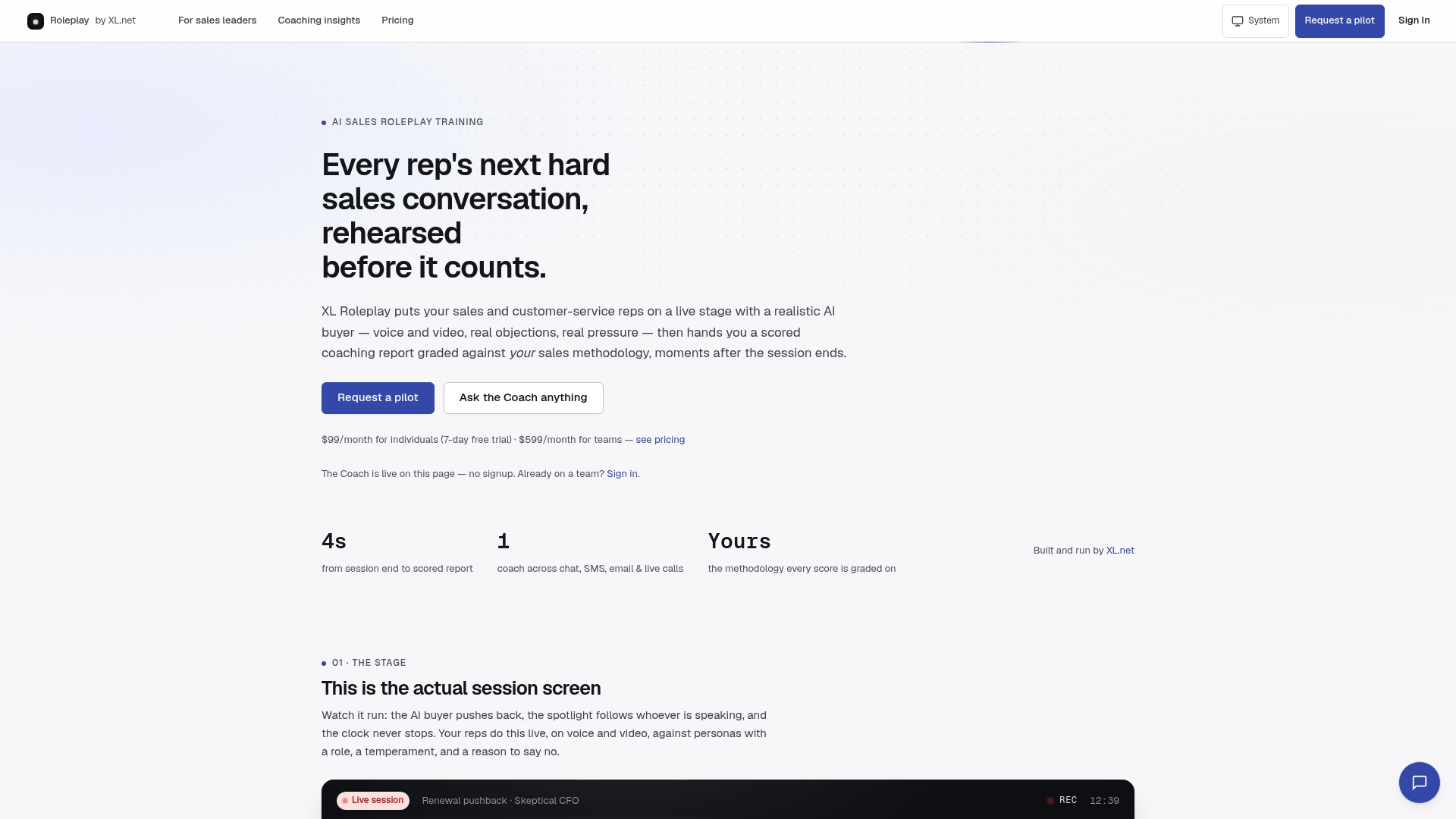
You can also talk through a scenario with the XL Roleplay Coach by text.
Our perspective on transcript review
We built XL Roleplay on a simple belief: a score without a source is an opinion. When a manager tells a rep their discovery was weak, the first thing the rep asks is where. The answer should be a line in the transcript, not a feeling.
That is why our scored coaching reports are tied to each organization’s own sales methodology and link to the transcript. A generic standard tells a team how sales is done in general. Your playbook tells them how you win. Reps and managers should be reading the same evidence, against the same rubric.
We also think practice is the right place to start the review habit. A practice session gives you a repeatable buyer, a safe place to fail and a transcript every time. The persistent AI coach carries memory across channels, so the next session can pick up where the last one left off, and the coaching builds instead of restarting.
Review the transcript, pick one behavior, run it again. That loop is the whole job.
Adam
FAQ
What are session transcripts?
A session transcript is the written record of a conversation, with each speaker labeled and often timestamped. In sales and service training, it lets a manager review the questions, objections and next steps without replaying the audio. In XL Roleplay, each practice session produces one alongside a scored coaching report.
How long should a transcript review take?
Plan on 15 to 20 minutes per session when you are new to it. Read the scored report first, then open the transcript only at the moments tied to the lowest-scoring criteria. With a short rubric and a habit of marking quotes as you go, most of the time goes to the coaching conversation instead of the reading.
What should I score in a transcript?
Score what you can quote: the opening, discovery questions, how the rep handled objections, whether facts and prices were accurate, and whether the next step was confirmed. Skip anything that needs a guess about motive or tone. If no line supports a judgment, record “insufficient evidence.”
How many things should I coach after one review?
One. You can score every criterion, but a rep changes one behavior at a time. Name the behavior so it is visible in the next transcript, for example “restate the objection before answering it,” and check it in the next session.
Sources
- Sales Coaching With Call Transcripts: A Manager’s Guide
- Sales coaching: Examples, models, techniques and best practices
- Sales Call Review Template: Coach From the Recording