Decide in 5 Steps: Simulation Training vs Role Play for Educators
Decide in 5 Steps: Simulation Training vs Role Play for Educators

Simulation training and role play both put learners into a scenario before it counts for real, but they solve different problems. Simulation is structured, scaffolded, and built around a specific level of realism to practice complex or high-stakes skills, always closing with a formal debrief. Role play is looser and character-driven, and it earns its keep on communication, empathy, and perspective-taking. Pick simulation when the stakes or complexity are high; pick role play when the goal is how people talk to each other.
TL;DR:
- Simulation is essential for high-stakes, complex procedures involving team coordination and decision-making, especially when mistakes could cause harm or cost.
- Role play best suits interpersonal communication skills, such as de-escalation and perspective-taking, with less emphasis on physical or procedural realism.
- Effective debriefing, tailored assessment rubrics, and facilitator skill are critical for maximizing learning outcomes in both methods.
- Repetition and structured feedback significantly enhance skill retention, particularly with mirrored scenarios and focused behavioral improvements.
- AI-driven role play platforms can scale interpersonal skills training by providing realistic objections and immediate coaching, reducing scheduling constraints.
Table of Contents
- Simulation vs. Role Play: The Practical Differences
- When Should You Use Simulation Instead of Role Play?
- How Do You Design and Run Each Method?
- What Debrief and Assessment Methods Actually Work?
- What Goes Wrong, and How Do You Avoid It?
- What Does the Evidence Actually Show?
- How Do You Decide Between Simulation and Role Play?
- Where Facilitator Judgment Still Beats the Framework
- A Faster Way to Get Repeated Role Play Practice
- Where to Read More
- Sources
Simulation vs. Role Play: The Practical Differences
The fastest way to tell these methods apart is to look at fidelity, structure, and what each one is actually optimizing for.
Fidelity is the first axis. Simulation sits anywhere from a plastic arm for practicing an IV stick to a full-body manikin that talks, bleeds, and codes in real time. Simulation modalities span this entire range, from part-task trainers and standardized patients to VR and in situ exercises staged in the real work environment. Role play rarely bothers with physical realism at all. Two learners with a one-page character brief can run a difficult performance review or an angry-customer call with zero equipment.
Structure is the second axis, and it’s where the real divide sits. Simulations are built as scaffolded, scenario-based activities with explicit rules and a built-in debrief, which means the scenario has defined parameters, a scoring or observation framework, and a fixed sequence of events. Role play is intentionally more improvisational. The “actor” (often a peer or the facilitator) reacts in the moment, and the learner has to adapt rather than execute a rehearsed procedure.
That structural gap shapes what each method is good at measuring:
- Simulation tends to emphasize procedural competency, decision sequencing under pressure, and team coordination (who calls what, when, in what order).
- Role play tends to emphasize communication skill, tone, active listening, and the ability to read another person’s perspective mid-conversation.
Two quick examples make the contrast concrete. A nursing program running a code-blue manikin scenario is testing whether a team executes the right steps in the right order under time pressure. A customer service training session where one rep plays an irate client over a billing dispute is testing whether the rep can de-escalate, ask the right discovery questions, and stay composed. Same “practice before it’s real” premise, completely different skill target.
When Should You Use Simulation Instead of Role Play?
The decision usually comes down to risk, complexity, and whether you’re training an individual behavior or a team system. Here’s a practical way to sort it:
- Ask how bad a mistake would be in real life. High-stakes, low-frequency events (a cardiac arrest, a plant shutdown, an active-shooter response) call for simulation because it lets teams rehearse the response without risk to real people. Role play is a poor fit here because it can’t replicate the physical or procedural stakes.
- Ask whether you’re training a person or a system. Simulation shines when multiple roles have to coordinate (a surgical team, a flight crew, an incident response squad). Role play works better for one-on-one interpersonal exchanges.
- Ask if the goal is procedural or affective. If success means “did they follow the steps,” lean simulation. If success means “did they read the room and adjust their tone,” lean role play.
- Check your constraints. Facilities, budget, facilitator training, class size, and time per learner all narrow the choice fast.
Discipline shows this clearly. Healthcare programs run high-fidelity manikin codes for resuscitation but use standardized patients (essentially role play with a trained actor) to teach breaking bad news. Teacher education programs simulate a full classroom management scenario for a semester-long practicum, but use quick role play drills to rehearse a single parent conference. Sales and customer service teams almost never need a manikin; they need repeated, realistic conversations, which is why role-play-based scenario training built from real calls tends to outperform generic scripts. History and humanities classrooms lean on role play almost exclusively (a mock trial, a debate framed as competing historical figures) because there’s no procedural skill to rehearse, only perspective.
Before committing, run through a short constraints checklist: how much time does each learner actually get in the hot seat, what facility or equipment does the scenario demand, how skilled does the facilitator need to be to run it well, and how large is the group you’re managing at once. A 40-person lecture hall cannot run the same simulation a 6-person clinical rotation can.
How Do You Design and Run Each Method?
Both methods start the same way: define the learning objective before you touch the scenario. Skipping this step is the single most common design mistake, because it’s easy to build an engaging scenario that doesn’t actually target the skill you meant to teach.
From there, the planning sequence looks like this:
- Set the objective. Name the specific behavior or decision you want learners to demonstrate, not just the topic.
- Select the scenario. Match the situation’s complexity to the learner’s current skill level, not the most dramatic case you can think of.
- Build the materials. For simulation, that means equipment specs, manikin programming, or standardized patient scripts. For role play, that means character sheets, a scenario brief, and improvisation prompts for whoever plays the counterpart.
- Write the role briefs. Give each participant just enough backstory to act consistently without over-scripting their responses.
- Plan the logistics. Room setup, timing, observer positions, and how you’ll signal the start and stop of the activity.
The operational differences show up once the activity starts. Simulation leans on physical or digital fidelity tools, part-task trainers, full-body manikins, standardized participants, or software that reacts to learner input. Role play leans on people: a peer, a facilitator, or, increasingly, an AI counterpart that can hold a consistent character across a conversation. Building strong character sheets matters more than people expect. A buyer persona with a clear motivation and objection pattern makes the improvisation believable instead of random.
Facilitators carry more weight in role play because there’s no equipment doing part of the job for them. Good facilitators use a starting script to set context, intervene sparingly during the activity (only to prevent harm or a total derailment), assign an observer role to a third learner when group size allows it, and keep strict time boxes so the exercise doesn’t drift. Running sessions that reps actually engage with instead of dreading comes down almost entirely to facilitator pacing and tone in the first few minutes.
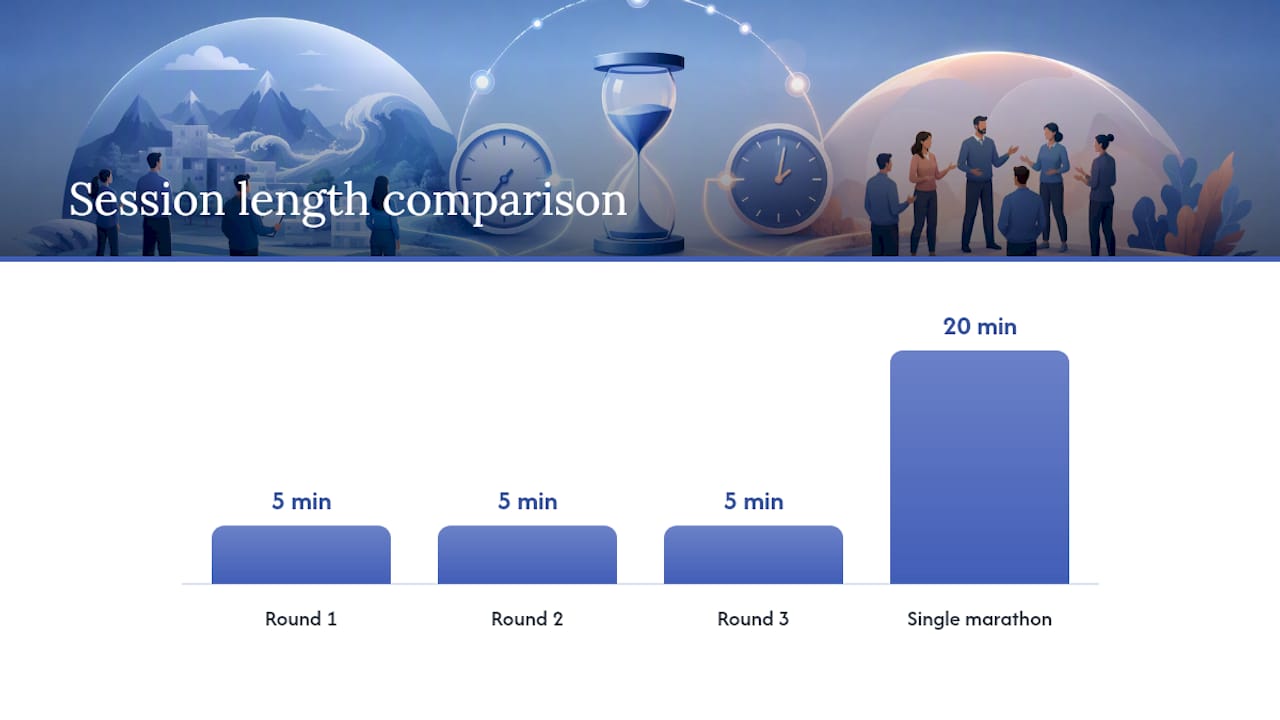
Pro Tip: Scaffold complexity across sessions instead of throwing learners into the hardest version on day one. Run short cycles with a micro-debrief after each one, reinforcing a single behavior before you add the next layer of difficulty. Learners retain more from three focused five-minute rounds than one messy twenty-minute marathon.
What Debrief and Assessment Methods Actually Work?
Skip the debrief and you’ve wasted most of the learning value of either method. The scenario creates the experience, but the debrief is where the experience turns into a lesson the learner can actually name and repeat.
Three debrief models cover most situations:
- Pendleton’s rules, where the learner states what went well first, then the facilitator adds strengths, then both discuss what could improve.
- Plus/delta, a faster format that simply lists what worked (plus) and what to change (delta), useful when time is tight.
- Structured reflection, guided by open questions (“What were you thinking at that moment?”) that push learners to articulate their own decision process instead of just receiving feedback.
Pick the model based on time available and group size, not personal preference. A five-minute role play round pairs well with plus/delta; a full simulation debrief after a team scenario often needs the full Pendleton structure to unpack multiple roles.
Assessment should match the objective you set during planning. Procedural simulations often use OSCE-style checklists that score discrete steps in sequence. Communication-focused role play tends to fit better with rubrics scored on tone, clarity, and responsiveness, plus peer feedback from whoever observed the exchange. Readiness scoring, a composite score built from repeated attempts, works well for tracking improvement over time rather than judging a single performance.
Two practical habits make feedback stick: deliver it as close to the activity as possible, while the moment is still fresh, and document outcomes somewhere retrievable, whether that’s a simple spreadsheet or a formal transcript, so managers or instructors can spot patterns across a cohort instead of relying on memory. Isolating one specific behavior for a re-run rather than critiquing the whole performance at once tends to produce faster improvement, because the learner isn’t trying to fix five things simultaneously.
What Goes Wrong, and How Do You Avoid It?
The most common failure in both methods isn’t a bad scenario. It’s skipping preparation for the parts that don’t feel like “the activity,” namely psychological safety and facilitator readiness.
Learner anxiety is real and measurable. Research on simulation environments shows that when scaffolding is weak, some learners report feeling humiliated rather than challenged, which shuts down learning instead of driving it. Fix this with ground rules stated out loud before the activity starts (mistakes are expected, this isn’t a performance review), and give learners a genuine opt-out mechanism if a scenario touches something too close to a real personal experience.
Resource limits don’t have to mean skipping the method entirely. Tabletop exercises, role swaps, and telesimulation all approximate team coordination learning at a fraction of the cost of full manikins or standardized patients, and a hybrid of tabletop plus role play can preserve most of the learning value when equipment budgets don’t stretch.
Facilitator skill is the quiet failure point most programs underestimate. A facilitator who doesn’t know how to redirect a derailing scenario, or when to step in versus let the discomfort play out, can undo good scenario design in minutes.
- Build a facilitator checklist covering intervention triggers, timeboxing rules, and debrief structure before the first session runs.
- Run a dry-run session with a colleague before using a new scenario live with learners.
- Budget for ongoing facilitator development, not just a one-time orientation.
Pro Tip: If your facilitators are new to running experiential activities, invest in their professional development before you invest more in scenario design. A weak facilitator running a great scenario will underperform a strong facilitator running an average one almost every time.
What Does the Evidence Actually Show?
The evidence base is strongest for simulation in healthcare, where outcomes are easiest to measure objectively.
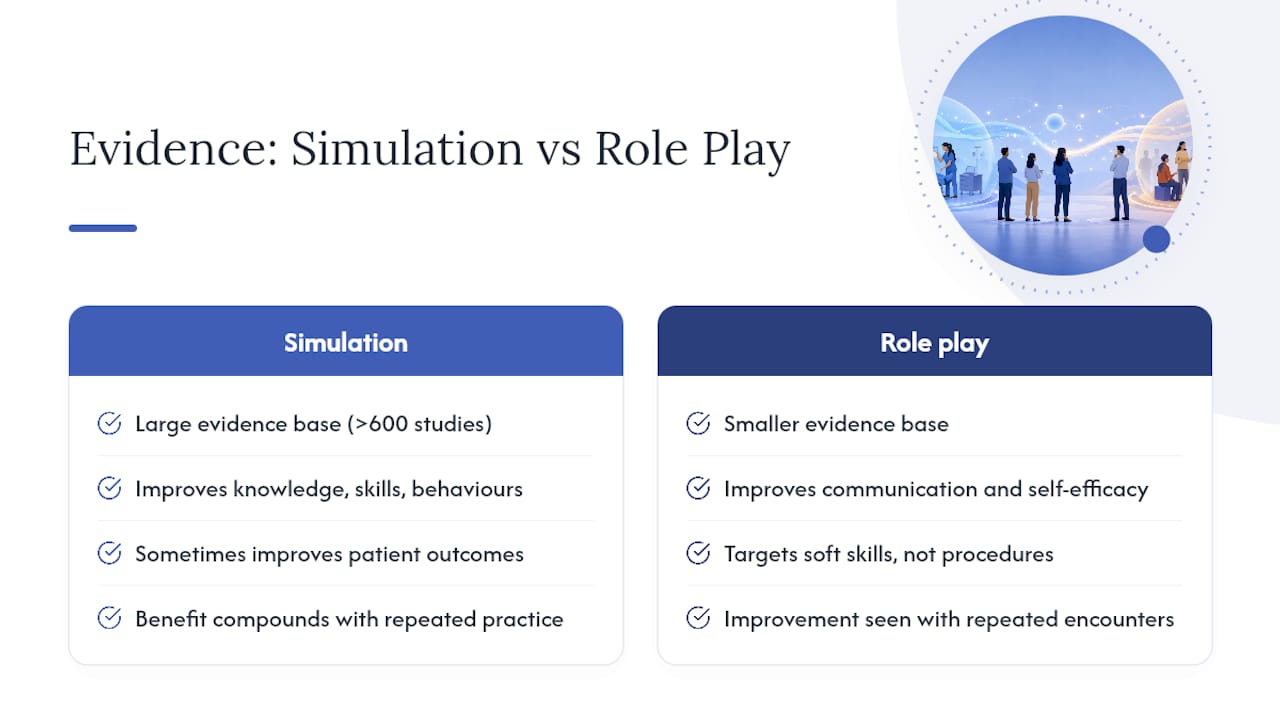
A systematic review covering more than 600 studies found that technology-enhanced simulation training improved knowledge, skills, behaviors, and, in a portion of studies, patient outcomes.
That’s a large evidence base, but it comes with real caveats. Study designs vary widely, standardization across programs is inconsistent, and most gains depend on repeated practice rather than a single session. One simulation attempt rarely moves the needle much; the benefit compounds across cycles.
Role play’s evidence is smaller in volume but specific in what it shows. A prospective study of undergraduate medical students found statistically significant improvements in communication skills and self-efficacy across three repeated role play encounters, reinforcing that repetition matters here just as much as in high-fidelity simulation. The gains showed up specifically in soft skills, not procedural competence, which tracks with what the method is built to teach.
Where research and practice converge is on quality assurance. A global consensus statement calls for embedding simulation into education with formal quality assurance, structured faculty development, and deliberate use of low-cost, high-impact methods to expand access rather than limiting it to well-funded institutions. That last point matters for anyone outside a hospital simulation center: you don’t need a six-figure manikin lab to get real learning gains, but you do need a rules-based scenario and a real debrief.
The honest summary: simulation has the deeper outcomes literature, largely because healthcare has funded it for decades. Role play has a thinner but consistent signal for the specific skills it targets. Neither method works well without the debrief step, and neither replaces the other.
How Do You Decide Between Simulation and Role Play?
Run through this sequence before building anything:
- Name the objective. Is the target a procedure, a decision sequence, or a conversation skill?
- Rate the risk. Would a real mistake cause harm, cost, or reputational damage?
- Set the fidelity requirement. Does the learner need to feel physical or procedural realism, or just conversational realism?
- Plan the assessment. Will you use a checklist, a rubric, peer feedback, or readiness scoring?
- Check resources. Facility, budget, facilitator skill, and available time per learner.
A hospital training a code team for the first time picks simulation: high risk, team coordination, a checklist-based OSCE assessment, and a manikin lab already on-site. A customer service team preparing reps for renewal-negotiation calls picks role play: low physical risk, communication-focused, rubric and peer feedback, and nothing more than two people and a script needed to run it.
Where Facilitator Judgment Still Beats the Framework
Every checklist in this article assumes you already know your learners well enough to read the room, and that assumption breaks more often than people admit. Three rules hold up across most experiential training I’ve seen described in the research: never run a scenario without a stated objective, never skip the debrief even when time is short, and never assume a scenario that worked for one cohort will work unchanged for the next.
AI-driven role play accelerates the repetition problem that kills most soft-skill programs, since a rep can run the same difficult conversation ten times in a week instead of once a quarter with a scheduled peer. It does not replace facilitator judgment in a live, high-stakes team simulation, and it doesn’t substitute for a trained observer catching a subtle cue a script can’t anticipate.
— Adam
A Faster Way to Get Repeated Role Play Practice
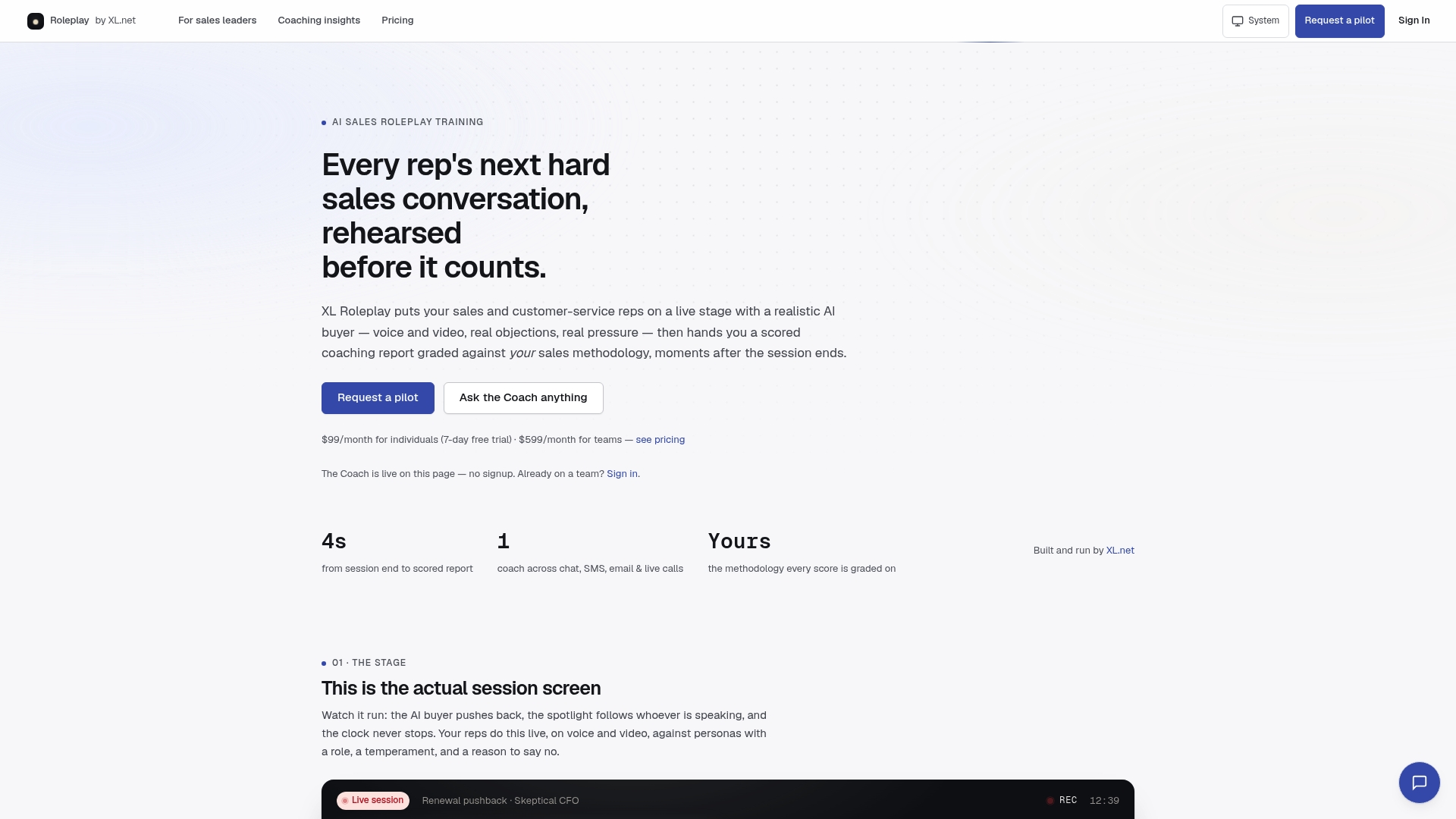
Everything above about scaffolding, debrief, and repeated cycles runs into the same wall in most organizations: scheduling humans to role-play with each other doesn’t scale. An AI-driven platform can solve that specific bottleneck by replacing the scheduling grind of peer-to-peer practice with AI buyers that hold a consistent character across live voice and video sessions, present the objections reps actually hear, and generate scored coaching reports tied to an organization’s sales methodology immediately after each call.
That matters most for interpersonal skills you’d otherwise practice in role play: discovery questions, objection handling, tone under pressure. Managers can get full transcripts and readiness scores instead of secondhand summaries, which solves the documentation gap that undermines many informal role play programs. In-person, high-fidelity simulation still wins for team coordination scenarios where physical presence or multi-person choreography matters. For scaling one-on-one conversational reps to fluency, Xl Roleplay gets more reps in front of realistic objections faster than a scheduling calendar ever will. Sales leaders evaluating this for a full team can start on the page built for sales leaders to see how team-wide readiness scoring works before rolling it out.
Where to Read More
For deeper grounding, start with the AHRQ primer on simulation training and the global consensus statement on simulation-based practice. For hands-on scenario design, CTE Resources’ guide to simulations and role play and Xl’s guide on building customer service roleplay training both offer practical next steps.
Sources
- Simulation training | PSNet (AHRQ)
- Simulations and role play | CTE Resources
- Effectiveness of scenario-based roleplay as a method of teaching soft skills for undergraduate medical students (PMC)
- Benefits of Simulation Training | Baystate Health
- Global consensus statement on simulation-based practice in healthcare