Fix Revenue in 90 Days: Skill Gap Analysis for Sales Leaders
Fix Revenue in 90 Days: Skill Gap Analysis for Sales Leaders

A sales skill gap analysis must pinpoint the specific skills constraining pipeline and revenue, not produce a generic list of weaknesses. Start with a quick funnel diagnostic paired with a short competency matrix: the diagnostic takes about two weeks, and it should feed directly into a prioritized action plan you can measure against real conversion data.
TL;DR:
- A proposal stage win rate decline often traces to weak earlier qualification, while long cycles point to poor next step discipline or incomplete stakeholder mapping.
- Score five to eight observable behaviors per role on a shared one to five rubric, combining rep, manager, and objective evidence, with call data weighted most heavily.
- Fix CRM or routing problems before coaching; coach inconsistent execution, and consider reassignment when foundational gaps are unlikely to close within a quarter.
- Limit the three month plan to three or four gaps, assign owners and checkpoints at days 30, 60, and 90, then pilot one cohort before scaling.
- Track leading indicators alongside win rate or cycle length, allow at least 30 days for behavior change, and compare a similar untrained group when possible.
Table of Contents
- 1. Build a Five-Step Framework for Diagnosing Sales Gaps
- 2. Which Funnel Metrics Reveal Specific Skill Breakdowns
- 3. Methods for Assessing Sales Competencies Without Guesswork
- 4. Turn Skill Gaps Into a Prioritized 90-Day Plan
- 5. Measuring Whether Training Actually Changed Behavior
- 6. Operationalizing Gap Closure Through Structured Practice
- The One Mistake That Wastes Most Training Budgets
- Run a Role-Play Pilot to Close the Gaps You Just Found
- FAQ
- Sources
1. Build a Five-Step Framework for Diagnosing Sales Gaps
Most skill gap analyses fail because they start with opinions instead of a model. A repeatable process turns guesswork into a ranked list of skills worth fixing, and it works the same way whether you run it quarterly or after a bad sales cycle.
- Define excellence. Build a role-specific competency model that describes observable behaviors, not vague traits. “Asks three discovery questions about budget and timeline” is coachable; “good at discovery” is not.
- Assess current reality. Collect three inputs: self-assessment, manager assessment, and objective data from calls or CRM activity. Weight objective data most heavily, since self-reports tend to compress the real spread of skill in a team.
- Identify disconnects. Compare the competency model against the assessment inputs to compute a gap score per skill per rep, then look for patterns across the team rather than one-off weaknesses.
- Prioritize. Rank gaps by business impact, ease of closing, and alignment with the quarter’s strategic goals, so you are not training on the skill that is easiest to teach but least connected to revenue.
- Build the blueprint. Translate the top gaps into a dated plan with owners, intervention types, and measurement checkpoints.
The competency model is the piece most teams skip, and it is the one that makes everything downstream meaningful. Without behavior-level definitions, a manager and a rep can rate the same call as a “7” for completely different reasons, which is exactly the kind of noise that undermines calibration later. When you assess current reality, resist the temptation to rely on a single data source: a comprehensive sales training evaluation framework recommends layering multiple levels of evidence rather than trusting one signal, because self-assessments commonly understate the real variance in a team and hide the outliers who need the most help.
Gap scoring does not need to be complicated. Prioritization criteria matter more than the scoring math: a skill tied directly to a stalled pipeline stage deserves attention before a skill that only affects edge-case deals, even if both score equally low.
2. Which Funnel Metrics Reveal Specific Skill Breakdowns
Skill gaps rarely show up as a vague feeling that “the team needs more training.” They show up as a specific drop at a specific stage of the funnel, and reading that pattern correctly saves you from training the wrong skill.
Conversion rate by stage is the most useful diagnostic you have, because it tells you where in the sales process reps are losing deals rather than just how many they are losing overall. A practical sales performance guide lays out how specific drop patterns map to specific coaching needs:
- A falling win rate at the proposal stage usually points to weak qualification or discovery earlier in the cycle, not a pricing problem.
- A stretching sales cycle length often signals missing next-step discipline or incomplete stakeholder mapping.
- High activity with low conversion suggests a messaging or ideal customer profile mismatch rather than a volume problem.
- A sudden drop in meeting-to-opportunity conversion often traces back to discovery questions that fail to uncover real pain.
Pair every activity metric with a quality benchmark to avoid rewarding busywork: a rep who books twenty calls a week but converts few of them needs a different intervention than a rep who books five calls and converts most of them, according to the sales performance guide.
Separate leading indicators from lagging ones before you decide what to train. Reply rate, meeting-to-opportunity conversion, and talk-to-listen ratio are leading signals you can act on within a week. Win rate and quota attainment are lagging signals that confirm whether an intervention worked, but they arrive too late to guide the initial diagnosis. Review leading indicators regularly, conversion-by-stage periodically, and full competency reassessments several times a year, so you catch skill erosion before it shows up in a missed number.
Before you attribute any of these patterns to a skill problem, rule out system and process issues. A CRM field that nobody fills in consistently can produce a conversion drop that looks like a skill gap but is actually a data quality problem, and a broken lead-routing rule can starve a rep of volume in a way no amount of coaching will fix.
3. Methods for Assessing Sales Competencies Without Guesswork
A competency matrix is only as good as how it gets scored, and this is where most assessments quietly fall apart.
Start by listing five to eight core behaviors per role, each written in observable terms, then score every rep against each behavior using a 1 to 5 scale with a short description of what each number looks like in practice. Run this scoring exercise for every rep at the same time, using the same rubric, so scores are comparable across the team rather than dependent on which manager happened to be reviewing.
- Self-assessment surfaces how reps perceive their own performance, which is useful context but a weak standalone measure.
- Manager assessment adds a second perspective, but it needs calibration sessions with anchored examples to stay consistent across managers.
- Objective scoring from call recordings, CRM stage audits, or short role-play sessions removes most of the bias in the first two inputs.
- Combined weighting merges all three into one gap score per skill, with objective data carrying the heaviest weight.
Self-assessments are weak on their own because reps tend to rate themselves close to the middle of the scale regardless of actual performance, which flattens out the real spread a manager needs to see. Manager assessments improve on this, but only when managers calibrate against each other using live examples and anchored rating sheets, since two managers watching the same call can land on very different scores without that step.
Objective measures do not require an elaborate rollout to start producing useful signal. Sample ten recent calls per rep, audit CRM stage transitions for the last quarter, or run a short role-play scenario built around a real objection the team hears often. Any one of these gives you a baseline that is harder to argue with than a self-rating.

Pro Tip: Run manager calibration before you run rep assessments: two managers scoring the same recorded call side by side will expose rating inconsistencies you need to fix before the scores mean anything.
When inputs disagree sharply, treat the variance itself as a data point. A rep who rates themselves a 5 on objection handling but scores a 2 on objective call review usually has a blind spot worth a direct conversation, not just a lower composite score.
4. Turn Skill Gaps Into a Prioritized 90-Day Plan
Once you have ranked gaps, the next step is deciding what to do about each one, and the decision is not always “more training.”
- Score each gap on impact versus effort. A gap tied to a high-volume deal stage and fixable with a short coaching cycle sits at the top of the list; a gap that affects one edge-case scenario sits at the bottom, regardless of how interesting it is to fix.
- Apply decision rules before choosing an intervention. Fix the process when the gap traces back to a broken CRM field, bad lead routing, or unclear handoff; coach the skill when the rep has the behavior in their competency model but executes it inconsistently; consider hiring or reassignment when the gap is foundational and unlikely to close within a quarter.
- Build the 90-day blueprint. List each prioritized gap with an owner, an intervention type (coaching, structured role-play practice, or a process fix), a start date, and a measurement checkpoint at day 30, 60, and 90.
- Pilot before you scale. Run the plan with one team or one cohort first, measure behavior change at the checkpoints, and only extend it to the full org once you see the metric move in the right direction.
A sample blueprint entry might look like this: discovery questioning ranked as the top gap, owned by the sales enablement lead, addressed through weekly role-play drills plus manager debriefs, with a day-30 check on reply-to-meeting conversion and a day-90 check on meeting-to-opportunity conversion. Keep the plan to three or four gaps at a time. A longer list dilutes manager attention and makes it harder to tell which intervention actually moved the number.
5. Measuring Whether Training Actually Changed Behavior
Proving that a skill intervention worked requires more than a satisfaction survey at the end of a workshop. A layered evaluation approach gives you a defensible answer instead of a guess.
The integrated training evaluation framework outlines four levels worth tracking, plus a utility layer that connects training to dollars:
| Level | What it measures | Realistic evidence |
|---|---|---|
| Reaction | Whether reps found the training useful | Post-session survey scores |
| Learning | Whether reps can demonstrate the skill | Role-play or quiz scores immediately after training |
| Behavior | Whether the skill shows up on real calls | Call scoring or CRM activity change over 30 to 60 days |
| Results | Whether business metrics moved | Conversion-by-stage or win-rate change over a full quarter |
Pick one or two leading KPIs, such as discovery question count or meeting-to-opportunity conversion, and one or two lagging KPIs, such as win rate or cycle length, and track both from the intervention’s start date. Kirkpatrick Partners notes that measurement programs succeed when they tie training indicators to business metrics already in executive reports, rather than inventing new metrics nobody else tracks.
- Measure behavior change over at least 30 days to avoid noise from a single good or bad week.
- Hold other variables steady where possible, since a pricing change or new lead source in the same quarter will confound your results.
- Compare the trained cohort against a similar untrained group when you can, rather than only before-and-after on the same team.
- Treat a single quarter of lagging data as directional, not final, especially for smaller teams where a few deals swing the average.
6. Operationalizing Gap Closure Through Structured Practice
Diagnosing a gap and closing it are different problems. Structured role-play with objective scoring gives reps repeated practice against the exact scenario tied to their lowest-scoring competency, and it gives managers evidence they can point to instead of a vague sense that “the call didn’t go well.”
- Scenarios built around real objections target the specific competency flagged in the gap analysis rather than generic selling skills, an approach described in how to build role-play scenarios from real calls.
- Managers review transcripts and rubric scores to run focused debriefs instead of relying on memory from a live call, following the debrief structure in running role-play training reps don’t dread.
- A reasonable pilot structure covers one cohort of eight to twelve reps, two drills per week for four weeks, with a scored checkpoint at week two and week four.
- Rubric design matters as much as drill frequency: a shared scoring rubric, like the ones outlined in sales skill certification rubric guides, keeps manager feedback consistent across a team.
This is the layer where a gap analysis stops being a report and starts changing what happens on calls.
The One Mistake That Wastes Most Training Budgets
The most common mistake is running broad training before checking whether the problem is even a skill problem. A messy CRM field, a bad lead source, or an unclear handoff can mimic a skill gap, and no amount of coaching fixes a process issue.
Before you commit a training budget, run three checks: audit conversion by stage for the real drop point, confirm the CRM data behind that drop is reliable, and pilot any fix on one small cohort before rolling it out. Measure, then scale.
— Adam
Run a Role-Play Pilot to Close the Gaps You Just Found
Once you know which skills are limiting your pipeline, the fastest way to close them is repeated, scored practice rather than another generic workshop. We built a platform around that exact handoff: live AI buyer scenarios scored against your own sales methodology, with transcripts and rubrics managers can use for focused debriefs instead of guesswork.
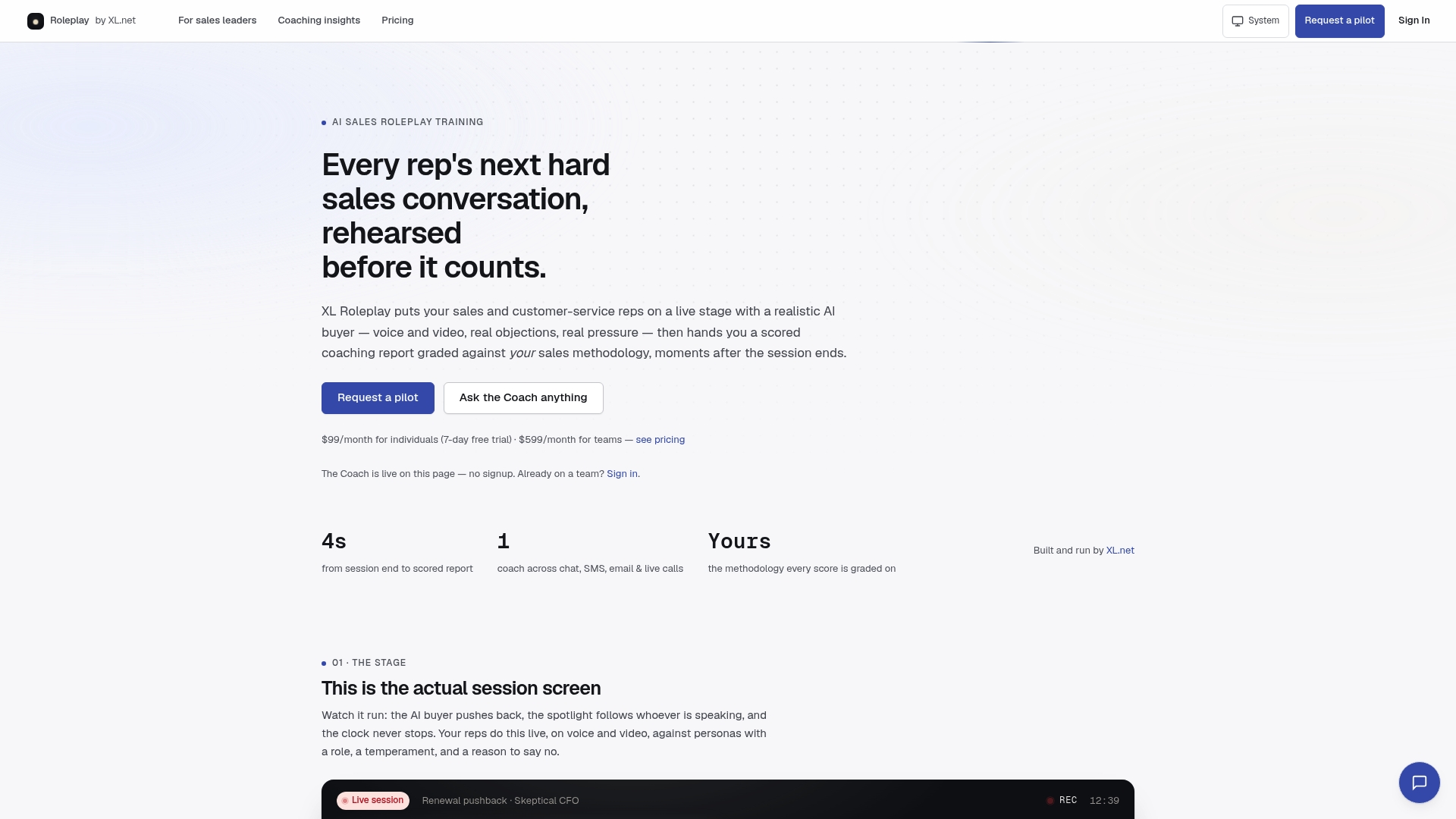
- Scenarios target the specific competencies flagged in your gap analysis, not generic selling skills.
- Scored coaching reports and transcripts give managers evidence for debriefs instead of memory and impression.
- A structured pilot lets you measure behavior change on a small cohort before committing budget team-wide.
A 90-day pilot tracks the same checkpoints outlined in this guide: readiness scores at day 30, call behavior at day 60, and conversion movement at day 90, enhanced by insights from the AI customer service tools for small business to improve client engagement efficiency. Pricing for Individual and Business plans is on our pricing page, and you can request a pilot program to see how scored role-play fits your team’s blueprint.
FAQ
What is an example of a sales skills gap analysis?
A typical example compares a rep’s discovery call performance against a competency model that specifies behaviors like asking budget and timeline questions, then scores the gap using self-assessment, manager review, and objective call scoring. The resulting gap score shows which specific behavior, not just which general skill, needs coaching.
What is the purpose of gap analysis in sales?
The purpose is to find the specific skills constraining pipeline and revenue so training budget and manager attention go to the highest-impact fix rather than a generic program. A well-run analysis also rules out process and CRM issues before attributing a performance drop to skill.
Can you give an example of a skill gap?
A common example is weak discovery questioning that shows up as a falling win rate at the proposal stage, since reps who skip budget and timeline questions early often lose deals later for reasons that look like pricing objections but actually trace back to poor qualification, a pattern described in practical sales performance guidance.
What are the four types of gap analysis?
Definitions vary across fields, but in a sales training context the four useful lenses are performance gap (current versus target results), skill gap (current versus required competency), process gap (system or CRM issues mimicking a skill problem), and knowledge gap (missing product or market information). Running all four checks before committing to a training intervention avoids spending budget on the wrong fix.
How do I measure whether sales training actually worked?
Track a leading indicator, such as discovery question count or meeting-to-opportunity conversion, alongside a lagging indicator like win rate, and give behavior change at least 30 days to show up before judging results. The integrated training evaluation framework recommends measuring reaction, learning, behavior, and business results separately rather than relying on a single post-training survey.
Sources
- Measure, manage, improve: a practical sales performance guide for team leaders (Pipedrive blog)
- Sales training evaluation: an integrated framework and research agenda (Journal article / WKU)
- Five easy pieces to performance measurement (Kirkpatrick Partners)