Make Sales Training Stick: Spaced Repetition Doubles Retention
Make Sales Training Stick: Spaced Repetition Doubles Retention

Use spaced retrieval practice, not one-off boot camps, to make sales training stick. The mechanism is simple: short, repeated retrieval sessions spread over days and weeks beat a single long training event because they force reps to actively recall skills instead of passively re-reading them. Managers should measure this by tracking behavior change in real conversations and business outcomes, not course completion rates.
TL;DR:
- Spaced retrieval practice improves sales skill retention more effectively than one-off training events, especially when practice is active rather than passive.
- Short, focused sessions scheduled over several weeks yield better long-term retention than long, infrequent training blocks, with no need for complex interval calculations.
- Measuring actual behavior change through scored roleplays and real call sampling provides a more accurate gauge of transfer than course completion metrics.
- An AI-driven platform like XL Roleplay can facilitate realistic, scheduled retrieval drills without overburdening managers or trainers.
- Starting with a narrow focus on one key behavior and a small pilot enables effective scaling of spaced retrieval programs in sales teams.
Table of Contents
- What Is Spaced Repetition Sales Training?
- The Evidence for Spacing in Sales and Workplace Learning
- How to Build a Spaced Retrieval Training Program
- Choosing the Right Spacing Schedule
- Measuring Whether Training Actually Transfers
- Putting Spaced Retrieval Into Practice With XL Roleplay
- An Editorial Take on Rolling This Out
- Run Spaced Retrieval Practice Without the Scheduling Headache
- Sources
- FAQ
What Is Spaced Repetition Sales Training?
Spacing and retrieval practice are two different levers, and mixing them up is the most common mistake trainers make. Spacing refers to when practice happens: spreading sessions out over time instead of cramming them into one workshop. Retrieval practice refers to what the learner does during that session: actively pulling information or a skill from memory rather than rereading a slide deck or watching a replay.
The active part matters more than people assume. A rep who answers a live objection from memory builds a stronger, more retrievable memory trace than one who reviews a script beforehand. That’s the difference between recognition and recall, and only recall holds up under the pressure of a real sales call.
There’s a wrinkle worth knowing: spaced retrieval practice feels harder in the moment than rereading notes, which is exactly why most reps underuse it. The 2022 Nature Reviews Psychology synthesis on spacing and retrieval notes that learners consistently misjudge which study strategies actually work, favoring the comfortable ones over the effective ones. That’s a coaching problem as much as a curriculum problem.
- Spacing = the calendar (when practice occurs)
- Retrieval practice = the task (recalling and applying a skill without prompts)
- Combining both outperforms either alone, especially for skills reps must produce under pressure
The Evidence for Spacing in Sales and Workplace Learning
The case for spaced retrieval in sales training isn’t theoretical. A 2010 quasi-experimental field study tracked 64 bank employees split into spaced and massed practice groups and found the spaced group showed higher transfer quality and stronger self-reported sales competence. Notably, spacing didn’t win on transfer quantity, meaning reps didn’t necessarily do more of the trained behavior. They did it better.
That distinction between quality and quantity should shape how you define success before you launch a program.
A 2021 meta-analysis of 29 studies found spaced retrieval practice improved final retention over massed practice with an aggregated effect of g = 0.74, a sizable effect by most learning-research standards. The same analysis found no meaningful advantage for expanding spacing intervals over simple uniform ones.
The effect isn’t confined to lab settings, either. A workplace analysis covering more than 10,000 employees found spacing effects held up across a messy, heterogeneous real-world learning population, not just controlled classroom conditions. For sales trainers, that means the burden of proof has shifted: the question isn’t whether spacing works, it’s whether your program is designed to use it well.
How to Build a Spaced Retrieval Training Program
Building this into a sales program doesn’t require a rebuild of your entire curriculum. It requires a different rhythm.
- Deliver focused initial instruction. Keep the first exposure short, whether that’s a microlearning module or a single-topic workshop. Long, multi-day onboarding blocks create the illusion of thoroughness while overwhelming working memory.
- Schedule a retrieval check within 24 to 48 hours. This is the first real test of whether the skill stuck, and it should require the rep to do something (answer an objection, run a discovery question) rather than recognize a correct answer on a quiz.
- Space out recurring retrievals over the following weeks. Use scenario-based roleplays with scored feedback so each retrieval session mirrors an actual sales moment, not a trivia review.
- Anchor every task to a target behavior. Discovery questioning, objection handling, and closing language should each get their own retrieval cadence rather than being lumped into generic “sales skills” practice.
- Build in manager review and remediation loops. When a rep’s scores lag, that’s a signal for a shorter, more frequent retrieval cycle on that specific behavior, not a repeat of the full training.
Operationally, this works best with adaptive scheduling that responds to performance, quick manager nudges, and low-friction formats like mobile micro-sessions reps can do between calls. A 2022 study on multi-session learning found retention nearly doubled after 12 hours and rose more than fivefold after 36 hours when practice was distributed across multiple sessions instead of massed into one. More sessions, even short ones, consistently beat one long one.
Pro Tip: Don’t build your retrieval tasks around fact recall alone. A rep who can list five objection-handling techniques on a quiz isn’t the same as a rep who can handle a live objection under time pressure. Design tasks that require the actual behavior, like a roleplay-based script practice exercise, not just its definition.

Choosing the Right Spacing Schedule
Onboarding content reps will use tomorrow needs tighter spacing, maybe a day or two between sessions. Rarely used skills, like handling an unusual enterprise objection, can tolerate wider gaps of several weeks.
The expanding-versus-uniform debate gets more attention than it deserves. The 2021 meta-analysis found no significant difference between expanding spacing (short gaps that grow over time) and simple uniform spacing (evenly spaced gaps). Don’t overengineer this. Consistency and follow-through matter more than mathematically perfect intervals.
What matters more is session count. Multiple shorter exposures beat one long one, even when the total practice time is identical.
A workable cadence for most sales orgs looks like this:
- Week one: daily five-minute retrieval drills on core discovery questions during onboarding
- Month one: twice-weekly scenario roleplays covering objection handling, tied to real deal stages
- Ongoing: monthly refreshers on core skills, quarterly deep-dive sessions on rarely used but high-stakes scenarios
Measuring Whether Training Actually Transfers
Completion rates tell you almost nothing about whether a rep can handle a real objection. Measuring transfer requires watching what reps actually do, not what they clicked through.
Start with primary metrics: scored roleplay performance against a defined rubric, readiness scores, and periodic sampling of real calls or CRM notes for the target behavior. These tell you whether the skill shows up when it counts.
Secondary metrics round out the picture: time-to-competence for new hires, and whether trained behaviors correlate with pipeline movement or close rates. None of these prove causation on their own, but tracked together they build a credible case.
- Run baseline versus post-training comparisons before rolling a program out company-wide
- Where feasible, pilot with a small randomized cohort before scaling
- Check recall immediately after training, again at one to three months, and tie a longer-term metric to business results
Report on a rhythm: immediate recall checks, short-term retention checks, and a quarterly look at whether trained behaviors are moving revenue-relevant numbers.
Putting Spaced Retrieval Into Practice With XL Roleplay
Most of this program design breaks down at the execution stage. Trainers know spacing works, but scheduling live roleplay partners every week for every rep isn’t realistic for most teams. That’s the gap an AI roleplay platform like XL Roleplay is built to close.
- Short, realistic roleplay drills can be scheduled on a recurring cadence, functioning as retrieval practice tied to specific target behaviors rather than generic “sales skills” review
- Each session produces a transcript and a coaching report, giving managers something concrete to review instead of a completion checkmark
- Onboarding pilots, objection-handling remediation loops, and monthly micro-practice sessions tied to a single KPI are all workable use cases without adding headcount to your training team
Pro Tip: If you’re piloting spaced retrieval for the first time, resist the urge to score everything. Pick one behavior, like discovery questioning, and build your rubric and cadence around that alone before expanding. Explore more program-design approaches in XL Roleplay’s coaching insights.
An Editorial Take on Rolling This Out

Most sales trainers overbuild their first spaced retrieval program. They try to cover every skill, every rep, every week, and it collapses under its own scheduling weight within a quarter.
Start narrower than feels comfortable: one behavior, one small cohort, and a clear way to score transfer quality before you scale anything. Favor short, frequent practice over quarterly all-hands events, since rep availability is the real constraint, not curriculum design. And when you pitch this internally, don’t lead with the learning science. Lead with one narrow KPI tied to one behavior, and let the improvement make the case for you.
— Adam
Run Spaced Retrieval Practice Without the Scheduling Headache
XL Roleplay gives you one AI coach that remembers each rep’s history across sessions and scores every roleplay against your own sales methodology, not a generic rubric borrowed from someone else’s playbook. That’s the piece most spaced retrieval programs are missing: a way to run short, realistic retrieval drills every week without booking a manager’s calendar or a peer roleplay partner for every rep, every time.
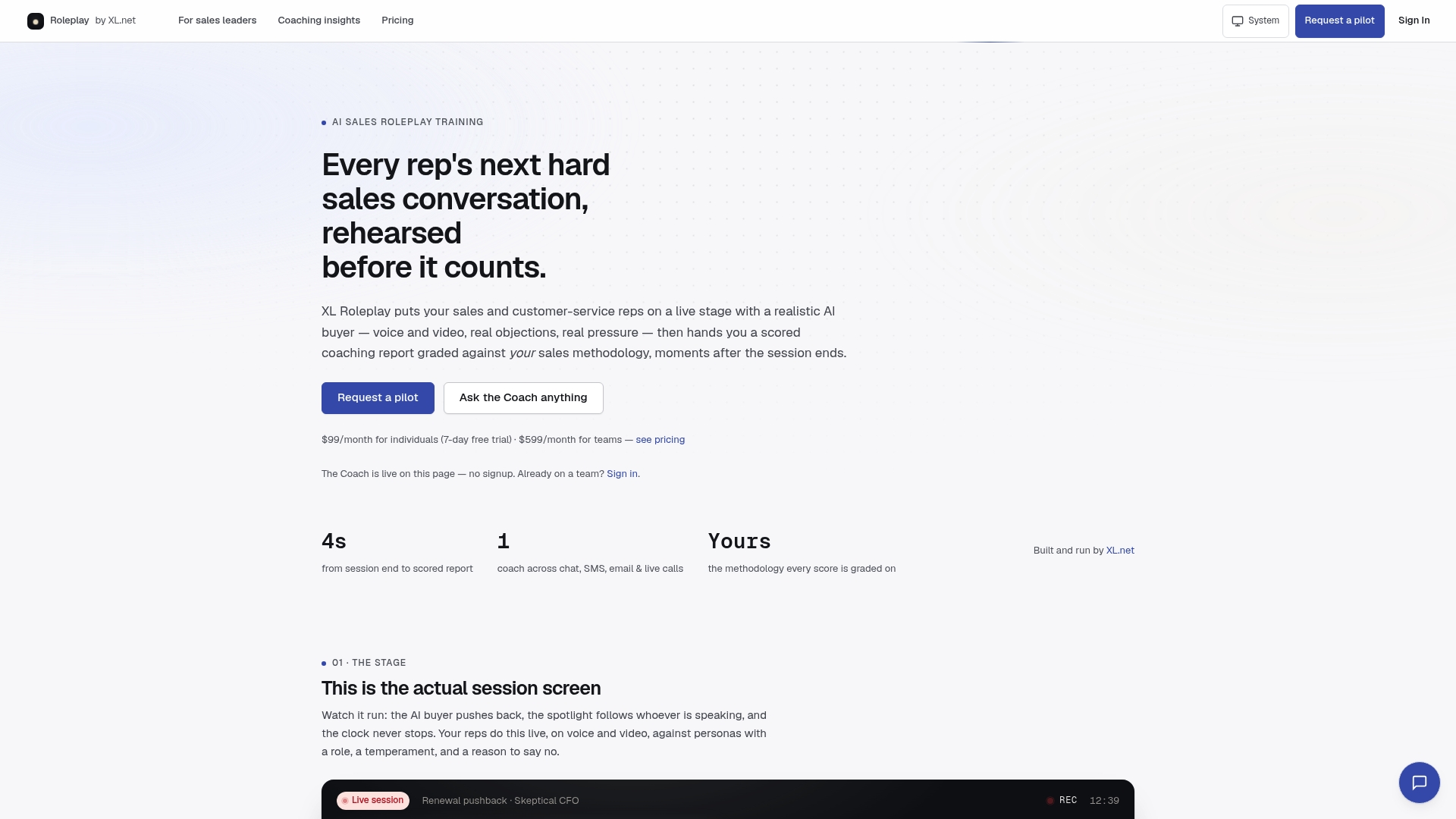
Every session generates a transcript and a scored coaching report your managers can actually use in one-on-ones, so the retrieval practice ties directly into the coaching cadence you already run. If you want to test this on a narrow use case first, the XL Roleplay pilot is built for exactly that: a small cohort, one or two target behaviors, and a clear before-and-after read on transfer quality. When you’re ready to scale, pricing details cover Individual plans at $99 per month and Business plans at $599 per month, with extra seats available at $54.95 per month each. Start with the pilot and see whether readiness scores move before committing to a team-wide rollout.
Sources
Sales training typically draws from four sources: formal onboarding curricula, manager coaching and live call review, peer or roleplay practice, and self-directed microlearning. Combining these with a spaced, retrieval-based cadence, rather than relying on any single source in isolation, tends to produce better skill retention.
- Sales Training: Effects of Spaced Practice on Training Transfer, Journal of European Industrial Training (2010)
- The science of effective learning with spacing and retrieval practice | Nature Reviews Psychology (2022)
- The spacing effect stands up to big data (workplace LMS analysis)
FAQ
What Is the Best Training Method for Sales Teams?
The strongest evidence points to spaced retrieval practice: short, repeated sessions that require reps to actively recall and apply skills rather than one long onboarding event. Field research on bank employees found this approach improved transfer quality and self-reported sales competence compared with massed, single-session training.
Which Spaced Repetition Schedule Works Best?
The 2021 meta-analysis found no meaningful difference between expanding and uniform spacing patterns, so consistency matters more than a mathematically perfect interval.
What Good Sales Training Programs Have in Common?
Effective programs favor short, recurring, realistic practice over long infrequent events, and they measure behavior change rather than course completion. Platforms like XL Roleplay operationalize this by scheduling scored roleplay drills and producing transcripts managers can review against a defined rubric.
How Do You Know If Sales Training Actually Worked?
Look at scored roleplay performance, readiness scores, and sampled real-call behavior rather than completion rates alone. Track recall immediately after training, again at one to three months, and connect trained behaviors to a narrow, revenue-relevant metric like conversion or pipeline movement.