50+ SPIN Selling Questions to Master Discovery Calls
50+ SPIN Selling Questions to Master Discovery Calls

SPIN selling questions are the four types of discovery questions, Situation, Problem, Implication, and Need-Payoff, that guide a buyer from describing their current setup to articulating why change is worth paying for. They matter because complex B2B deals rarely close on features; they close when the buyer connects a problem to a cost and says the fix out loud, in their own words.
Here’s a shortlist you can paste into your next call script today:
- Situation: “Walk me through how your team currently handles [process].”
- Situation: “Who’s involved when this process breaks down or slows things up?”
- Problem: “What’s the most frustrating part of managing this right now?”
- Problem: “Where do you see the most errors or delays creeping in?”
- Implication: “If this keeps happening, what does it cost you in missed deadlines or lost revenue?”
- Implication: “How does this issue affect other teams downstream?”
- Need-Payoff: “If you could fix this, what would that mean for your quarterly targets?”
- Need-Payoff: “How would solving this change the way your team operates day to day?”
Use this shortlist as the backbone of a 30 to 45 minute discovery call, not the whole conversation. Ask two or three Situation questions at most, then let Problem and Implication questions do the heavy lifting.
Pro Tip: Copy these questions into your CRM’s call template, but swap the bracketed language for the buyer’s actual product or process name before you dial. Generic phrasing is the fastest way to sound like you’re reading a script instead of having a conversation.
Key Takeaways
Mastering SPIN selling questions means asking fewer Situation questions and spending most of the call developing Problem into Implication before you ever ask for a Need-Payoff.
| Point | Details |
|---|---|
| Limit Situation questions | Ask no more than three or four before moving into Problem territory. |
| Implication questions drive urgency | Connect every confirmed problem to a cost, deadline, or stakeholder impact. |
| Let buyers state the value | Need-Payoff questions work best when the buyer articulates the payoff themselves. |
| Plan questions before the call | Draft Implication and Need-Payoff wording in advance to avoid sounding leading. |
| Practice with scored feedback | Platforms like XL Roleplay let reps rehearse full discovery calls and review transcripts against a scoring rubric. |
Table of Contents
- What Is SPIN Selling and When Does It Still Work?
- SPIN Selling Question Examples for Every Stage
- How to Sequence Questions on a Discovery Call
- Writing Implication and Need-Payoff Questions That Land
- Common SPIN Mistakes and Quick Fixes
- How to Practice SPIN Until It’s Second Nature
- When SPIN Should Lead and When to Blend Frameworks
- Turn SPIN Questions Into a Skill Your Whole Team Can Repeat
- Where to Learn More About SPIN Selling
- Sources
What Is SPIN Selling and When Does It Still Work?
Neil Rackham developed SPIN Selling after his firm, Huthwaite, studied tens of thousands of sales calls to figure out what separated top performers from average reps in complex, high-value deals. The acronym stands for Situation, Problem, Implication, and Need-Payoff, and each represents a distinct stage in how a buyer moves from small talk to a clear business case for change.
SPIN fits best in these situations:
- Complex B2B sales with multiple stakeholders who each weigh the decision differently.
- Sales cycles longer than 30 days, where trust and internal buy-in build over several conversations.
- Deals where the buyer doesn’t yet see the full cost of their current problem.
- Discovery-heavy sales motions where a pitch too early kills credibility.
The psychology is straightforward: Implication questions turn a vague complaint into a measurable business problem, and Need-Payoff questions let the buyer state the value themselves rather than hearing you claim it. People trust conclusions they reach on their own far more than ones you hand them. For a deeper look at how SPIN was validated across large-scale research, Huthwaite’s own breakdown of the original methodology is worth a read before you build your own scripts.
SPIN Selling Question Examples for Every Stage
Each SPIN category does a different job, and mixing them up is the fastest way to sound like you’re conducting an audit instead of a conversation. Here’s what each type is for, followed by long, categorized lists you can lift directly into your own scripts.
Situation questions: establish the baseline, then stop
Situation questions gather facts about the buyer’s current setup: tools, headcount, workflow, budget cycle. They’re necessary, but top-performing reps keep them short and move quickly into Problem territory, because a string of situation questions feels like a form, not a dialogue.
- “What tools are you currently using to manage [process]?”
- “How many people touch this workflow on a typical week?”
- “What does your current approval chain look like for this decision?”
- “How long have you been using your current solution or process?”
- “What’s your team’s structure for handling [function]?”
- “Where does this fall in your budget cycle right now?”
- “Who else is involved when you’re evaluating a change like this?”
- “What prompted you to take this call today?”
Cap it at three or four questions. If you’re still asking Situation questions ten minutes into the call, you’ve lost momentum.
Problem questions: surface friction the buyer may not name unprompted
Problem questions dig for dissatisfaction, bottlenecks, and things that aren’t working. A buyer will often mention a minor annoyance here that turns into your biggest lever once you develop it with Implication questions.
- “What’s the most time-consuming part of this process for your team?”
- “Where do you see errors or rework happening most often?”
- “What’s frustrating about how you’re handling this today?”
- “Is there a part of this workflow that consistently causes delays?”
- “What have you already tried to fix this, and why didn’t it stick?”
- “How confident are you in the accuracy of the data you’re working with?”
- “What keeps this from being a top priority even though it’s a known issue?”
- “Where does your team lose the most time in a given week on this?”
- “What would you change about this process if you had a blank slate?”
- “How often does this issue come up in conversations with your team?”
Implication questions: connect the dots to cost and consequence
This is the category that does the most work. Implication questions take a confirmed problem and expand it into explicit business impact, building urgency without you having to push anything.
- “How does this delay affect your ability to hit quarterly targets?”
- “What happens downstream when this process breaks down?”
- “How much does this cost your team in hours per week?”
- “Who else feels the impact when this goes wrong, and how?”
- “If this continues for another six months, what does that look like?”
- “How does this affect customer satisfaction or retention?”
- “What’s the risk to your team’s reputation internally if this isn’t fixed?”
- “How does this bottleneck limit your ability to scale?”
- “What’s the compounding effect if this issue touches multiple departments?”
- “How much revenue is tied up in deals delayed by this problem?”
Need-payoff questions: let the buyer sell themselves
Need-Payoff questions ask the buyer to articulate the value of solving the problem, which is a very different psychological experience than being told the value.
- “If this were solved, what would that free your team up to focus on?”
- “How would fixing this affect your numbers this quarter?”
- “What would it mean for your team to cut that time in half?”
- “How valuable would it be to have visibility into this in real time?”
- “If you could hand this problem off entirely, what would you do with that time?”
- “How would solving this change the conversation with your leadership team?”
- “What would a 20% improvement here be worth to your department?”
- “How would this impact your ability to onboard new hires faster?”
Adapting SPIN across industries
A SaaS rep might ask, “What happens when your reporting dashboard shows stale data before a board meeting?” A hardware rep might ask, “How much downtime does a failed part cause on your production line?” A professional services rep might ask, “What’s the cost of a missed deadline on a client engagement?” Same structure, different vocabulary. Swap the noun, keep the SPIN logic intact.

Pro Tip: Write your Implication questions before the call, not during it. The best ones connect a specific problem to a number the buyer already cares about, and that kind of specificity is nearly impossible to improvise live.
How to Sequence Questions on a Discovery Call
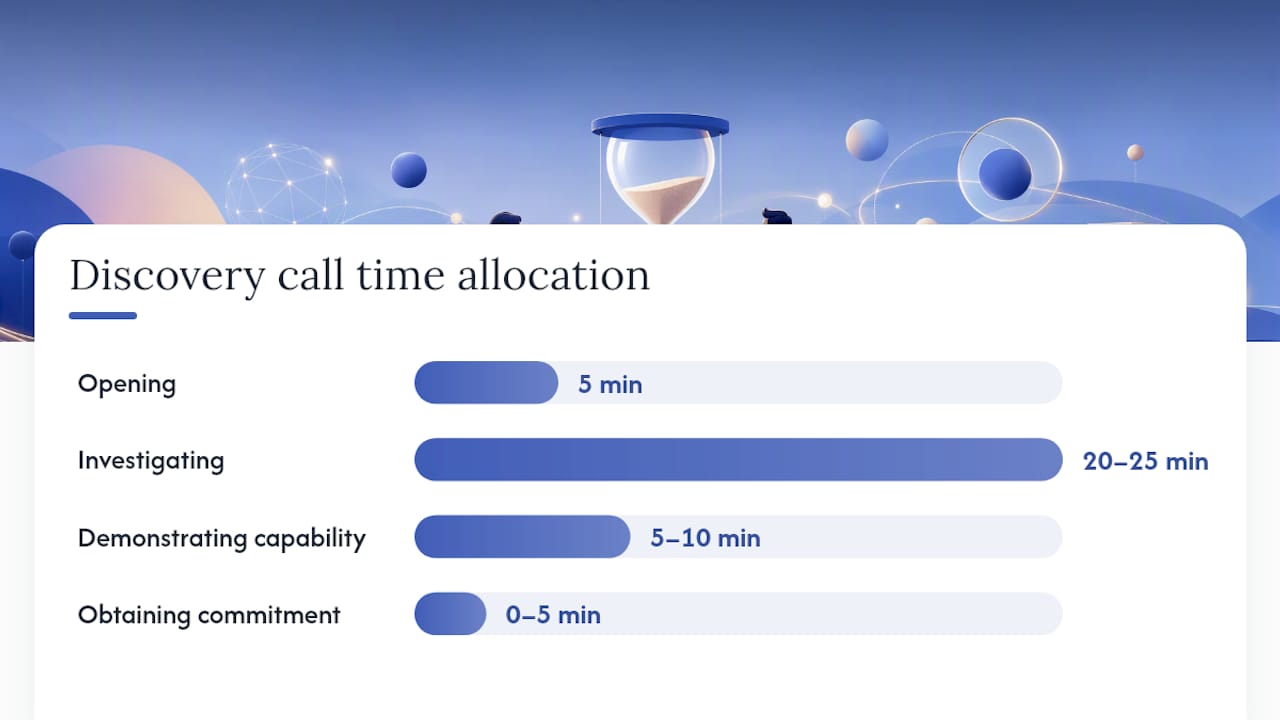
Structure matters as much as the questions themselves. A 30 to 45 minute discovery call generally breaks into four stages, and each one leans on a different SPIN type.
- Opening (5 minutes): Set context, confirm the agenda, and ask one or two Situation questions to orient yourself.
- Investigating (20 to 25 minutes): Move through Situation into Problem questions, then develop the strongest problem with two or three Implication questions.
- Demonstrating capability (5 to 10 minutes): Ask Need-Payoff questions so the buyer states the value, then briefly connect it to what you offer.
- Obtaining commitment (remaining time): Confirm next steps, timeline, and who else needs to be involved.
These stages aren’t rigid boxes. Skilled reps move fluidly between question types as new information surfaces, and an Implication question can show up the moment a problem is half developed, well before you’ve technically finished the “investigating” phase.
Here’s a compact six to eight question script that mixes types and transitions naturally:
- “Walk me through how your team handles this today.” (Situation)
- “What’s the most frustrating part of that process?” (Problem)
- “How does that affect your team’s output over a typical month?” (Implication)
- “Who else feels that impact?” (Implication)
- “If that were resolved, what would change for your team?” (Need-Payoff)
- “What would that be worth to you this quarter?” (Need-Payoff)
A short transcript snippet shows how the transition actually sounds:
Rep: “What’s the biggest bottleneck in your current approval process?” Buyer: “Honestly, it’s the manual sign-offs. They take forever.” Rep: “When those sign-offs stall, what happens to the deals waiting behind them?” Buyer: “We lose momentum, sometimes the buyer cools off entirely.” Rep: “If you could cut that approval time in half, what would that mean for your close rate?”
If a buyer gives a shallow answer, loop back rather than pushing forward. “Say more about that” is often the single most useful phrase in a discovery call.
Pro Tip: Keep a running note of which Implication question landed hardest. That’s the one you reference again during your proposal or demo, word for word if possible.
Writing Implication and Need-Payoff Questions That Land
Strong Implication and Need-Payoff questions don’t happen on the fly. Build them with this sequence: problem → business impact → metric → stakeholder → tailored question. Before the call, jot down two or three likely problems, then draft the implication question that follows from each one.
A simple worksheet before every discovery call:
- What problem do we expect to hear based on their industry or role?
- What’s the likely business impact if that problem goes unaddressed?
- What metric would make that impact concrete (hours, dollars, error rate)?
- Who besides our contact would feel that impact?
Two quick examples of the full chain:
Problem: “Where do you lose the most time each week?” Implication: “How does that lost time affect your team’s ability to hit deadlines?” Need-Payoff: “If you got that time back, what would your team focus on instead?”
Problem: “What’s driving the most support tickets right now?” Implication: “How does that ticket volume affect your team’s response times for other customers?” Need-Payoff: “How would cutting that volume change your customer satisfaction scores?”
Pro Tip: Never phrase a Need-Payoff question so it implies a capability you haven’t confirmed you can deliver. Rehearse the wording out loud before the call so it sounds curious, not leading. Practicing these out loud, ideally with a structured drill, is what separates a question that sounds natural from one that sounds rehearsed in the wrong way.
Common SPIN Mistakes and Quick Fixes
- Too many Situation questions. Fix: cap it at three or four, then move to Problem.
- Accepting surface-level answers. Fix: always follow up with “tell me more” or “why does that happen.”
- Weak Implication development. Fix: connect every problem to a number, a deadline, or a name.
- Leading Need-Payoff questions. Fix: ask what the buyer would value, don’t state it for them.
- Skipping Need-Payoff entirely. Fix: always let the buyer say the value out loud before you pitch.
- No documentation. Fix: log the strongest Implication answer verbatim in your CRM for later use.
Watch for buyers who answer in one sentence and stop. That’s a signal to probe further, not to move on.
How to Practice SPIN Until It’s Second Nature
Reading example questions won’t build fluency. You need repetition, ideally with feedback attached. Three formats work well together:
- Peer role-play: cheap and fast, but colleagues rarely push back the way a real skeptical buyer would.
- Recorded call review: shows what actually happened, but only after the deal is already in motion.
- AI-driven role-play: lets reps rehearse against a realistic, objection-raising buyer persona as many times as needed, with scored feedback and transcripts generated automatically.
A simple scoring rubric for managers to copy: rate each call on Situation discipline (1 to 5), Problem depth (1 to 5), Implication strength (1 to 5), and Need-Payoff clarity (1 to 5). Anything below a 3 on Implication is worth a coaching conversation.
Run a 20 to 30 minute drill weekly: five minutes of setup, fifteen minutes of role-play focused only on Problem and Implication questions, and five minutes of debrief. Ask the rep, “Which question got the most honest answer, and why?”
Pro Tip: Debrief on the Implication questions first, before anything else. That’s where deals get won or lost, and it’s the easiest place for reps to plateau without noticing.
When SPIN Should Lead and When to Blend Frameworks
SPIN earns its place as the backbone of discovery in any complex, multi-stakeholder sale, but it isn’t a complete qualification system on its own. Pairing it with a framework like MEDDIC works well because SPIN naturally surfaces the inputs MEDDIC needs, metrics, economic buyer, decision criteria, without turning the call into a checklist exercise.
For managers coaching this in real time, one micro-feedback line works better than a long review: “That was a solid Problem question. What Implication question could you have asked right after?” Keep adoption measurement simple too. Track one metric, the ratio of Implication to Situation questions per call, rather than building an elaborate scorecard nobody checks.
Turn SPIN Questions Into a Skill Your Whole Team Can Repeat
Reading a list of great questions doesn’t make them stick. Reps forget scripts under pressure unless they’ve said the words enough times that the phrasing becomes automatic, which is exactly the gap AI-driven role-play closes. XL Roleplay puts your reps into live voice and video conversations with AI buyers that raise real objections, then hands back a scored coaching report mapped to your own sales methodology, plus a full transcript your managers can review line by line.
Try this with your team this week: run a 30 minute session where each rep practices a single discovery call focused entirely on developing one Problem into two Implication questions and a Need-Payoff close. Compare the scored reports afterward and see where Implication development is weakest across the team, that’s your next coaching priority. If you’re leading a sales team and want to see how this fits your existing methodology, check out the option built for sales leaders and start a trial run with your next onboarding cohort.
Where to Learn More About SPIN Selling
- Huthwaite International’s own breakdown of the original 35,000-call research gives the clearest picture of SPIN’s origin and validation.
- Salesforce’s overview explains when SPIN fits best against other sales frameworks.
- Zendesk’s guide offers a practical walkthrough of Implication questions in customer-facing contexts.
- The Sales Blog’s example collection provides real-world scenario templates for adapting questions by industry.
- For readers building out a full qualification process around SPIN, this B2B sales qualification guide walks through how discovery inputs feed formal deal scoring.
Sources
- Exploring the power of SPIN Selling questions (with …)
- SPIN Selling: How It Works, Benefits, & Examples
- SPIN selling: A comprehensive guide on how it works
- SPIN Selling Questions: Framework, Examples, and Stages
- 14 Example SPIN Questions + Real World Scenarios To Use Them In | The Sales Blog