Pilot First: Run a 4–6 Week SPIN vs Challenger Test for Sales Leaders
Pilot First: Run a 4–6 Week SPIN vs Challenger Test for Sales Leaders

SPIN Selling fits deals where the buyer hasn’t fully named their problem yet, while the Challenger Sale fits competitive, mature markets where the buyer needs a new way of thinking before they’ll move. If your discovery calls stall because prospects can’t articulate pain, pilot SPIN. If prospects understand their situation but stay passive, pilot Challenger.
TL;DR:
- Pilot SPIN if prospects cannot articulate their problem, focusing on Implication and Need-payoff questions rather than Situation questions already answered publicly.
- Use Challenger in mature or competitive markets where prospects understand their situation but remain passive or stuck in the status quo, emphasizing teaching and tailored insights.
- Conduct short, focused pilots with 4 to 6 reps over six to eight weeks, tracking conversion rates and cycle times to determine which framework yields measurable improvements.
- Repetition and scored coaching, not just question lists, are essential for turning frameworks into consistent rep behavior, with roleplay drills tailored to each method.
- Most teams eventually run both methods at different deal stages rather than choosing a permanent one, optimizing based on observable pipeline gaps and pilot data.
Table of Contents
- SPIN vs Challenger at a glance
- SPIN Selling: origins, the four question types, and real-world application
- The Challenger Sale: teach, tailor, and take control
- What the research actually supports
- How to choose and pilot the right approach
- Turning methodology into rep habit
- Which one should you pilot first
- A practical way to build either skill set
- Sources
- FAQ
SPIN vs Challenger at a glance
The two methods start from opposite places. SPIN is question-led: reps guide a buyer through Situation, Problem, Implication, and Need-payoff questions until the buyer sees the cost of inaction themselves. Challenger is insight-led: reps arrive with a point of view that reframes how the buyer sees their own business, then tailor that insight and take control of the conversation.
Match the method to the deal in front of you.
- Choose SPIN when buyers are early-stage, unaware of the full problem, or new to the category.
- Choose Challenger when buyers are informed, comparing vendors, or stuck in status quo thinking.
- Combine both when your cycle has a long discovery phase followed by a competitive shortlist.
The most common pitfall is picking one framework and applying it to every deal type regardless of buyer maturity. Start with a two-week pilot scoped to a single deal archetype before rolling either method out to a full team.
SPIN Selling: origins, the four question types, and real-world application
Neil Rackham built SPIN Selling from research spanning thousands of recorded sales calls, a scale that gave the framework unusual credibility for its era. The four question types work in sequence:
- Situation questions establish facts about the buyer’s current setup.
- Problem questions surface dissatisfaction or friction in that setup.
- Implication questions connect that friction to broader business consequences.
- Need-payoff questions get the buyer to state the value of solving it.
A sample Implication prompt: “What happens to your onboarding timeline if this bottleneck continues into next quarter?” That question does the heavy lifting, since Implication questions distinguish top performers from reps who stop at surface-level Problem questions.
SPIN suits consultative deals with real discovery gaps: new categories, technical buyers, or long sales cycles where the buyer genuinely doesn’t know what they don’t know. It struggles in fast, competitive deals where the buyer already understands their problem and just wants a decisive point of view.
Pro Tip: Drop scripted Situation questions when the answer is already public. Spend that call time on Implication and Need-payoff instead.
The Challenger Sale: teach, tailor, and take control
CEB’s research, later published by Dixon and Adamson, sorted reps into five profiles and found that reps who teach, tailor, and take control outperform relationship-focused reps in complex B2B sales. The distinguishing trait wasn’t rapport. It was what CEB called commercial insight: a specific, sometimes uncomfortable point of view about how the buyer’s business could work better.
Three moves define the approach:
- Teach the buyer something about their own market or operations they hadn’t considered.
- Tailor that insight to the specific stakeholder’s role and priorities.
- Take control of the conversation, including price and timeline discussions, without being aggressive.
A tailored teach might sound like: “Most companies in your segment lose margin at the handoff between sales and fulfillment, and here’s the pattern we see in the data.” That kind of commercial insight shifts the frame instead of asking the buyer to describe a problem they already understand.
Challenger tends to beat pure discovery in mature, competitive markets where every vendor asks the same questions. The operational challenge is real: someone has to build the insight itself, which means marketing and enablement need to create a unique selling proposition to boost growth, not just train reps on delivery.
Pro Tip: Roleplay the tailoring step separately from the teaching step. Reps often nail the insight but deliver it identically to every stakeholder.

What the research actually supports
Headline numbers from both methodologies deserve a second look before you build a strategy around them. Rackham’s own team has said the SPIN results came from integrated coaching projects, not from the four question types working in isolation. Coaching intensity, not the questions alone, produced the performance gains.
- The original SPIN research combined the question framework with sustained coaching over time.
- CEB’s Challenger findings identified a rep profile correlated with outperformance in complex sales, not a guaranteed conversion lift for any team that adopts the language.
- Comparative guides note that high-performing teams often pair SPIN or Challenger with a qualification framework like MEDDIC rather than expecting one system to cover discovery, qualification, and closing.
A methodology’s published results describe the research conditions, including coaching, not the framework in a vacuum. The original SPIN studies built coaching into the design, which means adopting the questions without the coaching is a different experiment.
Before committing, audit your own pipeline: pull ten recent won and lost deals, tag where the conversation broke down, and check whether the gap looks like a discovery failure or a status-quo failure.
How to choose and pilot the right approach
Score your typical deal against four variables before picking a framework.
- Deal size and stakeholder count: more stakeholders often favor Challenger’s tailored messaging.
- Buyer awareness: low awareness favors SPIN, high awareness with inertia favors Challenger.
- Sales cycle length: long cycles have room for SPIN’s sequential discovery.
- Competitive intensity: crowded markets reward a differentiated insight over standard discovery questions.
Run a focused pilot rather than a full rollout.
- Pick one deal archetype and assign 4 to 6 reps to the pilot group.
- Train on one framework for two weeks, including scripted roleplay of the core question or insight sequence.
- Run the framework live for 4 to 6 weeks, tracking call recordings and stage-to-stage conversion.
- Compare pilot reps against a matched control group on discovery-to-proposal conversion and deal velocity.
- Iterate the script or stop the pilot based on what the data shows, not on how confident reps feel.
Six to eight weeks gives enough deal volume to see a pattern without locking in a framework prematurely.
Turning methodology into rep habit
Knowing the framework and running it under pressure are different skills, which is why Rackham’s own findings point to coaching, not question lists, as the mechanism that produced results. Reps need repeated practice against realistic pushback before a live call is the right place to test a new skill.
Two drills cover the gap:
- SPIN implication drill: give reps a Situation and Problem statement, then have them build three Implication questions live, scored against a rubric.
- Challenger insight drill: give reps a buyer persona and industry context, then have them deliver a tailored teach and defend it against an objection.
Track progress with session transcripts, a readiness score, and rubric items tied to specific behaviors rather than a single pass or fail grade. Structured roleplay drills for SPIN implication questions and Challenger commercial-insight practice give reps a repeatable way to build these behaviors before a live call.
Pro Tip: Score the drill on the question or insight’s structure first, then on delivery. Reps often fix delivery once the structure is right.
Which one should you pilot first
If your buyers can’t name their problem in a discovery call, pilot SPIN. If they can describe their situation fine but stay passive, pilot Challenger. Most sales orgs eventually run both at different stages of the same deal rather than picking a permanent winner.
Resist switching frameworks because a methodology is trending. Optimize for a measurable shift in conversion or cycle time from your own pilot data, and keep the pilot small enough that you can actually attribute the change to the framework instead of to a good quarter.
— Adam
A practical way to build either skill set
Reading about SPIN or Challenger won’t change what happens on a live call. Reps build the behavior through repetition against realistic pushback, scored against rubrics tied to specific behaviors, closing the gap many coaching programs aim to address.
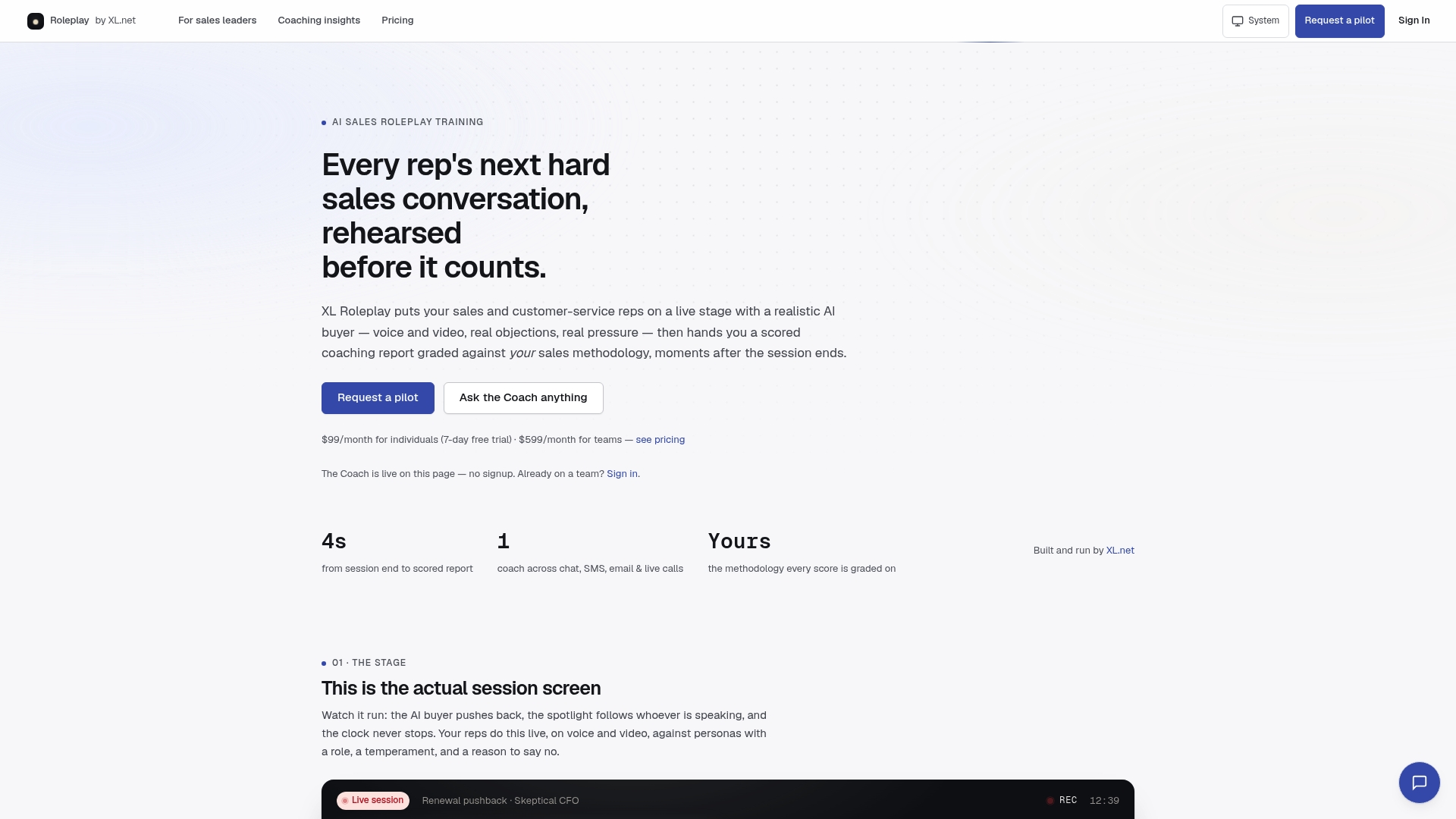
- Realistic AI buyers present the objections and pressure reps face in SPIN discovery calls or Challenger-style reframing conversations.
- Scored coaching reports grade each session against the client’s own sales methodologies and playbooks rather than generic standards.
- Managers review detailed transcripts and rubrics to see exactly where a rep’s Implication questions or commercial insight delivery broke down.
A small pilot cohort of 4 to 6 reps, run against a defined rubric for 4 to 6 weeks, mirrors the pilot structure outlined earlier in this article. Check the Individual and Business plans or start with the XL Roleplay pilot to scope a small test with your own team.
Sources
- The science behind SPIN ® Selling
- SPIN vs Challenger vs MEDDIC Compared | Sendspark
- Neil Rackham: Research behind SPIN (Huthwaite)
- SPIN Selling: How It Works, Benefits, & Examples
FAQ
What is the 3-3-3 rule in sales?
The 3-3-3 rule isn’t part of either SPIN or Challenger methodology and definitions vary widely depending on the source. Because no authoritative source ties a specific 3-3-3 framework to SPIN or Challenger, treat any claimed definition with caution and verify it against a primary source before using it in training.
Is SPIN Selling outdated?
SPIN Selling isn’t outdated, but modern practitioners adapt it for faster buying cycles. Practical guidance suggests skipping redundant Situation questions when the answer is already public, and focusing training time on Implication and Need-payoff skills instead.
What are the four stages of SPIN Selling?
The four stages are Situation, Problem, Implication, and Need-payoff questions, asked in that sequence during a discovery call. The original research behind SPIN found Implication questions to be a key differentiator between average and top-performing reps.
What are the top sales methodologies besides SPIN and Challenger?
Beyond SPIN and Challenger, MEDDIC is a commonly cited qualification framework, and comparative guides note that high-performing teams often pair a discovery or insight framework with a qualification framework rather than relying on one system alone. Other frameworks exist, but their evidence base varies, so check the primary source before adopting one wholesale.