Training Data Privacy for AI Role-Play Platforms: A Buyer's Guide
Training Data Privacy for AI Role-Play Platforms: A Buyer’s Guide
Training data privacy, in the context of an AI role-play platform, means controlling what happens to every session transcript, audio recording, prompt, embedding, and derived dataset your reps generate while practicing pitches and objection handling. It covers who can access that material, whether it gets used to train someone else’s model, and how fast it can be deleted on request.
The single control to demand before signing anything: an auditable retention policy (zero retention or a configurable short window) written into a Data Processing Agreement that names every sub-processor and explicitly bars training on your data without consent. Everything else in a security review is secondary to that one clause.
- Definition: transcripts, recordings, prompts, embeddings, and any dataset derived from them
- Top demand: auditable zero-or-configurable retention, plus a DPA binding all sub-processors
- Evaluate any vendor, including XL Roleplay, against this standard before a pilot
Key Takeaways
Training data privacy for AI role-play platforms comes down to one enforceable contract term: auditable retention plus a DPA that names every sub-processor and bars unconsented training.
| Point | Details |
|---|---|
| Define the scope | Training data includes transcripts, audio, prompts, embeddings, and any derived fine-tuning dataset. |
| Demand retention control | Require zero or configurable retention with proof of deletion, not just a stated policy. |
| Bind sub-processors | Get a signed DPA naming every sub-processor and granting audit rights. |
| Pilot on synthetic data | Test with fabricated scenarios and retention at zero before using real customer conversations. |
| Evaluate XL Roleplay against these standards | Request its DPA, data-flow diagram, and SOC 2 evidence alongside its transcript and scoring workflows. |
Where to Verify These Standards Yourself
For deeper technical grounding, review CISA’s guidance on AI data security, AWS’s prescriptive guidance on generative AI data protection, and Google’s research on protecting AI training data. For a real-world example of configurable retention language, see AssemblyAI’s documentation on data retention and model training.
Table of Contents
- What Counts as Training Data on a Role-Play Platform?
- What Should Be in Your RFP or Security Questionnaire?
- Where Does Training Data Actually Leak in the AI Pipeline?
- What Technical Evidence Should You Actually Ask to See?
- What Questions Should You Ask During a Demo or Pilot?
- How XL Roleplay Applies These Controls
- Sources
What Counts as Training Data on a Role-Play Platform?
Sales and support teams tend to think of “data” as the recording itself. That is only the surface layer. A role-play session generates a stack of artifacts: the audio or video file, the transcript, the scoring rubric output, the embeddings created for retrieval or similarity search, and sometimes a fine-tuning dataset built from aggregated sessions to improve the AI buyer’s realism. Each layer carries different risk. A transcript might include a rep’s real objection language and a prospect’s name mentioned in a scenario. An embedding is a compressed mathematical fingerprint of that same content, and it is frequently overlooked in privacy reviews even though it can be reverse-engineered under the right conditions. Protecting training data means accounting for all of these layers, not just the recording a manager pulls up for coaching.
What Should Be in Your RFP or Security Questionnaire?
Most procurement teams write security questionnaires that ask about encryption and call it done. That misses the parts of an AI role-play contract that actually determine your exposure. Use this order of priority when building your questionnaire.
- Retention policy. Ask whether transcripts and audio can be set to zero retention, and if not, what the shortest configurable window is and how deletion is verified.
- DPA and sub-processor list. Require a signed Data Processing Agreement that names every sub-processor by company, not by category, plus right-to-audit language.
- Access model. Confirm role-based or attribute-based access control, just-in-time access grants for support staff, and separation of duties between engineering and customer success.
- Encryption and tenant keying. Ask for encryption in transit and at rest, and whether your organization gets its own encryption key rather than sharing one across all customers.
- Audit logs and deletion proof. Require logs of who accessed which sessions and a way to confirm deletion actually happened, not just a policy statement that it will.
Pro Tip: Ask the vendor to show you the actual DPA language on sub-processors before the demo call, not after the contract is drafted. Vague answers here are the single fastest way to spot a vendor who hasn’t built privacy into the product.
Skip any vendor that treats retention as a fixed, non-negotiable setting. A platform built for enterprise procurement should let you dial retention down to nothing for sensitive teams and extend it only where coaching value genuinely requires a longer window.
Where Does Training Data Actually Leak in the AI Pipeline?
Data doesn’t leak at one point. It leaks at whichever seam in the pipeline nobody checked. A role-play session moves through ingest, pre-processing, storage, a training or fine-tuning queue, inference (including retrieval-augmented generation), and logging. Each stage has its own failure mode.
- Ingest and shadow AI: reps testing unofficial AI tools outside sanctioned platforms create data nobody is tracking.
- Storage and embeddings: vector databases holding session embeddings are often excluded from data-retention audits entirely, even though AI privacy engineering guidance treats embeddings as derived personal data that needs its own deletion workflow.
- Sub-processor retention: a vendor’s own AI provider may retain your data on a different schedule than your primary contract states.
- Model memorization: large models can memorize and later surface fragments of training data, a known risk with fine-tuned systems trained on real customer transcripts.
AWS’s guidance on generative AI data protection recommends data minimization, anonymization, synthetic data for testing, and output filtering as the core mitigations against these exact failure points. Differential privacy techniques, which add mathematical noise to training data so no individual record can be isolated, are increasingly standard in serious enterprise AI deployments and worth asking about directly. None of this requires a data science background to evaluate. It requires asking the vendor to walk you through their pipeline diagram and pointing at each stage: “What happens to the data here?”
What Technical Evidence Should You Actually Ask to See?
Policies are promises. Evidence is proof. The gap between the two is where most procurement reviews fail, because a vendor’s privacy page will say the right things regardless of what the architecture actually does.
Zero retention, done properly, means audio and prompts are processed in memory and never written to persistent storage, not “deleted after 30 days.” Ask the vendor to show you the architecture, not just describe it. The same scrutiny applies to embeddings and vector databases: if your contract calls for deletion, confirm that deletion actually reaches the vector store and any cache, not just the primary transcript file.
- Request a signed DPA with a full sub-processor annex, not a generic template
- Ask for a SOC 2 Type II report or equivalent third-party audit, not a self-attestation
- Request evidence of dataset provenance and cryptographic signing, which CISA’s guidance on AI data security identifies as a core defense against training data poisoning
- Ask how deletion is verified across backups, caches, and vector indexes, not just the primary database
Pro Tip: If a vendor can’t produce a data-flow diagram on request, treat that as a red flag rather than an oversight. A platform that has actually built privacy controls into its architecture can show you the diagram in minutes.
Google’s approach to protecting AI training data describes policy engines that check training jobs for compliance before they run. That is the standard to hold any vendor against: not “we have a privacy policy,” but “our system technically prevents non-compliant data from entering a training run.”

What Questions Should You Ask During a Demo or Pilot?
The demo call is where most buyers waste their leverage asking about features instead of data handling. Front-load the hard questions.
- Is retention configurable down to zero, and can you show me that setting live?
- Is our data ever used to train your model or anyone else’s, and where is that stated in writing?
- Who are your sub-processors, and will you name them in a signed DPA?
- What encryption standard applies in transit and at rest, and do we get tenant-specific keys?
- Can you produce a SOC 2 Type II report or comparable audit today, not after the contract is signed?
Once you move to a pilot, set three rules before a single real conversation happens. Run the pilot on synthetic scenarios first, not live customer calls. Set retention to zero for the duration. Then request proof, not a promise, that deletion and access logs actually worked the way the contract says they will. A vendor that resists a synthetic-data pilot is telling you something about how confident they are in their own controls.
How XL Roleplay Applies These Controls
XL Roleplay’s coaching workflow generates the same artifacts this guide covers: live voice and video sessions, scored transcripts, and rubric-based reports mapped to your organization’s own sales methodology. Managers review performance through those transcripts directly inside the platform rather than through a separate export, which narrows where copies of sensitive material can end up.
- Session transcripts and scoring reports are tied to your organization’s methodology rather than a shared training corpus
- Retention and access settings appear in platform configuration, providing procurement with settings to audit rather than relying solely on policy statements
- When evaluating XL Roleplay, request the documents recommended for any vendor, such as a signed DPA, a data-flow diagram, and any available audit evidence
Read the buyer’s checklist for evaluating AI sales role-play tools for the fuller evaluation framework this section draws from.
A procurement perspective worth taking seriously
Most teams evaluate role-play platforms on realism and coaching quality, then treat data privacy as a checkbox at the end. Flip that order. Run your first pilot on synthetic scenarios with retention set to zero, and get legal involved before the demo, not after the invoice. Ask for deletion proof, not a policy PDF.
— Adam
See XL Roleplay’s Approach to Session Data
If you’re building a shortlist against the standards in this guide, XL Roleplay is worth evaluating directly against them: transcript-based coaching, manager review tools, and configurable session data settings built for teams that can’t afford a leaked prospect name or a training dataset nobody signed off on.
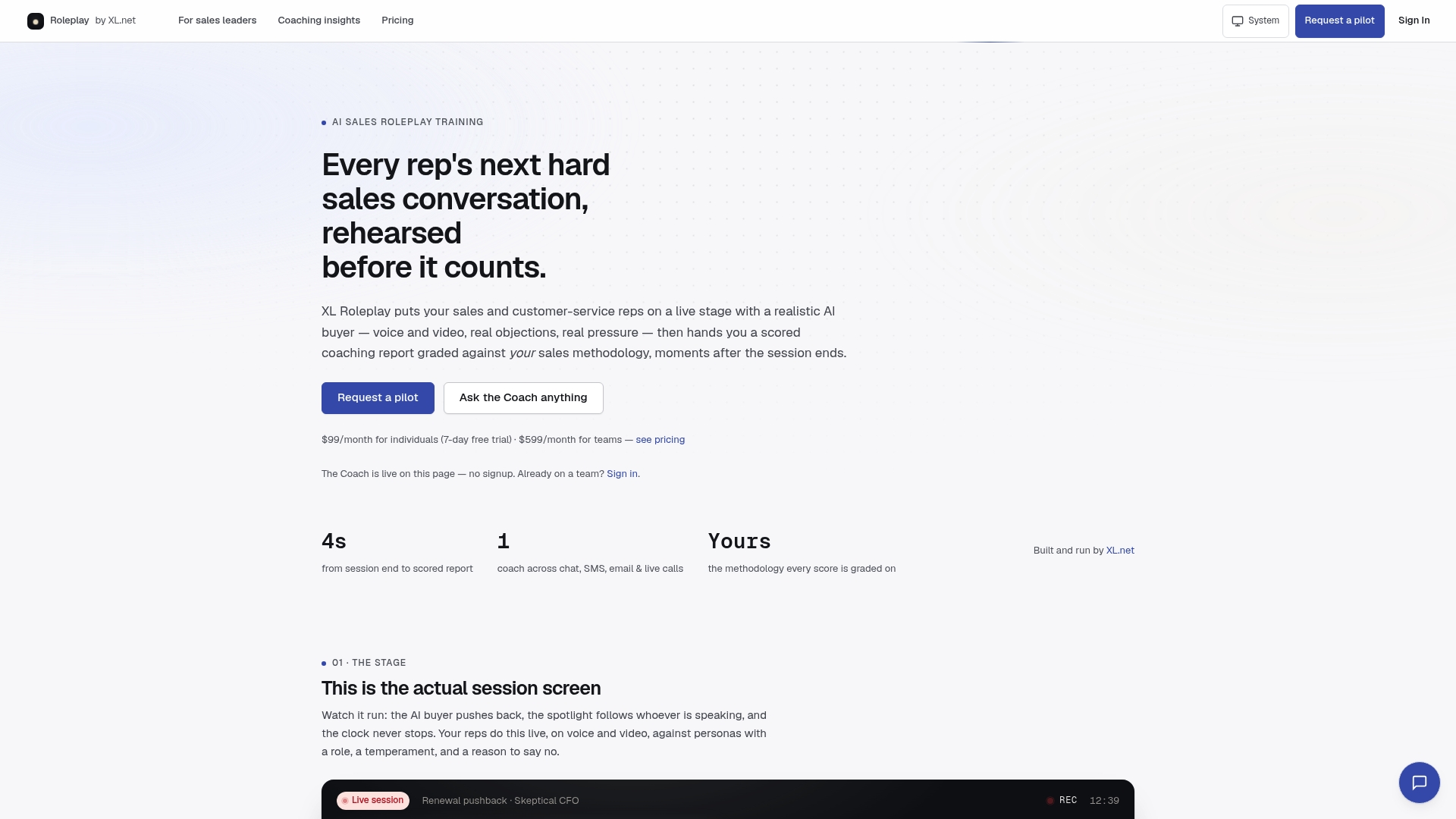
The platform’s coaching reports are scored against your own sales methodology, not a generic rubric, and every transcript a manager reviews stays inside that same audit trail rather than scattering across exports. If you’re comparing options for sales leaders evaluating role-play tools, request XL Roleplay’s DPA, sub-processor list, and data-flow diagram alongside a synthetic-data pilot before your team runs a single live scenario. Start that request through XL Roleplay’s product page and set retention to zero for the first round.
Sources
- CISA prescriptive guidance on AI data security
- AWS prescriptive guidance: strategy and data considerations for generative AI
- Google — Our approach to protecting AI training data
- AssemblyAI — Data retention and model training