5 Step Transcript Based Coaching Playbook for Sales Managers
5 Step Transcript Based Coaching Playbook for Sales Managers

Transcript-based coaching uses searchable call and roleplay transcripts to find specific moments worth coaching, rather than relistening to full recordings. It makes feedback faster to prepare, more specific because it quotes exact language, and easier to repeat across a whole team. The rest of this guide covers the evidence behind it, a weekly workflow, ready-to-use prompts, and how to measure whether it is actually working.
TL;DR:
- Speeding up coaching with transcripts requires pairing rapid search and extraction of specific moments with a calibrated coaching skill to avoid performance declines.
- Limiting coaching sessions to three transcript moments each maintains focus and prevents dilution of impact, especially during weekly rituals.
- Automated transcripts must be accurate in word recognition, speaker attribution, and timing; otherwise, coaching based on them risks misguidance or miscommunication.
- Building a small, calibrated rubric and starting with a pilot on one theme and one rep enhances trust in the process before scaling to larger teams.
- Using a transcript-linked scoring system in tools like XL Roleplay ensures coaching feedback directly references the actual call content for consistent improvement.
Table of Contents
- What transcript-based coaching is and when to use it
- Why transcripts improve coaching: the evidence
- Core workflow: a weekly ritual built from transcripts
- Ready-to-use prompts and feedback templates
- Tooling and accuracy: what to check before you trust a transcript
- Measuring impact: metrics and the frequency-versus-skill tradeoff
- How XL Roleplay operationalizes transcripts and scoring
- What I would do differently if I were starting this today
- Put this into practice with XL Roleplay
- FAQ
- Sources
What transcript-based coaching is and when to use it
Transcript-based coaching means pulling the written record of a sales call, support chat, or roleplay session and using it, rather than the audio or video, as the primary coaching artifact. A manager searches the text for a theme (say, how a rep handled a price objection), pulls the exact passage, and builds feedback around that specific language instead of a vague impression from memory.
It works across three source types: live call transcripts, chat or email threads, and roleplay session transcripts generated during practice sessions. Each has slightly different value. Call transcripts show how a rep handles real buyers under real pressure. Chat transcripts surface written communication habits that voice coaching misses. Roleplay transcripts let managers coach a skill before it ever costs a real deal.
The method adds the most value in three situations: onboarding new reps who need quick, repeatable feedback loops, objection handling where exact phrasing matters more than tone, and discovery skills where the quality of a question is easier to judge in text than in a recording you half remember. Expect the output to look like short annotated snippets, a few lines pulled from a transcript with a timestamp and a note attached, not a full written review of the call. That format is what makes the next step, building a weekly ritual, actually sustainable.

Why transcripts improve coaching: the evidence
Transcripts are searchable in a way recordings are not. A manager can type “price objection” or “next steps” and pull every instance across dozens of calls in minutes, instead of scrubbing through hours of audio hoping to land on the right moment. That searchability is what turns coaching from an occasional, time-consuming review into something a manager can do several times a week without burning out.
The throughput gain is real but it comes with a caveat worth taking seriously. A multilevel study of 1,246 sales representatives across 136 teams found that managerial coaching skill was directly related to annual sales goal attainment, but coaching frequency on its own could actually hurt performance when the manager’s coaching skill was low, according to the study linking coaching skill and sales goal attainment.
That finding matters for anyone excited about doing more coaching just because transcripts make it faster. Speed without a calibrated rubric and real coaching skill is not automatically an improvement. It can mean more frequent, lower-quality interventions that confuse reps or erode trust rather than build it. The fix is not to coach less. It is to pair the speed transcripts give you with a deliberate rubric and a feedback structure, which is what the workflow in the next section is built around.
Core workflow: a weekly ritual built from transcripts
A sustainable coaching ritual needs a repeatable structure, not a fresh decision every Monday about what to do. Here is a five-step version that fits inside an hour a week per rep or small pod.
- Pick one theme and selection criteria. Choose a single focus, such as discovery questions or next-step clarity, and select calls by recency, deal stage, or a specific learning objective rather than grabbing whatever is easiest to find.
- Generate the transcript and spot-check it. Run the call through your transcription tool, then do a quick human pass on any call tied to a high-value deal or a coaching decision, since automated transcripts can misread names, numbers, and fast cross-talk.
- Tag and extract the coaching moments. Mark passages under a small set of consistent themes, for example objections, discovery, close, and next-step clarity, so moments are easy to pull back up later.
- Build a short session from two or three moments. A focused 20 to 30 minute coaching conversation built from two or three tagged clips beats an hour-long general review almost every time.
- Log action items and bank good examples. Write down what the rep commits to trying next, and drop standout moments, good or bad, into a shared win and loss library the whole team can learn from.
A few habits make this easier to sustain:
- Keep a running list of theme tags so managers across a team use the same language.
- Cap each coaching session at three transcript moments; more than that dilutes the focus.
- Review the action-item log before the next session instead of starting cold.
Our guide to coaching sales reps from transcripts and scorecards walks through this same structure in more detail, and the one-on-one coaching template gives a session format you can reuse every week.
Pro Tip: Block 15 minutes on your calendar right after a call ends to tag moments while the context is still fresh; waiting until Friday means you will have forgotten why a passage mattered.

Ready-to-use prompts and feedback templates
Once transcripts are searchable, the quality of your prompts determines how fast you find something worth coaching. A few starting points:
- “Find every instance where the buyer raised a price objection and list the buyer’s exact words.”
- “Pull all moments where the rep asked an open-ended discovery question in the first ten minutes of the call.”
- “Identify any call that ended without a clearly stated next step and flag the closing line.”
- “Search for hesitation phrases from the rep, such as ‘I think’ or ‘maybe,’ during objection handling.”
For the feedback itself, a behavior-observation-impact-next-step structure keeps comments specific and actionable instead of vague. State the behavior you saw, quote the exact line from the transcript, explain the impact it had on the conversation, and name one concrete next step. For example: “When the buyer said pricing felt high, you moved straight to a discount instead of asking what ‘high’ meant to them. That skipped a chance to understand their budget constraints. Next call, try asking ‘what would make this worth that price to you?’ before offering any concession.”
Micro-lessons work best kept to 30 to 90 seconds: one transcript snippet, one clear takeaway, one thing to try differently. That length is short enough to deliver in a Slack message or a quick huddle, and specific enough that the rep remembers it on the next call.
Pro Tip: Save your best prompts in a shared doc so every manager on the team searches transcripts the same way; inconsistent search habits are the fastest way to end up with inconsistent coaching.
Tooling and accuracy: what to check before you trust a transcript
Not every transcription tool produces something reliable enough to coach from. Before you build a ritual around a tool, check a few things.
- Word error rate and speaker diarization. A transcript that mislabels who said what, or garbles key phrases, will send you coaching the wrong moment or the wrong rep.
- Timestamping. Coaching moments need to link back to the exact point in the call, not just appear as a wall of undated text.
- Integration with your CRM or LMS. A transcript that lives in a tool disconnected from where reps already work rarely gets reviewed.
- Searchable storage. If you cannot query across calls, you lose the main advantage of this whole approach.
Meeting and webinar transcription tends to have its own quirks around cross-talk and jargon; practical transcription guidance for webinars is a useful reference if you are transcribing group sessions rather than one-on-one calls.
Build consent and data handling into the workflow itself rather than treating it as a separate policy: tell reps and customers a call is recorded and transcribed, and store transcripts with the same access controls as any other customer data. Trust automated transcripts for routine coaching moments, but require a human review pass for any call tied to a deal decision, a compliance question, or a dispute, since that is where a misheard word does the most damage.
Measuring impact: metrics and the frequency-versus-skill tradeoff
A coaching ritual is only worth running if you can tell whether it is working. A few operational metrics make that visible:
| Metric | What it tells you |
|---|---|
| Coaching coverage | Percentage of reps who received at least one coaching session in the period |
| Time-to-coach | Days between a flagged call and the coaching conversation about it |
| Action-item completion rate | Percentage of logged next steps the rep actually tried on a later call |
| Readiness or score improvement | Change in a rep’s rubric score across sessions |
Build the rubric itself around a small number of calibrated behaviors rather than a long checklist, and get two or three managers to score the same transcript independently before rolling it out, so scores mean the same thing across the team. Our rubric calibration guide and quality monitoring scorecard examples are useful starting points for building that structure.
Keep the Wiley finding in mind here too: coaching skill, not coaching frequency, is what tracked with sales goal attainment in that study of 136 sales teams. Pilot any increase in coaching frequency on a small group first, and confirm your rubric is calibrated, before scaling it across the whole team.
How XL Roleplay operationalizes transcripts and scoring
We run realistic roleplay conversations between reps and AI buyers that raise the objections and pressure points a real deal would, then produce a full transcript and a scored coaching report tied to the organization’s own sales methodology for every session. Managers get transcript-linked feedback instead of a generic score, so a comment about discovery or objection handling points straight back to the line in the transcript that earned it.
That maps directly onto the weekly ritual described above: a manager can pull a rep’s most recent roleplay transcript, tag the moments that match this week’s theme, and build a short coaching session from the rubric score and the exact language the rep used. Because the coach persists across sessions with shared memory, feedback from previous calls informs how the next one gets scored, instead of starting from zero every time.
What I would do differently if I were starting this today
Start with one theme and one rep, not a full rollout. Pick something narrow, like discovery questions in the first five minutes, calibrate your rubric against two or three transcripts before you trust it, and protect psychological safety by making it clear this is practice, not a performance review.
The usual objections, not enough time, privacy concerns, and uneven coach skill across managers, are real but manageable: time shrinks once tagging becomes a habit, privacy is solved by disclosure and access controls, and coach skill improves with calibration sessions, not more volume.
Try a four-week pilot: one weekly 30-minute session, built from two transcript moments, with one rep. Expand only after that rhythm feels natural.
— Adam
Put this into practice with XL Roleplay
If the workflow above sounds right but building it from scratch feels like a lot to set up alone, we built XL Roleplay around exactly this problem: realistic AI roleplay sessions that generate the transcripts, scored reports, and shared coaching memory this whole ritual depends on, without anyone having to assemble the pieces by hand.
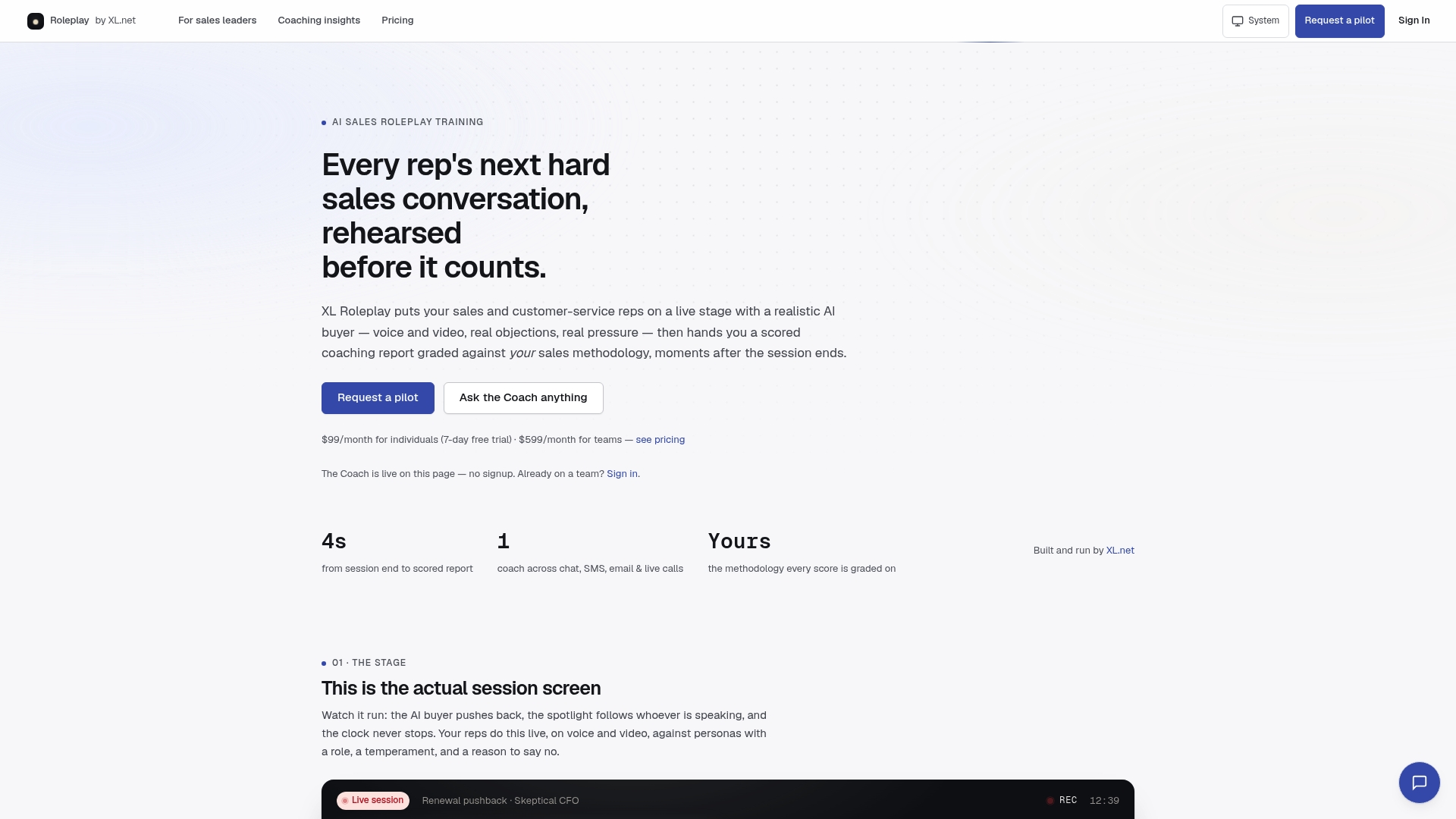
- Start a pilot to test scored, transcript-linked coaching with your own team before committing to anything.
- Check the pricing page if you already know this is the direction you want to go.
- Read more about how we support sales leaders running this kind of program day to day.
Whichever you pick, you will have a transcript and a scored report from the first session, ready to build your first weekly coaching ritual around.
FAQ
What is the 70/30 rule in coaching?
Definitions of common coaching ratio rules vary by source and context, so there is no single agreed-upon standard for sales coaching specifically. Treat any version you encounter as a rough guideline rather than a fixed rule, and check its origin before applying it to your own rubric.
Can ChatGPT be my life coach?
A general-purpose AI chat tool can help you brainstorm questions or reflect on a conversation, but it has no transcript of your actual calls, no scoring tied to your methodology, and no way to track progress across sessions. For sales and service coaching specifically, tools built around real transcripts and calibrated rubrics give feedback that is grounded in what actually happened on a call, not a generic response.
What are the four types of coaching?
Common frameworks split coaching into categories such as directive, non-directive, situational, and peer coaching, though the exact labels and counts shift depending on the source. In a sales context, most of what transcript-based coaching supports falls closer to situational and directive coaching, since it is built around specific, observed behavior rather than open-ended reflection.
What is the 80/20 rule in coaching?
There is no single authoritative definition of fixed ratio rules in coaching, and different sources apply them to different proportions of practice versus feedback or listening versus talking. Rather than relying on a fixed ratio, build your coaching sessions around calibrated rubrics and specific transcript moments, which gives you something concrete to measure instead of a rule of thumb.
How do I start transcript-based coaching with a small team?
Pick one coaching theme, select two or three recent calls or roleplay sessions, and build a single 20 to 30 minute session around tagged moments from those transcripts. Running a four-week pilot with one rep before expanding to the full team lets you calibrate your rubric and work out selection criteria without disrupting everyone at once.