Make One Behavior Stick: Video Analysis Coaching Workflow for Sales Managers
Make One Behavior Stick: Video Analysis Coaching Workflow for Sales Managers

The strongest video analysis coaching programs pair transcript-prioritized call selection with rubric-based scoring, AI-surfaced evidence, and manager-led coaching on one behavior at a time. Gartner recommends linking recordings directly to sales plays rather than posting them without structure, and a meta-analysis of video feedback backs the approach: coaching that follows this pattern produces measurable gains, while ad hoc review rarely does.
TL;DR:
- Structured video feedback using rubrics significantly increases the impact on interaction skills compared to unstructured review.
- Coaching skill is as important as the quality of evidence; unskilled managers delivering frequent feedback can harm performance.
- AI is best at identifying pattern deviations and surfacing high-impact calls, while managers excel at delivering concrete, relationship-sensitive feedback.
- Limiting coaching to one behavior per session and scheduling follow-ups improves retention and coaching effectiveness.
- Regular auditing of AI scores is necessary to reduce bias, as flip rates range from 5.4% to 13%, and scores should remain advisory with human review.
Table of Contents
- Why video feedback plus structured rubrics changes behavior
- Step-by-step workflow to run video analysis coaching at scale
- Design rubrics and scoring that lead to reliable coaching actions
- Methods to surface the highest-impact coachable recordings
- Who should do what: AI responsibilities vs manager responsibilities
- How to audit LLM and AI outputs and reduce bias risk
- A one-page checklist to start or improve video analysis coaching this week
- Managers still drive the value
- How XL Roleplay maps to the recommended workflow
- Sources
- FAQ
Why video feedback plus structured rubrics changes behavior
The case for this approach rests on more than intuition. A meta-analysis of 33 experimental studies covering 1,058 participants found that video feedback produces a medium effect on interaction skills, and that structured observation forms increase the impact further than unstructured review.
Video feedback shows a medium effect on interaction skills, and that effect grows when reviewers use a defined rubric instead of general impressions.

Manager skill matters just as much as the tool. A multilevel study of 1,246 reps across 136 teams found that coaching skill predicted annual goal attainment, while coaching frequency without skill sometimes hurt performance. More sessions from an unskilled coach can do more damage than fewer, sharper ones.
That is where AI and human coaching split the work well. A 2025 Journal of Business Research study involving 244 and 310 sales professionals found managers are stronger at low-level, concrete feedback, while AI performs better at higher-level, abstract framing.
- AI is suited to surfacing patterns across many calls and flagging where a rep’s approach deviates from the play.
- Managers are suited to turning that evidence into a specific, relationship-sensitive coaching conversation.
- Neither replaces the other: skill and structure are what make the feedback land.
Step-by-step workflow to run video analysis coaching at scale
A coaching program only works if it repeats reliably every week. The workflow below breaks that into five stages, each with a clear owner.
- Prepare: map each sales play to specific rubric items and attach a couple of example recordings that show the behavior done well.
- Prioritize: run transcript-driven coachability queries, looking for missed discovery questions or unresolved objections, and rank calls instead of sampling at random.
- Analyze: attach timestamps, transcript excerpts, and suggested rubric items to each flagged call, then have the manager review and edit the draft notes before the session.
- Coach: pick one behavior, set a measurable follow-up target, and schedule a re-run or role-play to practice it.
- Measure: score the follow-up interaction with the same rubric to confirm whether the behavior actually improved.
This sequence mirrors the operational recipe described in ACL 2023 industry research on transcript-based call prioritization, which found that ranking calls by rubric-relevant language cuts manager review time compared with random sampling.
Pro Tip: Cap each coaching session at one behavior. Reps retain more when they aren’t asked to fix three things at once.
A structured debrief format like this one is also easier to standardize across a team; a debrief guide built around this exact loop walks through how to keep sessions short and focused.
Design rubrics and scoring that lead to reliable coaching actions
A rubric only helps if the items describe something a manager can actually see or hear. “Handled objections well” is not observable. “Acknowledged the objection, then asked a clarifying question before responding” is.
- Write each item as an observable action tied to discovery, objection handling, or closing.
- Keep rubrics short: 3 to 6 items per play, using binary or simple anchored scales for consistency between reviewers.
- Link every scored item to a transcript excerpt and a recommended next action, not just a number.
- Avoid piling on feedback points in one sitting: more feedback only helps when the manager delivering it has strong coaching skill.
That last point matters because of the same multilevel coaching study cited earlier: volume of feedback without manager skill showed a negative relationship with goal attainment in low-skill coaching teams. A tight rubric with one clear action beats a long checklist nobody follows through on. For a worked example of scoring applied to a hiring context, see this piece on scoring roleplay for interviews.
Methods to surface the highest-impact coachable recordings
Not every recorded call deserves a manager’s time. The goal is to find the ones most likely to move a metric if coached.
- Define coachability queries in plain language: missed discovery questions, an objection that went unresolved, or a call that ended without a clear next step.
- Combine those rubric flags with business metadata like deal value, pipeline stage, and the rep’s recent history to decide what gets reviewed first.
- Periodically audit the recommendation model by having a manager manually sample calls the system did not flag, checking for missed coaching opportunities.
This transcript-first approach, described in the same ACL 2023 QA research, consistently surfaces higher-impact moments than random sampling because it targets language patterns tied to the rubric rather than pulling calls at random. Teams building their own scenario libraries can also pull from real recorded calls; see this guide on turning real calls into role-play scenarios.
Who should do what: AI responsibilities vs manager responsibilities
Splitting the work clearly avoids two failure modes: managers drowning in review time, or AI output that never turns into real coaching.
- AI handles routine scoring, ranks calls by coachability, pulls transcript excerpts, and drafts coaching notes.
- Managers deliver low-level, concrete feedback, decide which single action to prioritize, handle relational or morale-sensitive conversations, and sign off on any high-stakes assessment.
- The handoff runs one direction: AI surfaces evidence, the manager reviews it and sets one goal, then the rep re-runs the interaction.
This division lines up with findings from the Journal of Business Research study on complementary AI and manager coaching, and with broader observations on how AI and human roles divide in sales workflows, where automation handles scale and people handle judgment calls.
Pro Tip: If a manager spends more time reading AI notes than talking to reps, the split is backwards. Automation should buy back coaching time, not consume it.
How to audit LLM and AI outputs and reduce bias risk
Automated scoring is not neutral by default, and treating it that way creates risk. 2026 ACL Findings research on counterfactual fairness in LLM-based contact center QA found counterfactual flip rates between 5.4% and 13.0%, with larger score shifts under contextual priming, and found that fairness-aware prompting only modestly reduced the disparity.
Measured flip rates in the range of single-digit to low double-digit percentages mean an automated evaluator can score the same underlying performance differently depending on who or how it’s framed, which is exactly the kind of gap a human-only audit process is built to catch.
- Run counterfactual checks periodically, swapping identifying details in a transcript to see if the score changes.
- Track flip-rate and score-shift metrics on a recurring schedule, not just at launch.
- Sample a portion of AI-scored calls each month for manual human validation.
- Keep automated scores advisory only for pay or promotion decisions, and require a human sign-off before any evaluative outcome affects compensation.
A one-page checklist to start or improve video analysis coaching this week
- Pick 3 target behaviors per sales play and write a rubric item for each.
- Set a weekly transcript-ranking pass and a 30 to 60 minute manager review block on the calendar.
- Coach one behavior per session and schedule a re-run within two weeks.
- Audit automated recommendations monthly and log what changed as a result.
Pro Tip: Put the re-run on the calendar in the same meeting where you assign the coaching goal. Follow-ups that aren’t scheduled tend not to happen.
For a broader look at running sessions reps actually engage with, see this practical guide on structuring roleplay training.
Managers still drive the value
The evidence keeps pointing the same direction: AI is excellent at surfacing patterns across hundreds of calls, but it takes a manager to turn that evidence into a coaching goal a rep will actually act on. The tools change faster than the fundamentals of good coaching do.
— Adam
How XL Roleplay maps to the recommended workflow
XL Roleplay was built around this exact loop. Reps practice against realistic AI buyers, and every session produces a scored coaching report tied to your organization’s own sales methodology, complete with transcripts a manager can review and act on directly.
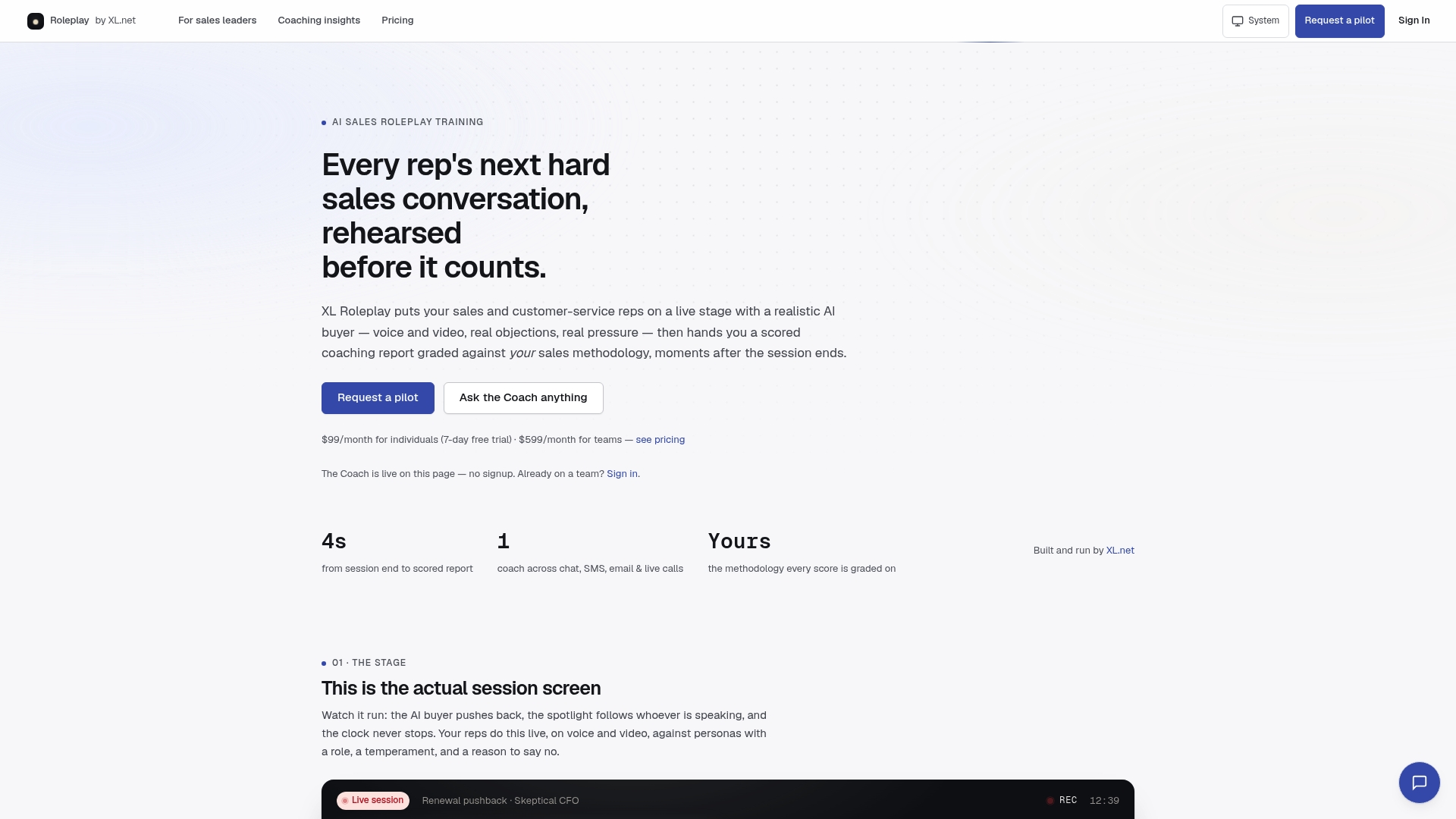
- AI-driven role-plays generate the recordings and evidence your rubric needs.
- Scored coaching reports and transcripts support to prepare, analyze, and coach steps described above.
- Plans start at $99 per month for Individual and $599 per month for Business, with extra seats and video hours available as needed.
If you want to see the workflow running with your own team’s plays before committing, the XL Roleplay pilot is a low-friction way to start. You can also read more about how the platform fits sales leaders specifically on the features page for sales leaders.
Sources
- Video feedback in education and training: putting learning in the picture — meta-analysis
- Does coaching matter? A multilevel model linking managerial coaching skill and frequency to sales goal attainment
- Comparing AI coaching and sales manager coaching: A construal-level approach — Journal of Business Research (2025)
- Contact-center QA: rubric-based review and transcript recommendations — ACL Industry (2023)
FAQ
What is video analysis coaching in a sales context?
It means reviewing recorded calls, role-plays, and video interactions to score rep performance against a rubric and deliver targeted coaching. A meta-analysis of video feedback found it produces a medium effect on interaction skills, particularly when paired with a structured observation form.
How do I choose which recorded calls to review first?
Use transcript-based queries that flag missed discovery questions, unresolved objections, or calls that ended without a next step, rather than sampling calls at random. ACL 2023 industry research found this approach surfaces higher-impact coaching moments and reduces manager review time.
Should AI or the manager deliver the coaching feedback?
Both play a role: a 2025 Journal of Business Research study found managers are more effective at concrete, low-level feedback, while AI performs better at higher-level pattern framing. The practical split is AI surfaces evidence, the manager sets the priority.
How much does XL Roleplay cost?
The Individual plan is $99 per month, and the Business plan is $599 per month, with extra seats and additional video hours billed separately. Full pricing details are listed on the pricing page.
Can AI scoring introduce bias into coaching decisions?
Yes: 2026 ACL Findings research measured counterfactual flip rates ranging from 5.4% to 13.0% in LLM-based QA scoring, meaning the same performance can be scored differently depending on framing. That’s why automated scores should stay advisory, with human sign-off required for any decision tied to pay or promotion.