Four Week Video Role Play Pilot for Sales Managers
Four Week Video Role Play Pilot for Sales Managers

Run a blended program: short AI-driven solo drills for repetition, paired live role-plays for pressure-testing, and a structured debrief tied to your sales methodology for both. Skip the theory phase and pilot it for four weeks with one team before rolling it out wider. A platform fitting this model pairs AI buyer sessions with scored coaching reports, so the practice and the measurement happen in the same workflow.
TL;DR:
- AI-driven solo drills save time and provide consistent scoring, but high adoption requires mandates or influential team advocates.
- Structuring video role-plays with clear objectives, scenario prep, and immediate debriefs significantly improves skill development.
- Tailor scenarios by experience level, using real call data for beginners, and escalate complexity gradually for more advanced reps.
- Tracking session participation and rubric trends over time offers better insight than vanity metrics, with automatic scoring accelerating feedback.
- Ethical practices, clear consent, secure storage, and transparency about AI use are essential to build trust and ensure compliance.
Table of Contents
- Why Video and AI-Driven Role-Play Training Works
- How to Run Effective Video Role-Play Training
- Designing Scenarios and Feedback That Build Real Skills
- Measuring Impact and Scaling Training With AI
- A Four-Week Pilot You Can Run This Quarter
- Privacy, Data, and Ethics in Recorded Role-Play Sessions
- Getting Facilitators and Reps Comfortable With the Technology
- Technical Setup: Hardware, Software, and Platforms
- What the Research Actually Supports
- Try a Structured Pilot With XL Roleplay
- Sources
- FAQ
Why Video and AI-Driven Role-Play Training Works
The math on traditional role-play is the problem. A standard human-led session runs about 15 to 20 minutes, and that clock doesn’t include the time a manager or instructor spends grading it afterward. Multiply that by a 12-person sales team practicing weekly, and you’ve eaten a full day of managerial time before anyone touches a live prospect.
Video and AI-driven formats attack that bottleneck directly. A rep can run a solo drill against an AI buyer during a slow afternoon, get scored instantly, and free the manager from sitting in on every rep. Video also does something live role-play can’t: it lets a rep watch their own hesitation, their filler words, the moment they caved on price. That review step matters more than most training plans admit.
- Solo AI sessions remove scheduling friction between managers and reps.
- Recorded sessions let reps self-review before a coach even looks at it.
- Scoring is consistent across every rep, every session, unlike a manager grading on gut feel.
Statistic to know: Instructors piloting AI-driven role-play tools reported real time savings and standardized scoring, but uptake wasn’t automatic. In one intercollegiate pilot, only about 40% of participants used the AI training when it was offered rather than required. Tech alone doesn’t drive adoption. A manager who mandates a minimum session count, or a designated “change agent” on the team who champions the tool, moves that number substantially.
How to Run Effective Video Role-Play Training
Most video role-play programs fail for a boring reason: nobody structures the session. Reps show up, wing a scenario, and walk away with nothing measurable. Here’s a workflow that avoids that.
- Set the learning objective first. Pick 2 to 3 rubric items tied directly to your sales methodology, such as “opens with a clear agenda” or “responds to price objection with proof, not discount.” Vague goals like “practice objections” produce vague feedback.
- Choose the session type and length. Run 10 to 15 minute solo AI drills for repetition on a single skill, and 15 to 25 minute paired live or video role-plays for full-conversation pressure, each followed by a 5 to 10 minute debrief.
- Write the brief before the session starts. Every scenario needs a persona, the trigger or referral context, 2 to 3 planned objections, and a stated outcome goal for the rep.
- Run it and record it. Whether it’s AI-paired or rep-to-rep, capture video. You cannot debrief what you can’t replay.
- Debrief immediately, in this order: self-reflection first (what did you notice?), then transcript or video review, then rubric scoring, then two concrete action items for next time.
On logistics: confirm recording consent before the first session, store transcripts somewhere managers can search by rep name or scenario type, and set a cadence. Weekly solo drills plus biweekly paired sessions is a reasonable starting rhythm for most teams.
Pro Tip: Don’t debrief on outcome (“did they buy?”). Debrief on process. Research on role-play skill development consistently shows feedback tied to observable conversational choices builds skill faster than feedback tied to whether the deal closed.
Live appointment-setting call exercises back this up in practice. One structured assignment ran calls of just 5 to 8 minutes total, split roughly 2 to 3 minutes of role-play and 3 to 5 minutes of immediate feedback, over a three-week window. Short, tight, and repeatable beat long and occasional.
Designing Scenarios and Feedback That Build Real Skills
New reps drown in complex scenarios. Give a rep three months into the job a multi-objection, price-sensitive, competitor-comparison scenario, and you’re not testing skill, you’re testing panic tolerance. Pedagogical guidance on role-play complexity is clear that beginners learn faster from simpler, process-focused scenarios, not high-realism ones.
Tier your scenario library by experience level instead of treating every rep the same:
- Beginner: one objection, low stakes, clear persona, no time pressure. The goal is repetition of a single skill, like handling “now’s not a good time.”
- Intermediate: two to three objections, a moderately skeptical buyer, moderate time pressure.
- Advanced: full-conversation scenarios with competitor comparisons, budget pushback, and multiple stakeholders in play.
Building scenarios from actual call recordings and real objections keeps them grounded instead of hypothetical, which reps notice fast.
Rubrics work the same way, tier by tier. Break objection handling into discrete, observable steps rather than a single “handled it well” checkbox: did the rep acknowledge the objection, ask a clarifying question, respond with specific evidence, and confirm a next step? Weight that response-to-objection step more heavily than the rest when the session’s whole purpose is objection practice.
| Rubric item | What it measures |
|---|---|
| Opening and framing | Did the rep set a clear agenda early in the call? |
| Discovery questions | Did the rep ask open questions before pitching? |
| Objection response | Did the rep acknowledge, clarify, and answer with evidence? |
| Close attempt | Did the rep ask for a clear next step? |
Transcripts turn this from a one-time grade into a coaching asset. A manager who can search “objection response” across ten reps’ transcripts spots the pattern fast, and can replay one specific behavior with the rep instead of re-running the whole scenario.
Measuring Impact and Scaling Training With AI
Track a small number of numbers, consistently, rather than a dashboard full of vanity metrics.
- Session counts per rep, weekly, to catch reps who quietly stop practicing.
- Average readiness or communication score, trended over time, not just a single session snapshot.
- Rubric trend lines by item, since one weak rubric category (say, objection response) across the whole team points to a coaching gap, not an individual problem.
- Time-to-coach, meaning how long it takes a manager to go from “session recorded” to “feedback delivered.”
AI-driven scoring and transcripts move that last metric the most. When a session generates a scored report automatically, a manager reviews and adds context instead of grading from scratch. That’s the time-shifting benefit faculty and sales managers report most often when adopting these tools: reps practice on their own schedule, and scoring stays consistent no matter who’s reviewing it.
Statistic to know: Adoption doesn’t happen by default. That same intercollegiate pilot found roughly 40% uptake when training was optional, and benefits correlated with how much prior program experience a participant already had, plus how many sessions they actually completed. A tool that sits unused teaches nobody anything.
Three tactics move that number: run a controlled pilot with one team before a company-wide rollout, appoint a change agent (a respected rep, not just a manager) to model usage, and make a minimum session count mandatory for the first cohort rather than optional. Incentives, even small ones tied to session completion, help more than a mandate alone.
A Four-Week Pilot You Can Run This Quarter

Week 1: Pick 6 to 10 reps, define 2 to 3 rubric items, and assign one solo AI drill. Week 2: Add a paired live or video role-play, debriefed the same day. Week 3: Repeat the cadence, and have managers pull transcripts for one-on-one coaching using the scoring data as a starting point, not the whole conversation. Week 4: Compare rubric trend lines against week one and decide whether to expand the cohort.
Managers get the most value from transcripts when they use them to prep for one-on-ones instead of relying on memory of the session. A scored coaching report turns “you seemed a little off on pricing” into a specific, repeatable coaching moment tied to an exact rubric item and timestamp.
Privacy, Data, and Ethics in Recorded Role-Play Sessions
Recording a rep’s practice session raises real questions, and skipping past them undermines adoption fast. Reps who suspect their mistakes will be used against them in a review, rather than to coach them, disengage from the whole program.
Get explicit consent before recording anyone, and be specific about it: who can view the session, how long it’s stored, and whether it factors into performance reviews. Separate “practice” from “evaluation” clearly in policy, even if the same platform generates both. A rep needs to know a rough early attempt at a new objection response won’t quietly surface in their annual review six months later.
Storage matters just as much as consent. Transcripts and video should sit behind role-based access, so a peer can’t browse another rep’s sessions out of curiosity, and retention periods should be defined rather than indefinite. If your organization operates under industry-specific compliance rules (financial services and healthcare sales teams especially), confirm your training platform’s data handling meets those standards before you record a single session.

Finally, be transparent that AI buyers are AI. Reps should never wonder whether they’re talking to a real prospect during practice. That clarity keeps trust intact and keeps the training frame honest.
Getting Facilitators and Reps Comfortable With the Technology
The single biggest adoption killer isn’t the technology. It’s a facilitator who doesn’t know how to run the session or a rep who feels ambushed by it.
Run a short onboarding for facilitators before launch: how to assign scenarios, how to read a scored report, and how to use a transcript in a coaching conversation rather than just reading a score aloud. A manager who treats the report as the whole conversation, instead of a starting point, will burn goodwill fast.
For reps, frame the first session as low-stakes on purpose. Let them run one throwaway drill against an easy persona before anything counts toward a metric a manager will see. Reps who understand the tool is there to make them better, not to catch them failing, engage with it far more willingly. A short internal guide on running sessions that reps don’t dread goes further than a mandate memo ever will.
Technical Setup: Hardware, Software, and Platforms
You don’t need a studio. A laptop with a working camera and microphone, a stable internet connection, and a quiet room cover most of what video role-play training requires.
On the software side, look for a platform that handles three things in one place: the AI buyer or live pairing mechanism, automatic recording and transcription, and rubric-based scoring tied to your own methodology rather than a generic sales framework. Running these as three separate tools (a video conferencing app, a manual grading spreadsheet, a separate storage drive) is exactly what creates the scheduling and grading friction that kills programs before they scale.
Bandwidth matters more than most teams expect, especially for remote or hybrid sales teams running sessions from home offices. Test your setup with one rep before rolling it out to twenty, and confirm recordings save reliably before you build a whole cohort’s training calendar around it.
What the Research Actually Supports
The evidence backs a specific claim, and it’s narrower than most vendors pitch: AI and video role-play work well as a scaling mechanism, not as a replacement for human judgment in coaching. The studies that show the biggest gains all pair AI-driven repetition with a human debrief tied to methodology. None of them show AI scoring alone, without a manager acting on it, producing skill improvement.
Where conventional advice falls short is treating adoption as a technology problem. It isn’t. The 40% uptake figure from one pilot says everything: the tool worked fine for those who used it, but most people didn’t touch it without a mandate or a champion pushing them. Buy the best platform available and skip the change management, and you’ll get a expensive tool nobody opens.
Prioritize this first: pick one rubric, one team, one four-week window, and one manager willing to actually read the transcripts. Scale after that works, not before.
— Adam
Try a Structured Pilot With XL Roleplay
If the workflow above sounds right but building it from scratch feels like a lot to stand up on your own, that’s a gap some platforms are built to close. Such platforms can run AI buyer conversations that present real objections, score each session against specific sales methodologies rather than generic frameworks, and provide managers with transcripts and rubrics they can actually coach from instead of vague summaries.
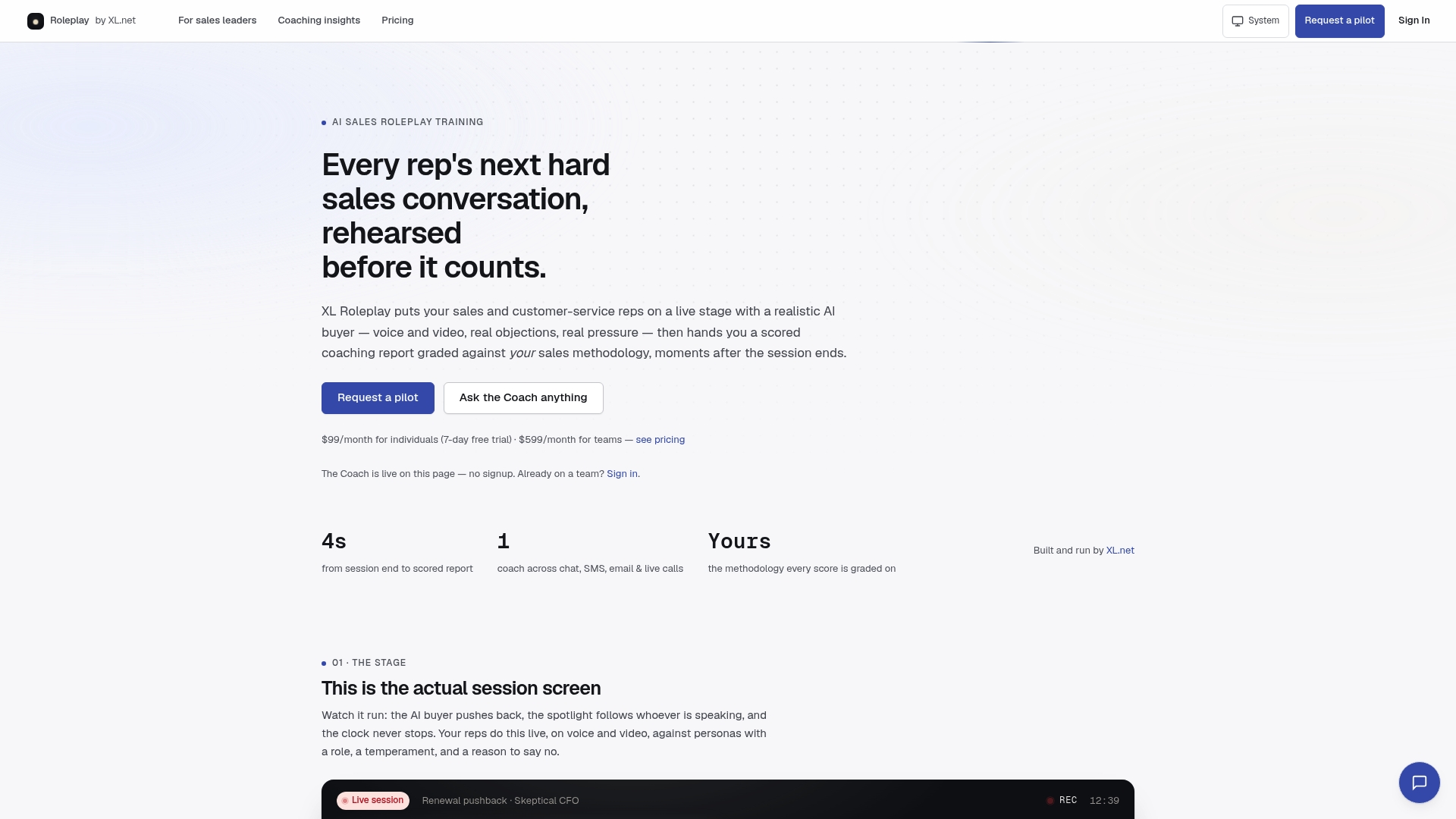
That combination, AI buyers plus methodology-specific scoring plus transcript-linked feedback, is exactly the setup the research above points to: repeatable practice paired with process-focused human coaching. If you want to run the four-week pilot outlined earlier without building the rubric and scheduling infrastructure yourself, start with the XL Roleplay pilot program. Teams ready to move past a trial can check plan details, including the Individual and Business subscription options, and sales leaders specifically can see how the platform maps to team rollouts on the page built for sales leaders.
Sources
- When AI Joins Your Teaching Team: Reinventing Sales Education with AI
- Objection practice using a live appointment-setting call with professionals
- Practice makes perfect: a case study for skill development
- Gen AI Avatar Sales Training: Exploratory Mixed Methods Examination of Diffusion
- Beginners and role-play complexity guidance
FAQ
How Long Should a Video Role-Play Session Last?
Solo AI drills work best at 10 to 15 minutes, focused on a single skill like objection response. Paired live or video role-plays run 15 to 25 minutes plus a 5 to 10 minute debrief, closer to the format used in studies on structured call practice.
Is AI Role-Play a Replacement for Live Role-Play?
No. Research on AI-driven training consistently finds it works best paired with human debriefs and live practice, not as a standalone replacement. Instructors in one pilot reported time savings and standardization from AI sessions, but valued keeping partner role-plays in the mix.
How Much Does XL Roleplay Cost?
XL Roleplay offers an Individual plan at $99 per month and a Business plan at $599 per month, with extra seats and extra video hours available beyond the base plan. Teams that want to test the approach first can start with the XL Roleplay pilot program.
What Should a Debrief Cover After a Role-Play?
A strong debrief moves through self-reflection first, then transcript or video review, then rubric scoring, then two specific action items. Feedback focused on observable conversational choices, rather than whether the deal closed, produces faster skill improvement.
How Do You Get Reps to Actually Use Role-Play Training?
Mandate a minimum session count for the first cohort, appoint a respected rep as a change agent, and frame early sessions as low-stakes practice. One pilot saw only about 40% uptake when the training was optional, which is why a manager mandate matters more than the tool itself.