Win-Loss Analysis vs Deal Review: What Each Does
Win-Loss Analysis vs Deal Review: What Each Does

A deal review and a win-loss analysis both ask “what is happening in this deal?”, but they answer different questions at different times. A deal review is an internal coaching conversation about one open opportunity, held while you can still change the outcome. Win-loss analysis studies closed deals, won and lost, to find patterns that explain why buyers chose you or someone else. One helps a rep close this deal. The other helps the whole go-to-market team win the next hundred.
TL;DR
- A deal review looks at one live deal, usually with the rep and manager, to expose risk and agree on next actions.
- Win-loss analysis looks at many closed deals, ideally with buyer interviews, to find patterns in positioning, messaging, product and execution.
- Run deal reviews weekly or at stage changes. Run win-loss interviews within weeks of a decision and report on a quarterly or monthly rhythm.
- Neither works alone: deal reviews fix the deal in front of you, and win-loss findings change what reps say on every future call.
- Findings only pay off when they reach reps’ practice, such as discovery questions and objection handling.
Table of Contents
- The short version: one deal versus a pattern
- Win-loss analysis vs deal review at a glance
- What a deal review is and how to run one
- What win-loss analysis is and how to run one
- How many deals do you need?
- Win rate and win-loss ratio are not win-loss analysis
- Turning findings into better selling
- How to choose: a quick decision guide
- Who owns what
- Our perspective
- Put findings into practice with XL Roleplay
- FAQ
- Sources
The short version: one deal versus a pattern
The simplest way to separate the two is by the unit of study. A deal review examines a single active opportunity to assess viability, expose risks and agree actions that improve its chance of closing. Win-loss analysis is a structured review of closed deals, both won and lost, meant to identify why outcomes happened and what can change to improve future win rates.

The second difference is whose voice you hear. Internal reviews usually capture what the selling team believed happened. Win-loss research, typically interviews or surveys run after a buying decision, aims to capture what the buying team experienced, valued and feared, often across several stakeholders.
The third is the audience for the output. A deal debrief on one closed deal produces behavioral change for one rep, while a win-loss review interviews buyers across a cohort and reports segment-level findings to the go-to-market team.
Win-loss analysis vs deal review at a glance
| Deal review | Win-loss analysis | |
|---|---|---|
| Deal status | Open, still winnable | Closed: won, lost or no decision |
| Scope | One opportunity | A cohort of deals, by segment or competitor |
| Main voice | Rep and manager | Buyers, plus rep debriefs and CRM data |
| Typical cadence | Weekly or after a stage change | Interviews weeks after the decision, reporting quarterly or monthly |
| Main output | Risks, owners, dated next actions | Themes that change positioning, product, messaging and coaching |
| Who benefits | The rep and the deal | Sales, marketing, product and leadership |
The differences below explain the table row by row.
What a deal review is and how to run one
A B2B deal review is a focused coaching conversation between an account executive and their manager about a specific active deal. It goes deeper than a pipeline review, which skims many deals for forecast purposes. The goal is to surface real risk, find what the rep may be missing and agree on the best move to advance the deal.
Timing and attendees
Deal reviews happen while a deal is live, commonly weekly or after a stage change. A typical session runs 15 to 30 minutes with the rep and manager, and sometimes a sales engineer or customer success lead joins.
What to inspect
A solid review checks the buyer’s stakeholders, the decision process, evidence of a champion, competitive threats, the business outcome the buyer wants, risks and next steps. RevCentric Partners recommends tying each assertion to evidence and recording an owner, a date and a next action for every gap. If the rep says “the CFO is on board,” the manager asks what happened that proves it.
Ask, do not tell
The coaching value comes from the questions. Risk questions work best when they are Socratic, so the rep builds their own risk awareness instead of hearing the manager’s opinion. Commitments should be specific and time-boxed. “I will reach out to the CFO directly by Thursday” is a commitment. “I need to get better executive access” is a wish.
A useful deal-review question set:
- Who has the budget, and when did we last speak to them?
- What does the buyer lose by doing nothing?
- Which alternative is the buyer most likely to pick, and why?
- What have we assumed that we have not confirmed?
- What is the one action, with a date, that moves this deal forward?
What win-loss analysis is and how to run one
Win-loss analysis systematically finds out why a buyer chose you or a competitor and feeds the answer into positioning, messaging and product decisions. The word “systematically” matters. A rep’s belief that a deal was lost on price is an impression. Asking the same questions across enough deals turns that impression into evidence.
Gather several kinds of evidence
Strong programs combine buyer interviews, seller debriefs and internal records. Outreach describes buyer interviews, seller debriefs, CRM records and conversation intelligence as complementary, with the CRM supplying context and segmentation rather than the sole explanation. A win-loss sprint can lean on CRM stage history, call snippets and email quotes, with every claim tied to a timestamp, quote or activity entry.
Interview the right buyer, independently
Good buyer questions cover how the buyer evaluated alternatives, which criteria mattered, what created confidence or concern, who took part and what could have changed the decision. Toflow advises talking to the champion or economic buyer, not only the person who delivered the rejection.
The interviewer should usually be someone other than the selling rep or manager, such as product marketing, research, RevOps or an outside firm, because buyers soften criticism when speaking to people who had a stake in the outcome. Your reps still matter: the sales team can deliver interview leads and help secure the conversations, while marketing, product, sales leadership and the executive team all need a seat at the program.
If your buyers first met you at events, a record of those early conversations helps you find and contact the right people later. Tools for trade show lead retrieval can capture who spoke to your team and what they asked about, which gives the interviewer context before the call.
Timing
Sources differ, so treat timing as a range and adapt it to your sales cycle. ORM describes a win-loss review as typically run two to four weeks after the decision, with reporting quarterly. Prospeo suggests 7 to 14 days for losses and 30 to 45 days for wins, noting that response rates drop and recall fades as time passes. Outreach allows a window of up to 60 to 90 days before recall of specific interactions diminishes. The common thread: sooner is better, especially after a loss.
How many deals do you need?
This is where the two methods differ most. A deal review needs exactly one deal. Win-loss analysis needs enough deals to separate a pattern from an anecdote.
Outreach suggests 20 to 30 interviews for directional patterns in one segment or competitive pairing, 50 or more to segment, and 100 or more to stabilize primary loss themes. Growth Velocity recommends at least 20 interviews, roughly 10 wins and 10 losses, because five or ten interviews produce fragile one-to-one comparisons. Koachly suggests a mix of roughly 60 to 70 percent losses and 30 to 40 percent wins, chosen randomly from closed deals.
Small teams are not locked out. A review of just five deals will not give you statistics, but it can surface patterns, quotes and hypotheses worth testing. Treat six mentions in 20 interviews as six anecdotes from a skewed sample, and call them hypotheses, not percentages. Start small, label the confidence honestly and keep adding deals every quarter.

Win rate and win-loss ratio are not win-loss analysis
People searching this topic often mix up the metrics and the method. The metrics tell you what happened. The analysis tells you why.
- Win-loss ratio is won deals divided by lost deals. Above 1.0 means more wins than losses, below 1.0 the opposite.
- Win rate is won divided by won plus lost. Including no-decision outcomes gives a more conservative picture of pipeline efficiency.
- A caution on the standard formula: SalesTap argues it almost always flatters the team, because it leaves out deals that went dark, stalled or were disqualified mid-process.
A worked example: a team closes 30 deals, loses 45 and sees 25 more go dark. The ratio is 30 to 45, or about 0.67. The basic win rate is 30 of 75, or 40 percent. Count the 25 no-decision deals and it is 30 of 100, or 30 percent. Same quarter, three different stories, and none of them says why buyers walked away. That question belongs to win-loss analysis.
Turning findings into better selling
Both methods fail if the output stays in a slide deck. The practical deliverable of win-loss work, as Liminal puts it, is changed behavior on the next call, not a quarterly PDF. Findings should update the tools reps use live: battlecards, discovery questions, objection-handling frameworks and competitive talk tracks.
A simple routing model:
- Competitive positioning findings go to enablement.
- Product gaps go to product.
- Messaging problems go to marketing.
- Execution patterns, such as weak discovery or late executive access, go to sales leadership.
That is the split Outreach recommends, with a cadence matched to the sales cycle. When you code interviews, use themes such as pricing perception, implementation risk, product depth and procurement friction, and count how often each appears while keeping the buyer’s own words.
This is also where deal reviews and win-loss meet. A pattern like “buyers say our reps never uncovered the real business case” shows up in win-loss interviews. The manager then asks the matching question in every live deal review. The loop closes when the rep practices the better conversation before it counts. Our own library of sales role-play scenarios and a guide to building roleplay scenarios from real calls show how teams turn recurring buyer objections into practice sessions.
How to choose: a quick decision guide
| If you need to… | Use |
|---|---|
| Decide whether a live deal is real and what the rep does by Friday | Deal review |
| Coach one rep on a specific buyer conversation | Deal review |
| Learn why you lose to one competitor in one segment | Win-loss analysis |
| Test whether your pricing story or messaging lands | Win-loss analysis |
| Hear what the buying committee actually thought | Win-loss analysis with buyer interviews |
| Give a rep a quick lesson from a deal that just closed | Deal debrief, then feed it into the win-loss data |
Most teams need all three on a rhythm. Deal reviews run weekly. Debriefs follow each close. Win-loss interviews build a growing dataset that someone owns and reports on regularly.
Who owns what
Deal reviews belong to front-line managers. Win-loss programs need a cross-functional owner, often product marketing, RevOps or enablement, with executive sponsorship. The rep contributes to both but should not interview their own buyers. For large deals the buying committee is wide: UserIntuition notes that in enterprise deals over $250K ACV, seven roles appear in almost every committee, so a program that talks to only one contact sees a sliver of the decision.
Our perspective
We see the same gap in most teams we talk to. Deal reviews generate good advice for the rep, and win-loss work generates good insight for leadership. Then the next call sounds the same as the last one.
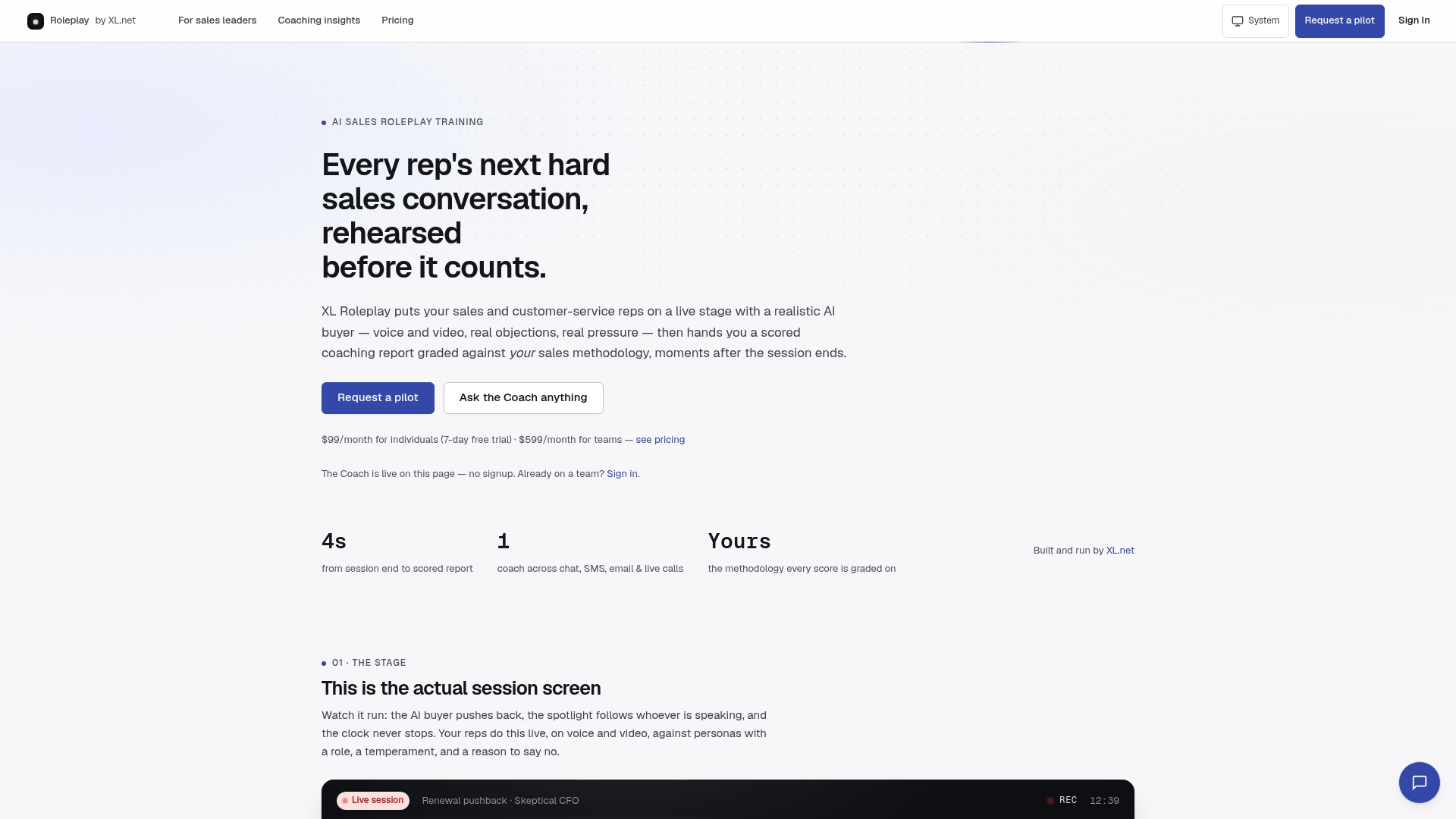
That is why we built XL Roleplay around practice. Reps hold live voice and video conversations with AI buyers that raise the objections and pressures your own deals produce. Each session ends in a scored coaching report built on your organization’s sales methodology, with a transcript that links feedback to the exact moment in the conversation.
In our view, a deal review should end with a dated commitment, and a win-loss finding should end with a rehearsal. When a manager hears “we lost on weak discovery,” the next step is to have the team run discovery against a realistic buyer, read the transcript together and score it against the playbook.
We designed one persistent AI coach with shared memory across channels, so the same coach follows a rep’s progress over time. Managers get transcripts and rubrics, which means coaching conversations rest on what was actually said, not on recollection.
Adam
Put findings into practice with XL Roleplay
If your win-loss themes or deal-review notes keep pointing at the same skill gaps, XL Roleplay gives your reps a place to work on them before the next live call. Sessions run as voice and video role-play with AI buyers, and scored reports follow your own methodology. Managers can review transcripts and rubrics for individuals and teams.
The Individual plan is $99 per month and the Business plan is $599 per month. Extra seats are $54.95 per month per seat, and extra video is $16.99 per hour. See the details on the pricing page. Sales leaders rolling this out to a team can start from the page for sales leaders or ask about the XL Roleplay pilot.
FAQ
Is a win-loss review the same as a deal debrief?
No. A deal debrief is an internal conversation about one closed deal, often within about five business days of close, and it targets one rep’s behavior. A win-loss review is a program that interviews buyers across many deals and reports patterns to the wider go-to-market team. Debriefs make useful raw material for the larger program.
Can a deal review replace win-loss analysis?
Not for the questions win-loss answers. A deal review reflects what the selling team believes, and it happens before the outcome is known. Win-loss analysis adds the buyer’s account after the decision, which is where you learn how buyers weighed alternatives and what shaped their confidence.
How often should we run each one?
Run deal reviews weekly or after a stage change on live deals. Run buyer interviews continuously as deals close, and report themes on a cadence that matches your sales cycle, commonly quarterly. Liminal says monthly updates to battlecards and talk tracks are more likely to change behavior than a report that sits in a shared drive.
Who should interview the buyer?
Someone independent of the deal, such as product marketing, research, RevOps or an outside firm. Buyers tend to soften their criticism with people who had a stake in the result, so the rep and manager who owned the deal are poor choices for the interview.
What is a good starting sample for a small team?
Aim for 20 or more interviews, with a mix of wins and losses, before you trust directional patterns. If you only have five deals, run the review anyway, and treat what you learn as hypotheses to test, not conclusions.
Sources
- What Is Win-Loss Analysis, and How Do You Build a Program?
- What Is Deal Review? Definition, Process and Examples
- What Is a Win/Loss Analysis?
- B2B Deal Review: How to Run an Effective Deal Review
- Sales Win-Loss Analysis: DIY vs. Third Party
- Win Loss Review vs Deal Debrief
- MEDDPICC Template for Manager-Led Deal Reviews
- The Win-Loss Sprint training
- How to run a win loss analysis that improves your win rate
- Win-Loss Analysis: The Complete Playbook
- How to Run a Win-Loss Analysis for B2B Sales
- Comprehensive Approach to Win/Loss Analysis
- Win-Loss Analysis for Enterprise Buyers
- How To Conduct A Win/Loss Analysis
- Win/Loss Analysis: Why the Sample Decides the Answer
- Win/Loss Analysis: The Complete Sales Guide
- Sales Win Rate: How to Calculate and Benchmark
- How to Calculate Your True Win Rate
- Win-Loss Analysis: A Practical Guide for Revenue Teams
- Win-loss analysis template