Deal Desk Approval Roleplay for Discounts
Chapters
TL;DR
A deal desk approval roleplay is a scored internal drill where the manager plays deal desk and the rep gets a time-boxed window to justify one specific concession. Score four things from the transcript alone: the buyer-verified metric, the economic buyer and the criteria they are scoring on, the competitive alternative, and the trade demanded in return for the discount. Miss any one of the four and the attempt fails and gets re-run before the live request goes in.
- Reps rehearse buyer conversations and then walk into the internal concession ask cold; margin leaves the building in that unrehearsed meeting.
- Use a four-row rubric: metric, economic buyer and decision criteria, competitive alternative, trade demanded.
- Run three escalating versions: routine term discount, multi-year floor break, non-standard legal terms plus price.
- The rubric never changes across the three scenarios; only the approver's pressure changes.
- A failed attempt is re-run before the rep submits the real request, not after the deal closes.
What is a deal desk approval roleplay?
A deal desk approval roleplay is a scored internal drill. The manager plays deal desk, the rep gets a fixed window to justify one concession on one live deal, and the session is graded against a rubric before any approval is discussed. Nothing about the buyer changes. What changes is that the rep has said the argument out loud once, under challenge, with someone scoring it.
It is easy for a practice program to stop at the buyer's side of the table. Reps drill discovery, objection first responses, and margin defense in negotiation, then submit the discount request in a thread at the end of the quarter with no rehearsal at all. A concession request is a sales call with the buyer sitting inside your own company.
The drill is also a qualification audit in disguise. If the rep cannot state the metric the buyer verified, the deal was never qualified to the depth the discount implies. That gap surfaces early in the transcript, which is cheaper than finding it in a signed order at a broken floor.
This drill does not replace buyer-facing margin work. Keep running negotiation roleplay for margin separately; the internal ask is a different audience with a different burden of proof.
Why does the discount get approved on urgency instead of evidence?
Because urgency is available on demand and evidence is not. A rep who has the buyer's cost figure in writing can produce it. A rep who does not still has the calendar, the logo, the champion's enthusiasm, and the forecast commit — and all four sound like arguments at quarter-end. Deal desk is timeboxed, the request is late, and the path of least resistance is approval with a note.
Urgency is the cheapest argument in the room because it is available whether or not the evidence exists.
There is a fair counterargument: the rep already lives inside the deal, so rehearsing the ask looks like theater. We disagree, narrowly. Knowing a deal and composing its economics into a short argument that survives challenge are different skills, and only the second one is what deal desk buys. Reps who know their deals cold still lose the room when the first question is "what does the CFO say this is worth" and the answer starts with "the champion feels."
Scored evidence also corrects the review itself. Confident reps get approved more often than careful ones when the only input is how the ask sounded live. A transcript and a rubric put the quiet rep with the verified metric ahead of the loud rep with the deadline.
The four-row rubric
Four rows, each pass/fail, each verifiable from the transcript by a manager who was not in the room. No composite score, no weighting. Three of the rows borrow MEDDPICC language on purpose — Metrics, Economic buyer with Decision criteria, Competition — because deal desk is inspecting qualification depth, not conversation craft, and that checklist is built for exactly that inspection. The fourth row is not a qualification field at all. If you already grade stage advancement against those fields, reuse the wording so the rep hears one standard; our MEDDPICC exit criteria guide covers that alignment.
A discount is a purchase your company makes, and every purchase needs a stated return.
Score the trade row strictly. It is the row reps skip, and it is the only row that recovers value.
| Rubric row | Passes when the transcript shows | Fails when the transcript shows |
|---|---|---|
| Metric | A quantified outcome the buyer stated, attributed to a named person and a date | "They see strong ROI" with no source |
| Economic buyer and decision criteria | The signer named, plus the criteria that person ranks first and second, in the buyer's words | A champion's title offered as if it were signing authority |
| Competitive alternative | The named alternative — vendor, internal build, or do nothing — and its posture as the buyer described it | "They're probably looking around" |
| Trade demanded | A specific return requested for the concession, stated as the sentence the rep will say to the buyer | The concession requested with nothing asked back |
Three escalating scenarios
Run these in order across three weeks. Each uses a real deal from the rep's own pipeline, not a fictional one, because the point is to test evidence the rep either has or does not have. Write the deal desk exit criteria on the scenario card before the session starts, so the verdict is set before anyone performs.
The rubric is identical in all three. Only the approver's pressure rises. The manager's job is posture, not cruelty: one clarifying question in the first scenario, sustained pushback in the second, interruption and a split ask in the third. The drill tests composition under pressure — and it belongs on a difficulty ladder where the rep clears the routine version before facing the floor break.
Escalate the pressure on the rep, never the number of rows being scored.
| Scenario | Deal desk posture | What the pressure tests |
|---|---|---|
| Routine term discount, inside policy | One clarifying question, then a decision | Whether all four rows exist at all when the ask is easy |
| Multi-year floor break | Two pushbacks; demands the buyer's own words behind the metric | Whether the metric row survives a demand for attribution, and whether the trade holds |
| Non-standard legal terms plus price | Interrupts and splits the ask into terms and price | Whether the trade row stays attached to the price concession instead of being spent on the legal ask |
The script the rep rehearses
Give the rep a skeleton, then drill it until the order is automatic. The order matters more than the wording: evidence first, ask last. A discount justification script that opens with the number the rep wants is a script that invites the room to negotiate the rep instead of the deal. We recommend a ninety-second opening window before questions, and the frame says so out loud.
Frame. "I'm asking for one concession on the Harborline deal. Ninety seconds, then your questions. If the answer is no, say so and I'll take the alternate structure back to them." That is a Sandler up-front contract applied internally: purpose, time, both agendas, and no as an acceptable outcome. It is the same opening discipline you already drill in call opening roleplay.
Metric. "Their controller put the cost of the manual close at [figure] per quarter, in writing, on [date]."
Economic buyer and criteria. "The signer is [name], VP Finance. She ranks implementation risk first and price second — her words on [date]."
Competitive alternative. "They are comparing us against [vendor] and an internal build."
Trade. "I am asking for the concession in exchange for a multi-year term and a signed order by [date]. I have not offered anything yet."
The last sentence is the one to drill hardest. Reps who have already hinted at a number to the buyer arrive at deal desk asking for permission they have effectively granted themselves.
What does a failing attempt sound like?
It sounds like a forecast update. "They love us, the champion is pushing internally, procurement came in hot, and I need the extra points to get this signed by Friday." Four sentences, zero rubric rows. No attributed figure, no signer, no named alternative, and no return requested. Approve that and you have bought urgency at list-minus.
The second failure mode is subtler: three rows clean and the trade row empty. The rep names the controller's cost figure, names the VP Finance, names the competitor, then asks for the discount flat. Strong preparation, no exchange. Score it a fail anyway; three of four does not pass.
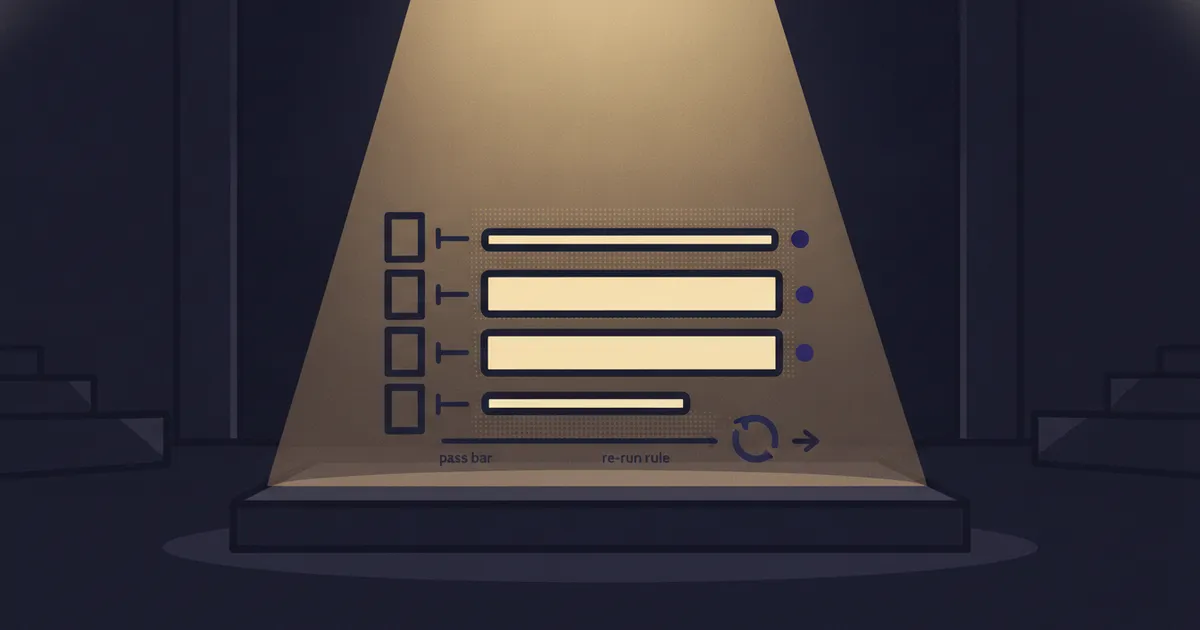
The pass bar is simple enough to audit. All four rows evidenced inside the window, the trade stated as a sentence the rep will actually say to the buyer, and the concession still unoffered at the moment of the ask. A second manager reading only the transcript should reach the same verdict without having been in the room. If two managers disagree, the rubric row is written loosely — fix the wording, then re-score. Our rubric calibration guide covers how to run that check across a team.
A drill without a pass bar a second reader can verify is a conversation, not a certification.
The re-run rule and where the drill lives
A failed attempt is re-run before the live request is submitted. Not next week, not next quarter — before the rep sends the real ask. That rule is the entire value of the drill; without it, you have added a meeting and changed nothing. If the rep fails because the evidence does not exist, the re-run happens after a call with the buyer to get it, which is the correct outcome.
Debrief one behavior. Pick the single row that failed, ask the rep to self-diagnose the moment first, then render the verdict and book the re-run. Covering all four rows at once produces agreement and no change. The structure is in our debrief guide.
We recommend a thirty-minute run cost for the manager — five minutes setup, fifteen minutes drill, ten minutes debrief — plus roughly ten minutes beforehand to pick the deal and choose the rubric row. Put that block on the coaching calendar, not the pipeline call. The internal deal review drill dies the moment it shares an agenda with forecast, because the forecast is urgent and the skill is merely important; we make the full case in sales coaching vs deal review.
Teams running discount approval practice inside XL Roleplay load their own deal desk standards and rubric rows first, so the scored session cites your concession policy rather than generic negotiation advice.
Frequently asked questions
Should the actual deal desk analyst play the role?
When they will attend, yes — it calibrates the standard fast. When they will not, the manager plays the role from a one-page posture sheet listing the questions your approver actually asks.
We have no formal deal desk. Is the drill still useful?
Yes. Substitute whoever approves non-standard pricing, usually the VP Sales or CFO. The four rubric rows do not change when the approver's title does.
What if the rep passes the drill and the real request is still denied?
That is a pass. The rubric scores the quality and completeness of the argument, not the outcome. A well-evidenced ask that gets declined tells you the concession was genuinely wrong for the deal.
Can reps practice this without a manager present?
Yes, as solo scored reps against an AI approver, then bring the flagged transcript to the coaching block. See async scored drills for the format and its limits.
How long should the justification window be?
We recommend ninety seconds for the opening argument, then open questions. Short enough to force sequencing, long enough to land four rows of evidence.