Asynchronous Sales Practice: How to Run It Well
Asynchronous Sales Practice: How to Run It Well

Asynchronous sales practice means a rep rehearses a sales or service conversation on their own time, with no manager or peer on the line, and gets feedback afterward. It is different from asynchronous selling, which is about how you communicate with buyers. Practice is about how reps get ready for those buyers. The hard part is making solo reps feel like a real call and making the feedback specific enough to change behavior. That is why we built XL Roleplay around live voice and video sessions with AI buyers who raise typical objections, then score each session against your own sales methodology.
TL;DR
- Asynchronous sales practice is rehearsal without scheduling: the rep practices when they can, and the review happens later from a recording or transcript.
- It works only if the practice feels like a real conversation (a buyer who pushes back) and the feedback is tied to a rubric, not a general impression.
- Short, frequent sessions on one skill, such as discovery questions or a price objection, beat an occasional long workshop.
- Managers get the most from it by reviewing transcripts and scores instead of sitting through every session.
- Keep live role-play for nuanced, high-stakes moments and use async practice for the daily reps that build the habit.
Table of Contents
- What asynchronous sales practice is, and what it is not
- Why practice beats more product training
- What makes async practice feel real
- A weekly routine for asynchronous practice
- Practice for specific reader situations
- How managers review without drowning
- Measuring whether it works
- Where async practice fits, and where live role-play fits
- Our perspective
- Getting started with XL Roleplay
- FAQ
- Sources
What asynchronous sales practice is, and what it is not
Most pages ranking for this phrase are really about asynchronous selling: recorded demos, personalized video outreach and written follow-ups that let a buyer engage when it suits them. Sendspark’s guide describes the strongest teams as a blend, with live conversations for complex negotiation and real-time objection handling, and asynchronous touches for outreach and follow-up.
That blend is exactly why practice matters. Buyers are in less contact with sellers than they used to be. Dock’s guide to asynchronous sales cites the finding that buyers spend only 17% of their total buying time talking to sales teams. When live time is that scarce, each conversation carries more weight, and a rep who stumbles on an objection has fewer chances to recover.
Asynchronous sales practice is the preparation side of that equation. It covers:
- Discovery rehearsal: asking open questions, following up on vague answers, and uncovering the real problem.
- Objection handling: responding to price, timing, “we already have a vendor” and “send me an email” without freezing.
- Call openers and closes: the first thirty seconds and the next-step ask.
- Service recovery: for customer service teams, de-escalating an upset customer or holding a policy line politely.
The word “asynchronous” refers to scheduling, not to quality. The rep and the reviewer do not need to be in the same place at the same time. The practice itself can still be a live back-and-forth with a buyer persona.
Why practice beats more product training
Reps usually know their product. What they lack is repetition at saying the right thing under pressure. Knowledge transfers in a slide deck, but a skill like objection handling only improves when the rep speaks the words aloud and hears how they land.
There is academic support for rehearsal with realistic pushback. A 2022 study in Marketing Education Review by Cummins at the University of Nebraska Omaha, covering 97 students practicing objection handling in a live appointment-setting exercise, found significantly higher perceived confidence and actual learning on objection response among those who practiced live with professionals. Participants were also more likely to receive job or internship offers. The point for a sales leader: practice against a realistic counterpart builds both skill and confidence, and confidence shows up on the real call.
The obstacle is logistics. Live role-play needs two people, a calendar slot and a manager who has the energy to play a skeptical buyer for the fifth time that week. Async practice removes the scheduling problem, so the number of reps a person gets is no longer limited by someone else’s availability.
What makes async practice feel real
A rep talking into a blank recorder is not practicing a conversation. Conversations have a counterpart who interrupts, doubts and changes direction. Three things separate useful async practice from a box-ticking exercise.
A buyer who pushes back
The scenario needs a persona with a role, a motivation and a set of objections. A procurement lead who cares about contract terms behaves differently from a department head worried about rollout. In XL Roleplay, reps hold live voice and video conversations with AI buyers that present typical objections and pressures, drawn from a customizable scenario library, so the rep has to respond in the moment rather than read from a script.

A rubric that matches how you sell
If your team sells with a specific methodology, generic feedback such as “be more confident” does not help. Feedback should say whether the rep quantified the pain, confirmed the decision process and set a clear next step, in your terms. Our scoring and coaching reports are built on each organization’s own sales methodology and playbook, so a rep sees how they did against the standard your team actually uses.
Feedback tied to the exact moment
A score without evidence invites argument. A transcript lets both the rep and the manager point to the sentence where the call went off track. Our feedback is transcript-linked, so a comment about a missed follow-up question sits next to the moment it happened.
A weekly routine for asynchronous practice
The routine below works for a sales team of any size and adapts easily to a support team. The principle is one skill, short sessions, a visible score and a review loop.
- Pick one skill for the week. Choose from your own call reviews: for example, “discovery: digging past the first answer.” Do not try to train five things at once.
- Assign two or three scenarios. Use one easy, one realistic and one hard persona. A new rep starts with the easy one to build fluency.
- Have reps practice in short sessions. Ten to fifteen minutes, two or three times a week, is easier to sustain than one long block. Reps can fit them between calls.
- Read the scored report before retrying. The rep reviews the rubric results and the transcript, picks one thing to change and runs the scenario again.
- Manager reviews the exceptions. Rather than listening to every session, the manager looks at the lowest scores, the biggest improvements and a few sampled transcripts.
- Hold a short live debrief. Once a week, the team talks through one scenario together, covering what worked and what to copy.
- Close the loop with real calls. Compare the week’s skill with what shows up in live conversations and set the next focus.
The step where most programs fail is the fourth. If reps never read the feedback or retry, the practice becomes a completion checkbox. Building a rule that every report is followed by a second attempt turns feedback into skill.
Practice for specific reader situations
New reps
A new hire should not make their first mistakes with a paying prospect. Async practice lets them rehearse the pitch, the top five objections and the handoff process before they go live. A manager can see readiness from the scores and transcripts and decide when the rep is ready for calls instead of guessing.
Customer service teams
Service conversations carry pressure of a different kind: an upset customer, a refund request outside policy, a cancellation threat. Scenarios can recreate those moments so agents practice the exact phrasing for empathy and boundaries, and managers can check that the policy language was used consistently.
Teams standardizing a methodology
When a company rolls out a new framework, the training day is the easy part. Weeks later, reps drift back to their own habits. Practice scored against the framework keeps the standard visible and gives leaders evidence of who is applying it. Our guide to asynchronous sales coaching goes deeper on that loop.
Individual reps
If you are practicing on your own to get better at interviews, quota or a new product, the same routine applies: pick one skill, run a scenario, read the score and retry. You do not need a manager to start the habit.
How managers review without drowning
Async practice can create a pile of recordings. The manager’s job is to turn it into coaching, not a backlog. A workable approach:
- Review by score, not by session. Sort by lowest rubric results on the focus skill.
- Read before you listen. A transcript shows the pattern in two minutes. Listen only where the text suggests a problem.
- Give one note per rep. One behavior to change before the next session beats a list of eight.
- Share a strong example. With permission, play a good objection response in the team meeting so the standard is concrete.
- Track readiness over time. A rep who improves across several sessions is a stronger signal than one great attempt.
We built XL Roleplay so managers can see detailed session transcripts, rubrics, readiness scoring and performance for both individuals and teams in one place, and use live debriefing tools when the team wants to talk a scenario through together.
Measuring whether it works
Practice has to show up in outcomes, or leaders stop funding it. Measure in layers, from fastest to slowest.
| Layer | What to look at | How soon it moves |
|---|---|---|
| Participation | Sessions completed per rep per week, retries after feedback | Within days |
| Skill scores | Rubric results on the focus skill across sessions | Within weeks |
| Call behavior | Whether the practiced behavior appears in recorded live calls | One to two months |
| Business results | Conversion from first call to next step, ramp time for new hires, escalation rate in service | A quarter or more |
Do not skip the third row. The test of practice is transfer: did the rep ask the better discovery question on a real call? If the scores rise but real calls do not change, adjust the scenarios to match the objections your reps actually hear. Compare groups where you can, such as a cohort who practiced against one who has not yet started, and keep the comparison modest. Many things move sales numbers at once.
Where async practice fits, and where live role-play fits
Async practice is best for volume and consistency: the first fifty repetitions of a pitch, the weekly objection drill, the new hire ramp, a team spread across time zones. Live role-play with a manager or peer is best for nuance, such as a strategic account plan, a complex multi-stakeholder negotiation or a coaching conversation where the manager wants to probe the rep’s reasoning in real time.

The two reinforce each other. Reps who arrive at a live session having already practiced the basics spend the manager’s time on judgment instead of fundamentals. Our live debriefing tools are made for that handoff. For more scenario ideas, see our collection of role-play exercises for sales.
Our perspective
We think the biggest waste in sales enablement is a good training session followed by nothing. Reps nod through the workshop, then go back to calls where the first real objection is also their first attempt at the new approach.
What we have built XL Roleplay to do is give each rep one persistent AI coach, with shared memory across channels, that holds the conversation to your playbook rather than a generic standard. Every session produces a scored coaching report grounded in your methodology and linked to the transcript, so a rep knows exactly what to change and a manager can see the evidence without sitting in on every call.
Practice should be frequent, specific and safe to fail in. When reps can rehearse a hard conversation at their own pace, with a buyer who actually pushes back, they walk into the real call having already heard the objection once. That is the readiness we want every team to have.
Adam
Getting started with XL Roleplay
Our Individual plan is $99 per month and our Business plan is $599 per month. Extra seats are $54.95 per month per seat, and extra video is $16.99 per hour. We offer free trials, so a rep or a manager can run a first scenario and read a scored report before committing.
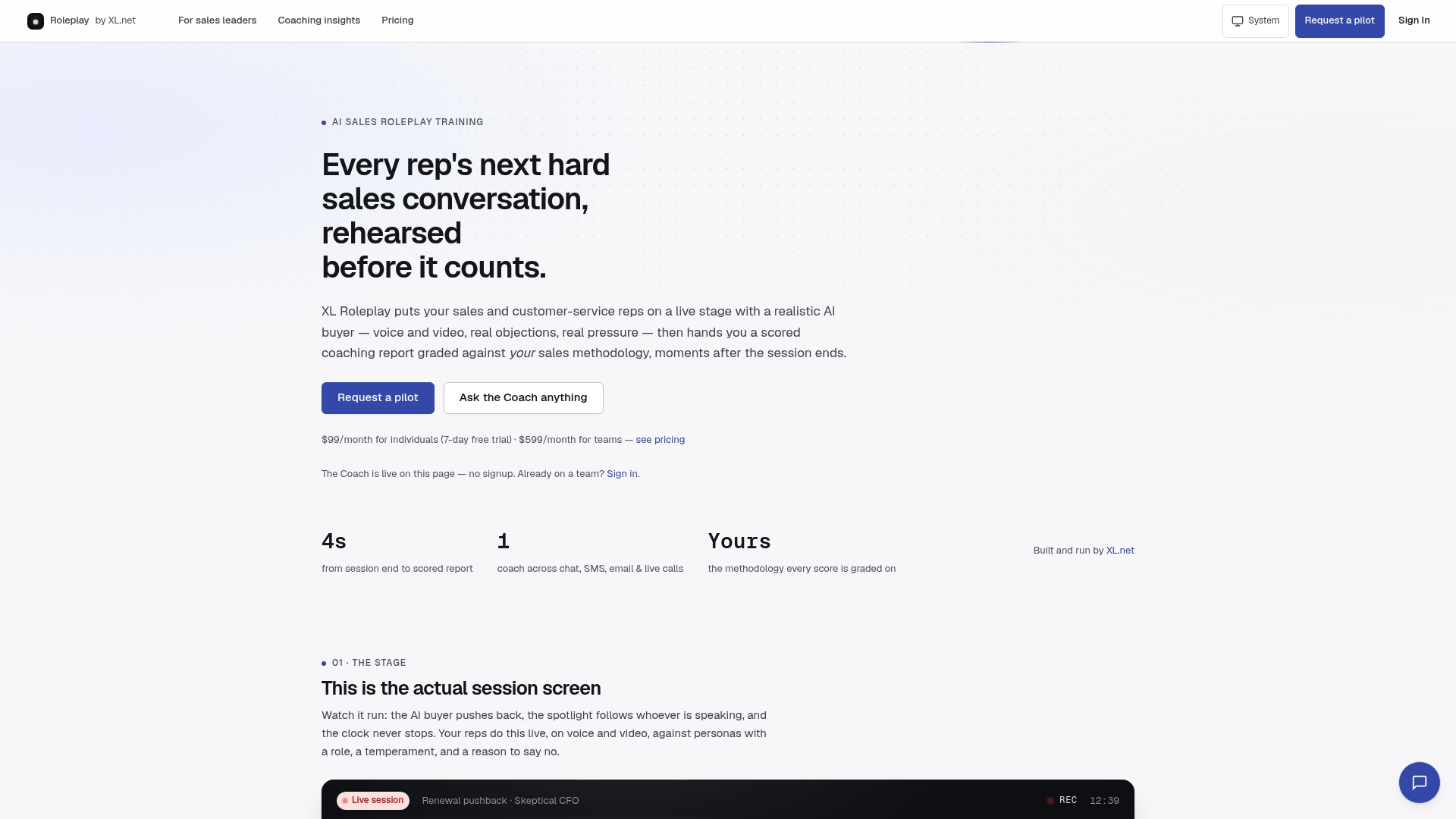
If you lead a team, the pilot is a way to roll out practice to a group with your own methodology and scenarios, and our page for sales leaders explains how readiness reporting works at team level.
FAQ
What is the difference between asynchronous selling and asynchronous sales practice?
Asynchronous selling is how a seller communicates with buyers when they are not live together, for example through recorded videos and written follow-ups. Asynchronous sales practice is how reps rehearse and get coached without needing someone available at the same time. One faces the buyer, the other prepares the rep.
How often should reps practice?
Short and frequent works better than long and rare. Two or three sessions of ten to fifteen minutes a week on a single skill is a realistic target for most teams. Pair each session with a read of the feedback and one retry.
Can asynchronous practice replace live role-play?
It covers the repetition that live sessions cannot schedule, but the two do different jobs. Use async practice for daily reps on discovery, objections and openers. Keep live sessions for complex negotiations and for discussing a rep’s reasoning with their manager.
How do I know a rep is ready for real calls?
Look at the trend, not a single result: rubric scores on the key skills across several sessions, how the rep handles the hardest personas, and whether the transcript shows your methodology being followed. Readiness scoring in XL Roleplay summarizes this for individuals and teams.
Does it work for customer service teams?
Yes. Service scenarios such as an upset customer, a cancellation threat or a policy boundary can be practiced the same way as sales objections, and scored on empathy, clarity and adherence to your standards.
Sources
- Asynchronous Selling: 2026 Guide to Async Sales, Sendspark
- Asynchronous Sales Guide: Sell more by meeting less, Dock
- Objection practice using a live appointment-setting call, Marketing Education Review, 2022