Buyer Personas for Role-Play: Build Ones Reps Can Practice On
Buyer Personas for Role-Play: Build Ones Reps Can Practice On

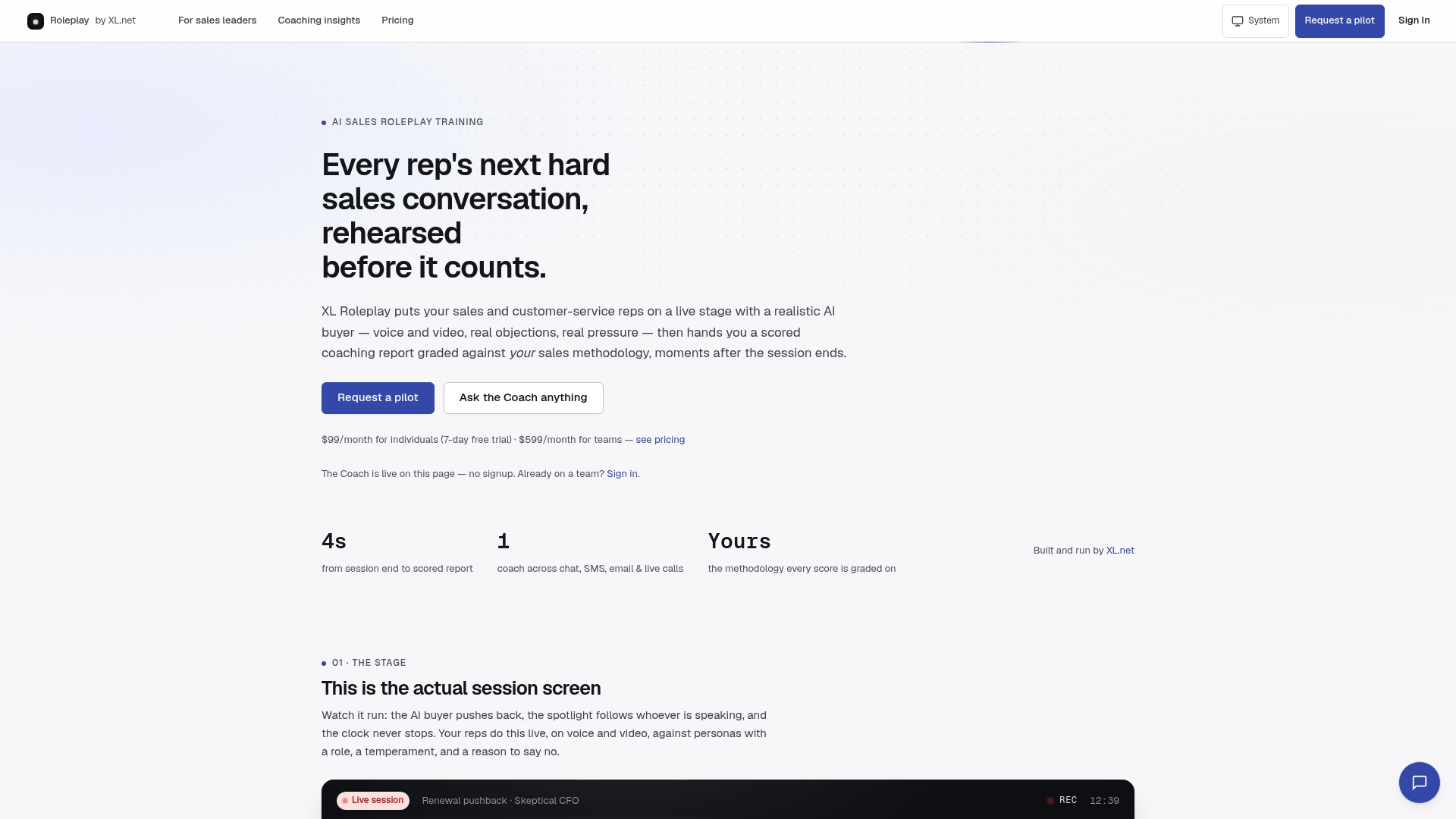
A buyer persona for role-play is a short character sheet that tells the person (or AI) playing the buyer who they are, what they want, what worries them and how they will push back. A marketing persona describes an audience. A role-play persona has to describe a person who talks back. If you build it that way, with a clear role, a hidden concern, two or three objections and a rule for when the buyer says yes, reps get practice that feels like a real call. With XL Roleplay, reps practice live voice and video conversations with AI buyers built around personas like these, then get a scored coaching report and a transcript.
TL;DR
- A role-play persona is a playable character: role, goals, concerns, communication style, objections and a decision rule. Demographics matter only when they change how the buyer decides.
- Start with 3 to 5 personas drawn from your real buying committee and real call recordings, not invented stereotypes.
- Give every persona a hidden concern and a “yes” condition, so discovery questions are rewarded and pitching too early is not.
- Score each session against your own methodology, and review the transcript, not just the outcome.
- Rotate difficulty: the same persona can be friendly, rushed or hostile depending on the scenario.
Table of Contents
- What a buyer persona means in role-play
- What to put on a role-play persona sheet
- Buyer persona examples you can use as a starting point
- How to build personas from real conversations
- How many personas should a team practice?
- Run the session so the persona does its job
- Common mistakes with role-play personas
- Perspective
- Put your personas to work
- FAQ
- Sources
What a buyer persona means in role-play
Most persona advice is written for marketers: pick an audience, give it a name, aim your content at it. That is useful, but it is not enough for practice.
A useful definition comes from a B2B guide that describes a buyer persona as a fictional representation of a decision-maker, built from research and observable data. According to INFUSEmedia’s 2023 guide, a persona focuses on the individual’s role and aspirations, while an ideal customer profile (ICP) describes the target company as a whole. In other words, the ICP tells you which accounts to call, and the persona tells you who you will be talking to inside them.
For role-play you add one more layer: behavior. A persona on a slide says “VP of Operations, cares about efficiency.” A persona in a role-play says “VP of Operations, cut off two vendors last year, answers in short sentences, and will not discuss price until she believes you understand her rollout risk.” The second one can be played. The first one cannot.
What to put on a role-play persona sheet
Keep it to one page. The person playing the buyer should be able to read it in two minutes and stay in character for twenty.
INFUSEmedia’s guide says useful details include the buyer’s role (leader or influencer), communication preferences, objections or barriers to purchase and the part they play in the buying decision. It also says personal details belong only where they bear on the decision. That is a good filter for role-play: if a detail will not change what the buyer says, cut it.
A practical sheet has these parts:
| Field | What to write | Why it matters in practice |
|---|---|---|
| Role and company context | Title, team size, what they own, what the company does | Sets the vocabulary and the stakes |
| Role in the decision | Champion, economic buyer, technical evaluator, blocker | Tells the rep who they are really selling to |
| Goals and pressure | What they are measured on this quarter | Gives discovery something to find |
| Hidden concern | The worry they will not volunteer | Rewards good questions |
| Communication style | Terse, chatty, data-driven, skeptical | Forces reps to adapt |
| Top objections | Two or three, in the buyer’s own words | Makes objection handling specific |
| Yes condition | What must be true before they agree to a next step | Defines success for the session |
| Walk-away trigger | What ends the call badly | Makes mistakes cost something |
The hidden concern and the yes condition are what turn a persona into an exercise. Without them, the buyer is a talking FAQ. With them, the rep has to earn the answers.
Buyer persona examples you can use as a starting point
These are illustrative archetypes, not research findings. Adjust them to the people your reps actually meet.
The skeptical economic buyer
A CFO or finance director who has seen too many vendors promise savings. Short answers, interrupts with “what’s the payback?” Hidden concern: a failed rollout that lands on her. Yes condition: a clear, credible view of cost and risk and a small first step. This persona trains reps to lead with business impact and to stop reciting features.
The friendly champion with no power
A director who loves your product, answers every question warmly and cannot sign anything. Hidden concern: looking foolish in front of his boss if the deal stalls. Yes condition: help preparing an internal case. This persona trains reps to notice that enthusiasm is not authority, and to ask who else has to say yes.
The technical evaluator
An IT or operations lead who asks detailed questions about integrations, security and support. Hidden concern: inheriting a tool that breaks her workflow. Yes condition: straight answers and a clear implementation plan. Reps learn to say “I’ll find out” instead of guessing.
The rushed gatekeeper
An executive assistant or front-desk contact with thirty seconds to spare. Hidden concern: letting a time-waster through. Yes condition: a reason that is specific and brief. If your team struggles at the door, our pieces on gatekeeper role-play and sales gatekeeper challenges go deeper.
The upset customer
For customer service teams: a long-time customer who was billed twice and has already called once. Hidden concern: being passed around again. Yes condition: ownership of the problem, a clear next step and a date. This persona trains acknowledging the issue before explaining it.
The happy-but-price-focused renewal
A procurement contact who likes the product but has a mandate to cut spend. Hidden concern: being blamed for paying more. Yes condition: a justification he can forward. This persona trains negotiation without defaulting to discounts. More drills are collected under sales negotiation exercises.
How to build personas from real conversations
Invented personas drift toward caricature. Reps notice, and the practice stops transferring to real calls. Build from evidence instead.
- Pull real calls and tickets. Find ten to twenty recent conversations with the buyer type you want to model. Note the first objection, the question that changed the tone and the phrase that ended the conversation.
- Interview your best reps. Ask which buyers they find hardest and what they do differently with them.
- Check the sales team’s view. One guide on persona building suggests running a draft past two or three salespeople who talk to this buyer regularly and asking what rings true and what is missing. That check catches a persona that reads well but sounds wrong.
- Write the objections in the buyer’s words. “We already have a vendor for that” is more useful than “competitive incumbent objection.”
- Turn the persona into scenarios. One persona can appear in several situations: a first discovery call, a stalled deal, a pricing conversation, a renewal. Our guide to building scenarios from real calls walks through the conversion.
Where your CRM, call recordings and win-loss notes already hold this material, the work is mostly editing. With XL Roleplay, the scenario library can be customized to your playbook, so the personas your reps face use your buyers, your objections and your methodology rather than generic ones.
How many personas should a team practice?
Fewer than most teams build. One guide suggests that most businesses work well with three to five personas, starting with two or three for the highest-value segments and adding more as you learn. It also notes that if personas begin to overlap heavily, you have too many.
For role-play, apply the same logic with a practical twist:
- New reps: start with two or three. The friendly champion, the skeptical economic buyer and one common objection-heavy persona cover most first-call skills.
- Experienced reps: add the technical evaluator, the blocker and multi-stakeholder scenarios.
- Service teams: pick the three complaint types that generate the most repeat contacts and build one persona each.
Prioritize by two questions. Where do deals or tickets actually stall? And which buyer types do reps avoid practicing because they are uncomfortable? The second list is often the more valuable one.
Vary difficulty rather than multiplying characters. The same skeptical CFO can be cooperative in a first scenario, rushed in a second and openly hostile in a third. That gives progression without a bigger library to maintain.

Run the session so the persona does its job

A good persona still produces a bad session if the structure is loose. Sales educator Barry Rhein, quoted in a Stanford Graduate School of Business class summary, says selling skills must be practiced. The same article describes a role-play in which one student tries to close while another raises objections, treating each objection as a chance to understand how the customer thinks. That framing is the right one for personas: the objection is information, not an obstacle.
A simple session format:
- Brief (2 minutes). The rep gets the scenario, not the hidden concern. Give them the goal, such as “earn a next step.”
- Conversation (10 to 15 minutes). The buyer stays in character and follows the yes condition and the walk-away trigger.
- Debrief (5 to 10 minutes). Review what the rep asked, what they missed and which moments changed the buyer’s tone.
- Repeat. Run the same persona again with one change: a different opening, a harder objection or less time.
Score what you can observe
Vague feedback (“be more confident”) does not change behavior. Write the rubric before the session and tie it to your methodology: Did the rep uncover the hidden concern? Did they confirm the decision process? Did they handle the first objection without discounting? Did they agree a specific next step?
Then review the transcript line by line. Moments such as “you asked about timeline here, and the buyer opened up” are what a rep remembers. Our overview of role-play exercises for sales and best sales role-play scenarios gives more drills to pair with your personas.
Where human role-play breaks down
Peer role-play has a known weak point: the colleague playing the buyer is either too kind or too inconsistent. Personas fade after the first minute, feedback varies by who is playing, and managers cannot sit in on every session. An AI buyer holds the persona steady, repeats it as often as needed and produces a record of the conversation for the manager. XL Roleplay’s sessions run as live voice and video conversations with AI buyers and personas that present typical objections and pressures, and the scored coaching reports are based on your organization’s own sales methodology.
Common mistakes with role-play personas
- Too much biography. Hobbies and favorite coffee shops rarely change a buying decision. Keep what shapes the conversation.
- No hidden concern. If the buyer reveals everything on request, discovery skills never get tested.
- Every buyer is hostile. Constant pushback teaches reps to expect a fight. Mix cooperative, neutral and difficult buyers.
- Personas that never change. Update them when win-loss notes or new call recordings show the buyer has changed.
- No link to the playbook. If feedback is not tied to the way your team is supposed to sell, practice reinforces habits instead of standards.
Perspective
Here is how we think about personas. A persona is only as good as the conversation it produces, so we judge it by one test: does the rep leave the session knowing something specific they will do differently on their next call?
That is why we built XL Roleplay around a persistent AI coach, scoring grounded in your own sales methodology, and feedback linked to the transcript. A generic buyer with generic objections gives generic feedback. A buyer shaped around your playbook lets the coaching report say, in your team’s language, what the rep did well and where the conversation turned.
For managers, the same transcripts and rubrics make coaching concrete. Instead of guessing how a rep handles a skeptical economic buyer, you can read the exchange. For new reps, it is a safer place to make the first hundred mistakes before a real prospect hears them.
Start with a few personas drawn from real calls, score them against a clear rubric and rotate the difficulty. Everything else is refinement.
Adam
Put your personas to work
If you already have persona sheets, or a handful of recent calls to build them from, the quickest way to see them in action is to practice against them. XL Roleplay offers an Individual plan at $99 per month and a Business plan at $599 per month, with extra seats at $54.95 per month per seat and extra video at $16.99 per hour. Details are on the pricing page. Sales leaders rolling this out to a team can look at the XL Roleplay pilot or the page for sales leaders.
For a deeper walk through writing the character sheet itself, see our guide to playing the buyer with persona character sheets.
FAQ
How is a buyer persona different from an ideal customer profile?
An ICP describes the kind of company most likely to buy and succeed with your product. A buyer persona describes an individual inside that company: their role, goals, concerns and part in the decision. For role-play you need the persona, because reps talk to people, not to firmographics.
How long should a role-play persona be?
One page is enough. Cover role, decision role, goals, hidden concern, communication style, two or three objections, a yes condition and a walk-away trigger. If the person playing the buyer cannot absorb it in a couple of minutes, trim it.
How many personas does a new rep need?
Two or three. A skeptical economic buyer, a friendly champion and one objection-heavy buyer give a new rep a solid base for discovery and objection handling. Add technical evaluators, blockers and multi-stakeholder scenarios as skills grow.
Can customer service teams use buyer personas too?
Yes. The format is the same, but the persona is a customer with a problem: an upset repeat caller, a confused first-time user or a renewal at risk. Give each a hidden concern and a clear condition for feeling the issue is resolved, then score on ownership, clarity and next steps.
Sources
- INFUSEmedia: Definitive Guide to B2B Buyer Personas (2023)
- Stanford Graduate School of Business: Class Takeaways, The Fundamentals of Effective Selling
- How to Create a Buyer Persona: Step-by-Step Guide with Examples