Call Center QA vs. Coaching: How They Differ and Work Together
Call Center QA vs. Coaching: How They Differ and Work Together

Quality assurance (QA) measures how agents perform against a standard. Coaching develops the skills that move those scores. QA produces evidence, and coaching uses that evidence to change behavior. A call center needs both, and the trouble starts when one is expected to do the other’s job: a scorecard handed over as if it were a coaching session, or coaching with no data behind it.
This guide explains what each function does, who should own it, where they overlap, and how to connect them without turning every coaching conversation into a grading meeting.
TL;DR
- QA is measurement. Analysts or supervisors score a sample of interactions against a calibrated scorecard to find gaps, compliance risks and trends.
- Coaching is development. A manager uses that evidence in a two-way conversation, agrees on one observable goal, and follows up.
- Keep them distinct, but connected. QA findings should decide what to coach, while the coaching conversation stays separate from the score conversation.
- Practice is the missing link. Feedback changes behavior faster when agents rehearse the new behavior before the next live call.
- Judge both by outcomes. Track whether scores and customer satisfaction move after coaching, not just how many evaluations were completed.
Table of Contents
- QA and coaching side by side
- What QA is responsible for
- What coaching is responsible for
- Where the two get confused
- How to connect QA findings to coaching
- One team, two roles: who does what
- Measuring whether it works
- Where practice fits in
- Our perspective
- Try it with your team
- FAQ
- Sources
QA and coaching side by side
The two functions share a goal, better customer conversations, but they differ in almost everything else.
| Call center QA | Call center coaching | |
|---|---|---|
| Main purpose | Measure quality and compliance | Build skills and change behavior |
| Typical owner | QA analysts or supervisors | Team leads, line managers, mentors |
| Core tool | Calibrated scorecard and sampling | Feedback conversation, goal, practice |
| Output | Scores, trends, compliance flags | Agreed action and follow-up date |
| Audience | Operations, compliance, leadership | The individual agent |
| Rhythm | Continuous sampling and reporting | Regular one-to-ones, tied to a goal |
| Failure mode | Scores nobody acts on | Opinions with no evidence behind them |
The split of roles is described the same way across the industry. One contact center vendor guide puts it this way: QA evaluates interactions against standards, while coaching is an ongoing, two-way process for improving skills. We use that framing here because it matches how most U.S. contact centers divide the work.
What QA is responsible for
QA reviews customer interactions and scores them against a rubric. In most centers that rubric covers things like:
- Customer verification and information accuracy
- Required disclosures and regulatory language
- Tone, empathy and de-escalation
- Whether the issue was actually resolved
- Escalation handling, after-call work and documentation
The results do three jobs. They show whether the center meets its standards. They flag compliance exposure. And they reveal patterns across many agents, such as a policy that customers keep misunderstanding or a product change that nobody trained on.
That third job is easy to miss. QA is not only a verdict on individual agents. Some of what it finds is a process, knowledge-base or training problem that no amount of one-to-one coaching will fix. A scorecard that shows twenty agents missing the same step is telling you about the system.
If your scorecard needs work, we cover the design questions in our guide to QA scorecards for call centers and in this look at quality monitoring scorecards.
The sampling problem
Traditional QA reviews a small slice of calls. A reviewer might score a handful of conversations per agent per month, which is a thin view of hundreds of interactions. That is fine for spotting broad problems and a weak basis for judging any one person, and it is the main reason agents sometimes distrust their scores. Calibration sessions, where several reviewers score the same call and reconcile differences, are how mature programs keep scores consistent.
Automation is changing the sampling picture. The Quality Assurance & Training Connection notes that QA can increase the number of calls evaluated and give a more valid basis for judging performance. More coverage makes the evidence better. It does not, on its own, make the agent any better.
What coaching is responsible for
Coaching takes the evidence and turns it into growth. A good coaching conversation has a recognizable shape:
- Start from specific interactions, not general impressions.
- Invite the agent’s view of what happened and why.
- Name a strength along with the gap.
- Agree on one observable goal, something a manager could actually hear on a future call.
- Practice the behavior in the session.
- Record the next step and a follow-up date.
ICMI describes effective coaching along the same lines: regular feedback, training and support, attention to performance gaps and strengths, and role-play or targeted training with specific, measurable action plans.
Coaching is owned by someone close to the agent. The Quality Assurance & Training Connection makes the point that supervisors are responsible for agent performance and are best placed to follow up on behavior change, which is why QA results get passed to them.
For anyone building their feedback skills, practical tips on giving and receiving feedback at work are a good complement to the structure above.
Where the two get confused
The most common mistake is treating the QA review as the coaching session. The manager opens the scorecard, walks through the line items, explains the number, and calls it coaching. The agent leaves knowing the score and not knowing what to do differently.
A few patterns to watch for:
- Score delivery as coaching. If the agent’s role is to listen to a verdict, no development has been planned. Coaching should give the agent a real part in deciding the next action.
- Defensive conversations. When scoring and coaching happen in the same breath, agents tend to argue about points instead of absorbing feedback. Many practitioners separate the two: dispute or discuss the score in one conversation, then coach in another.
- Coaching with no evidence. The opposite failure. A manager coaches from memory or from the last bad call, and the agent feels singled out.
- QA that never reaches the floor. Reports go to leadership, and agents see only a number at month end.
The BenchmarkPortal white paper on quality monitoring and coaching makes a similar argument from an older vantage point: monitoring may serve measurement, development or both, and in development-focused programs it reinforces the behaviors that help callers and modifies those that do not. The paper dates from 2003, and the core idea has held up.
How to connect QA findings to coaching
The connection is a workflow, not a single meeting. Here is a version that works for most teams.

1. Review scores by skill, not by total
A total score of 82 tells a manager very little. The same score broken down by rubric skill might show strong greetings and verification but weak discovery and de-escalation. Coaching targets skills.
2. Separate patterns from one-offs
One missed disclosure may be a bad day. The same miss in four of six reviewed calls is a pattern. Coach patterns first, and leave isolated misses for a quick note.
3. Choose one or two focus areas
Agents cannot change six behaviors at once. Pick the one or two areas supported by several conversations, and say why. Pull concrete examples, and include one thing the agent did well so the session is not only a list of faults.
4. Hold the coaching conversation apart from scoring
Let the agent ask questions about the score in its own slot. In the coaching slot, ask what they were trying to do, what they would change, and what would help.
5. Set a goal someone can observe
“Be more empathetic” cannot be checked. “Acknowledge the customer’s frustration in your own words before moving to the fix” can be heard on a recording.
6. Practice before the next live call
This is where many programs stall. The agent agrees with the feedback, goes back on the phones, and the next hard call arrives before the new behavior has been rehearsed even once. Role-play closes that gap. Our own resources on customer service role-play training and role-play for customer service teams go deeper on how to run it.
7. Follow up and re-score
Put the follow-up date on the calendar in the session itself. At the follow-up, QA data tells you whether the behavior shows up in real interactions.
One team, two roles: who does what
Small centers often have one person doing both jobs. That can work, with a caveat: the same person who scores calls will find it harder to coach them without the conversation turning into a defense of the score. Larger centers usually separate analysts from team leads.
The Quality Assurance & Training Connection’s view is that the roles can be combined or separated, but supervisors are ultimately best positioned to follow up on behavior change because they own agent performance. A practical split:
- QA analysts build and calibrate scorecards, sample interactions, spot trends and report to operations and compliance.
- Team leads and managers read the QA data for their people, run coaching, and own follow-up.
- Trainers or enablement turn recurring patterns into new-hire and refresher training.
- Agents take part in calibration where possible, so the scorecard feels fair.
Whoever does what, the handoff has to be explicit. A QA finding with no named person to act on it is a report, not a program.
Measuring whether it works
Completing evaluations is activity. Improvement is the outcome. A few ways to tell the difference:
- Track KPIs before, during and after changes. Comparing performance across a coaching cycle shows whether it moved anything.
- Tie quality measures to customer satisfaction. ICMI recommends correlating quality monitoring measures with customer satisfaction feedback to see how specific attributes affect the customer’s experience.
- Check that the scorecard matches what customers care about. SQM Group’s research on call center QA emphasizes that having QA and coaching programs is not enough if they are not aligned to the real drivers of customer satisfaction.
- Watch behavior-level change. Did the agent who was coached on discovery actually ask better questions in the next reviewed calls?
The industry is investing in this area. A 2022 ContactBabel study, reported by Call Centre Helper, found that 77% of organizations were increasing their focus on QA measurement and coaching, and 80% were increasing investment in soft-skills training. The survey covers the UK market, so treat it as a signal of direction rather than a U.S. benchmark.
Where practice fits in
QA tells you what went wrong. Coaching tells the agent what to try. Neither gives the agent a safe place to try it. Live calls are a poor rehearsal space: the customer is real, the stakes are real, and the same scenario may not come up again for days.
That is why many teams add a practice layer between coaching and the next live call. The agent gets to run the exact situation from their QA review, such as an upset customer or a vague request that needs better discovery, as many times as they need. The manager can then see in a transcript whether the new behavior is landing.
Teams often find that practice scenarios work best when they come straight from QA findings. If the data shows that agents struggle when customers push back on a refund decision, that becomes the scenario. Our collection on handling angry customers and the AI service training articles show how this looks in practice.
Our perspective
We see QA and coaching as two halves of one loop, and most teams are strong on the first half and thin on the second. They have scorecards, dashboards and monthly reviews. What they often lack is a place for an agent to rehearse the behavior that the review asked for.
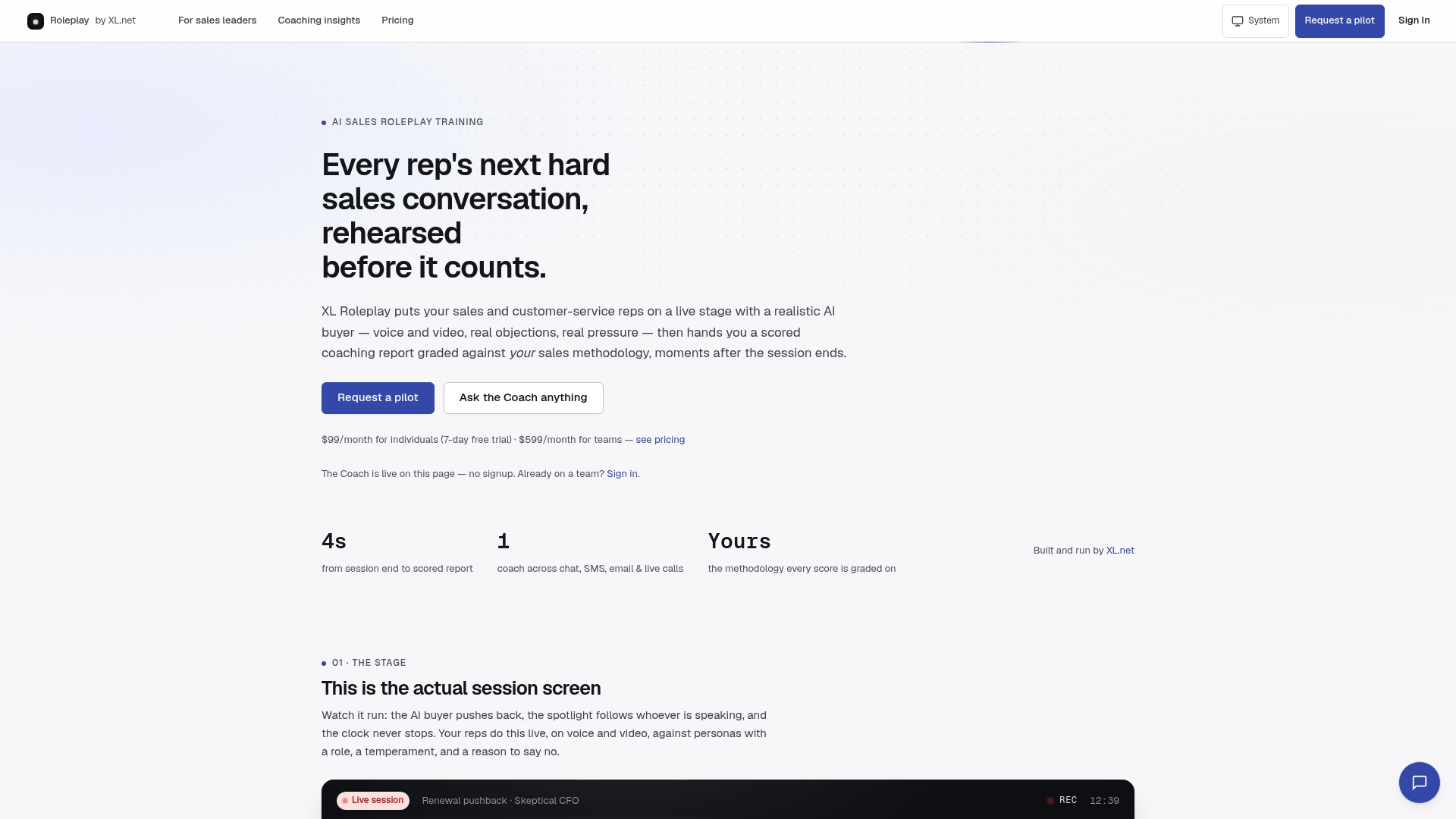
That is the gap we built XL Roleplay to fill. Agents practice live voice and video conversations with realistic AI buyers and customers who raise the objections and pressures real calls bring. Each session produces a scored coaching report grounded in the organization’s own methodology and playbook, not a generic standard, and every point in the report links back to the transcript so the manager and the rep are looking at the same evidence.
We think this changes the coaching conversation. When the feedback is tied to a specific moment in a transcript, the discussion moves from “I disagree with the score” to “here is what I would say differently.” Managers get detailed session evidence for every rep, not only the few calls a QA sample catches, and reps get a low-risk place to try again.
Our advice: keep scoring and coaching in separate conversations, coach one behavior at a time, and put practice between the coaching session and the next live call.
Adam
Try it with your team
If your QA data already shows where agents struggle, the next step is giving them somewhere to practice. XL Roleplay offers live voice and video role-play with AI buyers and personas, scenario libraries built around your own playbook, scored coaching reports, transcripts and readiness scoring for individuals and teams.
Plans are published on the pricing page: Individual is $99 per month and Business is $599 per month. Extra seats are $54.95 per month per seat, and extra video is $16.99 per hour. Teams that want to test it against a specific coaching goal can look at the XL Roleplay pilot.
For more on building the measurement side, browse our articles on customer service QA best practices, QA scorecard templates and effective QA strategies for call centers.
FAQ
Is QA the same as coaching in a call center?
No. QA evaluates interactions against a standard and produces scores, trends and compliance findings. Coaching is the ongoing conversation and practice that helps an agent improve. QA supplies the evidence, and coaching uses it.
Who should do QA and who should do coaching?
QA is usually done by dedicated analysts or supervisors using a calibrated scorecard. Coaching belongs with the team lead or manager who owns the agent’s performance. In small centers one person may do both, in which case it helps to hold scoring and coaching conversations separately.
How often should agents be coached after a QA review?
There is no single right cadence, but coaching should be regular and tied to a follow-up date set in the session. Many managers pair a recurring one-to-one with a specific goal, then check recent reviewed calls at the next meeting to see whether the behavior changed.
Can AI replace QA or coaching?
AI can widen QA coverage by evaluating far more interactions than a human sample, and it can provide practice partners for agents. Coaching still depends on a manager who knows the person and agrees on next steps with them. The best use of AI is to give managers better evidence and agents more practice.
What should a QA-informed coaching session cover?
One or two skills backed by several conversations, a concrete example of each, a strength to reinforce, the agent’s own view, and one observable goal. End by recording the next step and the date you will check progress.
Sources
- Quality Assurance vs Coaching in Contact Centers
- Ask the Expert: Quality Assurance and Training Connection
- Five Must-Haves for an Effective Contact Center QA Program (ICMI)
- Best Practices in Quality Monitoring and Coaching (BenchmarkPortal)
- Measure Up and What You Can Do About It (ICMI)
- Call Center Customer Service QA (SQM Group)
- How to Empower Customer Service Agents (Call Centre Helper)