Trainer Ready Call Center Role Play: Five Phase Scripts and Rubric
Trainer Ready Call Center Role Play: Five Phase Scripts and Rubric

Run a phased scenario curriculum with time-boxed practice, copy-paste scripts, and a simple scoring rubric, then repeat the weak scenarios until agents hit a readiness threshold. That sequence beats one-off practice sessions because it builds skill in the order agents actually need it: intake first, then procedures, then systems, then the hard emotional calls. Below you’ll find a scenario shortlist by training goal, a five-phase progression plan, a session runbook with a scoring rubric, ready scripts, and notes on where AI role-play tools like XL Roleplay fit into the mix.
TL;DR:
- Role-play should follow a phased curriculum starting with intake and basic procedures before progressing to complex soft skills and full-call simulations.
- Scenarios must be aligned with specific training goals, using real call logs to ensure emotional authenticity and system relevance.
- Use a consistent rubric with five scoring dimensions to track agent progress and ensure reliable, measurable development across practice sessions.
- Incorporate AI role-play tools for scalable repetition and objective scoring, especially for scenarios demanding high-pressure de-escalation and system navigation drills.
- Effective debriefing involves identifying one behavior for improvement, re-running the scenario immediately, and linking scores to targeted coaching and KPI adjustments.
Table of Contents
- Call Center Role Play Scenarios by Training Goal
- A Five-Phase Curriculum for Call Center Training Scenarios
- How to Run a Role-Play Session: A 5-Step Runbook
- Scripts You Can Use Today
- When AI Role-Play Simulators Actually Help
- Debriefing, Scoring, and Closing the Improvement Loop
- Customizing Scenarios to Your Systems and KPIs
- Handling Resistance and Discomfort in Role Play
- Getting Realistic Emotional Reactions Out of Role Players
- Turning Role-Play Data Into Ongoing Performance Management
- Trainer Perspective: The Mistakes That Quietly Sink Role Play
- Try XL Roleplay Alongside Your Live Sessions
- Sources
- FAQ
Call Center Role Play Scenarios by Training Goal
Picking the right scenario for a session matters more than picking a lot of them. Group your library by the skill you’re actually training, and the selection gets fast.
Intake and identification
- Standard verification call. Customer calls in frustrated that they “already gave this information twice.” Agent must verify identity smoothly without repeating the friction. Best for new hires in week one.
- Wrong account pulled up. Agent has to catch a mismatched account before proceeding. Trains attention to detail over speed.
Billing and refunds
- Overcharge dispute. Customer swears they were charged twice; the log shows one legitimate charge. Agent must explain without sounding dismissive.
- Refund outside policy window. Customer wants a refund 45 days after a 30-day cutoff. Best for agents who’ve already mastered the standard refund flow.
- Partial refund negotiation. Product was used but defective. Agent offers a partial credit and has to justify the math clearly.
Technical troubleshooting
- Basic reset walk-through. Customer isn’t tech-savvy; agent must give step-by-step instructions without jargon. Good beginner scenario.
- Intermittent issue, no clear cause. Customer describes a problem that doesn’t reproduce on command. Trains diagnostic questioning.
- Multi-device conflict. Two devices on one account are fighting each other. Advanced scenario requiring system fluency.
Escalation and de-escalation
- Loud, angry opener. Customer starts yelling in the first ten seconds. Agent must slow the pace and regain control. This one is best run with an experienced role-player, since scenario design pulled from real failed calls tends to feel more authentic than an invented script.
- Demand to speak to a manager immediately. Agent has to decide whether to de-escalate or transfer, and defend that choice in the debrief.
Retention and churn prevention
- Cancellation request, price complaint. Customer wants out over cost. Agent has one retention offer to use, no more.
- Silent churn signal. Customer isn’t asking to cancel but mentions a competitor twice. Trains agents to catch signals they’d otherwise miss.
Policy limits (cannot refund/waive)
- Firm no with empathy. Company policy genuinely can’t bend. Agent must say no without saying “policy” more than once.
Upsell and expansion
- Natural upgrade opening. Customer’s usage pattern suggests they need a bigger plan. Agent has to raise it without sounding like a pitch.
Multi-step workflows
- Ticket creation plus callback scheduling plus internal note. Tests whether an agent can hold a conversation while executing three system tasks correctly.
Beginners should stick to intake, basic troubleshooting, and the firm-no scenario. Save escalation, silent churn, and multi-step workflows for agents who’ve already passed Phase 2 of the curriculum below.
A Five-Phase Curriculum for Call Center Training Scenarios
Skipping straight to hard emotional scenarios is the single biggest mistake in most training programs. A phased, scenario-based curriculum that moves from intake to procedures to systems to complex soft skills to full-call runs builds readiness more reliably than random scenario selection.
- Phase 1: Intake and identity verification. Objective: agents can open a call and verify a customer without stumbling. Practice the intake script repeatedly, since heavy repetition of this exact script early in training is what builds real call control. Run this frequently in early training sessions with several reps per session. Pass criteria: agent completes verification efficiently with all required fields correctly verified.
- Phase 2: Straightforward procedures. Objective: handle common, low-emotion requests (address change, simple refund, plan lookup) end to end. Practice three to four times a week. Pass criteria: high procedural accuracy consistently demonstrated across multiple attempts.
- Phase 3: Systems fluency. Objective: navigate the CRM or ticketing system while talking, not before or after. Blend sandbox time with live-dialog practice. Pass criteria: correct fields populated on first attempt, with minimal system navigation errors.
- Phase 4: Complex soft skills and troubleshooting. Objective: handle anger, ambiguity, and multi-cause technical problems. This is where scenarios built around real escalation calls pay off most, since invented anger rarely matches the real thing. Pass criteria: strong rubric scores indicating effective empathy and resolution clarity.
- Phase 5: Full-call runs. Objective: string together intake, procedure, system work, and emotional management in one uninterrupted call, timed like a real shift. Run weekly. Pass criteria: full call completed within target handle time with satisfactory rubric scores across all dimensions.
Blend classroom micro-learning (10 minutes on a concept) with drill practice (repetition of one skill) and sandbox time (system-only, no talking) so agents aren’t learning three new things at once.
How to Run a Role-Play Session: A 5-Step Runbook
Most sessions fail not because the scenario was bad, but because nobody assigned clear roles or timed anything. Here’s a runbook you can use tomorrow.
- Prepare. Pick one scenario, print or share the script snippet, and confirm the customer persona and key facts in advance.
- Assign roles. One agent, one customer role-player, one observer scoring the rubric, and ideally one coach who stays silent until the debrief.
- Timebox it. Cap the call portion at 5 to 8 minutes. Longer calls dilute focus and make debriefs sprawl.
- Score it. Use a rubric with five dimensions: empathy, compliance, process accuracy, system navigation, and resolution clarity. Score each 1 to 5.
- Debrief and re-run. Discuss one behavior to fix, not five. Re-run the same scenario immediately so the fix gets encoded while it’s fresh.
Rotate roles every session so agents experience both sides of the conversation. A typical cadence is two to three sessions a week, 20 to 30 minutes each, with role-players and observers swapping in.
A sample pass threshold: an agent needs an average rubric score of 4.0 or higher, with no single dimension below 3, to move to the next phase.
For remote or hybrid teams, record every session (with consent), use a reliable softphone or VoIP connection, and share screens during system-navigation scenarios. Chat-based variants work the same way, just swap the script for typed lines and score response time as an added dimension.
Pro Tip: Keep an observer’s rubric sheet visible to the agent during the debrief, not just verbal feedback. Seeing the actual score next to “empathy: 2” lands differently than hearing it.
Scripts You Can Use Today
Scripted lines that sound robotic defeat the purpose. Use these as fragments to adapt, not lines to memorize word for word.
- Intake opener: “Thanks for calling, I can see your account here. Before we get into it, can you confirm the name on the account for me?”
- Empathy line: “That’s frustrating, and I’d feel the same way if it happened to me. Let’s figure out what went wrong.”
- Facts check: “Just so I have this right, the charge appeared on the 14th and you didn’t recognize it. Does that match what you’re seeing?”
- Policy refusal with empathy: “I know that’s not the answer you were hoping for, and I wish I could make an exception here. What I can do is…”
- Escalation handoff: “I want to make sure this gets resolved the right way, so I’m going to bring in someone who can help further. Give me one moment.”
- Retention offer: “Before you go, I want to make sure you know about an option that might change things. Can I walk you through it?”
- Close: “Is there anything else I can help you with today, or did we get everything sorted?”
A simple scenario template: goal (what does resolution look like) → persona (who is this customer, what’s their mood) → key facts (what’s actually true in the account) → system actions (what must the agent click or log) → script fragments (which lines above apply). A reusable script framework built this way scales across dozens of scenarios without rewriting from scratch each time.
When AI Role-Play Simulators Actually Help
AI simulation isn’t a replacement for live practice, but it fills gaps live sessions can’t cover well. It shines in three situations: scaled repetition (running the same intake script fifty times without burning out a human role-player), high-pressure de-escalation drills where a live partner might soften the intensity, and combined talk-plus-system simulation where the AI tracks both dialog and clicks at once.
AI role-play platforms give you repeatable, data-driven practice that pairs conversation with system navigation and produces an objective score instead of a supervisor’s gut feeling.
What to capture from an AI session:
- Readiness scores that show whether an agent is trending toward Phase 4 or 5 pass criteria.
- Transcripts you can pull specific lines from during a debrief.
- Rubric breakdowns that flag which dimension (empathy, compliance, process accuracy) is dragging the average down.
XL Roleplay, for instance, runs live voice and video sessions against AI buyers built around your organization’s own methodology, then hands back a scored coaching report and full transcript so a manager can see exactly where an agent lost the thread instead of relying on a vague summary. The value only shows up when someone actually reviews that report and assigns a fix. Simulation without a follow-up rubric is just a fancy recording.
Debriefing, Scoring, and Closing the Improvement Loop
A debrief that skips straight to “good job, next scenario” wastes the entire exercise. The fix is boring but effective: pick one behavior to improve, name it specifically, and re-run the same scenario before moving on. That immediate re-run is what encodes the corrected behavior instead of letting the mistake fade into a vague memory of “that one call.”
Scoring should never be purely subjective. Use the five-dimension rubric from the runbook (empathy, compliance, process accuracy, system navigation, resolution clarity) every single time, even for a two-minute practice round. Consistency matters more than complexity here. A rubric that changes shape from session to session gives you no way to track progress across weeks.
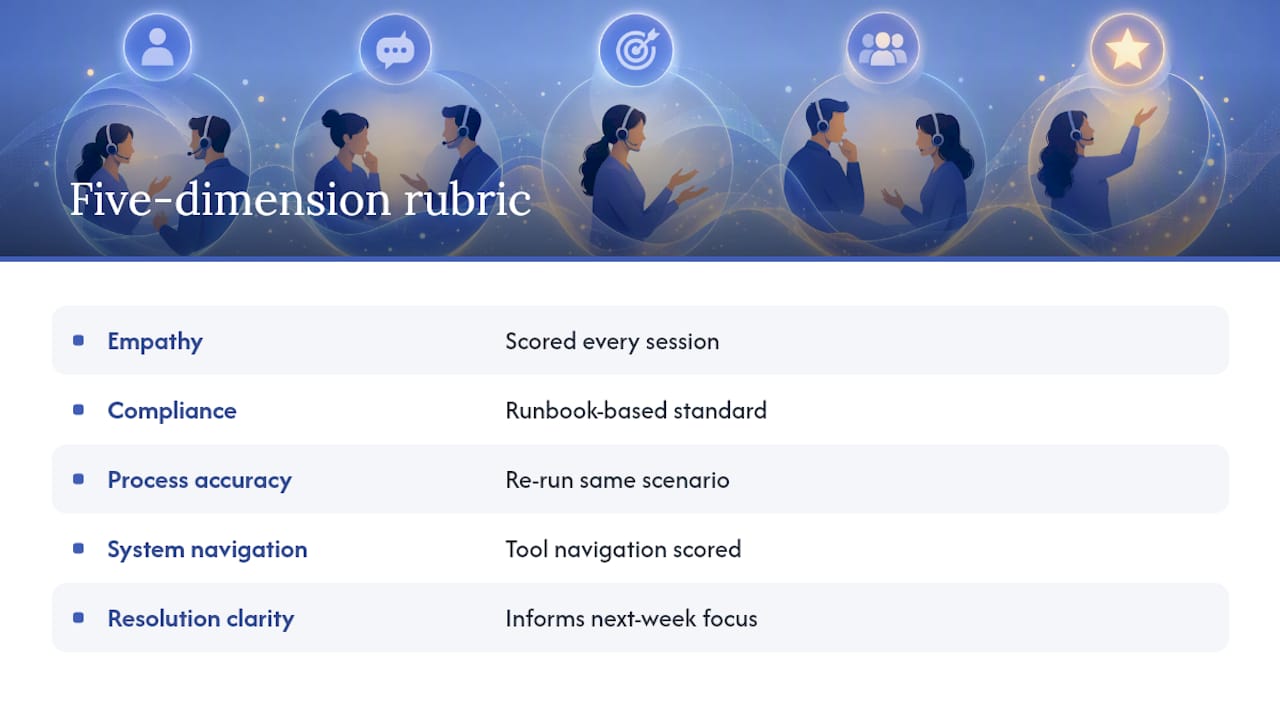
Readiness criteria should be explicit and written down before the session starts, not decided after the fact based on how the call felt. An agent is ready to move phases when they hit a defined score threshold across multiple consecutive attempts, not a single lucky run.
The improvement loop closes when scores from this week’s sessions feed into next week’s scenario selection. If three agents all scored low on “resolution clarity” during billing disputes, that becomes next week’s focus scenario, not a random pick from the library. Managers who track this at the individual level catch skill gaps months before they show up in live-call quality audits.
Customizing Scenarios to Your Systems and KPIs
A generic scenario script from a blog post won’t match your CRM screens, your hold-time targets, or your specific refund policy. It needs adapting before it’s useful.
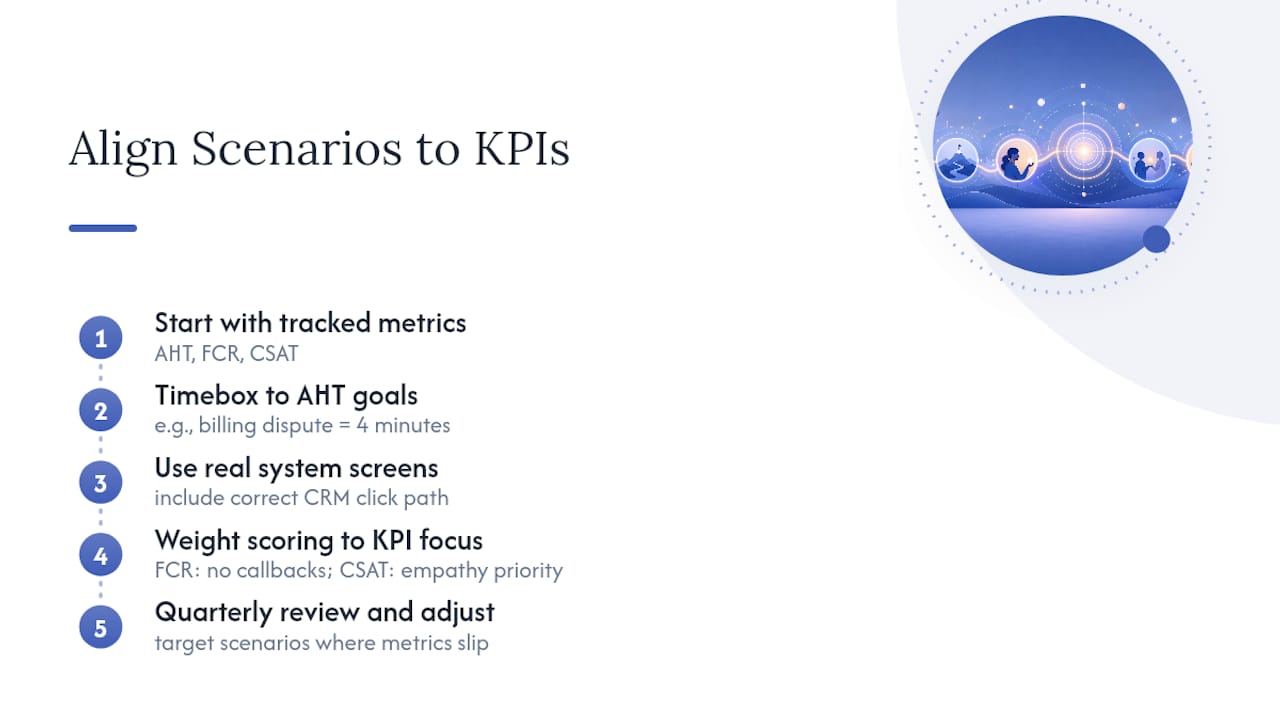
Start with the metrics your center actually tracks: average handle time (AHT), first-call resolution (FCR), and customer satisfaction (CSAT). Build scoring notes into scenarios that mirror those targets. If your AHT goal for a billing dispute is four minutes, timebox that scenario at four minutes and flag it when an agent runs long, so the practice constraint matches the real one.
Pull your actual system screens into the scenario. If system navigation is scored during role play, the observer needs to know the correct click path in your specific CRM, not a generic one. Scenarios built from your own past calls or ticket logs will always outperform generic scripts, since they surface the exact friction points your systems actually create for agents.
FCR practice means building scenarios that require full resolution in one call, no callback shortcuts allowed, and scoring agents down when they punt an issue that should’ve been solved on the spot. CSAT-focused scenarios should weight the empathy and resolution-clarity rubric dimensions more heavily than process accuracy, since that’s closer to what a satisfaction survey actually measures.
Review your KPI dashboards quarterly and adjust scenario difficulty and frequency based on where real call metrics are slipping. If FCR dropped last quarter specifically on technical tickets, that’s your next scenario-writing priority, not a hunch.
Handling Resistance and Discomfort in Role Play
Some agents dread role play more than the actual angry customer. That reaction is common, and ignoring it just makes people fake their way through sessions instead of practicing honestly.
The most frequent complaint is embarrassment in front of peers. Fix this by starting new hires with one-on-one sessions before adding an audience, and by normalizing mistakes out loud: tell the group upfront that stumbling here is the entire point, since a mistake in practice costs nothing and a mistake on a live call costs a customer.
Another common source of resistance is scenarios that feel fake or exaggerated. Agents can tell when a customer persona doesn’t match anything they’ve actually encountered, and they check out mentally. Scenarios built from transcribed real calls solve this, since the emotional beats and phrasing already ring true instead of sounding like a training manual wrote them.
Experienced agents sometimes resist because they feel role play is beneath them. Address this directly by putting them in the observer or coach seat sometimes, scoring newer agents instead of always being scored themselves. It reframes the exercise as a skill they’ve mastered rather than a hoop to jump through.
Finally, some resistance is really about the debrief, not the role play itself. If feedback in the past felt like public criticism, agents will avoid volunteering. Keep debrief language specific and behavior focused (“the hold-time explanation ran long” rather than “you weren’t clear”), and the discomfort usually fades within two or three sessions.
Getting Realistic Emotional Reactions Out of Role Players
A customer role-player who plays it too calm defeats the entire scenario. The agent never has to practice actually managing tension, and the session teaches nothing about de-escalation.
Give role-players a specific emotional trajectory to follow, not just “be angry.” A note like “start at a 6 out of 10 on frustration, escalate to an 8 if the agent apologizes without offering a concrete next step, de-escalate to a 3 once a real timeline is given” gives them something to actually perform instead of guessing.
Coach observers to watch for the moment an agent’s tone shifts under pressure, since that’s usually where the real skill gap lives. A rubric score alone won’t capture that a gent’s voice got flatter and faster the second the customer raised their voice. Note it verbally in the debrief.
Feedback lands better when it’s immediate and narrow. Don’t save every observation for the end of a ten-minute call. A quick pause after a rough moment (“let’s rewind that line, try it again with a slower pace”) reinforces the fix while the context is still live in the agent’s memory.
Rotating who plays the difficult customer also matters. An agent who always plays calm customers never builds the muscle for handling a genuinely hostile one, and a role-player who always plays angry burns out fast. Spread the emotional range across the team.
Turning Role-Play Data Into Ongoing Performance Management
A role-play score that lives in a spreadsheet nobody reopens is wasted effort. The real value comes from connecting session results to the systems you already use for coaching and reviews.
Feed rubric scores into whatever one-on-one coaching cadence your team already runs. If an agent consistently scores low on compliance during policy-refusal scenarios, that becomes a specific agenda item in their next coaching check-in, not a vague “keep improving” note.
Readiness scores from Phase 4 and 5 practice should inform actual scheduling decisions. An agent who hasn’t cleared the full-call-run threshold probably shouldn’t be handling the center’s most complex ticket queue yet, regardless of tenure.
Quarterly performance reviews get sharper when they cite specific rubric trends instead of general impressions. “Empathy scores climbed from 2.8 to 4.1 over two months of escalation practice” is a concrete, defensible data point that both the agent and the manager can act on.
Transcripts and scored coaching reports also help identify systemic gaps across an entire team, not just individuals. If ten agents all score low on the same dimension in the same scenario type, that’s a training design problem, not ten separate performance issues. Treat the pattern, not just the individual score.
Trainer Perspective: The Mistakes That Quietly Sink Role Play
The biggest failure is over-scripting. Word-for-word scripts produce agents who freeze the second a real customer deviates from the page. The fix is modular fragments, not full scripts, so agents practice adapting rather than reciting.
Second, most programs skip system practice and only rehearse the talking. That’s backwards. Agents fumble tickets on live calls not because they can’t empathize, but because nobody made them click through the actual CRM while talking under pressure.
Third, inconsistent debriefs kill the whole exercise. If the rubric changes every session, nobody can track progress. Pick five dimensions, score every time, and don’t improvise new criteria mid-session. Record the weak scenarios and re-run them the following week instead of moving on and hoping it sticks.
— Adam
Try XL Roleplay Alongside Your Live Sessions
Live role play builds the muscle. XL Roleplay adds the repetition your schedule can’t fit. It runs on-demand voice and video sessions against AI buyers modeled on your organization’s own sales or service methodology, then returns a scored coaching report and full transcript so a manager can see exactly where a call went sideways without sitting in on every session personally.
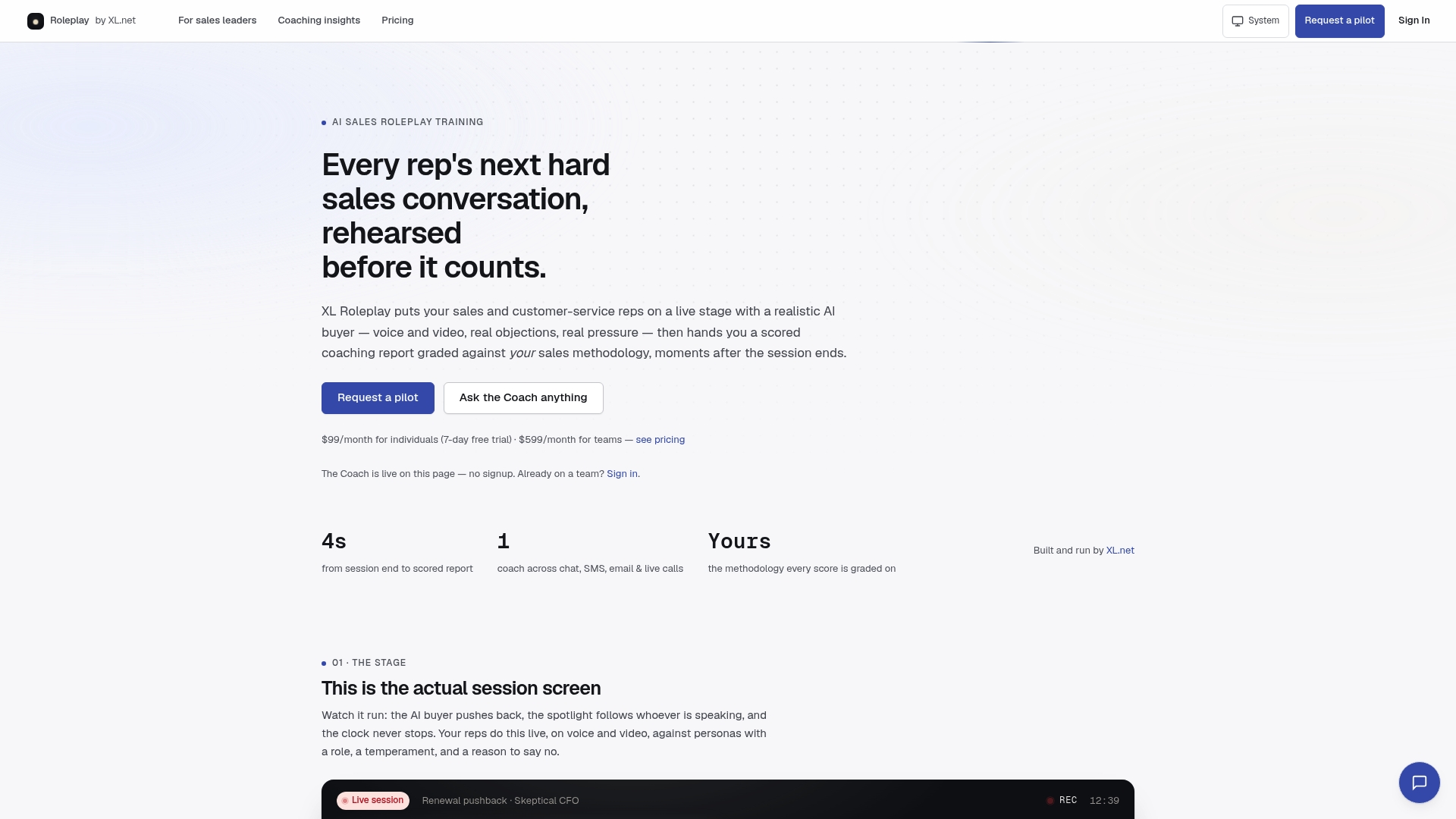
Think of it as the Phase 4 and 5 practice partner that’s available at 11 p.m. the night before a big shift change, not a replacement for the peer-to-peer sessions in your runbook. It slots into the curriculum above: agents who’ve cleared Phase 3 can log extra reps on complex de-escalation or troubleshooting scenarios between scheduled live sessions, and the readiness score tells you when they’re actually ready to move on. If you’re a trainer wanting to try a session yourself, start at Roleplay. If you manage a team and want to see the readiness-scoring and reporting side first, the page for sales leaders is the faster starting point.
Sources
- Scenario-Based Training: Role-playing Examples for Call Center Training
- AI Role Play Training for Contact Centers: A Complete Guide
- Customer service role play scripts: 16 scenarios + free PDF 2026
FAQ
What Are Some Good Role-Play Ideas for Customer Service?
Strong starting points include an overcharge dispute, a wrong-item complaint, a firm policy refusal delivered with empathy, and a basic technical walk-through for a non-technical customer. Pick scenarios that match your team’s actual call logs rather than generic examples.
Can You Give an Example of a Role-Play Scenario?
A common one: a customer calls demanding a full refund 45 days after a 30-day policy window, and the agent must explain the limit, offer an alternative like a partial credit, and keep the tone calm throughout. This scenario works well once agents have cleared basic procedural training.
What Are Good Role-Play Scenarios for Interviews?
Interview role plays typically mirror the same categories used in training: an angry customer needing de-escalation, a policy-limited refund request, and a straightforward troubleshooting call. Interviewers watch for tone control, clear explanations, and whether the candidate stays calm under pressure.
What Are the Four Types of Role Play?
Definitions vary across training programs, but a common breakdown includes scripted role play (following a fixed script), improvised role play (reacting without a script), simulation-based role play (using AI or system sandboxes like XL Roleplay), and observer-based role play (where a participant scores rather than performs).
How Often Should Call Center Teams Run Role-Play Practice?
Two to three live sessions a week of 20 to 30 minutes each works well for most teams, supplemented with additional AI-driven repetition for agents working on specific weak scenarios between sessions.