Certification vs. Readiness: What Each Proves in Sales
Certification vs. Readiness: What Each Proves in Sales

A certification tells you a person learned something and passed a test. Readiness tells you whether that person can handle a live, unscripted customer conversation: finding the real need, answering a hard objection, staying calm under pressure. The two are related, but one does not guarantee the other. Leaders who treat them as the same thing find the gap on the first difficult call.
This article explains what each one measures, where they overlap, how to assess readiness on a sales or customer service team, and how to use certification and practice together.
TL;DR
- Certification validates knowledge and skills against a defined standard. Readiness is the ability to perform in a real conversation, and it has to be observed.
- Certifications are cheap, portable and useful for hiring and onboarding. They are weak evidence of how someone handles objections, complaints or pressure.
- Readiness is measured by comparing current performance with a target, using scored practice on realistic scenarios rather than quiz results.
- The strongest approach is both: certify the fundamentals, then rehearse and score the conversations that matter to your business.
Table of Contents
- What certification actually tells you
- What readiness means in practice
- Certification vs. readiness side by side
- Why a certificate does not mean someone is ready
- How to assess readiness on your team
- A simple readiness checklist for managers
- Our perspective
- Put readiness into practice with XL Roleplay
- Using certification and readiness together
- FAQ
- Sources
What certification actually tells you
A certification is a third-party or industry-recognized statement that someone met a standard. In retail sales and service in the U.S., a well-known example is the NRF Foundation’s RISE Up Customer Service & Sales credential. It is an intermediate, industry-recognized course developed with more than 20 retailers, and it validates knowledge and skills to employers while building workplace readiness in areas such as engaging customers, assessing needs, problem solving and teamwork.
The details show what a certification is built to do. The exam for the NRF Customer Service and Sales Certified Specialist credential covers the customer life cycle, engaging customers, assessing needs, closing sales, problem solving, teamwork, body language, satisfaction and retention. Indiana’s workforce development summary lists a $55 exam cost and no renewal requirement (2023 document). The NRF Foundation itself says exams start at $60, course content at $65 and bundles at $120, and that learners receive a printable completion certificate, a digital badge and a credential.
The online course version is 14 hours long and costs $125. It covers needs discovery, listening, objection handling, complaints, professionalism, teamwork and problem solving. Prices can change, so check the provider’s page for the current figure.
That is a real benefit. A certification gives a new hire a shared vocabulary and a baseline, and gives an employer a signal that is easy to check. But notice what it measures: coverage of a body of knowledge, at a point in time, usually under test conditions. It does not show how that person sounds when a buyer says “your competitor is half the price” and the call is going badly.

Certificates and certifications are not the same
People often mix up the two terms. A certificate generally signals that you completed a course or program. A certification validates your skills and knowledge against a standard within a profession. Both matter less than most job postings imply when the real question is performance on the phone or on video.
Work-readiness credentials versus industry certifications
There is a second distinction. Achieve, a nonprofit education organization, separates work-readiness credentials from industry certifications. Work-readiness credentials signal generic proficiencies such as punctuality, communication, self-discipline and organizational skills. Industry certifications measure qualifications for a specific industry or job function. So “readiness” appears in the name of some credentials, but a work-readiness certificate describes general workplace habits, not whether someone can run a discovery call for your product.
What readiness means in practice
Readiness is performance-based. It asks: can this person do the job’s most important conversations well, today, in your context?
The U.S. Department of Labor’s ONET database gives a useful picture of what that job involves. For customer service representatives, ONET identifies active listening, speaking, reading comprehension, critical thinking and monitoring as essential skills, alongside service orientation, complex problem solving, time management, negotiation, persuasion and social perceptiveness. For sales representatives of services, its core work activities include consulting with customers about their needs, answering questions, explaining proposals, negotiating terms, quoting prices or fulfillment dates, and recommending features based on customer needs.
None of those are things you can fully prove with a multiple-choice question. They are behaviors, and behaviors show up only when someone performs them.
That matches how industrial-organizational psychologists define competencies. The Society for Industrial and Organizational Psychology’s 2022 paper says competencies include the knowledge, skills, abilities and other characteristics needed for effective job performance, and that they are typically defined by on-the-job behaviors. Knowledge is one ingredient. Readiness is the behavior that results when knowledge meets a real person.
A readiness example from a real call
Take a customer service rep handling a billing complaint. O*NET’s description of the role gives the shape of a good outcome: the rep provides product or service information, assesses the complaint, resolves it or refers it for investigation, records the interaction and actions taken, and checks whether the problem was resolved.
A certified rep can probably name every one of those steps. A ready rep does them in order, while the customer is frustrated and interrupting, and still remembers to confirm the problem is solved. The first is knowledge. The second is readiness.
In sales the same split appears in discovery. A certified rep knows that needs assessment comes before pitching. A ready rep asks a second and third follow-up question when the buyer gives a vague answer, instead of jumping to the demo.
Certification vs. readiness side by side
| Certification | Readiness | |
|---|---|---|
| What it shows | Knowledge and skills met a defined standard | The person can perform in real conversations |
| Evidence | Exam score, completion record, badge | Observed behavior, scored practice, call review |
| When it is measured | At one point in time | Continuously, as scenarios and targets change |
| Who sets the standard | An industry body or course provider | Your team, based on your product, buyers and methodology |
| Typical cost | Tens to low hundreds of dollars per person | Manager time and practice time |
| Best for | Hiring screens, baseline onboarding, career portability | Deciding who is ready for live calls and where to coach |
| Weakness | Generic, can be passed without being able to perform | Takes structure to measure consistently |
Both columns have a place. The mistake is using the left column to answer a question that belongs to the right.
Why a certificate does not mean someone is ready
There are four reasons the two diverge.
The standard is generic. A credential built with many employers has to fit all of them. Your buyers, your objections and your sales methodology are specific. A rep can pass a general customer service exam and still stumble on the pricing pushback your market raises every week.
Knowing is not doing. Reading about objection handling and handling an objection out loud are different skills. The second needs repetition and feedback, the way any spoken skill does.
The signal is uneven. Achieve notes that research on how employers use and value work-readiness and industry credentials is sparse, that acceptance varies, and that value depends on the industry and job classification. A badge may carry real weight in one hiring context and little in another.
It is a snapshot. Products change, pricing changes, competitors change. A credential with no renewal requirement says nothing about how current someone’s skills are.
None of this makes certification worthless. It makes it a floor. Think of it as proof someone has the vocabulary, not proof they can have the conversation.

How to assess readiness on your team
If readiness is behavior, you need a way to see behavior before a customer does. Three approaches work, and they combine well.
1. Define the target behaviors
Start by writing down what “good” looks like for each key conversation: discovery, objection handling, pricing, escalation, de-escalation. SIOP says competency-based performance management creates a shared understanding of the work-related behaviors that will be monitored, measured and evaluated. That shared understanding is what lets two managers score the same call the same way.
2. Run a gap assessment
Compare each rep’s current proficiency with the target. SIOP describes competency gap assessments this way: the largest gaps show where training and development matter most. In practice this tells you that one rep needs work on discovery questions, another on closing, and a third on staying composed with angry customers, instead of sending everyone to the same refresher.
3. Observe people performing
The oldest tool here is the assessment center. The Association for Talent Development describes assessment centers as formal procedures using group and individual exercises to evaluate behaviors important to a specific position, typically with trained assessors and several exercises. The principle is sound: judge what people do in a realistic exercise. The old way is expensive and hard to repeat weekly.
This is where AI simulation changes the economics. ATD reported in 2025 that AI simulations can provide scorecards showing missed compliance issues and hesitation points, then direct learners toward targeted practice or microlearning. It also reported that scenarios can be built from sales workflows, scripts, customer objections and defined personas, so reps practice realistic conversations. You get an assessment-center style observation without scheduling assessors.
If you want ideas for what to rehearse, our sales role play scenarios playbook lays out scenarios trainers can use, and our sales simulation scenarios articles go further.
A simple readiness checklist for managers
Before putting a rep on live calls, ask:
- Can they run discovery and surface a need the buyer did not state at first?
- Do they handle the top three objections for your product without stalling or discounting immediately?
- Do they follow your sales methodology, not just a generic one?
- Do they stay composed when the buyer is rushed, skeptical or upset?
- Do they close the conversation with a clear next step and record it?
- Has someone other than the rep reviewed the evidence, such as a transcript or a scored session?
A rep who passes a certification and fails this list needs practice, not another course.
Our perspective
We build training around one belief: readiness is something you demonstrate, not something you declare. We have seen the pattern from both sides. A team completes the course, collects the badges, and still treats the first hard objection as a surprise.
So we do not see certification and readiness as rivals. Certification is a good way to get everyone to a common baseline. But the thing sales leaders and service managers really want to know is whether a rep will hold up in the conversation that matters, and that needs practice against realistic buyers, scoring against your own methodology, and a record managers can review.
That is why XL Roleplay is built around one persistent AI coach with shared memory across channels, and why scoring and coaching are grounded in each organization’s own playbook rather than a generic standard. Feedback is linked to the transcript, so a rep can see exactly which sentence lost the buyer and a manager can see it too. Generic standards tell you whether someone knows the material. Your playbook tells you whether they are ready for your customers.
— Adam
Put readiness into practice with XL Roleplay
XL Roleplay lets reps practice live voice and video conversations with realistic AI buyers who raise typical objections and pressure. Each session ends with a scored coaching report based on your methodology, plus a full transcript and rubric your managers can review. You can also build a customized scenario library so practice mirrors your real calls.
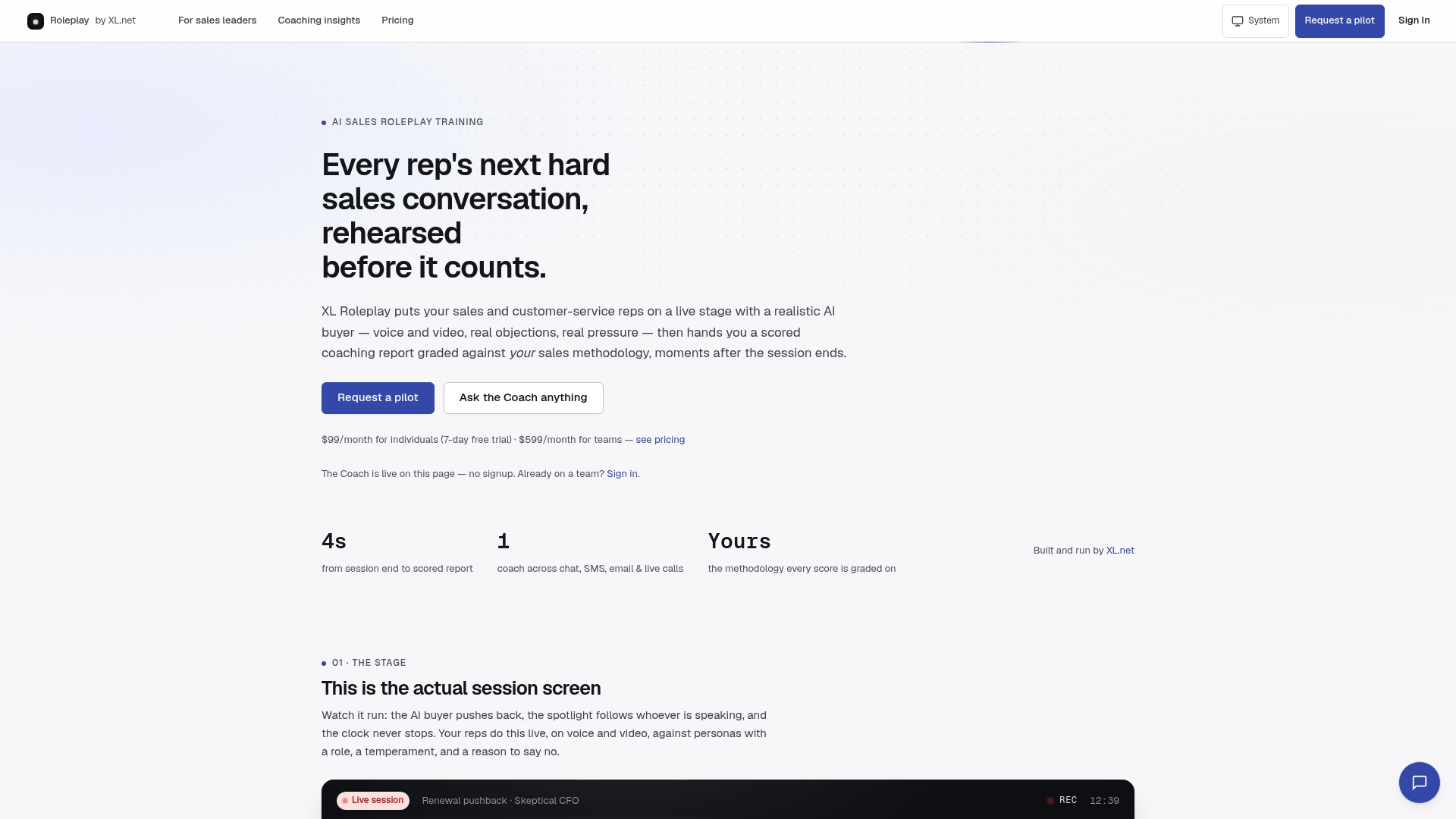
Plans are published on our pricing page: Individual is $99 per month and Business is $599 per month. Extra seats are $54.95 per month per seat, and extra video is $16.99 per hour. If you lead a team and want to test it on a real group first, look at the XL Roleplay pilot, or read how we work for sales leaders.
Using certification and readiness together
The practical answer is a sequence, not a choice.
Step one: certify the fundamentals. For new hires without a background in sales or service, a recognized credential gives structure and a baseline. It also tells you who completed the learning.
Step two: translate the standard into your scenarios. Take the topics the credential covers, such as needs assessment, objection handling and complaint resolution, and turn each into a scenario using your product, your buyers and your real objections.
Step three: score practice, not just completion. Track how reps perform against your rubric over several sessions. Improvement across sessions is better evidence of readiness than a single pass.
Step four: review with evidence. Managers coach from transcripts and scores, so feedback names specific moments rather than general impressions.
Step five: set a readiness bar. Decide what score on which scenarios means a rep is cleared for live calls, and apply it to everyone the same way. That is the standardization leaders usually want and rarely get from certificates alone.
If you are exploring tooling, our articles on AI sales role play and AI service training cover how teams use it for sales and support.
FAQ
What is the difference between training and certification?
Training is the learning itself: lessons, practice, coaching. Certification is a formal validation, usually an exam, that you met a defined standard. Training builds the skill, certification records that you have the knowledge. Many credentials bundle both, but you can have training with no certification and the reverse.
Can you give an example of readiness?
A customer service rep who gets an angry billing complaint, finds the cause, resolves it or refers it correctly, records what happened and confirms the customer’s problem is solved is showing readiness. O*NET describes these steps as part of the role. The key is that the rep does them live, under pressure.
Does a certification mean a rep is ready for customer calls?
Not by itself. It shows the rep learned and was tested on a body of material. Readiness needs observed performance in realistic conversations, ideally scored against your own standards. Treat certification as a baseline and readiness as the decision about live calls.
How do I measure readiness across a team?
Define target behaviors for your key conversations, score each rep against them, and compare current and target proficiency to find the biggest gaps. Repeat on a schedule so you can see change. Realistic simulation makes this repeatable, because every rep faces comparable scenarios and gets scored the same way.
Is a work-readiness certificate the same as sales readiness?
No. Work-readiness certificates generally signal general workplace skills such as communication and punctuality. Sales readiness is specific: discovery, objections, negotiation and following your methodology with your buyers.
Sources
- NRF Foundation: Customer Service & Sales credential
- NRF Foundation: Customer Service & Sales course
- Indiana DWD: Customer Service and Sales Certified Specialist
- Achieve: Work Readiness Certification and Industry Credentials
- O*NET: Customer Service Representatives
- O*NET: Sales Representatives of Services
- SIOP: Competency Modeling
- ATD: The Assessment Center as an Aid in Management Development
- ATD: Selling AI-Backed Learning