Coaching Workflow for Managers: A Six-Step Cycle
Coaching Workflow for Managers: A Six-Step Cycle

A coaching workflow is a repeatable cycle a manager runs with each direct report: decide whether to coach or direct, prepare, hold the conversation, give focused feedback, practice the skill, then agree actions and follow up. The cycle matters more than any single conversation. Coaching that happens once, without practice or follow-up, rarely changes what an employee does on the next customer call.
This guide lays out that cycle step by step, with the questions to ask, the pieces of paper to keep and the mistakes that quietly break it. It is written for sales and customer service managers, but the structure works for any team that talks to customers.
TL;DR
- Coach when the employee knows enough to think the problem through and the cost of a mistake is acceptable. Direct when safety, legal duties, or non-negotiable standards are involved.
- Run coaching as a cycle: goal, observation, reflection, feedback, practice, follow-up. Skipping follow-up is where most managers lose the gain.
- Prepare for every one-on-one by reviewing past notes and open action items, and end by confirming the next actions in writing.
- Give feedback on one or two specific behaviors, not a list of ten.
- Add practice between conversations, so the next real customer call is not the first attempt.
Table of Contents
- Decide first: coach or direct
- The six steps at a glance
- Step 1: Prepare for the conversation
- Step 2: Open with questions, not answers
- Step 3: Give feedback that can be used
- Step 4: Practice the behavior before the next real call
- Step 5: Agree on actions and close the loop
- Step 6: Follow up and measure
- Matching coaching style to the situation
- Ten coaching skills to build
- Our perspective: why practice is the missing step
- Put practice into your workflow with XL Roleplay
- Mistakes that quietly break the workflow
- A sample four-week cycle
- FAQ
- Sources
Decide first: coach or direct
The workflow starts before any conversation, with a choice. Not every situation calls for coaching. One framework from a professional training provider says a manager should coach when the employee has enough knowledge to think through the situation and the cost of learning by trying is acceptable. It says to direct instead when safety, legal duties, severe time pressure or non-negotiable standards are in play.
The same source treats coaching, advising, teaching and directing as distinct responses, not rungs on a ladder. The useful rule is to pick the least directive response that is still safe and useful for the specific task.
In a sales or support team, that sorts out like this:
- Coach: a rep who runs a weak discovery call but knows the product and the process. A support agent who gets defensive when a customer pushes back on a refund.
- Teach: a new hire who does not yet know the qualification framework or the pricing rules.
- Direct: a rep about to make a claim that breaks a compliance rule. A deadline that cannot move.
Most managers get this wrong in one direction. They give instructions and call it coaching. If you find yourself talking for most of the meeting, you are probably telling, not coaching.
The six steps at a glance
| Step | What the manager does | Output |
|---|---|---|
| 1. Prepare | Reviews prior notes, open actions, recent calls | A short agenda |
| 2. Open the conversation | Asks open questions, listens | Shared view of the challenge |
| 3. Give feedback | Names one or two specific behaviors | A clear focus area |
| 4. Practice | Rehearses the behavior in a safe setting | Observed attempt |
| 5. Agree actions | Writes down what happens before the next meeting | Action items with an owner |
| 6. Follow up | Checks results against the goal | Evidence of change, or a new cycle |
Research on coaching cycles describes the same shape. A Columbia University education center says real change needs cycles of goal setting, observation, reflection, feedback and follow-up, not one-off interactions. The context there is teaching, but the logic carries over to any skill that is performed in front of another person.
Step 1: Prepare for the conversation
Preparation is the cheapest step and the most skipped. University HR guidance for one-on-ones suggests managers review previous conversations, open action items, observations and feedback before the meeting, and agree on a simple agenda with the employee.
A ten-minute preparation routine for a sales or service manager:
- Open your notes from the last session. What did you agree on?
- Check whether those actions happened. Do not guess.
- Pick one or two recent calls, recordings or tickets to anchor the discussion. One specific example beats a general impression.
- Write the single outcome you want from this meeting, such as a rep who can describe how they will open discovery differently.
- Note the employee’s recent wins. You will start there.
The agenda should be shared, not sprung on the employee. The same UC Irvine guide frames the meeting as mutually beneficial, so the employee should be able to add items.
Cadence matters too. That guide suggests monthly one-on-ones as a baseline. Many sales teams run coaching more often than that; our articles on sales coaching cadence look at how teams set the rhythm. Whatever you pick, the point is that it is fixed on the calendar and survives a busy quarter.
Step 2: Open with questions, not answers
The core coaching skills are plain. A Harvey Mudd College feedback and coaching guide lists them as active listening, powerful open-ended questions, and helping the employee solve the problem rather than handing over the answer. Stanford’s executive coaching curriculum describes a similar arc: frame the issue, explore possible actions, commit to a path.
That arc gives you a simple question set:
Frame the issue
- What would you like to get out of this conversation?
- Walk me through the call. Where did it start to feel difficult?
- What were you trying to achieve at that moment?
Explore options
- What else could you have said there?
- What have you seen work for other reps, or in your own best calls?
- What would the customer have heard if you had asked that question?
Commit
- Which of those will you try on your next call?
- What could get in the way?
- How will we both know it worked?
Two habits make these questions land. First, pause after asking. A silence of a few seconds feels long to a manager and is usually when the employee does the thinking. Second, reflect back what you heard before adding your own view. A sales-coaching blog describes a prompt called WAIT (Why Am I Talking) as a way to catch the urge to jump in with instructions, and the idea is worth borrowing even if you never use the acronym.
Stanford’s first module also covers cognitive and implicit biases, and personal leadership hot-buttons, as factors in engaging others. Worth a note for managers: the rep you find most annoying is the one whose calls you are most likely to over-correct. Check that your feedback is about the behavior.
Step 3: Give feedback that can be used
Feedback is where coaching conversations most often fall apart. The Columbia guidance says effective feedback is specific, manageable and strengths-based, focused on one or two clear areas tied to the goal. That rules out the debrief that lists eight issues from one call.
A workable structure:
- Start with what worked, and be exact. Not ‘good energy’, but ‘you asked what had changed in their process before you pitched’.
- Name one behavior to change, in observable terms. ‘You moved to pricing before the customer confirmed the problem’ is observable. ‘You rushed’ is not.
- Say why it matters for the goal you both agreed on.
- Ask the employee how they would handle it differently, before you offer your version.
We have collected worked examples in coaching feedback examples that change behavior, and the articles on coaching conversation skills go further into wording.
Keep coaching separate from deal strategy. A pipeline review asks what will happen with this deal. Coaching asks what skill the rep needs to build. Mixing the two makes the rep defensive about the deal and the skill gets no attention. We explain the distinction in sales coaching versus deal review.
Step 4: Practice the behavior before the next real call
Feedback tells a rep what to change. It does not make the change. Knowing you should confirm the problem before pitching is different from doing it while a skeptical buyer is pushing on price.
Practice closes that gap, and it can be simple:
- Live rehearsal with you. Play the customer for two minutes and let the rep try the new opening. Stop, then run it again with one adjustment.
- Peer role-play. Pair reps, give them a scenario card with the customer’s objection, and have the observer note one thing that worked and one to change.
- Realistic simulation. An AI buyer that speaks, pushes back and can be replayed gives a rep repeated attempts without a manager in the room each time.
The common failure in the first two is time. Managers have a full calendar, and peer role-play often turns awkward and gets dropped. That is the gap AI role-play is built to fill: the rep can rehearse on their own schedule, and you review the result.
Whatever format you use, match the practice to the feedback. If the focus is confirming the problem before pitching, the scenario should put the rep in a call where the buyer volunteers a solution request early. Practicing a general call teaches a general lesson.
Step 5: Agree on actions and close the loop
End each conversation the same way. The UC Irvine guide suggests summarizing the key points and agreeing on action items to be completed by the next meeting, then confirming you are aligned.
Good action items are small, owned and checkable:
| Weak | Better |
|---|---|
| Improve discovery | Ask at least three open questions before presenting on every call this week |
| Handle objections better | Practice the pricing objection scenario twice before Thursday and bring one recording to our next meeting |
| Be more confident | Open the next two escalations by restating the customer’s issue in your own words |
Write them down where both of you can see them. A shared document or a note in your one-on-one tool is enough. Without a record, the next meeting begins with ‘where were we?’ and the cycle loses a week.
Step 6: Follow up and measure
The Columbia guidance quotes a researcher who says that growth stalls when follow-up is skipped, because follow-up is the most essential part of a coaching cycle. You do not need an elaborate system, but you do need to look.
The U.S. Office of Personnel Management’s performance management roadmap for supervisors says to establish relevant KPIs and monitor performance against benchmarks or historical data. University of Minnesota HR describes performance management as a continuous process of goal setting, ongoing feedback and coaching, and evaluation, which is why coaching should not live apart from your regular review of results.
For a sales or service team, pair two kinds of evidence:
- Behavior measures you can observe quickly: number of discovery questions asked, whether the rep summarized the customer’s problem, how the rep handled the objection you coached. These change within days.
- Outcome measures that move slowly: conversion between stages, average handle time, customer satisfaction, escalation rate. These confirm that behavior change matters, but they lag and have other causes.
When you follow up, ask three questions. Did the actions happen? Did the behavior show up in real calls? Did the outcome measure move? If the first answer is no, the problem is commitment or capacity. If the second is no, the practice was not realistic enough. If the third is no, you may be coaching the wrong skill.
Matching coaching style to the situation
The cycle above assumes you are coaching. In a typical week you will switch styles. A useful way to remember the options:
| Style | What you do | Use when |
|---|---|---|
| Coaching | Ask questions, reflect, let the employee reach the answer | The employee has the knowledge and the stakes allow learning by trying |
| Advising | Offer your recommendation and reasoning | The employee has asked, or has hit the limit of what they can work out |
| Teaching | Explain a concept or process | The employee lacks the knowledge |
| Directing | State what must be done | Safety, legal or standards-based requirements, or no time |
This follows the logic in the SEED Academy framework above: choose by the employee’s readiness for the task and the consequences of getting it wrong. A public sector professional association also describes modern management as moving away from command and control toward a Lead-Manage-Coach-Relate model, which is a reminder that coaching is one capability among several, not the whole job.
There is no single best coaching style. Managers who can move between these four, and say out loud which one they are using, tend to be easier to work for. ‘I am going to direct on this one because it is a compliance issue, then I would like to coach you on the rest’ is a perfectly honest sentence.
Ten coaching skills to build
Searchers often ask for a list of coaching skills. Drawing on the sources above, these are the ones that matter in a workflow like this:
- Active listening
- Open-ended questioning
- Reflecting back what you heard
- Tolerating silence
- Framing the issue clearly
- Specific, strengths-based feedback
- Spotting your own biases and triggers
- Goal setting tied to measurable behavior
- Agreeing on actions and writing them down
- Following up consistently
Pick two to work on at a time. Trying to improve all ten at once is the coaching version of giving a rep eight pieces of feedback.
Our perspective: why practice is the missing step
We build XL Roleplay, so we see where coaching workflows break. Most managers do the first three steps reasonably well. They prepare, they ask decent questions and they give feedback. The workflow breaks at step four. The rep nods, agrees with the feedback, and walks into the next call with no rehearsal in between. The manager hears the same issue again next month and concludes the rep is not coachable.

Usually the rep is coachable and has simply had no safe place to try the new behavior. A manager cannot sit in on every rehearsal, and role-play with peers is awkward and inconsistent. So we built live voice and video sessions against AI buyers who raise typical objections and pressure, with a scored report afterward that is tied to the organization’s own sales methodology, plus a transcript the manager can review. The point is not to replace the manager’s judgment. It is to give the manager evidence: what the rep actually said, scored against the standard the team already uses, so the next one-on-one starts from the session and not from memory.
We also think coaching should be grounded in your playbook, not a generic checklist. If your team sells on a particular discovery framework, the feedback should use its vocabulary. Otherwise reps get two sets of advice and follow neither.
— Adam
Put practice into your workflow with XL Roleplay
If you want a practice step that does not depend on your calendar, XL Roleplay gives reps realistic AI buyer conversations and gives you scored coaching reports and transcripts to bring to the next one-on-one. Plans are published on our pricing page: Individual is $99 per month, and Business is $599 per month. Extra seats are $54.95 per month per seat, and extra video is $16.99 per hour.
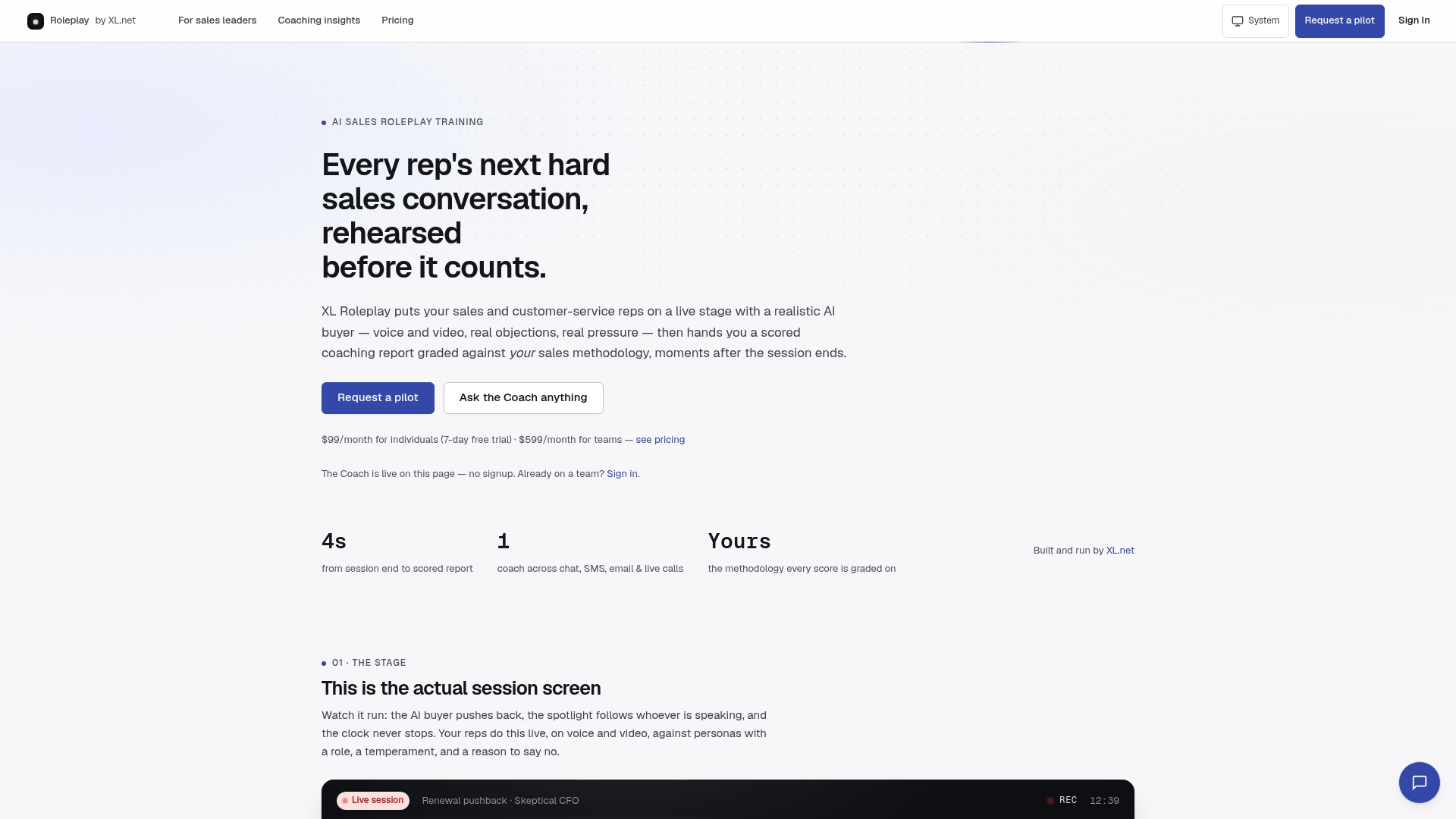
Not sure how it fits your team yet? Our pilot is a way to test it with a group of reps before you commit. If you are building your own coaching skills first, see our sales manager coaching certification path.
Mistakes that quietly break the workflow
Coaching only the people who struggle. Top performers need coaching too, and ignoring them signals that coaching is a punishment.
Letting the one-on-one become a status update. If the meeting is mostly pipeline or ticket queue, the skill conversation never starts. Keep a separate slot, or at least a separate section on the agenda.
Giving feedback on the person. ‘You are not assertive enough’ gives the rep nothing to practice. ‘You accepted the first discount request without asking what it was tied to’ does.
Changing the focus every week. One skill for two to four weeks lets the rep build a habit. A new priority every meeting resets the clock.
Never reviewing the record. If you do not open last time’s action items, the rep learns they do not matter.
A sample four-week cycle
Here is how the six steps might run for a rep who struggles to uncover the customer’s problem before presenting:
- Week 1: Review two recent calls. In a 30-minute one-on-one, ask the rep to walk through where discovery felt thin. Give feedback on one behavior: moving to the demo before confirming the problem. Agree on an action: practice a discovery opening twice before the next call.
- Week 2: The rep practices the scenario in a simulated call or with a peer. You review the results and give a short note on one adjustment.
- Week 3: Listen to one real call. Check whether the new opening showed up. In a 15-minute check-in, ask what felt different.
- Week 4: Compare behavior and outcome measures with where you started. Decide whether to keep the focus, move to the next skill or close the topic.
The time cost is modest, and every step produces something you can look at later.
FAQ
What is a coaching workflow for managers?
It is a repeatable sequence a manager follows with each direct report: prepare, hold a questions-led conversation, give focused feedback, practice, agree on actions, and follow up. The repeat is what separates it from occasional advice. Each cycle should end with a recorded action and begin with a review of it.
How often should a manager coach?
University HR guidance suggests at least monthly one-on-ones with a set agenda. Teams that depend on conversation skills, such as sales and support, often add shorter, more frequent skill check-ins. Choose a rhythm you can keep through busy periods, because consistency matters more than intensity.
When should a manager direct instead of coach?
Direct when safety, legal duties, severe time pressure or non-negotiable standards apply, or when the employee does not yet have the knowledge to think the problem through. Say so openly, then return to coaching for the parts that allow it.
What are the different coaching styles?
In practice, managers move between coaching, advising, teaching and directing. Coaching is the least directive and relies on questions and listening, while directing gives explicit instructions. Pick the least directive style that is still safe and effective for the task at hand.
How do I know if coaching is working?
Look at observable behavior first, such as whether the coached skill appears in real calls, then at slower outcomes such as conversion, handle time or satisfaction. Set the measures before the first conversation and compare at follow-up. If behavior has not changed, review whether practice was realistic enough.
Sources
- When Should Managers Coach or Direct Employees? (SEED Academy)
- Coaching Cycles: A Framework for Growth (Columbia University CPET)
- One-on-One Guide (UC Irvine)
- Feedback and Coaching Guide (Harvey Mudd College)
- Coaching Skills for Effective Leadership curriculum (Stanford GSB)
- Sales Coaching Techniques (MySalesCoach)
- Performance Management Roadmap for Supervisors (OPM)
- Managing and Evaluating Performance (University of Minnesota)
- Learning and Development overview (PSPA)