How to Create Role-Play Scenarios Your Reps Will Use
How to Create Role-Play Scenarios Your Reps Will Use

A good role-play scenario is a short brief with five parts: a real situation, a buyer or customer with a motive, one skill to practice, a few pressure points, and a scoring rubric tied to behaviors you can observe. Build it from your own calls and your own methodology, not from a generic script, and reps will practice what they actually face. Below is the process, three worked examples, and how to keep scenarios current. If you build scenarios for a whole team, we show where our platform takes the manual work off your hands.
TL;DR
- Start with one behavior to change (for example, asking about impact before pitching), not with a topic.
- Every scenario needs a persona, a goal, an opening line, two or three objections or curveballs, and a rubric of observable behaviors.
- Ground scenarios in real calls and tickets, anonymized, so reps recognize the situation.
- Score every session on the same rubric, debrief one behavior, then re-run the scenario.
- Review results every 6 to 8 weeks and rewrite the scenarios that are not moving the numbers, before blaming the reps.
Table of Contents
- What a role-play scenario has to include
- Step 1: Pick the skill and the real conversation behind it
- Step 2: Build the persona and the brief
- Step 3: Add pressure points and curveballs
- Step 4: Write a rubric that two reviewers would score the same way
- Three scenarios you can adapt
- Step 5: Customize for your products, customers and standards
- Step 6: Run the session and debrief one behavior
- Step 7: Measure whether the scenarios work, then revise
- Doing it by hand versus building it into a platform
- Perspective
- Try it on your own playbook
- FAQ
- Sources
What a role-play scenario has to include
A role-play scenario is a written setup for a practice conversation. It tells the person playing the rep what situation they are in, tells the person (or AI) playing the buyer how to behave, and tells the reviewer what good looks like. Most scenarios that fail, fail because one of those three is missing.
Here is the minimum set of parts:
| Part | What it contains | Why it matters |
|---|---|---|
| Skill target | One behavior, such as “quantify the cost of the problem” | Keeps practice focused and makes feedback specific |
| Context | Company size, role, deal stage, what happened before this call | Makes the situation commercially realistic |
| Persona | Job title, priorities, personality, hidden motive | Gives the buyer a reason to push back |
| Opening line | The first thing the buyer says | Starts the conversation without a blank-page pause |
| Pressure points | Two or three objections, a curveball, a decision moment | Tests adaptation rather than recall |
| Rubric | 4 to 6 observable criteria, each scored the same way by every reviewer | Makes feedback consistent |
| Debrief prompts | Questions that turn the result into the next practice | Closes the loop |
This mirrors the seven-step workflow in one published scenario-builder playbook, which runs from defining the behavior target through to debrief prompts that turn outcomes into the next practice action. The same playbook asks that scenarios be stage-appropriate, scored on observable criteria that stay consistent across reviewers, and include at least one unexpected turn to test adaptation.
Step 1: Pick the skill and the real conversation behind it
Do not start with “let’s do an objection scenario.” Start with a behavior you have seen go wrong. Three questions get you there fast:
- Where do deals stall or tickets escalate? Look at lost deals, stalled opportunities, escalations and low-scored calls.
- What did the rep do (or skip) at that moment? Name it as an action: “accepted the first price objection and offered a discount.”
- What would a strong rep do instead? Write that as the target: “asks what the buyer is comparing against, then ties price to the cost of the problem.”
The skills worth building scenarios for are usually the same few: discovery questioning, objection handling, handling a price conversation, setting a clear next step, and staying composed with an upset customer. Pick one per scenario. A scenario that tries to test discovery, pricing and closing at once produces feedback that is too diffuse to act on.
Use real calls, anonymized
The best raw material is already in your call recordings, support tickets and lost-deal notes. Pull the exact phrasing buyers use (“We’re already on a spreadsheet and it works”), strip names and company details, and keep the tension. Reps spot a fake scenario within seconds, and a recognizable one gets taken seriously. We walk through this in more detail in our guide to building sales role-play scenarios from real calls.
Step 2: Build the persona and the brief
A persona is more than a job title. Give the buyer three things: what they care about, what they are afraid of, and what they are not saying yet.
Example persona for a mid-market software sale:
- Role: Operations director at a 200-person logistics company.
- Cares about: Fewer manual errors, a smooth rollout for her team.
- Afraid of: Another tool nobody adopts, and a budget overrun she has to explain.
- Not saying: Her CFO already told her to cut software spend this quarter.
That last line is what makes the role-play useful. A rep who asks good questions will uncover it. A rep who pitches features never will.
Write three short briefs from the same scenario:
- Rep brief: Situation, goal for the call, what you know so far. Nothing about the buyer’s hidden motive.
- Buyer brief: Persona, opening line, how hard to push, when to soften.
- Reviewer brief: The rubric and what a strong, average and weak answer looks like.
If you only write one, the rep and buyer end up improvising and the reviewer ends up grading on gut feel.
Step 3: Add pressure points and curveballs
A scenario where the buyer agrees to everything teaches nothing. Add two or three pressure points, ordered the way they tend to arrive in a real call:
- The early objection, such as “We’re happy with what we have.”
- The mid-call turn, such as “This is significantly more than our current solution.”
- The curveball, such as a new stakeholder joining, or a competitor’s name dropped.
- The decision moment, where the rep must ask for a specific next step.
Set a difficulty level for each scenario. A new hire might get a friendly buyer with one objection. A tenured rep gets the skeptical buyer with a budget freeze and an interrupted call. Raise difficulty only after the rep clears the easier version.
For customer service, the pressure is emotional more than financial. Typical difficult situations include a customer asking you to bend company policy, a verbally abusive caller, a faulty product purchase, and a customer who demands a manager. Another useful variation is a caller who wants to change someone else’s account: it tests whether an agent can say no calmly when emotions and risk are both high.
Step 4: Write a rubric that two reviewers would score the same way
The rubric is where most homemade scenarios fall apart. Words like “good rapport” or “strong close” produce scores that depend on who is listening. Replace them with behaviors a reviewer can find in the transcript.
A simple five-criterion rubric, similar to one published 5-point sales role-play rubric covering active listening, question quality, value defense, composure and a clear next step, looks like this:
| Criterion | Observable evidence | Score 1 | Score 5 |
|---|---|---|---|
| Active listening | Paraphrases the buyer’s concern before responding | Responds with a pitch | Restates the concern and checks it |
| Question quality | Open questions that move from problem to impact to gap | Closed, feature-led questions | Layered questions that surface the cost of the problem |
| Value defense | Reframes price to outcome | Offers a discount | Ties price to quantified impact |
| Composure | Tone and pace under pushback | Defensive, talks over the buyer | Calm, steady, no apologizing |
| Next step | Asks for a specific, dated commitment | Ends with “I’ll follow up” | Agrees a named next step and time |
Tune the criteria to your own methodology. If your team sells with a particular framework, each stage of it should show up as a line in the rubric. Otherwise reps are practicing one method and being graded on another.
Three scenarios you can adapt
Discovery call
Target behavior: Earn the right to propose by uncovering impact.
Setup: The prospect runs a key workflow in spreadsheets and says it is fine. The rep has 20 minutes.
Buyer’s hidden motive: Month-end errors cost her team a full day of rework every month.
Pressure points: She gives short answers at first and cuts the call short at minute 15.
What to score: Depth of questioning, flow from problem to impact to gap, and whether the rep waits to propose until the problem has a cost. This tracks the discovery-call scenario one sales guide describes.
Price objection mid-demo
Target behavior: Reframe to return on investment without getting defensive.
Setup: The demo is going well, then the buyer says the price is far above what they pay now.
Curveball: A finance manager joins late and asks for a cheaper tier.
What to score: Active listening, reframing to ROI, composure, and whether the rep asks for a next step.
Upset customer asking for a policy exception
Target behavior: Acknowledge, explain the boundary, offer an alternative.
Setup: A customer past the return window wants a full refund and asks for a manager.

Curveball: After the first answer, the customer says they will post a review.
What to score: Empathy statement before any policy language, clear explanation of what the agent can do, a specific alternative, and no promises outside authority.
Step 5: Customize for your products, customers and standards
Generic scenarios feel like school exercises. Customizing them is mostly about swapping in four things:
- Your product and pricing reality: Real plan names, real objections about your price points, real competitors’ claims described by category.
- Your buyer segments: A procurement-led enterprise buyer and a founder-led small business buyer object in different ways.
- Your methodology: The stages, qualifying questions and language your team is expected to use.
- Your service standards: Refund rules, escalation paths, response promises.
Do this once in a master template, then produce variants by changing the persona and the pressure points. A library of 15 to 25 scenarios covering your top objections and top ticket types is a more realistic goal than hundreds.
Step 6: Run the session and debrief one behavior
Practice only improves skills when the feedback is specific and the rep tries again. A few rules keep sessions useful:
- Run a short session, 10 to 15 minutes, on one scenario.
- Have the reviewer score against the rubric before giving any opinion.
- Pick one behavior to fix, not five.
- Re-run the same scenario immediately so the rep can apply the fix.
There is academic support for the approach. An exploratory study of sales training cycle times found that role-play using modeling and combination techniques outperformed a control group on trainees’ interaction and presentation skills, and that it can shorten the time to an effective role-play. Our own debrief method is laid out in one behavior, re-run.
Step 7: Measure whether the scenarios work, then revise
A scenario is a hypothesis about what will improve performance. Check it. Useful signals include objection-to-next-step conversion, average discount trending down, win rate on deals where objections came up, and how quickly new hires reach competency. One published guide suggests that if numbers are not improving after 6 to 8 weeks of consistent sessions, you should recalibrate the scenarios, not the reps.
Practical revision habits:
- Rotate scenarios so reps do not practice the same objection twice in a week, and revisit each one monthly.
- Retire a scenario when reps clear it easily.
- When a live call scores low, write a new scenario from it.
- Update personas when your pricing, product or competitors change.
Doing it by hand versus building it into a platform
Building scenarios in documents works for a handful of reps. It strains when you need a human to play every buyer, a reviewer for every session, and a consistent rubric across managers. That is the work our platform is designed to remove.
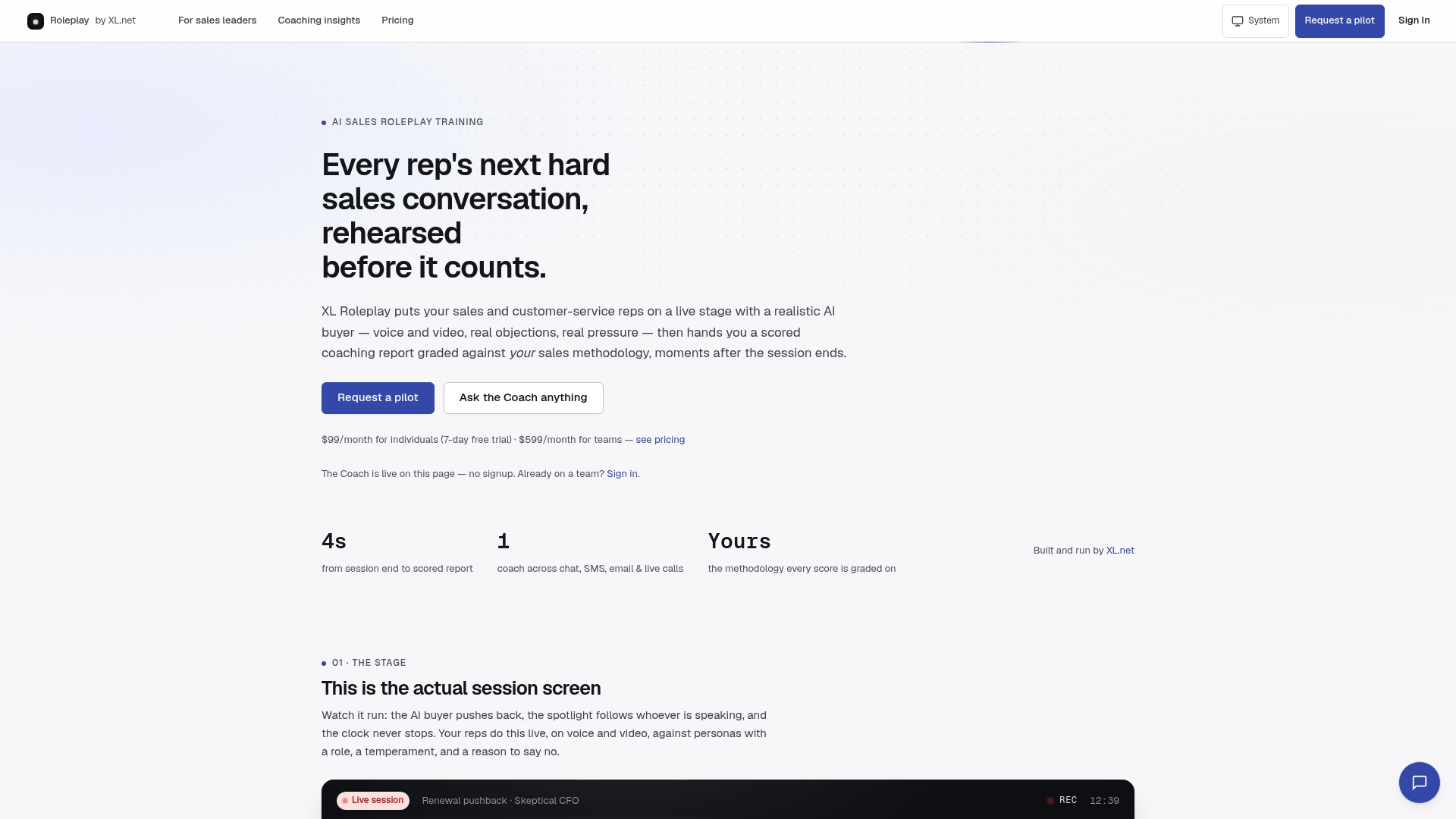
XL Roleplay runs live voice and video role-play with AI buyers and personas, on customized scenario libraries built around your own playbook. After each session, the rep gets a scored coaching report based on your organization’s sales methodology, and managers can review the transcript and rubric behind every score. Because the same coach carries shared memory across channels, practice builds on what came before rather than starting from zero each time.
Perspective
We built XL Roleplay on one belief: practice only counts if it looks like the conversation your rep is about to have, and is scored the way your own team defines good.
Most teams start with generic scripts. The reps nod, play along, and go back to their usual habits, because nothing in the exercise resembled their deals or their standards. Scenarios built on your playbook change that. The buyer pushes back the way your buyers do, and the feedback uses your language.
The second belief is that feedback should point to evidence. Every score in our coaching reports links back to the transcript, so a rep can see the exact moment they skipped the impact question, and a manager can coach that moment instead of arguing about impressions.
Start with one behavior, one persona and one rubric. Run it, debrief it, run it again. That loop is the whole method.
Adam
Try it on your own playbook
If you want to see your scenarios running with an AI buyer, the Individual plan is $99 per month and the Business plan is $599 per month, with extra seats at $54.95 per month per seat and extra video at $16.99 per hour. You can compare them on the XL Roleplay pricing page. Teams that want to start with their own playbook and scenarios can look at the XL Roleplay pilot.
You can also text the coach directly through our texting page.
FAQ
How many role-play scenarios does a team need?
Start with five to eight covering your most common objections and your most frequent escalation types. Grow toward a library of 15 to 25 as you learn which situations cost you the most deals or tickets. Quality and realism matter more than count.
How long should one scenario take?
A focused scenario runs 10 to 15 minutes, followed by a short debrief and a re-run. Longer sessions tend to blur the feedback across too many behaviors. Keep each scenario tied to one skill target.
What is the difference between a role-play and a simulation?
A role-play is a conversation with a person or AI playing a defined role. A simulation usually models a broader environment with more variables and outcomes. For conversation skills such as discovery and objection handling, a well-built role-play is the right scale. You can read more in our articles on role-play versus simulation.
Can the same scenario format work for customer service?
Yes. The parts are the same: a skill target, a persona with a motive, pressure points and an observable rubric. The difference is that the pressure is emotional or policy-driven rather than price-driven. Our collection on customer service role-play has more examples.
Sources
- Roleplay Scenario Builder Playbook
- Sales Role Play: Scenarios, Scripts & Templates (2026)
- 12 Customer Service Role Play Scenarios
- Improving sales training cycle times for new trainees