Customer Service Coaching: A Manager's Practical Playbook
Customer Service Coaching: A Manager’s Practical Playbook

Customer service coaching is a regular, structured conversation between a manager and an agent that turns specific interaction moments into repeatable skills. According to Medallia’s Stella Connect framework, it is ongoing, goal-directed communication designed to improve how agents handle difficult situations. The single action you can take this week: pull one low-CSAT interaction, identify one teachable moment, and schedule a 10–15 minute micro-coaching session before Friday.
Three-step quick plan:
- Prepare: Pull a transcript or call clip. Pick one or two specific moments tied to a CSAT or FCR goal.
- Observe and attach evidence: Timestamp the exact clip or line. Bring it to the session so the agent can see or hear it.
- Coach: State one behavioral goal, practice it through a short roleplay, and agree on a next-interaction target.
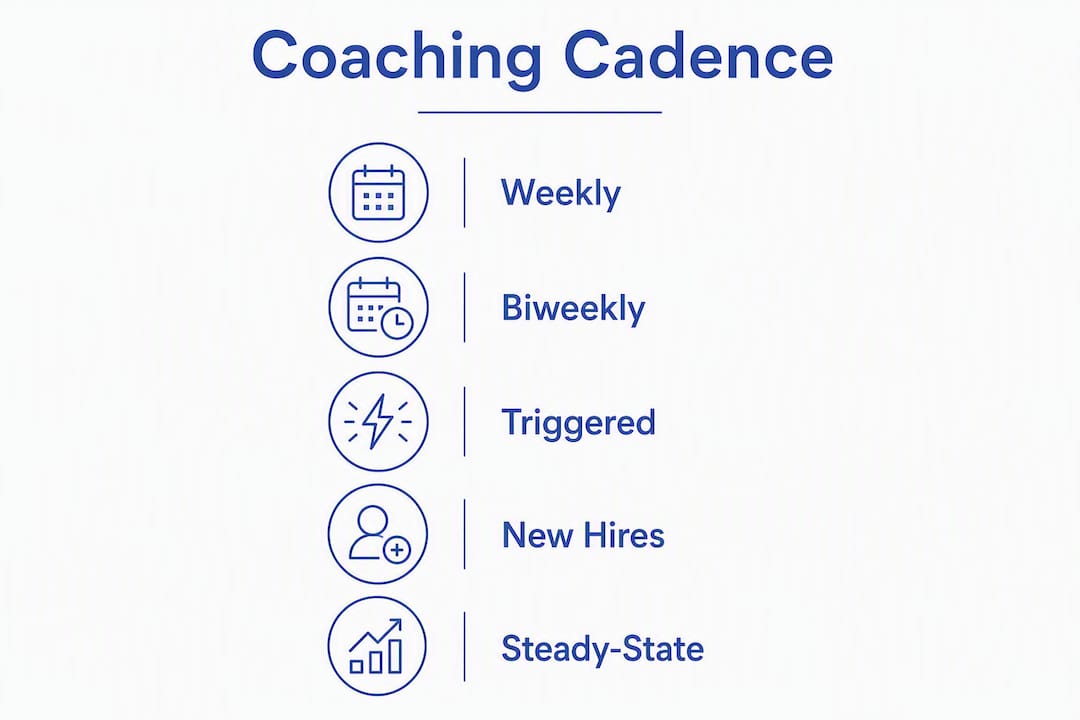
Cadence baseline: weekly or biweekly for steady-state agents, more frequently for new hires or anyone in a skill-gap sprint. High-performing contact centers consistently run coaching at this rhythm. Aim for a 3:1 positive-to-constructive ratio in every session, a standard Service Quality Centre identifies as the threshold where feedback lands without triggering defensiveness. Track progress against CSAT and FCR from session one.
Table of Contents
- When should you coach, and how often?
- Which coaching model fits the situation?
- How to run a coaching session, step by step
- Feedback language that actually changes behavior
- Making coaching objective with data and scorecards
- Why roleplay works and how to run short drills
- How to measure coaching impact and prove ROI
- Copy-ready templates you can use this week
- How AI roleplay and transcript-based coaching scale your program
- Legal and ethical considerations in coaching
- Key Takeaways
- The coaching mindset that actually changes teams
- Xl brings AI roleplay into your coaching workflow
- Useful sources and further reading
When should you coach, and how often?
82% of service professionals say customer expectations are higher than they used to be, making ongoing coaching critical to meet rising standards. That pressure does not ease with a quarterly review cycle. Coaching needs a cadence that matches the pace of customer interactions.
Steady-state agents: weekly or biweekly formal sessions, 30–45 minutes each. New hires (first 90 days): weekly formal sessions plus micro-coaching after any notable interaction. Improvement sprints: increase to two formal sessions per week until the target behavior stabilizes.
Interaction triggers that should prompt immediate coaching rather than waiting for the next scheduled session include QA failures, back-to-back low CSAT scores, repeat errors on the same issue type, escalations that could have been resolved at first contact, and behavioral drift (an agent who was strong suddenly slipping).
Pro Tip: Micro-coaching works best within two hours of the interaction. Recency keeps the agent’s memory sharp and reduces the defensiveness that builds when feedback arrives days later. Keep it to 10–15 minutes: one clip, one behavior, one goal.
Cadence setup checklist:
- Block recurring 1:1 slots in the calendar before the week starts
- Set a QA trigger threshold (e.g., any score below 80%) that auto-flags for micro-coaching
- Create a 90-day ramp schedule for new hires with decreasing frequency as competency builds
- Document every session, even micro-sessions, with a one-line goal and outcome note
Which coaching model fits the situation?
No single model works for every scenario. Here are four, each suited to a different context.

GROW (Goal, Reality, Options, Will): Best for structured 1:1s with agents who need to solve a recurring problem. The manager asks questions rather than delivers answers. Example: an agent who consistently struggles with de-escalation. You ask what a successful call would look like, what is currently happening, what options exist, and what the agent commits to trying next.
Two Stars & a Wish: Fast and low-threat. Name two specific things the agent did well, then one thing to improve. Works well for new hires or after a roleplay drill when you want to keep momentum positive. The structure prevents the session from collapsing into a list of problems.
THINK (Is it True, Helpful, Inspiring, Necessary, Kind?): Useful when an agent’s language or tone is the issue. Walk the agent through their own phrasing using the THINK filter. It builds self-awareness without the manager playing language police.
Situational hybrid: For complex judgment calls (an agent who handles policy exceptions inconsistently), combine GROW’s questioning structure with transcript evidence. Open with GROW questions, then anchor the conversation to a specific clip.
Modern coaching must cover voice, chat, email, and messaging channels, with emphasis on judgment and empathy rather than script adherence. The model you pick should reflect the channel and the competency gap, not just habit.
How to run a coaching session, step by step
1. Prepare (before the session) Pull one interaction: a call clip, chat transcript, or email thread. Identify one or two teachable moments. Write a session objective tied to a KPI: “By end of session, agent will practice one empathy statement per escalation, targeting a CSAT improvement from 3.8 to 4.2.”

2. Collect and attach evidence Timestamp the exact clip or transcript line. Bring the raw recording or text, not a paraphrase. Anchoring feedback to the exact interaction moment raises agent receptiveness because there is nothing to debate about what happened.
3. Open the conversation Start with a question, not a verdict. Try: “How do you feel that interaction went overall?” or “What would you do differently if you had that call again?” This surfaces the agent’s own awareness before you add yours.
4. Deliver feedback State what you observed (fact), not what it means about the agent (opinion). “At 2:14, you said ‘that’s not our policy’ without offering an alternative” is a fact. “You were dismissive” is a judgment. Keep the session to 30–45 minutes with a clear agenda: evidence review, feedback, practice, goal-setting.
5. Practice Run a 5–10 minute roleplay using the exact scenario from the interaction. The agent plays themselves; you play the customer. Score it against one or two rubric criteria.
6. Agree on next steps and follow up Set one measurable goal for the next interaction: “Use an empathy statement within the first 60 seconds of any escalation.” Schedule a follow-up within five business days. Document the goal and the agreed date.
Feedback language that actually changes behavior
Weak feedback sounds like: “You need to be more empathetic.” Strong feedback sounds like: “At the point where the customer said they’d been waiting three days, you moved straight to troubleshooting. Next time, try acknowledging the wait first: ‘I completely understand how frustrating that wait has been.’”
The 3:1 ratio in practice: For every corrective point, name three specific things the agent did well. Service Quality Centre identifies this ratio as the point where feedback is received rather than resisted. It is not about being soft; it is about keeping the agent’s brain out of threat mode so the corrective point actually lands.
Dos and don’ts:
- Do name the exact moment (“at 3:42 in the recording”)
- Do separate fact from opinion (“you said X” not “you were X”)
- Do focus on next-time behavior, not past failure
- Don’t use global judgments (“you always,” “you never”)
- Don’t stack more than two corrective points in one session
- Don’t deliver corrective feedback in front of peers
Pro Tip: Use supportive prompting instead of giving the answer. Ask “What do you think would have worked better there?” before offering your own suggestion. Agents who generate the answer themselves retain it longer and feel ownership over the change.
Making coaching objective with data and scorecards
Gut-feel coaching is hard to defend to leadership and easy for agents to dismiss. Data changes both problems.
KPIs that link directly to coaching:
| KPI | What it tells you | Coaching trigger |
|---|---|---|
| QA score | Behavior-level compliance and skill | Below threshold score on any rubric criterion |
| CSAT | Customer perception of the interaction | Score below team average or declining trend |
| FCR | Problem resolution at first contact | Repeat contacts from same customer |
| AHT | Handle time efficiency | Significant deviation from team median |
Sample scorecard fields: opening and greeting, empathy and acknowledgment, problem ownership, accuracy of information, compliance with policy, and closing and next steps. Score each on a 1–4 scale with behavioral anchors at each level.
Coaching from transcripts and scorecards gives you timestamped evidence that anchors the conversation to observable behavior. Agents are far less likely to dispute a clip they can hear than a manager’s verbal recollection.
Calibration checklist: At least monthly, two or more managers should score the same interaction independently, then compare. Disagreements above one point on any criterion signal a standards gap, not an agent gap. Resolve it before it becomes a coaching inconsistency.
Reporting cadence: review QA trends weekly, CSAT monthly, and FCR monthly. Expect to see QA score movement within 30 days of consistent coaching. CSAT shifts typically appear in the 60–90 day window.
Why roleplay works and how to run short drills
Active practice beats passive instruction every time. Roleplay forces the agent to retrieve and apply a skill under simulated pressure, which is how behavioral change actually sticks. Spaced repetition across multiple short sessions outperforms a single long training block.
10–15 minute drill template:
- Roles: Manager plays the customer; agent plays themselves
- Objective: Practice one specific behavior (e.g., empathy statement before troubleshooting)
- Scenario: Use a real interaction type from the past week
- Timebox: 5–7 minutes of roleplay, 5–8 minutes of debrief
- Scoring cues: Two rubric criteria maximum per drill
Channel adaptations:
- Voice: Focus on tone, pacing, and verbal empathy markers
- Chat: Focus on response time, clarity, and avoiding ambiguous phrasing
- Email: Focus on structure, tone, and completeness of resolution
Running roleplay sessions agents actually engage with requires realistic scenarios, not sanitized ones. Use real objections, real customer frustration patterns, and real policy edge cases. Generic scripts produce generic performance.
How to measure coaching impact and prove ROI
Coaching without measurement is just conversation. Here is what to track and when to expect results.
Metric checklist:
- QA score trend per agent (weekly)
- CSAT score trend per agent (monthly)
- FCR rate (monthly)
- Handle time deviation from team median (weekly)
- Repeat coaching topics (signals whether behavior is changing)
- Retention signals: absenteeism, voluntary turnover rate
30/60/90-day reporting template:
- Day 30: QA score movement, session completion rate, agent self-assessment
- Day 60: CSAT trend, FCR change, reduction in repeat coaching topics
- Day 90: Aggregate program KPIs, retention signals, ROI narrative for leadership
Supportman’s research links strong coaching programs to a 94% retention-related growth statistic, underscoring that the ROI case extends well beyond CSAT. Turnover in customer service is expensive; coaching that keeps agents engaged pays back in reduced hiring costs alone.
Set measurable per-agent goals before each sprint (e.g., “raise QA score from 74 to 82 within 60 days”) and aggregate those into a program-level dashboard for leadership. A two-point QA score improvement across a team of 10 is a concrete, defensible result.
Copy-ready templates you can use this week
Coaching session checklist:
- [ ] Interaction pulled and timestamped
- [ ] One or two teachable moments identified
- [ ] Session objective written (behavior + KPI target)
- [ ] Rubric criteria selected (max two per session)
- [ ] Roleplay scenario prepared
- [ ] Follow-up date blocked in calendar
Recognition script: “On that call at [timestamp], you caught the customer’s frustration early and acknowledged it before moving to the solution. That’s exactly the kind of empathy that drives CSAT. Keep doing that.”
Correction script: “At [timestamp], the customer mentioned they’d already tried that step. You moved forward without acknowledging it. Next time, try: ‘I hear you’ve already tried that — let me look at this from a different angle.’ Want to practice that now?”
Coaching rubric (4 criteria, 1–4 scale):
| Criterion | 1 (Below standard) | 2 (Developing) | 3 (Meets standard) | 4 (Exceeds) |
|---|---|---|---|---|
| Empathy | No acknowledgment of emotion | Partial acknowledgment | Clear acknowledgment | Proactive, specific empathy |
| Problem ownership | Deflects or transfers | Partially owns | Owns and resolves | Owns, resolves, and follows up |
| Accuracy | Incorrect information | Mostly accurate | Accurate | Accurate with proactive context |
| Closing | Abrupt or incomplete | Partial close | Full close | Full close with next-step confirmation |
Action plan template:
- Goal: [Specific behavior] in [next X interactions]
- Measure: [KPI] reviewed at [date]
- Support: [Resource or practice method]
- Follow-up date: [Date]
How AI roleplay and transcript-based coaching scale your program
The workflow runs in five steps: scenario selection, AI roleplay session, transcript and score generation, manager review, and micro-coaching session. Each step produces a documented artifact.
Pilot implementation (small team, 4–6 weeks):
- Select three to five scenario types from your most common interaction failures
- Run weekly AI roleplay sessions per agent (15–20 minutes each)
- Review scored transcripts before each 1:1; flag two coachable moments per agent
- Run micro-coaching sessions anchored to transcript timestamps
- Track QA score and CSAT at week two and week four
Customer service roleplay training built on realistic AI personas gives agents repetitions they cannot get from live customer volume alone, especially for low-frequency, high-stakes scenarios like escalations or policy exceptions. The scored transcript becomes the evidence base for the coaching session, cutting prep time and reducing the “what actually happened” debate.
Metrics to watch in the pilot: QA score movement per agent, session completion rate, time from QA flag to coaching session (the QA-to-coach loop), and agent self-assessment scores over time.
Legal and ethical considerations in coaching
Coaching conversations involve performance data, recorded interactions, and documented assessments. A few non-negotiables apply in the United States.
Recording consent: Federal law under the Electronic Communications Privacy Act requires at least one-party consent for call recording, but many states (California, Illinois, Florida, and others) require all-party consent. Confirm your state’s requirement before using call recordings in coaching sessions, and verify your customer disclosure language covers coaching use.
Documentation and consistency: Coaching records can surface in employment disputes. Document sessions consistently across all agents, apply rubric criteria uniformly, and never coach selectively based on protected characteristics. An appeals or contest process for QA scores, where agents can flag a disputed score, turns disagreement into a clarifying conversation and creates a defensible audit trail.
Data privacy: Transcripts and recordings containing customer personal information are subject to applicable state privacy laws (California Consumer Privacy Act, for example). Store coaching artifacts in systems with appropriate access controls and retention policies.
Psychological safety: Harvard Business Review research identifies psychological safety as a prerequisite for high team performance. Coaching that feels punitive rather than developmental erodes it. Keep corrective feedback private, frame every session around growth, and never use coaching records as the sole basis for a disciplinary action without a separate performance management process.
This article is general information, not legal or HR advice. Confirm recording consent requirements and data handling obligations with qualified legal counsel for your specific state and situation.
Key Takeaways
Consistent, evidence-based customer service coaching tied to CSAT and FCR metrics produces measurable QA score movement within 30 days and meaningful CSAT improvement within 60–90 days.
| Point | Details |
|---|---|
| Cadence drives results | Coach weekly or biweekly for steady-state agents; increase frequency for new hires and skill-gap sprints. |
| Evidence anchors feedback | Timestamped clips and transcript lines reduce defensiveness and speed behavior change. |
| 3:1 ratio protects morale | Three specific positive observations for every corrective point keeps agents receptive rather than defensive. |
| Measure leading and lagging indicators | Track QA score weekly and CSAT/FCR monthly; expect QA movement by day 30 and CSAT shifts by day 90. |
| Xl scales practice with AI roleplay | Xl’s scored transcripts and AI personas cut prep time and generate the evidence base for every micro-coaching session. |
The coaching mindset that actually changes teams
The managers who get the best results from coaching are not the ones with the most detailed rubrics. They are the ones who walk into a session genuinely curious about what the agent experienced, not ready to deliver a verdict.
The shift worth making: stop asking “what did they do wrong?” before the session and start asking “what was hard about that interaction, and what would make it easier next time?” That reframe changes the entire tone. Agents who feel interrogated go quiet. Agents who feel supported start diagnosing their own gaps, which is exactly what you want.
Resistance is almost always a signal that the agent does not feel safe, not that they are unwilling to improve. When an agent pushes back on feedback, the move is not to repeat the point louder. Ask: “What did it feel like from your side of that call?” Then listen. The agent’s answer usually contains the coachable moment.
The 3:1 ratio is not a formula for being nice. It is a formula for keeping the conversation productive. A session that opens with three genuine, specific observations of what worked puts the agent in a learning state. The corrective point lands in that state. Without it, the agent is defending, not absorbing.
Xl brings AI roleplay into your coaching workflow
Most coaching programs stall not because managers lack skill but because there is not enough practice volume between sessions. Agents handle one coached scenario per week and then face 200 live interactions with no structured repetition.
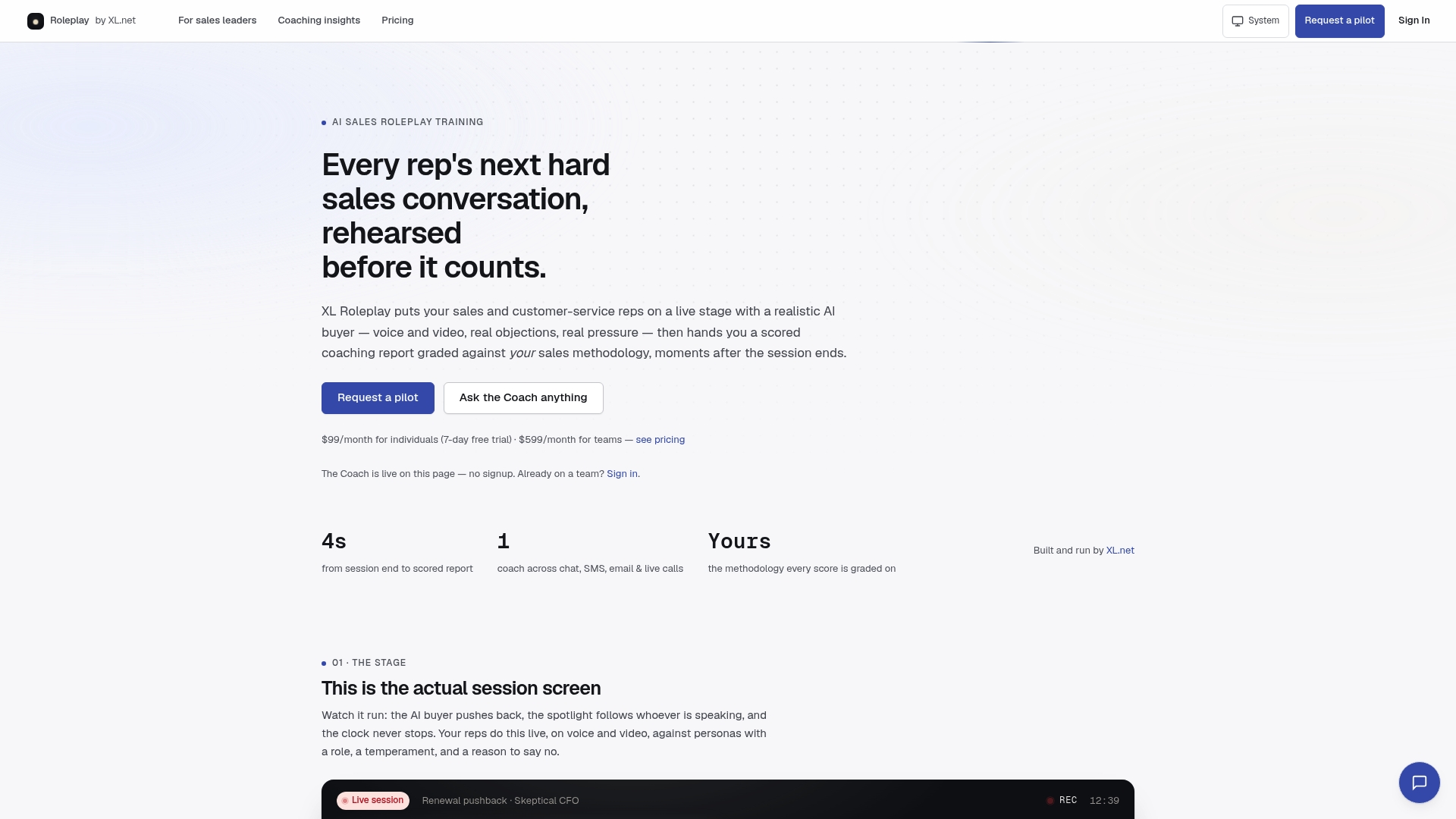
Xl solves that gap. The platform runs live voice and video roleplay sessions with realistic AI personas, scored against your organization’s own rubric criteria. Every session produces a timestamped transcript and a coaching report, so your next 1:1 starts with evidence already in hand rather than a manager spending 20 minutes hunting for a relevant clip. The QA-to-coach loop shrinks from days to hours.
A small pilot runs in four to six weeks: pick three to five scenario types, assign weekly AI sessions per agent, and review scored transcripts before each 1:1. Track QA score movement and session completion rate as your leading indicators. Start a pilot with your team at XL Roleplay and see what a week of structured practice does to your next coaching conversation.
Useful sources and further reading
- Service Quality Centre coaching playbook — the 3:1 feedback ratio, supportive prompting techniques, and QA appeals as a teaching tool.
- HBR on psychological safety — the research foundation for why coaching tone and safety matter as much as technique.
- Xl coaching insights — articles on transcript-based feedback, scorecard design, and running roleplay drills that scale.
- Coaching from transcripts and scorecards — practical guidance on extracting coachable moments and building rubrics from real interaction data.
Suggested next step: Run a 7-day pilot using the session checklist and action-plan template from this article. Pull one low-CSAT interaction per agent on Monday, send the clip by Tuesday, and run a 10-minute micro-coaching session by Wednesday. By Friday, you will have a baseline to measure against.