B2B Discount Requests: Scripts and Roleplay to Stop Margin Leaks
B2B Discount Requests: Scripts and Roleplay to Stop Margin Leaks

When a buyer asks for a discount, acknowledge the request, restate value, and offer only a conditional concession in exchange for measurable reciprocal value. If the ask exceeds what you can approve on your own, say so plainly and route it to the right approver instead of guessing. That single habit, trade rather than give, protects margin on almost every deal.
TL;DR:
- Ask two or three questions to learn whether the request reflects a budget cap, comparison, approval hurdle, timing issue, or habit before proposing a trade.
- Match the return to the buyer’s constraint: cash flow buyers often accept annual billing, while comparison shoppers may value a reference, case study, or pilot extension.
- For loyal customers, offer service upgrades or priority support instead of automatic renewal discounts; apply one published policy consistently to nonprofit requests.
- Set written approval bands, disclose your limit and next approval date, and make each later concession smaller than the previous one.
- Record each concession’s value, reciprocal trade, expiry, and approver in CRM; managers can review transcripts and recurring drills to catch margin leakage.
Table of Contents
- A simple IF→THEN framework for handling concession requests
- Scripts and phrasing for phone, email, and chat
- Matching your response to the type of customer asking
- Setting discount tiers and approval thresholds that hold
- What to ask for when you grant a discount
- Tracking every concession so nothing slips through
- Practicing these conversations through roleplay and coaching
- Handling loyalty cycles, serial discounters, and charity asks
- An operational checklist for rolling this out across a team
- Practicing discount conversations with XL Roleplay
- FAQ
- Sources
A simple IF→THEN framework for handling concession requests
Most reps either cave immediately or get defensive when a buyer asks for a lower price. Neither works well. A short, repeatable sequence does better because it treats the discount request as information, not an attack.
Here is the process to run every time, in any channel:
- Acknowledge the request without agreeing or refusing yet.
- Discover the motive with two or three quick questions.
- Restate your top value point, chosen based on what you just learned.
- Offer a conditional concession, framed as IF they do something THEN you can do something.
- Document the trade immediately, before the call ends or the thread goes cold.
Step two is where most reps skip too fast. A discount request can mean five different things: a real budget cap, a comparison shopping tactic, an internal approval hurdle, a timeline problem, or simple habit from a buyer who always asks. Useful diagnostic questions include:
- “Is this about total budget, or about how the payment is structured?”
- “Are you comparing us against another option, or is this purely an internal number you need to hit?”
- “Who else needs to sign off on this, and what would make that easier for them?”
Concession-management playbooks recommend trading every concession for reciprocal value rather than handing it over, and shrinking the size of each successive concession to signal you are reaching a limit.
Once you know the motive, match it to a trade. A budget cap might trade for a longer contract term. A comparison shopper might trade for a case study or reference call that removes their risk. An internal approval problem might trade for a shorter payment window that’s easier to push through finance. The concession changes, the structure doesn’t: nothing moves without something coming back.

Scripts and phrasing for phone, email, and chat
Exact wording matters because hesitation reads as weakness and over-apologizing invites more pressure. Below are ready-to-use lines organized by channel and purpose. Swap in your own numbers and value points.
Phone, immediate deferral:
- “That’s a fair question, let me understand what’s driving it before I answer.”
- “I want to get you the right answer, not a fast one. Can you walk me through your budget constraint?”
Phone, conditional concession:
- “If you can commit to a two-year term, I can bring the price down to match your target.”
- “I can offer 10% off if we move to annual billing instead of monthly.”
Phone, polite refusal:
- “I can’t move on price here, but I can add three months of onboarding support at no extra cost.”
Email templates:
Thanks for flagging this. Before I propose anything, can you tell me whether the concern is total cost, payment timing, or something else? That helps me bring you the right option instead of a generic discount.
I reviewed this with my manager. We can offer [X]% if we extend the term to [length] and add a signed reference call once you’re live. Let me know if that works on your end.
I’m not able to discount this package, but I can include [specific add-on] at no cost, which addresses the gap you mentioned without changing the core price.
Chat or snippet variants:
- “Happy to look at options. Quick question first: is this about the total number or how we structure payments?”
- “I can’t discount this tier, but I can upgrade you to [feature] at no charge if that helps close the gap.”
De-escalators for pressure tactics:
Personalizing any of these takes thirty seconds: drop in your product’s top differentiator where “value point” would go, and name the specific trade (term length, referral, payment terms) that fits the deal in front of you.
Matching your response to the type of customer asking
The same discount request means something different depending on who’s asking, and a one-size response leaves value on the table or damages a relationship you want to keep.
- Loyal customer, long tenure: lead with recognition rather than price. Offer a service upgrade, priority support, or an early-access feature instead of a straight discount; these often land better than a few points off and cost less.
- Budget buyer, cost-driven: trade on payment terms or contract length rather than headline price, since their real constraint is usually cash flow timing, not total spend.
- Comparison shopper, weighing alternatives: trade a reference call, case study, or pilot extension for the discount, since removing perceived risk often matters more to them than the number itself.
- Nonprofit or charity requester: apply a consistent, published policy rather than negotiating case by case, so every similar request gets the same treatment and no one feels singled out.
- Internal stakeholder pushing on behalf of a buyer: trade a shorter approval timeline or a smaller pilot scope, since their real goal is usually making their own sign-off easier, not the discount itself.
Reading the profile correctly before you respond helps keep the concession proportional to what’s actually driving the ask.
Setting discount tiers and approval thresholds that hold
Unmanaged discounting rarely happens as one big concession. It happens as a dozen small ones, each reasonable on its own, that together erode margin across a quarter. A tiered approval structure stops that pattern before it starts.
- Rep-level authority: set a small band, often in the single digits, that a rep can approve without escalation, tied to specific trades (term length, payment timing) rather than open discretion.
- Manager-level authority: a wider band for deals with clear reciprocal value attached, reviewed before the offer goes out, not after.
- VP-level authority: reserved for larger discounts or strategic accounts, requiring documented justification and an expected trade.
- Executive-level authority: the top tier, used rarely, for exceptional circumstances with explicit sign-off.
Deal-closing playbooks recommend using these thresholds as negotiation leverage, not just internal control: telling a buyer “I can approve this much today, anything beyond that needs a VP conversation” creates useful friction and often closes the gap without any further discount.
Shrinking concessions matter here too. Pair shrinking concessions with a visible approval timeline (next sign-off cycle is Thursday) so buyers see a real cost to pushing further, not just a reluctant rep.
What to ask for when you grant a discount
Every discount should buy something back. The order you ask for these matters: lead with what has the highest impact on your business and the highest likelihood the buyer can actually say yes to.
- Multi-year commitment: highest impact, since it locks in revenue and reduces renewal risk, and many buyers can approve a term extension more easily than a price change.
- Volume or expansion: trading a discount for a larger initial order or additional seats directly offsets the margin given up.
- Payment terms: moving from monthly to annual, or requiring upfront payment, improves cash flow even when the headline number doesn’t change.
- Referral or reference: a signed case study or an introduction to a prospect account carries real pipeline value at near-zero cost to the buyer.
Pro Tip: Phrase every trade conditionally: “If we move to annual billing, then I can offer 10% off” keeps the concession explicitly tied to the trade instead of sounding like a favor.
Prioritize asks that link to measurable outcomes: a multi-year term improves lifetime value directly, while a referral reduces future acquisition cost. Both are easier to defend internally than a discount given with nothing attached.
Tracking every concession so nothing slips through
A concession that isn’t recorded becomes a precedent nobody remembers agreeing to. Business guidance on discount handling points to standardizing policy and documenting the reason behind every concession so buyers aren’t quietly trained to ask again next cycle.
The minimum fields worth capturing on every concession:
- Requester name and account
- Discount percent or dollar value
- What was traded for it
- Expiry date or renewal condition
- Approver on record
- Link to the related proposal or contract
Store these as custom fields on the opportunity record in your CRM, tagged consistently (for example, “concession:term-trade” or “concession:payment-terms”) so reporting can pull leakage by category later.
| Field | Example entry |
|---|---|
| Requester | Account: Meridian Logistics |
| Discount | 10% off list |
| Traded for | 2-year term, annual billing |
| Expiry | Renewal date, 2 years out |
| Approver | Sales manager |
| Proposal link | Opportunity record |
A filled example like this takes under a minute to log and turns into a template you can duplicate for the next deal.
Practicing these conversations through roleplay and coaching
Reading a script is not the same as delivering one under pressure, especially when a buyer pushes back twice in a row. Research on customer price importance sensing found that salespeople who accurately read how much price actually matters to a given buyer negotiate smaller discounts while maintaining purchase intent, a skill that improves with repetition, not just instruction.
Drills worth running on a regular cadence:
- Deal-desk approval drill: practice asking for escalation mid-call without losing the buyer’s confidence.
- Budget objection drill: practice the diagnostic questions before any concession is offered.
- Referral request drill: practice asking for a reference call as part of the trade, not as an afterthought.
- Shrinking-concession drill: practice making a second offer smaller than the first while explaining why.
Pro Tip: Score these drills against a rubric, not a gut feel, so improvement is visible session over session rather than anecdotal.
Managers coaching this skill benefit from reviewing transcripts, not just call summaries, since the exact phrasing a rep used often explains why a concession spiraled or held. XL Roleplay builds scenarios specifically around protecting margin during negotiation, and a related deal-desk approval drill walks through practicing the escalation conversation itself.
Handling loyalty cycles, serial discounters, and charity asks
Some recurring scenarios deserve specific, pre-decided tactics rather than a fresh judgment call every time.
- The loyalty-discount cycle: research on customer loyalty and price negotiation found that loyal customers often receive deeper discounts over time, and that those discounts can in turn reinforce loyalty, creating a cycle that steadily compresses margin. Non-monetary rewards, like priority support or early access, often deliver comparable perceived value at lower cost.
- Serial requesters: if a buyer asks for a discount on every renewal regardless of circumstance, apply the same trade-for-trade rule every time rather than softening over repetition, and set a walk-away threshold in advance so the decision isn’t made under pressure.
- Charity or nonprofit requests: apply one published policy consistently rather than negotiating case by case, so every similar organization gets the same answer and no single rep is left deciding alone.
- Manipulation tactics: a buyer who implies a competitor offered a much lower price without naming it or showing proof deserves a calm request for specifics before any concession is considered.
An operational checklist for rolling this out across a team
Start by teaching the IF→THEN framework in a single session, then set approval bands in writing so no rep is guessing where their authority ends. Schedule roleplay drills on a recurring cadence, weekly for new hires, monthly for tenured reps, and track concession leakage as a percentage of expected revenue so slow erosion shows up before it compounds across a renewal cycle.
A useful weekly touchpoint: a manager pulls three recent concessions from the CRM, checks whether each was traded for something measurable, and spends ten minutes with the rep walking through what they’d do differently on the next ask.
— Adam
Practicing discount conversations with XL Roleplay
Reading this framework is one thing. Holding the line when a buyer pushes back twice in a row, in real time, is another. Certain AI-driven roleplay platforms offer live voice and video sessions with AI buyers that raise common budget objections and pressure tactics, scored against customized organizational methodologies rather than generic rubrics.
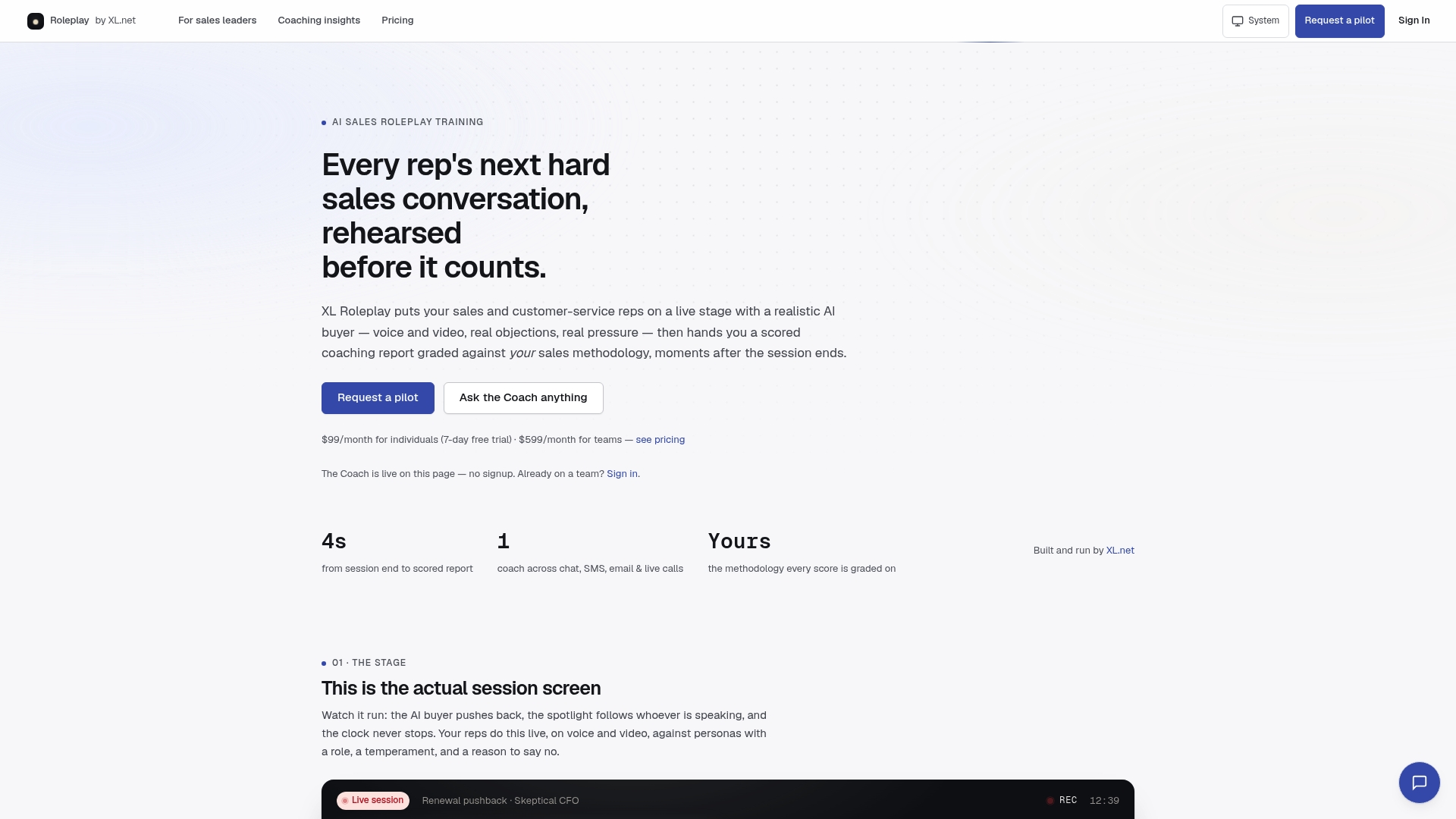
What that looks like in practice:
- AI-driven roleplay sessions that simulate realistic discount pushback across phone, video, and chat-style scenarios.
- Scored coaching reports tied to your team’s specific sales methodology, not a one-size rubric.
- Full session transcripts and rubrics managers can review to coach the exact phrasing that worked or didn’t.
Our Individual plan runs $99 per month, and our Business plan runs $599 per month for team access. If you’d rather test the approach with your own scenarios first, our pilot program is a practical next step before committing to a plan.
FAQ
How to professionally ask for a discount?
State the specific reason for the request (budget, timeline, volume) and offer something in return, such as a longer commitment or faster payment, rather than asking for a lower price with nothing attached. Framing the ask as a trade tends to get a faster, more favorable response than an open-ended request.
How do you handle a customer who asks for a discount we can’t give?
Acknowledge the request, explain clearly that the price isn’t moving, and offer an alternative form of value instead, like an add-on feature, extended support, or priority onboarding. This keeps the relationship positive without setting a pricing precedent you can’t sustain.
How to politely decline a discount request?
Thank the buyer for raising it, state plainly that you can’t adjust the price, and immediately pivot to what you can offer instead. A direct, respectful “no” paired with an alternative tends to land better than a vague deflection.
How to politely ask to reduce price?
Explain your specific constraint, whether it’s budget, timeline, or an internal approval limit, and propose what you can offer in exchange, such as a longer contract or a reference. Being specific and offering a trade makes the request easier for the other side to say yes to.
Sources
- Saving on Discounts through Accurate Sensing – ScienceDirect
- Concession Management in Deal Closing: Trade, Never Give (2026) - Rework resources
- The role of customer loyalty in price negotiations (Habel et al.) - WRAP/Warwick
- A simple, reliable way to deal with discount requests - Forbes