Enterprise Coaching Governance: A Practical Guide
Enterprise Coaching Governance: A Practical Guide

Enterprise coaching governance is the set of decisions that keep coaching consistent, accountable and tied to business goals once it spreads past a handful of managers. It answers four questions: who owns the program, what standards every coach and manager follows, how local teams adapt without breaking those standards, and how you prove it works. This guide walks through each one, with a focus on sales and customer service organizations, where coaching volume is high and the cost of inconsistency shows up in revenue.
TL;DR
- Governance sets the rules of the program (ownership, standards, exceptions). Enterprise coaching itself is the work of changing structures and leadership behavior. Keep the two separate.
- Name one accountable owner, ideally dedicated to program management, plus an executive sponsor and budget holders.
- Standardize the rubric, the evidence rules and the review rhythm centrally. Let regions and teams choose scenarios, pacing and examples.
- Decide how you will evaluate the program at design time, not after launch.
- For sales and service teams, scored practice sessions with transcripts give governance something concrete to audit.
Table of Contents
- What enterprise coaching governance actually means
- Who should own and sponsor the program
- The policies a coaching program needs
- Aligning coaching across teams while allowing local needs
- A step-by-step way to establish governance
- Measuring whether the program works
- Building a coaching culture, not just a compliance process
- Our perspective: governance needs evidence you can inspect
- Putting it into practice with XL Roleplay
- FAQ
- Sources
What enterprise coaching governance actually means
People often mix up two things. Enterprise coaching is a service: according to one practitioner’s description, it works at the level of funding models, governance rhythms, incentive systems and operating model, helping leaders change both those systems and their own behavior. Governance is the framework around any coaching, which says who is accountable, what rules apply and what happens when something falls outside them.
The same practitioner notes that the output of enterprise coaching is rarely a document. It is usually decisions made by leadership, with the coach as a thinking partner. That is exactly why governance matters: if the work leaves no paper trail by nature, someone has to define what gets recorded, who sees it and how it connects to results.
The Institute of Coaching handbook frames organizational coaching as serving both the individual’s needs and the sponsoring organization’s goals, which means coaches and program owners handle stakeholder interests at several levels at once. Governance is where those interests are written down and reconciled.
In a sales or service organization, the practical version is simple. Reps get coached by many people: first-line managers, enablement, peers, sometimes external trainers. Without governance, each one uses a different yardstick, and a rep who “passed” with one manager looks weak to the next.
Who should own and sponsor the program
Start with people, not policy. Three roles show up repeatedly in the research.
The executive sponsor. One source describes a sponsor who represents the coaching strategy to the executive team or board, alongside a director leading the area and budget holders. Sponsorship is what keeps a program funded when quarterly pressure hits.
The program owner. A Training Magazine piece describes a “coaching custodian”, often someone in L&D, talent or HR, who sets the business rationale, selects coaches, measures success and harvests learning across the organization. In sales organizations this role often sits in sales enablement or revenue operations. The title matters less than the clarity.
Dedicated capacity. The Center for Creative Leadership’s research on coaching infrastructure reports that the most robust programs have a resource dedicated exclusively to program management instead of splitting time with other HR duties. If coaching is one of nine things your enablement lead owns, governance will be the first thing to slip.
In interviews with companies about agile transformations, a Business Agility Institute report found enterprise coaches were usually funded and assigned to a Center of Excellence or Transformation Office rather than to individual business units. The lesson carries over: central funding and central ownership make it easier to hold a single standard.
Map your stakeholders first
The same Aicura guidance recommends a stakeholder map listing sponsors, directors, budget holders and the managers of participants, because each group expects something different. A VP of Sales wants pipeline impact. A customer service director wants fewer escalations. Finance wants cost per head. Write each expectation down next to the owner’s name before you design anything.

The policies a coaching program needs
Governance documents do not need to be long. They need to answer the same few questions every time someone asks.
Ownership of the standard
Whoever owns your coaching framework owns its updates. One competency-framework guide puts it plainly: governance rules define who owns the framework, how competencies are updated, how coaching models reference it and how exceptions are handled. For a sales team, replace “competency framework” with “sales methodology and scoring rubric”. If a regional manager wants to change the definition of good discovery, there should be a named person and a process.
Confidentiality and what gets shared
The Executive Coaching Handbook points out that coaches must agree on what information may be shared with the organization and when exceptions apply. In rep-level sales coaching the stakes are lower than in executive coaching, but the principle holds. Decide in advance whether practice sessions are visible to managers (we think they should be, for skills practice), whether they are used in performance reviews, and who can see transcripts. Tell reps before their first session.
Quality assurance for coaches
The CIPD’s factsheet describes supervision and support as a critical quality assurance mechanism because it gives coaches structured time to reflect on their practice. It also flags that line managers who coach may struggle with impartiality because of power dynamics. Sales managers are line managers. Governance should account for that, for example by separating skill coaching from deal inspection. We cover that split in sales coaching versus deal review.
Reporting and records
Decide what progress is reported, how often and to whom. A practical set: participation rate, rubric scores by skill over time, and the link to a business metric the sponsor already tracks. Our note on what to report when you take a practice program upward covers how to frame that for finance and executives.
Aligning coaching across teams while allowing local needs
This is where most enterprise programs wobble. Too much central control and regional teams ignore the program. Too little and you have twelve programs with twelve definitions of “ready”.
A workable split is to decide what is fixed, what is flexible and what needs approval.
| Decision | Set centrally | Set locally |
|---|---|---|
| Scoring rubric and methodology definitions | Yes | No, changes go through the owner |
| Evidence rules (what counts as a pass) | Yes | No |
| Review cadence for leadership reporting | Yes | No |
| Scenarios and buyer personas | Core library | Add segment or region specific scenarios |
| Practice frequency and timing | Minimum expectation | Team chooses within it |
| Examples, product detail, competitor context | Guidelines | Team supplies |
| Exceptions to the standard | Approval process | Request through the process |
The logic mirrors the exception handling in the framework governance guidance above: the standard stays stable because changes have a route, not because nobody asks for them.
Two habits keep this honest. First, review exception requests quarterly. If three regions ask for the same change, it probably belongs in the central standard. Second, share local scenarios back to the central library so that good ideas travel.
If you are building the methodology layer, our collection of articles on sales coaching methodologies shows how teams translate a framework into scorable behaviors.
A step-by-step way to establish governance
The Center for Creative Leadership’s infrastructure paper lists the building blocks: making a strategic case, securing senior-management support, developing coaching champions, sourcing and preparing coaches, identifying needs, setting objectives, monitoring engagements and evaluating outcomes. Turned into a sequence for a sales or service team:
- Write the business case in one page. Name the metric (ramp time, win rate, handle quality) and the owner of that metric.
- Secure a visible sponsor. The same research highlights visible top leadership as an element of effective programs.
- Appoint the program owner and protect their time.
- Define behavioral objectives. “Better at objections” cannot be scored. “Acknowledges the concern, asks a clarifying question, then responds with evidence” can.
- Build the rubric and the evidence rule. Decide what a transcript must show for a skill to count as demonstrated.
- Prepare the coaches. Train managers on the rubric and on giving feedback tied to specific moments. Our tag page on effective coaching feedback is a good place to start.
- Monitor engagements. Track who is practicing, how often and whether scores move.
- Evaluate and revise on a schedule set at the start.
The Training Magazine piece adds a useful point for owners who have never coached themselves: custodians who are not coaches may rely on a coach to help them understand how to set up coaching for greater impact. Borrow expertise rather than guessing.
Measuring whether the program works
Plan evaluation while you design, not after launch. A review of coaching program evaluation recommends setting clear objectives at the design phase, using quantitative data to assess magnitude and qualitative data to understand barriers and facilitators. It also separates two kinds of evaluation: outcome-based, which assesses change, and process-based, which assesses whether the program was implemented as intended.
Both matter to governance. Outcome measures tell the sponsor whether to keep funding. Process measures tell the owner whether a weak result comes from the design or from the fact that half the regions never ran it.
A simple scorecard:
| Layer | Example measures | Question answered |
|---|---|---|
| Process | Share of reps practicing weekly, manager review completion | Is the program running as designed? |
| Skill | Rubric scores by competency, trend per rep and team | Are behaviors changing? |
| Business | Ramp time, conversion at a stage, escalation rate | Does the change show up in results? |
| Qualitative | Rep and manager feedback, common blockers | Why or why not? |
For tooling ideas, see the articles tagged coaching evaluation tools and data-driven sales training. If budget approval is part of your plan, the budgeting for sales training collection helps with the numbers.
Building a coaching culture, not just a compliance process
Governance is not the goal. A coaching culture is. The Center for Creative Leadership’s research on creating coaching cultures says that enterprise coaching can support culture change by coaching senior leadership teams, seeding leaders and managers as coaching role models, and linking coaching outcomes to business goals.
For a sales organization that means leaders who practice in front of their teams, managers who cite specific moments in feedback and reps who see scores as information, not judgment. Good governance makes that safe by being explicit about how evidence will and will not be used.
Our perspective: governance needs evidence you can inspect
We build XL Roleplay, so we see this problem from the practice side. The most common governance gap we see described is not a missing policy. It is that coaching leaves no inspectable evidence. A manager says a rep “handled the objection fine”, and nobody else can check.
Our view is that governance gets easier when practice produces artifacts. In XL Roleplay, reps run live voice and video sessions with AI buyers that raise typical objections and pressures, and each session ends with a scored coaching report. The scoring is built around an organization’s own sales methodology, so the rubric your leadership approved is the rubric reps are measured against, not a generic standard. Managers can review the transcript and the rubric behind each score, which makes feedback specific and makes calibration between managers possible.

We also built it around one persistent AI coach with shared memory across channels, so a rep’s practice history does not reset when the format changes. For a program owner, that means one record per rep and per team, which is what reporting upward needs.
We would argue that a standard you can only describe in a slide deck is not yet a standard. A standard that scores every practice session against the same rubric, with a transcript attached, is one you can govern.
— Adam
Putting it into practice with XL Roleplay
If you are setting up governance for a sales or service team, you can start small. XL Roleplay’s Individual plan is $99 per month and the Business plan is $599 per month, with extra seats at $54.95 per month per seat and extra video at $16.99 per hour. See the current details on the pricing page. If you would rather test the approach with a defined group and a defined success measure first, ask about the XL Roleplay pilot.
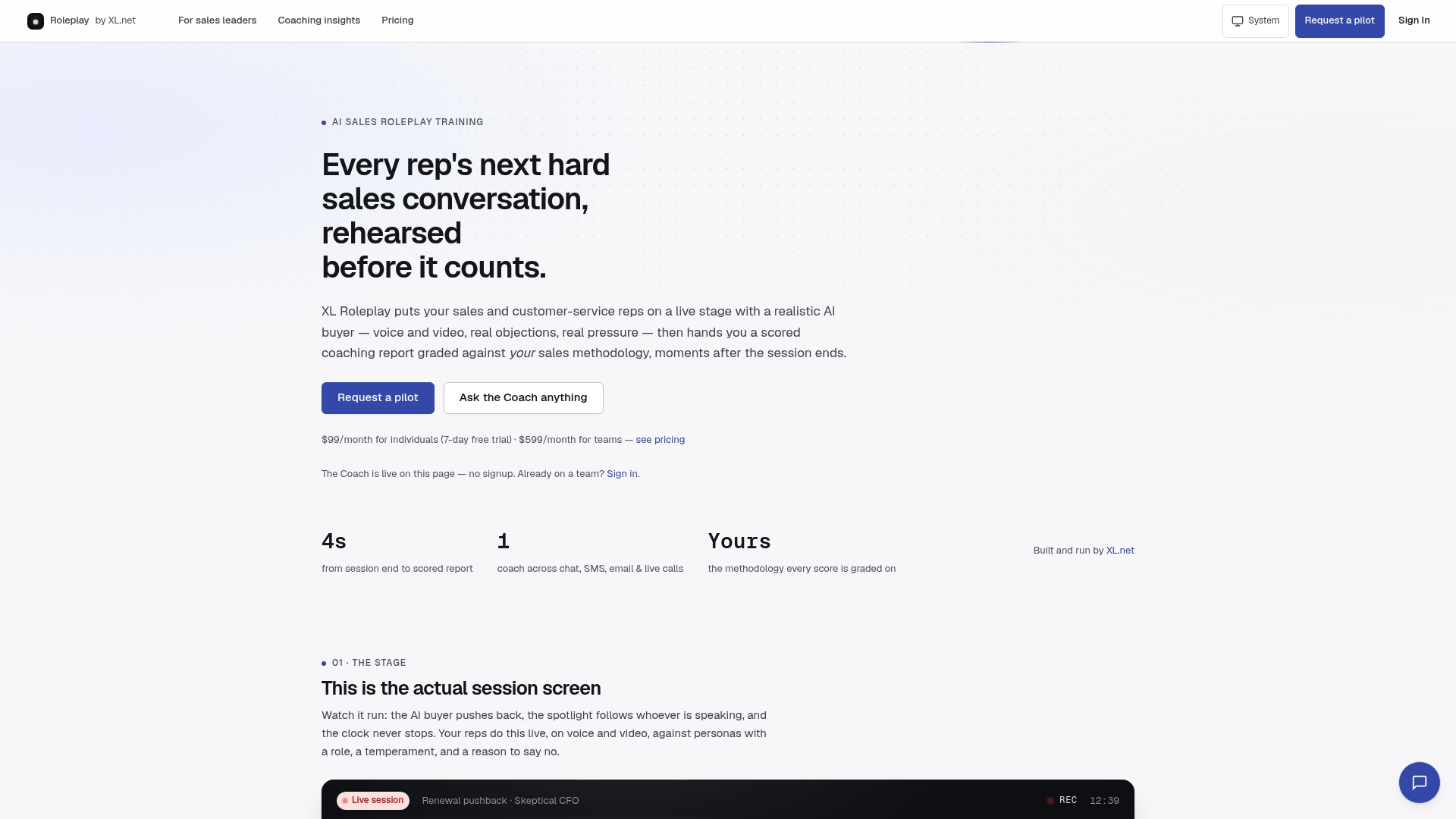
Pair either route with the governance steps above: name the owner, fix the rubric and decide the review rhythm before the first session. For examples of what managers do with the output, see our coaching report examples and the articles tagged coaching feedback examples.
FAQ
What is the difference between enterprise coaching and coaching governance?
Enterprise coaching is the work: helping leaders change structures, funding, incentives and their own behavior. Governance is the framework around coaching of any kind: who owns it, which standards apply, what is reported and how exceptions are handled. You can have coaching without governance, but it tends to drift into inconsistent practice as it scales.
Who should own a coaching program?
One accountable program owner, often a coaching custodian in L&D, talent, HR or sales enablement, supported by an executive sponsor and the budget holders. Research from the Center for Creative Leadership reports that the strongest programs give program management to someone dedicated to it rather than someone with a split role.
How do I keep coaching consistent across regions?
Fix the rubric, the evidence rules and the reporting cadence centrally. Let regions choose scenarios, practice timing and local examples within those limits. Give exceptions a route, a named approver and a quarterly review so useful local changes can become the shared standard.
How often should I evaluate the program?
Set the schedule at design time. Review process measures such as participation more often, and outcome measures such as ramp time or conversion on a longer cycle that matches your sales cycle. Combine numbers with rep and manager feedback to understand what is helping or blocking progress.
Do managers make good coaches under governance rules?
Yes, with support. The CIPD notes that line managers can face impartiality challenges because of power dynamics, so give them a clear rubric, training on specific feedback and, ideally, calibration sessions with peers. Keeping skills coaching separate from deal inspection also helps.
Sources
- Enterprise coaching: the systemic level above team coaching
- The Executive Coaching Handbook
- Institute of Coaching, Executive Coaching Handbook, 6th edition
- Working With Coaching Stakeholders, Aicura
- Coaching Infrastructure, Center for Creative Leadership
- Connecting Coach to Business Need, Business Agility Institute
- Maximizing Coaching Impact, Training Magazine
- Agile Coaching Competency Framework
- Coaching and mentoring factsheet, CIPD
- Evaluating Coaching Programs
- Creating Coaching Cultures, Center for Creative Leadership