Persona-Based Role Play: How to Build Practice That Works
Persona-Based Role Play: How to Build Practice That Works

Persona-based role play is practice against a defined buyer or customer character, with a role, goals, a communication style and likely objections, instead of a vague “pretend you’re a prospect” exercise. Done well, it gives reps repeated, low-risk rehearsal of discovery and objection handling before the real call. This guide shows how to build personas, turn them into scenarios, run sessions and judge readiness.
TL;DR
- A persona turns role play from improvisation into a repeatable drill: the same character, goals and pressure points every time, with room for the rep to adapt.
- Keep each scenario short, specific and tied to a real customer case. Three to six sentences is enough to brief a rep.
- Score against three to seven observable goals that mirror your actual sales or service process.
- Vary the persona’s style (analytical, emotional, talkative, guarded) so reps learn to adapt rather than recite a script.
- Standardize the method and the rubric across the team, then let each segment or product line have its own personas.
Table of Contents
- What persona-based role play actually is
- The parts of a useful persona
- How to build personas from real data
- From persona to scenario
- Vary the style, not only the story
- Structure a session for discovery and objections
- Score readiness with observable criteria
- Standardize practice across a team
- What the evidence says about results
- Perspective
- Try persona-based practice with your team
- FAQ
- Sources
What persona-based role play actually is
A persona is a working profile of a person your team talks to: who they are, what they want, what worries them and how they behave in a conversation. In role play, one person (or an AI buyer) plays that character while the rep runs the conversation. The persona keeps the exercise honest. A partner who plays “a difficult customer” tends to drift toward whatever is easiest to improvise. A partner playing a defined persona stays on character and pushes where a real buyer would push.
The design choices matter more than the format. A peer-reviewed study by Jonna Koponen and Saara Julkunen on simulation-based sales training recommends building role play around a specific communication context, using authentic client cases, encouraging reflective participation, creating psychological safety and planning for transfer to real sales situations. Each of those points maps onto persona work:
- Specific context: the persona sits in a particular situation, such as a renewal call with a skeptical operations director.
- Authentic cases: the persona’s history comes from real deals and real tickets, not imagination.
- Reflection: the session ends with a debrief on what the rep noticed and chose.
- Safety: mistakes happen in practice, not in front of a paying customer.
- Transfer: the scenario resembles the calls the rep will take next week.
The parts of a useful persona
Most teams over-describe demographics and under-describe behavior. A persona for role play needs to tell the person playing it what to say and when to push back. A practical set of fields:
| Field | What it answers | Example |
|---|---|---|
| Role and context | Who is this and why are they on the call? | VP of Operations at a regional logistics firm, evaluating vendors after a missed quarter |
| Goal | What outcome do they want? | Reduce onboarding time for new dispatchers |
| Current situation | What is happening today, and what does it cost? | Manual training, high early turnover |
| Hidden concern | What do they not volunteer? | Fear of a failed rollout after a bad vendor experience |
| Communication style | How do they talk? | Analytical, asks for numbers, short answers |
| Likely objections | What will they push on? | Price, implementation effort, “we already have a process” |
| Decision hurdles | Who and what must be cleared? | Needs finance sign-off and IT review |
| Success signal | What makes them agree to a next step? | A clear pilot with a measurable target |
The “hidden concern” and “decision hurdles” rows do the most work. They give the rep something to discover, which is the point of discovery practice.
How to build personas from real data
Start with what you already know about buyers and customers, then check it with people.
- Mine your closed deals and tickets. Pull ten to twenty won, lost and stalled conversations per segment. Look for repeated stories, phrases and objections. Call recordings, CRM notes and support transcripts are the raw material.
- Group by behavior, not title. Two directors at similar companies can buy in entirely different ways. Cluster by what they asked, what slowed them down and who else got involved.
- Interview the people who talk to them. Top reps, support leads and customer success managers know which objections are real and which are noise. A short conversation with each often corrects a persona’s tone.
- Write the persona in plain language. Use the table above. One page, no marketing gloss.
- Test and trim. Run a few sessions, ask experienced reps whether the character feels right, and cut anything the persona never uses.
A persona is a hypothesis about your buyers. Treat it as a draft that gets revised when win/loss reviews or customer interviews show a different pattern.
From persona to scenario

The persona is the character. The scenario is the situation the rep walks into. LivePerson’s published guidance on scenario best practices for its simulation tooling suggests stating the customer’s goals, giving concrete context and what they have already tried, writing in the second person, keeping the description to roughly three to six sentences and using relative rather than absolute dates so the scenario does not go stale. Those habits apply well beyond that product.
Here is a short scenario written that way:
You run operations for a mid-sized logistics company. Your team missed its onboarding targets twice this year, and you tried a vendor course that nobody finished. You have 20 minutes with a rep you have not met. You want a faster ramp for new dispatchers, but you are wary of another failed rollout and you will ask about price early.
Notice what it leaves out: the script. The persona knows its goals and its worries, and the rep has to find them through questions.
Build in the discovery payoff
Stanford Graduate School of Business notes in its class takeaways on effective selling that effective selling begins with finding out what matters to the customer, the negative consequences of the current situation, the customer’s ideal solution and the decision-making hurdles that have to be cleared. Use that as a checklist when you write personas. If a persona has no cost of the status quo, no picture of an ideal outcome and no internal hurdle, a rep has nothing to discover and the session becomes a pitch rehearsal.

Vary the style, not only the story
Two buyers with the same problem can behave very differently. The University of Dayton describes how its customized AI buyers use detailed fictional-company cases and different social styles, including emotional, analytical, talkative and guarded, so conversations take different paths and students have to adapt instead of reciting canned lines.
You can copy that idea with any format. Keep the business case constant and change the style:
- Analytical: wants data, tests every claim, gets impatient with vague answers.
- Emotional: responds to stories and trust, reacts strongly to feeling dismissed.
- Talkative: drifts off topic, so the rep must steer without being rude.
- Guarded: gives short answers and reveals problems only after the rep earns trust.
Running the same rep through all four on one case is one of the fastest ways to see who has a method and who has a script.
Structure a session for discovery and objections
A good session has a beginning, a middle and an end, and the end is not “time’s up.”
- Brief (2 minutes). The rep reads the scenario and the goal for the session, such as “uncover the cost of the current process and secure a next step.”
- Conversation (10 to 20 minutes). The persona plays its style and raises its objections naturally, not on a timer.
- Self-review (3 minutes). Before any feedback, the rep says what went well and what they would change.
- Scored feedback (5 to 10 minutes). A manager, coach or scoring report gives evidence against the rubric, pointing to specific moments.
- Second run. The rep retries the weakest moment, ideally with a different persona style.
Treat objections as information
Stanford’s Jim Lattin and Barry Rhein, in the same class takeaways, frame objections as a chance to understand how the customer thinks and what is blocking a deal, not as obstacles to beat. They favor curiosity, discovery and repeated role play. In practice, tell reps that an objection in a scenario is a prompt for a question. “What would need to be true for this to work?” teaches more than a rebuttal.
Why scripted role play often disappoints
People who have sat through live peer role play know the problem. In a piece for ATD’s Talent Development Leader, Fortuna argues that traditional role play can be uncomfortable, unrealistic and often superficial. Persona-based practice addresses that in two ways: the character has defined behavior, so nobody has to invent a villain on the spot, and the rehearsal can be repeated privately until the rep is ready for a manager’s eyes.
Score readiness with observable criteria
Feedback is where practice becomes training. LivePerson recommends assessment criteria that are specific and observable in the transcript, aligned with the organization’s real process, independent of one another, and generally three to seven per scenario. Its guidance is a useful standard for any rubric.
A sample rubric for a discovery call might include:
| Goal | Observable evidence in the transcript |
|---|---|
| Opens with purpose and agenda | Rep states why the call matters and confirms the time |
| Uncovers the current process | At least two open questions about how the work is done today |
| Quantifies the cost | Persona states a number, a delay or a risk in their own words |
| Handles the price objection | Rep asks about value or budget logic before defending the number |
| Secures a next step | A dated, specific follow-up is agreed |
Keep goals independent. If one rubric line depends on another, a single mistake gets punished twice and the score stops telling you anything.
What a manager looks for in a readiness decision
A rep is ready when results hold across personas, not when they ace one favorite scenario. Look for consistency on the same rubric over several sessions, improvement between first and second runs, and quality of questions under pressure. Transcripts help because you can point to the minute where a rep skipped the cost question, and the rep can see it too.
Standardize practice across a team
Standardizing persona-based practice means one method and one rubric, with personas that vary by segment. A workable approach:
- Anchor on your sales or service methodology. Write rubric lines in the language your team already uses for discovery, qualification and next steps.
- Keep a shared persona library. Give each persona an owner, a version date and a short note on the deal or ticket pattern it came from.
- Separate core from local. Core scenarios (first discovery call, pricing pushback, competitor comparison) are the same for everyone. Segment scenarios (enterprise procurement, small-business owner, escalated complaint) are added by the teams who know them.
- Refresh on a schedule. Review the library each quarter against recent wins, losses and complaints, and retire scenarios that no longer match what buyers say.
- Calibrate scorers. Have managers score the same transcript independently, compare, and discuss gaps until their ratings line up.
Persona practice works best as one step in a broader plan. If you are building that plan, the principles behind designing corporate learning paths can help you decide where role play sits between onboarding, coaching and ongoing development.
What the evidence says about results
Published figures should be read as examples, not promises. An ATD Blog article on measuring the ROI of human skills training reports that AI role play led to a 23 percent increase in deal size, an 18 percent rise in conversions and a shorter sales cycle. For customer service, it reports that empathy training delivered a 15 percent jump in first-call resolution, 20 percent fewer escalations and a 12-point NPS lift.
Your own numbers will differ. To see whether practice is paying off in your team, pick two or three metrics before you start, such as conversion from first call to second meeting, average deal size, first-contact resolution or escalation rate. Compare reps who practice regularly with their own earlier results, and review after a full sales cycle rather than a week.
Perspective
We built XL Roleplay around a simple observation: reps do not fail because they lack a script. They fail because they have not had enough realistic reps at the hard moments, and nobody could see where the conversation went wrong.
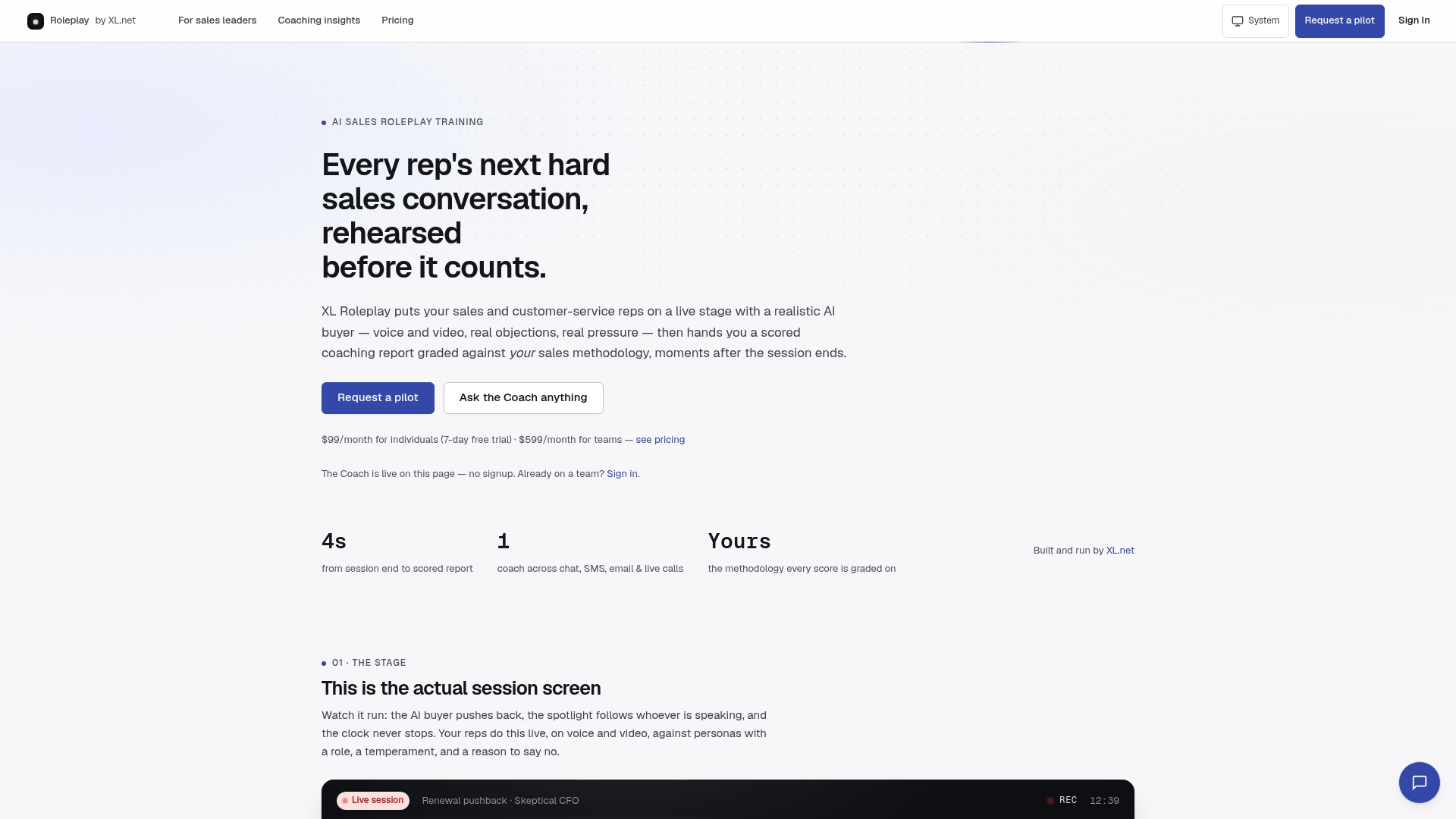
That is why we put personas at the center. Our AI buyers carry a role, a style and objections into live voice and video sessions, so a rep faces the same pressure a real buyer applies. The scenario library can be customized to your own buyers, so practice reflects the conversations your team actually has.
We also think scoring should belong to your organization, not to a generic standard. Our coaching reports are designed to be grounded in your sales methodology, and every score links back to the transcript. A manager can see what was said, which rubric line it touched and what to rehearse next.
One persistent AI coach with shared memory across channels means practice builds on itself instead of starting from zero each session. That is our answer to the weakest part of traditional role play: it is hard to repeat, hard to measure and easy to avoid.
Adam
Try persona-based practice with your team
If you want to run this approach without recruiting colleagues as buyers, XL Roleplay gives reps live voice and video sessions with AI buyers, scored coaching reports built around your methodology, and transcripts managers can review. Published plans on the pricing page start with Individual at $99 per month and Business at $599 per month. Extra seats are $54.95 per month per seat, and extra video is $16.99 per hour.
If you would rather test it on a real use case first, the XL Roleplay pilot is the place to start. For more on scenario design, browse our articles on role-play scenarios and AI sales role play.
FAQ
What is persona-based role play?
It is practice in which a defined character plays the buyer or customer, with set goals, a communication style and likely objections. The rep runs a realistic conversation and gets feedback against a rubric. Because the persona is consistent, the exercise can be repeated and compared over time.
How many personas does a team need?
Start with three to five that cover your most common and most costly conversations, such as a first discovery call, a price objection and an unhappy customer. Add more only when win/loss reviews or ticket data show a distinct pattern. A small library that people actually use beats a large one that nobody maintains.
How long should a scenario description be?
Short. LivePerson’s guidance suggests roughly three to six sentences, written in the second person, covering the customer’s goals, context and what they have already done. Detail beyond that usually belongs in the persona profile or the scoring rubric, not in the brief the rep reads.
How do I know if the practice is working?
Track the same rubric over several sessions and watch for improvement between first and second attempts. Then connect it to business metrics you chose in advance, such as conversion rate, deal size, first-call resolution or escalations, and review them after a full sales cycle.
Sources
- Theoretical Principles of Simulation-Based Sales Training (Koponen and Julkunen, 2015)
- LivePerson: Work in the Simulation and Training Studio, scenario best practices
- Stanford GSB: Class Takeaways, The Fundamentals of Effective Selling
- University of Dayton: AI in the Business Classroom, Learn, Practice, Sell
- ATD Talent Development Leader: Selling AI-Backed Learning
- ATD Blog: Soft Skills, Hard Results, Measuring the ROI of Human Skills Training
- How to design corporate learning paths that work