Realistic Sales Role Play: How to Set It Up and Run It
Realistic Sales Role Play: How to Set It Up and Run It

A sales role play feels realistic when the buyer behaves like a real buyer: guarded, distracted, a little skeptical, and unwilling to hand over information unless the rep earns it. To get there, you need four things: a scenario built from real calls, a buyer with a clear motive and a hidden concern, rules for how hard the buyer pushes back, and a scored debrief tied to specific moments in the conversation. This guide covers each one, with exercises you can run this week.
TL;DR
- Realism comes from buyer behavior, not from a fancier script. Give the buyer a goal, a hidden concern and a mood.
- Build scenarios from your own recent calls and your most common objections, not from generic lists.
- Run short rounds with one skill each (discovery, one objection, one close) and score them against a rubric.
- Feedback works best right after the call and when it points to exact moments in the transcript.
- AI buyers make this practice available on demand, so reps can repeat a scenario until it holds up.
Table of Contents
- What makes a sales role play realistic
- How to set up a realistic role play, step by step
- Scenarios worth practicing
- Realistic role play for customer service teams
- A first exercise for a new rep
- Feedback and scoring that change behavior
- Our perspective: practice should match your playbook
- Try it with your team
- Running role play week after week
- FAQ
- Sources
What makes a sales role play realistic
Most role plays fail for the same reason: the person playing the buyer is a colleague who wants to be nice. They give up budget information in the first minute, accept the first answer to an objection and never interrupt. The rep walks away feeling good and no better prepared.
A realistic role play has five traits.
The buyer has a reason to be there and a reason to say no. A real prospect took the meeting because of a pain, a deadline or curiosity, and has a concern they will not volunteer. Write both down before the session starts.
Information has a cost. The buyer shares details only in response to good questions. A vague “tell me about your process” gets a vague answer. A specific question about the last time the process broke gets a story.
Pressure is part of the setup. Real calls have a cut-off time, a second stakeholder who joins late, a competitor already in the account or a budget that was frozen last week. Add one pressure per scenario, not five.
The conversation can go off script. Buyers change the subject, ask something unrelated or object before the rep has finished the pitch. Reps need to respond to what was said, not to what the exercise outline expected.
The format matches the real channel. If your reps sell by phone, practice by voice. If they sell on video calls, practice on video, with the same awkward silences and the same temptation to read from notes.
There is research behind the value of this kind of practice. A study from the University of Nebraska Omaha on objection practice with live appointment-setting calls found that students who took part in live professional role-play calls showed higher actual and perceived learning about objection response techniques. The point carries over to a sales floor: practice that feels like the real call teaches more than practice that feels like a classroom.

How to set up a realistic role play, step by step
You do not need a long workshop. A good setup takes fifteen minutes and fits on one page.
1. Pick one skill and one objective
Write a single sentence for what a successful round looks like. “Uncover the cost of the current process before presenting anything” is a usable objective. “Be better at sales” is not. One skill per round keeps feedback specific.
2. Build the scenario from real calls
Pull three recent calls: one won, one lost, one stalled. Note the exact words buyers used when they pushed back. Those phrases are worth more than any invented script, because your reps will hear them again. If you want a method for this, our guide on building sales role-play scenarios from real calls walks through it.
3. Write the buyer card
A buyer card fits in five lines:
- Role and company size
- Why they took the meeting
- What they are afraid of (the hidden concern)
- Their mood (rushed, friendly but noncommittal, openly skeptical)
- One line they will say if the rep gets it wrong, and one if the rep gets it right
The last line matters. Buyers should react to quality. A rep who asks a sharp question should feel the conversation open up. A rep who pitches too early should feel it close down.
4. Set the rules of play
Tell reps the objective, the time limit and whether the buyer will be tough or cooperative. Keep rounds to five to ten minutes. Longer rounds drift, and reps lose focus on the one skill you are practicing.
5. Let the buyer actually push back
Whoever plays the buyer, human or AI, should hold their position until the rep earns a change. One common objection-handling pattern is to clarify, acknowledge, respond and confirm, as described in the Omaha objection-practice study. A buyer who sits through all four steps before softening makes the rep use them. A buyer who folds after the first reply teaches nothing.

6. Debrief right away
The longer you wait, the more the rep remembers what they meant to say instead of what they said. Debrief within minutes, using the transcript or recording. We cover this in detail below.
Scenarios worth practicing
The best scenarios mirror moments where deals are commonly won or lost. The table below pairs each moment with the skill it builds and the pressure that makes it realistic.
| Moment | Skill practiced | Realistic pressure to add | What good looks like |
|---|---|---|---|
| Cold call opener | Earning the next 30 seconds | Buyer says “I only have a minute” | Clear reason for the call, one relevant question |
| Discovery call | Layered questions, finding impact | Buyer gives short answers until asked about a specific recent event | Rep uncovers cost and urgency before pitching |
| Price objection | Diagnosing instead of discounting | Buyer cites a cheaper quote | Rep asks what the cheaper option leaves out |
| “We already have a vendor” | Opening a gap without attacking | Buyer is loyal to a long-term supplier | Rep asks about gaps and renewal timing |
| Stakeholder shows up late | Resetting the conversation | A new person joins ten minutes in | Rep recaps briefly and asks the newcomer what matters to them |
| Negotiation | Trading, not conceding | Buyer asks for a discount at the end | Rep asks for something in return |
| Closing | Asking for the next step | Buyer says “send me something” | Rep secures a dated next step |
For deeper libraries, see our trainer’s playbook of sales role-play scenarios and the collection of sales negotiation exercises.
Add improvisation to break the script
Reps who rehearse one script freeze when the buyer goes elsewhere. Improv techniques help. A paper indexed by ERIC on teaching the “Yes, And” method of improv in sales describes using improvisation to build adaptive selling skills and responsiveness to unexpected buyer input. In practice, have the buyer throw in one unplanned remark per round and ask the rep to acknowledge it and build on it. If you want a wider view of how to react to what buyers say, this piece on selling techniques that win deals is a good companion read.
Realistic role play for customer service teams
Service reps face a different version of the same problem. The customer is not evaluating a purchase; they are frustrated, and often the objection is “this should not have happened” or “I want a refund now.” The scenario design rules still apply.
- Give the customer a story. A late shipment is a different call if the customer needed it for an event, or if it is the third time.
- Give the customer a mood that shifts. Start irritated. Let the tone drop if the rep acknowledges the problem and offers a clear next step. Let it rise if the rep recites policy.
- Include a boundary. Real customers ask for things the rep cannot approve. Practice saying no while keeping the relationship intact.
- Practice the retention save. “I am thinking of canceling” is an objection too, and it responds to the same clarify, acknowledge, respond and confirm pattern.
Score service rounds on the same kind of rubric: did the rep acknowledge the issue before explaining, did they confirm understanding, and did they end with a clear next step?
A first exercise for a new rep
New reps need repetitions before they touch real accounts. A simple three-round sequence works well in the first two weeks.
- Round one: the opener. The buyer is busy. The rep has 60 seconds to state who they are, why they are calling and ask one relevant question. Repeat three times with different buyer moods.
- Round two: one objection. Choose the objection your team hears most. The buyer raises it in the first two minutes. The rep uses clarify, acknowledge, respond and confirm.
- Round three: the full short call. Opener, two discovery questions, one objection and a request for a next step. Ten minutes in total.
Have the rep run each round until they can finish it without needing a hint, then move to a harder buyer. The goal is not a perfect performance. It is that the first real call is not the first time the rep has heard “we are not interested.”
Feedback and scoring that change behavior
Practicing without feedback builds confidence, not skill. A few principles keep debriefs useful.
Feedback is immediate and specific. In the Omaha study, professionals gave immediate feedback after live calls and students completed a reflection assignment afterward. The pairing is worth copying: a fast outside view, then the rep’s own written takeaway.
Peers help. The same research notes that engaging peers in role play, including recording and peer review, improves learning by encouraging self-regulated reflection and observational learning. A rep who watches a teammate handle a tough buyer picks up phrasing they can borrow.
Score against a rubric, not a feeling. The exercise in the study scored a clear introduction and reason for the call, use of the referral person, rapport, objection response and ease of close. Adapt the list to your own motion. A discovery rubric might score:
| Criterion | Score 1 | Score 3 | Score 5 |
|---|---|---|---|
| Opening | No agenda | Agenda stated | Agenda agreed with the buyer |
| Question quality | Closed, surface-level | Open, some follow-up | Layered, tied to impact |
| Listening | Interrupts or moves on | Paraphrases once | Reflects and builds on answers |
| Objection handling | Argues or caves | Responds without checking | Clarifies, acknowledges, responds, confirms |
| Next step | None | Vague | Specific, dated, owned by both |
Point to moments. “You rushed discovery” is not useful. “At 3:40 the buyer mentioned a failed rollout and you moved on” is. Transcripts make this easy, which is why they matter so much for managers who cannot sit in on every practice session.
Limit the takeaways. Give each rep one thing to keep and one thing to change. Then run the same scenario again.
Our perspective: practice should match your playbook
We built XL Roleplay on a simple belief: reps improve when they practice against buyers who act like real buyers, and when the feedback reflects how your organization actually sells.
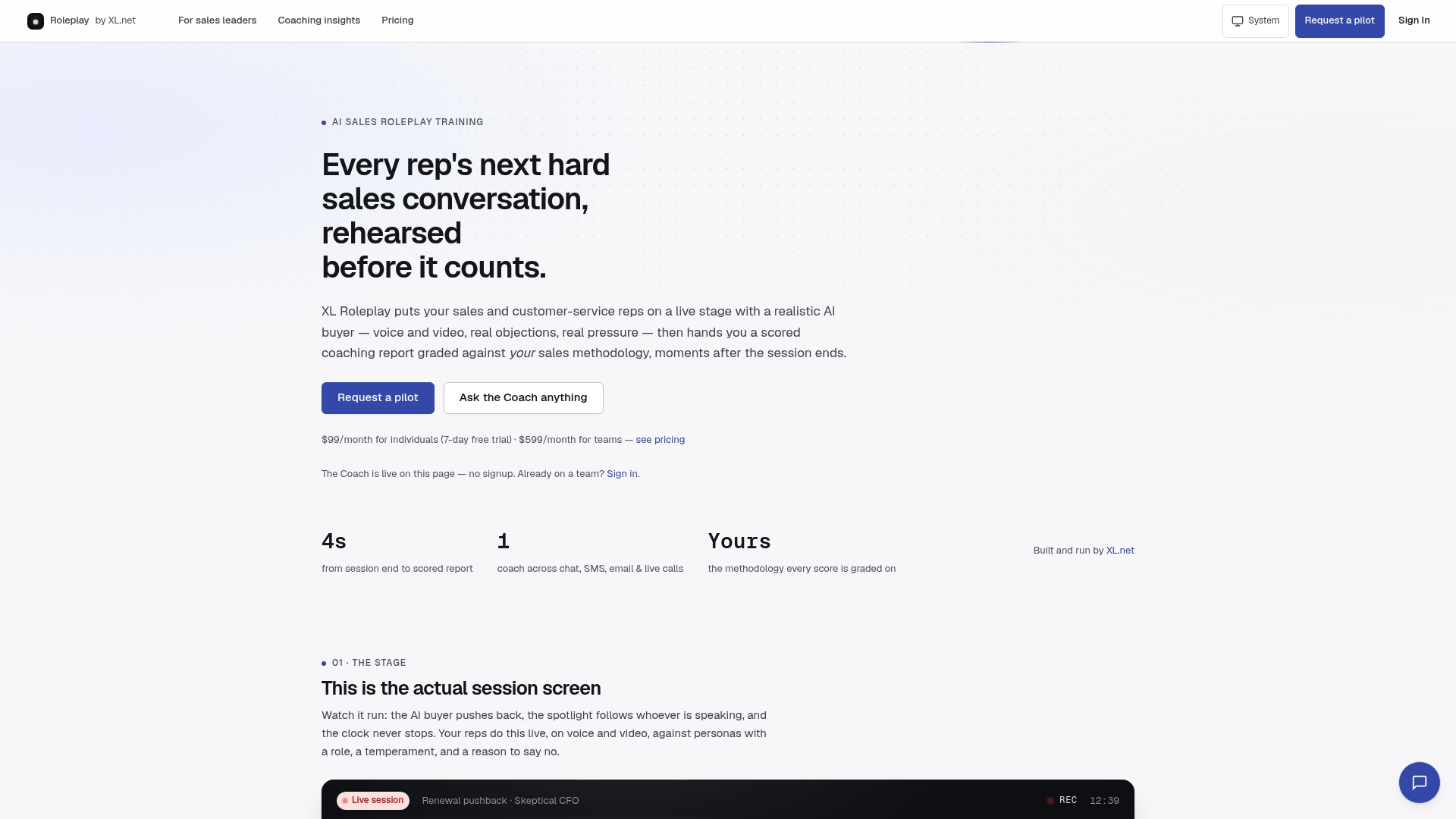
Generic role play has a ceiling. If the buyer is a scripted stand-in and the scoring checks a generic list, reps learn to perform for the exercise. Our platform is designed to run live voice and video conversations with AI buyers and personas that raise typical objections and pressure, then produce a scored coaching report grounded in your own methodology, whether that is a framework you teach or a playbook you wrote.
We also think managers should not have to guess. Every session produces a transcript and a rubric-linked report, so a coaching conversation can start from what was said, not from memory. One persistent AI coach carries context across sessions, so practice builds on itself instead of starting fresh each time.
That is the standard we hold ourselves to: practice that is realistic, scored and tied to your way of selling, available whenever a rep has fifteen minutes.
Adam
Try it with your team
If you want reps to practice against AI buyers built around your own scenarios, XL Roleplay gives you live voice and video sessions, scored coaching reports and transcripts managers can review. Plans are published on the pricing page: Individual is $99 per month and Business is $599 per month. Extra seats are $54.95 per month per seat, and extra video is $16.99 per hour. If you would rather test it with a defined group first, ask about the XL Roleplay pilot.
For more ideas, browse our articles on AI sales role play and sales training scenarios.
Running role play week after week
One good session does not change a team. Habits do. A simple cadence:
- Weekly: each rep runs two or three short rounds on the skill the team is working on that month.
- Biweekly: managers review a few transcripts and pick one moment to discuss in the one-on-one.
- Monthly: refresh scenarios with phrases from recent calls so practice never goes stale.
- After a loss: turn the stuck moment into a scenario and have the whole team run it.
Track two things: whether scores on the rubric rise for the targeted skill, and whether the behavior shows up on live calls. Practice earns its place when the second follows the first.
FAQ
What is a good role play for a sales team?
A good role play has a clear objective, a buyer with a hidden concern and a single skill to practice. A price objection after a strong demo is a reliable starting point, because every team hears it and the right response is a diagnostic question rather than a discount. Keep it under ten minutes and debrief right away.
How long should a sales role-play round be?
Five to ten minutes is enough for one skill. Short rounds keep the focus narrow and allow repetition, which is where improvement comes from. Save longer, full-call simulations for reps who are already comfortable with the individual pieces.
How do you make AI role play feel realistic?
Give the AI buyer a persona with a motive, a mood and a concern it will not reveal until asked well. Use phrases taken from real calls and add one pressure, such as a time limit or a competitor in the account. Voice or video format also helps, because it matches how reps actually sell.
Can customer service teams use sales-style role play?
Yes. Swap the buyer card for a customer story with a mood that shifts depending on the rep’s response, and score acknowledgement, clarity and next steps. Objection patterns such as clarify, acknowledge, respond and confirm apply to refund demands and cancellation threats as well.
Sources
- Objection practice using a live appointment-setting call (University of Nebraska Omaha)
- Teaching “Yes, And” improv in sales (ERIC)