Role Play vs Shadowing: How to Train Reps for Real Calls
Role Play vs Shadowing: How to Train Reps for Real Calls

Role play and shadowing train different things, and the strongest programs use both in a set order. Shadowing shows a new rep how a real call is structured. Role play lets that rep practice the hard moments, again and again, before a real buyer is on the line. If you can only start one, start with role play, because it is the only one of the two where every rep gets to speak, get scored and try again the same day. We built XL Roleplay for exactly that: live voice and video sessions with AI buyers, and scored coaching reports your managers can review.
TL;DR
- Shadowing means a new hire listens in on an experienced rep’s live calls. It teaches call flow and how veterans handle surprises.
- Role play means the rep practices a conversation against a buyer played by a colleague or an AI, then gets feedback and reruns it. It builds fluency and confidence.
- Best order: watch to learn structure, practice to build fluency, then coach on real calls to build judgment.
- Readiness should be scored against a written rubric, not a manager’s gut feel, so two managers reach the same verdict.
- Debrief every session in a few minutes, rep first. That habit decides whether either method sticks.
Table of Contents
- What each method actually is
- Side-by-side comparison
- Where each method breaks down
- Which one to use, and when
- How to run a role-play session that works
- How to assess a sales role play
- Turning results into coaching
- Where XL Roleplay fits
- Our view: practice is where readiness is built
- A simple 30-day plan for a new rep
- Common mistakes to avoid
- FAQ
- Sources
What each method actually is
Shadowing
Call shadowing is a training technique where a new hire joins an experienced rep during calls with customers or prospects and listens without being heard by the other participants. Quo describes it as a low-cost way to see how different scenarios play out in the real world and how people with years of institutional knowledge handle challenges.
The value is real context. A new rep hears the actual pace of a discovery call, the way a veteran recovers from a stalled answer, and what a real pricing objection sounds like. Nobody can fully script that.
Shadowing also works from the manager’s side. Everstage’s 2026 coaching guide notes that listening to real calls gives coaches direct visibility into missed cues, weak discovery questions and poor follow-ups that do not always show up in pipeline metrics.
Role play
Role play is practice of one part of a sales conversation. A colleague or an AI plays the buyer from a written brief, the rep responds out loud, and the session ends with feedback and a rerun. It is not a performance. It is a drill.
The case for it is straightforward. ATD, the Association for Talent Development, says readiness programs for sales and customer-facing staff should include both role play and coaching: role play builds skill through practical application, and coaching supplies ongoing feedback to fine-tune it.
The key difference is who does the work. In shadowing, the rep is an audience. In role play, the rep is the one talking.
Side-by-side comparison
| Role play | Shadowing | |
|---|---|---|
| What the rep does | Speaks, answers objections, asks questions | Listens and takes notes |
| What it teaches best | Fluency, confidence, discovery questions, objection handling | Call structure, pacing, how veterans handle real situations |
| Repetition | As many reruns as the rep needs, on the same moment | One live call, once |
| Risk to real buyers | None, the buyer is simulated | None for the rep, but quality depends on which calls happen that day |
| Manager time | Low with a scored report; higher if managers play the buyer | Tied to the senior rep’s calendar |
| Consistency | Same scenario and rubric for every rep | Every rep hears different calls |
| Best at | Building skill before going live | Showing what “good” sounds like in context |
The last two rows matter most for a sales leader. A team that shadows ends up with reps who have each seen different calls and absorbed different habits. A team that role-plays against the same scenario and the same rubric can compare reps and standardize on one methodology.
Where each method breaks down
Both methods fail in predictable ways, and each failure has a fix.
Shadowing fails when it becomes passive. A new rep who sits through ten calls without a task will remember little. Give the rep a job: note the discovery questions asked, flag the moment the buyer’s tone changed, write down one thing they would have said differently.
Shadowing also fails when it feels like an audit. SalesHive’s coaching guidance points out that when reps know a manager is listening to grade them, they tense up and perform an artificial version of the job. If you shadow your own reps, say that the goal is learning, and keep the debrief short.
Role play fails when the scenario is invented. A buyer who raises objections nobody has ever heard teaches nothing useful. Pull the moment from a real call instead. We cover how in building sales role play scenarios from real calls.
Role play fails when the buyer is played badly. A buyer who folds immediately builds false confidence. A buyer who is hostile for no reason builds dread. Paired practice between two students also loses realism. Triad formats with a salesperson, a customer and an observer are common in sales courses, but they work better when someone other than a fellow trainee plays the customer, as sales training practitioner Mike Kunkle notes. An AI buyer that holds a consistent persona and pushes back the way real buyers do removes that variable.
Role play fails when nobody checks what happens next. Practice only matters if the new behavior shows up on live calls. That is where call review and coaching come in.

Which one to use, and when
The cleanest rule is a sequence. New reps learn structure by watching, build fluency through practice, and then develop judgment on real calls with coaching. That maps onto three stages:
- Watch (days 1 to 5). Shadow a handful of calls with a specific task for each. Founder and sales author Pete Kazanjy argues in his Founding Sales handbook that drilling, repetition, paired sparring and shadowing all matter for building muscle memory before reps go live, and that presenting information from slides, even with a test, is not enough.
- Practice (weeks 1 to 2, then ongoing). Run short role-play sessions on the specific moments that decide deals: the opener, discovery, the first pricing objection, the ask for next steps.
- Go live with coaching. Move to real calls once the rep clears your readiness bar, and review those calls against the same rubric used in practice.
If you have to choose one because time is short, choose role play. Shadowing depends on what happens to be on a senior rep’s calendar. Role play can be scheduled, repeated and scored. It also scales: you can run it for ten new hires at once without pulling ten senior reps off the phones.
Customer service teams follow the same logic. Shadowing shows a new agent how an experienced colleague de-escalates an upset customer. Role play lets the agent rehearse the refund refusal, the cancellation request and the angry opener until the response is steady.
How to run a role-play session that works
A good session is short and focused. Aim for 30 to 40 minutes at most, built like this:
- Pick one moment. Choose a single point in the conversation from a real call: for example, the buyer says they are happy with their current vendor.
- Write a private buyer brief. The buyer knows their budget, their worry and what would make them say yes. The rep does not.
- Run one round of 10 to 12 minutes. Keep it live and out loud. Do not stop to coach mid-round.
- Debrief, rep first. Ask the rep to say what they would change before you say anything.
- Rerun the same moment. The rerun is where the learning shows. If the second attempt is not better, the debrief was too vague.
The debrief can follow three plain questions from the shadowing guidance above, and they work just as well after practice: What was the goal of the conversation? What worked? What is one thing you would change next time?
The formats you can choose from
Kunkle lists several formats: paired A/B practice, triads with an observer, fishbowl (one pair performs while others watch), single-skill drills and full scenarios. Fishbowl adds pressure, so psychological safety matters most there. For most teams, single-skill drills and short scenarios are the right default because they are easy to repeat.
How to assess a sales role play
If you want to know whether a rep is ready, you need a rubric. Without one, two managers will score the same session differently, and “ready” means whatever the loudest voice says.
A workable rubric scores the behaviors that matter for the call type. Here is a simple 100-point structure you can adapt to your own methodology:
| Category | Points | What you listen for |
|---|---|---|
| Opener | 15 | Clear reason for the call, earns the next 30 seconds |
| Discovery questions | 25 | Open questions, follow-ups on the buyer’s answers, uncovers the real problem |
| Objection handling | 20 | Acknowledges the concern, asks a clarifying question, answers without arguing |
| Close and next steps | 15 | Proposes a specific next step with a date |
| Tone and rapport | 15 | Steady pace, natural language, listens more than talks |
| Coachability | 10 | Takes feedback and improves on the rerun |
Set your own thresholds, for example a score where reps are cleared for live calls, a range that needs targeted practice, and a range that needs a restart on the fundamentals. The exact numbers matter less than using the same ones for every rep.
Two habits keep scoring honest. First, score from the transcript or recording, not from memory. Second, score the rerun as well as the first attempt, because the improvement between them is the best evidence of coachability.
Turning results into coaching
Assessment is only useful if it changes what reps do next. Use a simple loop:
- Pick one gap per rep. Not five. If discovery scores low, the next three sessions are discovery.
- Link feedback to the moment. “Your questions were shallow” is vague. “At minute four the buyer mentioned a budget freeze and you moved on” is something a rep can fix.
- Compare practice to live calls. If a rep scores well in practice but stalls live, review a live call against the same rubric. If a rep struggles in both, the fix is more practice on that skill.
- Track the trend, not one session. Readiness is a pattern across several sessions.
This is also where shadowing earns its place again. A manager who listens to a few live calls after practice can see whether the rehearsed behavior carried over, and the short debrief questions keep it from feeling like an audit.
Where XL Roleplay fits
Role play is hard to run well by hand. Managers have to write the briefs, play the buyers, score the sessions and remember who struggled with what. XL Roleplay takes that work on.
Reps hold live voice and video conversations with AI buyers and personas that raise the typical objections and pressures. Each session ends with a scored coaching report built on your organization’s own sales methodology, not a generic standard. Managers can open the transcript and the rubric to see exactly where a score came from, and track readiness for individuals and for the team.
Pricing is published. The Individual plan is $99 per month and the Business plan is $599 per month. Extra seats are $54.95 per month per seat, and extra video is $16.99 per hour. If you want to see how it works with your own playbook before rolling it out, the XL Roleplay pilot is the place to start.
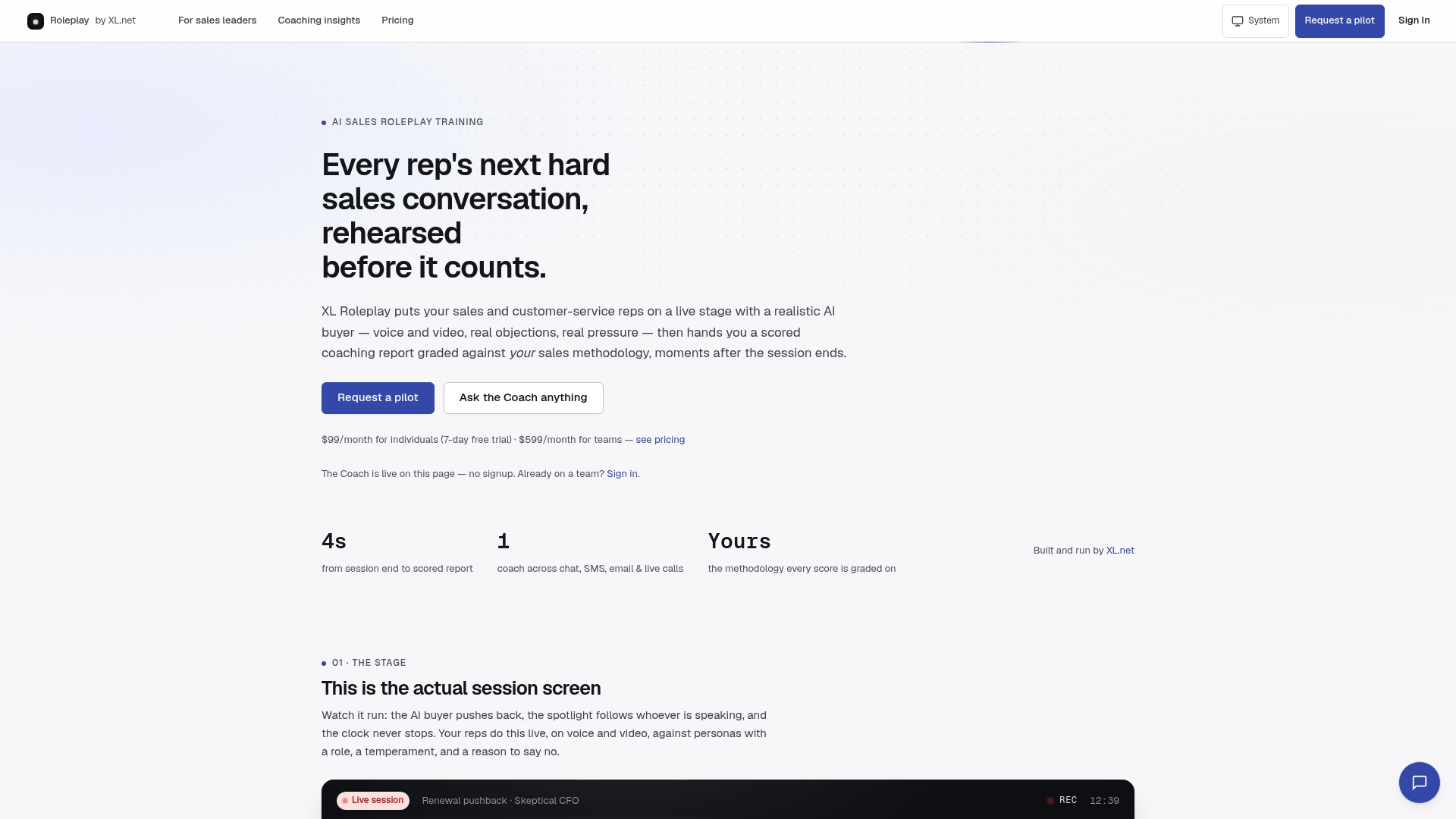
Sessions can also be built around scenarios taken from your real calls, which keeps the practice close to what your reps face. You can browse sales role play scenarios and role play exercises for sales to see the kinds of situations teams rehearse.
Our view: practice is where readiness is built
Most teams treat shadowing as the training and role play as an occasional extra. We would flip the weight. Watching a good call is useful, but nobody gets better at objection handling by listening to someone else handle one.
What a rep needs is a place to be wrong cheaply. A buyer who pushes back, a score that says exactly why, and a rerun ten minutes later. That loop is what turns knowing the playbook into being able to use it.
It is also what managers have been missing. Coaching without evidence turns into opinion. When every session leaves a transcript and a rubric score tied to your own methodology, the conversation changes from “I think you rushed discovery” to “here is the moment, here is the score, try it again.”
That is why we built one persistent AI coach that grounds its feedback in your playbook rather than a generic checklist. Shadow to see what good sounds like. Practice until you can do it. Then go live.
Adam
A simple 30-day plan for a new rep
If you want something to copy, here is a plan that uses both methods in the right order.

Week 1: learn the shape of a call. The rep shadows several live calls, each with a task sheet. In parallel, they run two or three short role-play sessions on the opener so they are speaking from day one rather than only listening.
Week 2: build discovery. The rep runs discovery drills against buyer personas with different attitudes: friendly but vague, skeptical, rushed. Each session ends with a scored report and a rerun. The manager reads one transcript per rep.
Week 3: handle pressure. The rep practices the three objections your team hears most, taken from real calls. The manager checks scores against the rubric, and a rep who clears your bar starts taking live calls with a senior rep listening in.
Week 4: go live and review. The rep takes live calls. The manager reviews a few against the same rubric, uses the three debrief questions, and chooses one gap to drill next.
The point of this plan is that every stage has an exit test. Nobody moves on because the calendar says so.
Common mistakes to avoid
- Shadowing with no task. Passive listening produces little recall.
- Running long sessions. A 30-40 minute block with a single focus beats a two-hour workshop.
- Skipping the rerun. Without it, feedback is just a comment.
- Scoring from memory. Use the transcript.
- Letting trainees play the buyer. Realistic pushback is what makes practice transfer.
- Never connecting practice to live calls. Review a few real calls against the same rubric, or the practice stays in a silo.
FAQ
Is role play better than shadowing for new sales reps?
For building skill, yes, because the rep is the one speaking and can repeat the moment until it improves. Shadowing is still valuable in the first week to show how a real call flows. Most teams get the best result by watching first and practicing right alongside it.
How long should a role-play session last?
About 30 to 40 minutes, including a 10 to 12 minute round, a debrief and one rerun. Keeping the focus on a single moment from a real call stops the session from drifting. Short, frequent sessions beat one long workshop.
What does a sales role play assessment measure?
It measures observable behaviors against a rubric: the opener, discovery questions, objection handling, the close and next steps, tone and rapport, and coachability. Weight each category by what matters to your sales motion and use the same scoring for every rep. Scoring from a transcript keeps managers consistent.
Can customer service teams use the same approach?
Yes. Shadowing shows a new agent how an experienced colleague handles an upset customer, and role play lets the agent rehearse refusals, cancellations and escalations. The rubric changes, for example empathy and resolution instead of discovery and close, but the watch, practice and coach sequence is the same.
How do I know when a rep is ready for live calls?
Set a score threshold on your rubric and require it across several sessions, not just one. Then check the first live calls against the same rubric. A rep who clears the bar in practice and holds it live is ready.
Sources
- Call Shadowing: The Essential Support and Sales Training Technique, Quo
- Sales Training Needs Role Play and Coaching for True Sales Readiness, ATD
- Sales Performance Coaching, Everstage
- SDR Coaching: How to Build a Coaching Culture, SalesHive
- Maximizing the Power of Role Play and Sales Simulations, Mike Kunkle
- Drilling, Repetitions, and Shadowing, Founding Sales