Sales Training Software Cost: 2026 Pricing Guide for US Teams
Sales Training Software Cost: 2026 Pricing Guide for US Teams

Sales training software costs anywhere from about $99 a month for one person to well over $40,000 in the first year for a mid-size team on an enterprise platform. The spread comes from three things: how the vendor charges (per seat, flat fee, or usage), how much setup the product needs, and what the contract does at renewal. This guide shows the ranges we can source, the fees buyers miss, and a way to turn any quote into a cost per rep.
TL;DR
- Enterprise readiness platforms are commonly quoted at $100 to $200 per user per year, but onboarding and implementation can add $10,000 to $50,000 or more.
- Conversation-intelligence suites can reach $40,000 to $60,000 or more in year one for a 20-person team once platform fees and setup are counted.
- AI role-play platforms usually price per seat per month. XL Roleplay publishes its prices: $99 per month for Individual and $599 per month for Business.
- Judge any quote by total first-year cost divided by the reps who actually practice, not by the headline seat price.
- Read the renewal clause before you sign: auto-renewal, notice windows and price escalators move the real cost more than the first invoice does.
Table of Contents
- What sales training software actually costs in the US
- The pricing models you will run into
- What XL Roleplay costs
- Costs that do not appear on the pricing page
- Contract terms that change the real price
- How to work out your cost per rep
- What to look for beyond price
- Perspective: pay for practice, not for shelfware
- Start with a pilot or a plan
- FAQ
- Sources
What sales training software actually costs in the US
There is no single market price, because “sales training software” covers several different products. Pricing falls into rough tiers by what the tool does.
| Type of tool | Typical pricing signal | What drives the total |
|---|---|---|
| Enterprise readiness and enablement platform | Around $100 to $200 per user per year for a core platform | Implementation, integrations, premium support, annual escalators |
| Conversation intelligence and revenue suite | Per-user fees of roughly $1,400 to $1,600 per user per year plus a platform fee | Platform fee, team size, add-on modules |
| AI role-play platform | Monthly subscription, per seat or per team | Seats, practice hours, video sessions, scenario customization |
| Learning management system with sales content | Free tiers up to quote-based enterprise plans | Number of learners, content creation, admin time |
Two figures from the research show how wide the range is. A core readiness platform at $100 to $200 per user looks cheap until onboarding and implementation of $10,000 to $50,000 or more is added, which depends on deployment complexity and integrations. A revenue suite for a 20-person team can land at $40,000 to $60,000 or more in year one, which works out to roughly $2,000 to $3,000 per rep before anyone has practiced a single call.
The lesson: the seat price tells you very little. The first-year invoice does.
The pricing models you will run into
Every vendor uses one of a handful of structures, and each one changes how your cost grows as the team grows.
Per-seat subscription
You pay a fixed amount for each rep, usually monthly or annually. It is easy to forecast and easy to scale up. The risk is paying for seats that nobody uses, so a pilot with real usage data is worth more than a demo.
Platform fee plus per-user fee
Common in enterprise software. A base fee covers the platform and admin features, and a per-user fee sits on top. At small team sizes the platform fee dominates, which is why cost per rep falls as you add people, and why a quote for 10 reps can look worse per head than a quote for 50.
Flat team plan
One monthly price covers a defined team or bundle, with extras sold separately. This is the simplest to budget when your headcount is stable. Check what the bundle includes and what each extra seat costs.
Usage-based add-ons
AI role-play and video practice use real compute, so some vendors charge for extra practice hours on top of the subscription. That is fair, but it means heavy users can cost more than light ones. Ask for the rate per hour, not just the plan price.
Quote-only pricing
Many enterprise tools publish nothing and price by negotiation. That is not a problem by itself, but it means you need two or three quotes on the same scope before the numbers mean anything.
What XL Roleplay costs
We publish our prices, so you can run the math before you talk to anyone. These are the amounts on our pricing page:
| Item | Price |
|---|---|
| Individual plan | $99 per month |
| Business plan | $599 per month |
| Extra seats | $54.95 per month per seat |
| Extra video | $16.99 per hour |
Over a year, Individual comes to $1,188 and Business to $7,188. If you add five extra seats to Business, that is another $3,297 a year ($54.95 × 5 × 12), for a total of $10,485. Extra video is billed at $16.99 per hour, so a team that adds 20 hours of video practice in a month adds $339.80 to that month.
The XL Roleplay pilot is the way to start with a team. It has no published price, so the pilot page is where you go to scope it.
For context on what the money buys: our platform runs live voice and video role-play against AI buyers, produces scored coaching reports built on your own sales methodology, and gives managers transcripts and rubrics to review.

Costs that do not appear on the pricing page
The subscription is rarely the whole bill. Before you compare quotes, list these separately.
Implementation and onboarding. For larger platforms this is the big one, with figures of $10,000 to $50,000 or more reported depending on integrations and deployment complexity. If your reps live in a CRM, the scope of the connection matters; a guide to HubSpot onboarding scope shows what that kind of setup typically includes.
Premium support. Support packages can add 10 to 20 percent to annual contract value on some enterprise contracts. Ask whether the support you need is in the base price.
Annual escalators. The same source notes that contracts often carry annual price increases of 3 to 7 percent, and that buyers should negotiate caps. A 5 percent escalator on a $50,000 contract is $2,500 in year two for the same product.
Content and scenario building. Someone has to write or configure the scenarios, rubrics and playbooks. If the vendor does it, expect a services fee. If your team does it, count the manager hours.
Usage overages. Video minutes, practice hours or call volume may be capped. Ask what happens when your top performers practice twice as much as planned.
Admin time. A tool that needs a full-time enablement owner costs a salary fraction on top of the license.
Contract terms that change the real price
The cheapest quote can become the most expensive one at renewal. Four clauses deserve a close read.
- Auto-renewal. Many SaaS contracts renew automatically for another full term unless you cancel in time.
- Notice window. Cancellation notice periods of 30, 60 or 90 days are common, and that window is the main leverage point for avoiding an unwanted renewal.
- Initial term. A 12-month term, a 24-month term and a month-to-month plan carry very different commitments for the same sticker price.
- Renewal pricing. Check whether renewal is at the same price or at the vendor’s then-current rates, a distinction the same SaaS contract checklist flags.
Put the notice date in your calendar the day you sign. For legal questions about a specific agreement, have your company’s counsel read it before you commit.
If renewal price conversations are part of your own job, our price increase conversation practice lets reps rehearse exactly that scenario.

How to work out your cost per rep
A quote only becomes comparable when it is turned into one number. Use this method for every vendor on your list.
- Add the first-year costs. Subscription or license, platform fee, implementation, support package, content services, and any extra seats or hours you expect to use.
- Divide by active learners. Use the number of reps who will practice at least a few times a month, not the number of licenses you bought.
- Add year two. Apply the escalator or renewal rate. A tool that is cheap in year one and 7 percent more in year two is still cheap; one that doubles is not.
- Compare with what you spend today. Add up trainer fees, off-site workshops and manager time spent running live role-plays. Software replaces part of that, not all of it.
A worked example
Say you run a 15-rep team on the Business plan at $599 per month, plus five extra seats at $54.95 per month. Annual cost is $7,188 plus $3,297, so $10,485. Divided by 20 active users, that is about $524 per rep per year, or roughly $44 per rep per month.
Compare that with a suite that lands at $40,000 to $60,000 for a 20-person team: $2,000 to $3,000 per rep. The two are not the same product, so the question is which job you need done. If the job is repeated practice of discovery, objections and pricing conversations before reps get on live calls, that points to a role-play tool. If the job is analyzing recorded customer calls across the whole revenue org, it points to a different category.
Is it worth it?
A simple test: what is one ramped rep worth, and how many weeks sooner does practice get a new hire there? Use your own numbers: average first-year quota, time to first deal, and attainment of your current cohort. If the annual cost per rep is smaller than the value of even a modest gain in ramp time or win rate, the purchase is easy to defend. If you cannot name the behavior you want to change, fix that before you buy anything.
What to look for beyond price
Price matters, but a cheap tool that nobody uses is the most expensive option. Check these:
- Fit with your methodology. Generic scoring teaches generic selling. Look for scoring tied to your own playbook.
- Realistic practice. Voice and video sessions with buyers who push back, rather than quizzes or slides.
- Manager visibility. Transcripts, rubrics and readiness scores so coaching conversations use evidence.
- Speed to first session. If reps can be practicing the week you buy, adoption does not stall.
- Scenario control. Can you build the objections your market actually raises?
If you are comparing categories, our articles on AI sales training software, simulation versus role-play and role-play scenarios go deeper on each. For planning the spend itself, see our pieces on budgeting for sales training and building an effective sales training budget.
Perspective: pay for practice, not for shelfware
We see the same pattern in almost every budget conversation. Teams spend heavily on content and analytics, then wonder why reps still stumble through the first discovery call or freeze at the pricing objection. Knowing what good looks like is not the same as having done it ten times.
That is why we built XL Roleplay around one persistent AI coach. Reps practice live, by voice or video, against buyers who raise the objections they will really hear. Each session ends with a scored coaching report grounded in your organization’s own sales methodology, not a generic standard, and managers get the transcript and rubric behind every score.
We publish our prices because we think a sales leader should be able to do the arithmetic before a single call. A monthly plan, clear seat and video rates, and a pilot for teams who want to prove it first keep the commitment proportional to the evidence you gather.
Our advice: whatever you buy, tie the cost to a behavior you can measure, and give reps a place to fail before the customer sees it.
Adam
Start with a pilot or a plan
If you want to see what practice does for your team before committing a budget line, we offer a pilot for teams and published monthly plans for individuals and organizations. The Individual plan is $99 per month and Business is $599 per month, with extra seats at $54.95 per month and extra video at $16.99 per hour.
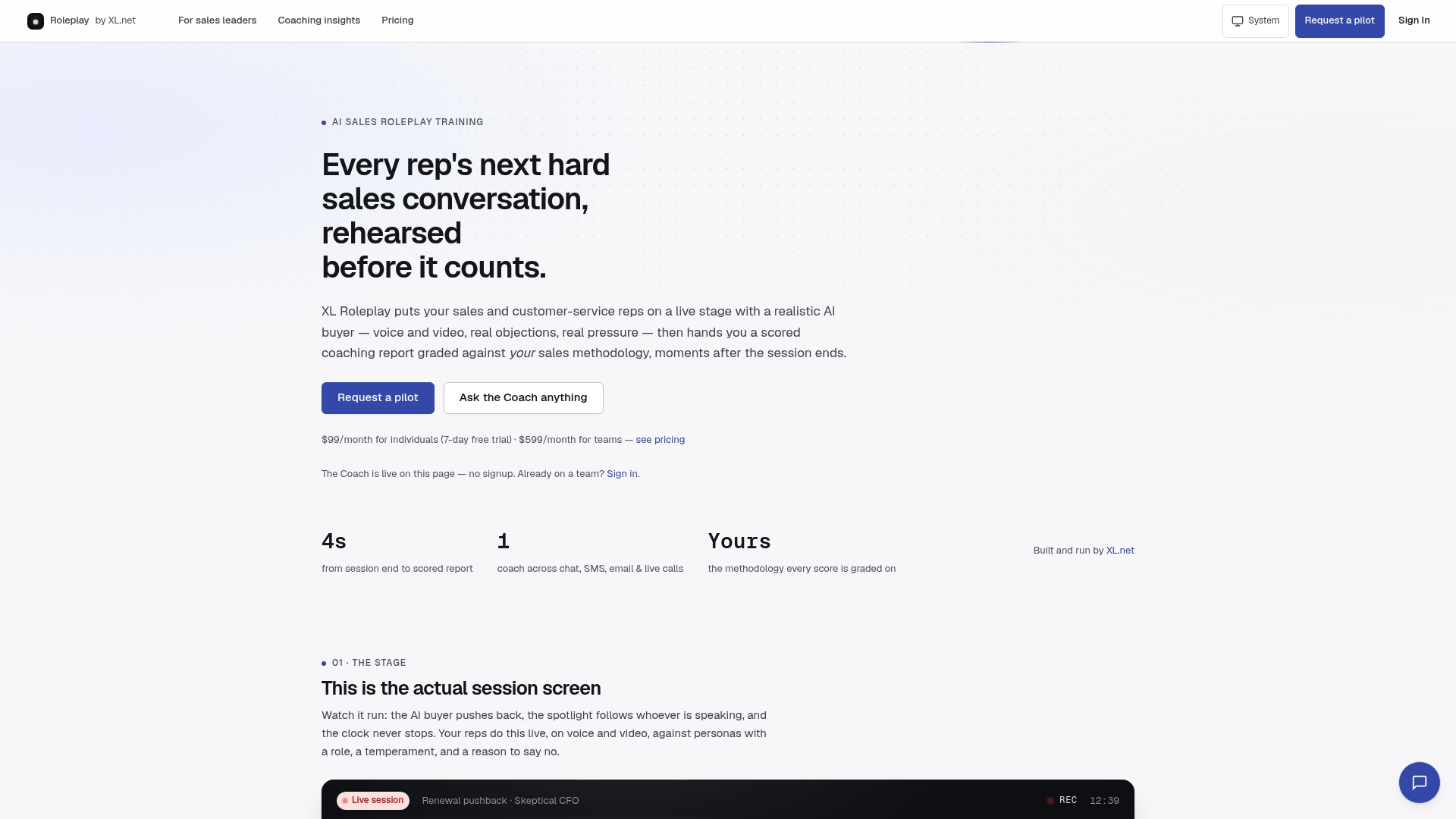
See the plans on our pricing page, or scope a team trial through the XL Roleplay pilot.
FAQ
How much does sales training software cost per user?
It ranges from roughly $100 to $200 per user per year for a core enterprise readiness platform to around $1,400 to $1,600 per user per year for a revenue suite, before platform fees. AI role-play tools usually charge monthly per seat. Always convert a quote to total first-year cost per active rep.
Is monthly or annual billing cheaper?
Annual contracts often come with a discount, but they lock you in and may auto-renew. Monthly plans cost more per month and let you leave quickly. If you are unsure about adoption, start monthly or with a pilot, then move to a longer term once usage is proven.
What hidden fees should I ask about?
Ask about implementation, integrations, premium support, content services, usage or video overages, and renewal escalators. Implementation alone can run $10,000 to $50,000 or more on enterprise platforms. Ask for every fee in writing.
How do I avoid an unwanted auto-renewal?
Find the notice window in the contract, since 30, 60 or 90 days are common, and set a reminder well before it. Confirm whether renewal is at the same price or current rates. Have counsel review any multi-year agreement.
Sources
- Vendr: sales readiness platform pricing and plans, 2026
- Dupple: the best sales training software platforms in 2026
- Pactly: your first SaaS contract checklist
- Axenda: HubSpot onboarding, what it includes and how to do it