Branching Scenarios vs Linear Online Learning: 5 Checks for Designers
Branching Scenarios vs Linear Online Learning: 5 Checks for Designers

Use branching scenarios when the learner’s choices must change what happens next: judgment, multi-step decisions, communication practice and skills that benefit from consequences. Use linear e-learning when everyone needs the same instruction: consistent explanations, demonstrations, compliance training and ordered procedures. If the route never changes, branching only adds cost. If the consequence teaches why a decision matters, it earns its place.
TL;DR:
- A randomized trial of 378 MOOC participants found higher dropout with branched virtual patients, although both linear and branching designs improved learning outcomes.
- For novices, begin with a short linear primer, limit decision points, give immediate explanatory feedback, and offer replay or an instructor debrief.
- Cap each decision point at three choices, map each to a distinct consequence, and test every route for logic, accessibility, and objective alignment.
- Measure workplace transfer with baseline observations, work samples, or call reviews, then repeat checks after a few weeks; completion alone cannot show behavior changed.
Table of Contents
- How do branching scenarios and linear e-learning differ in practice?
- Which format fits your module? A decision checklist
- How do you build a branching scenario step by step?
- How do you scaffold a branching scenario and measure whether it worked?
- Which authoring and delivery format should you choose?
- How much time and money does branching add?
- What does the evidence show when you compare the two formats?
- How do you add AI role-play to branching or linear courses?
- How do you measure behavior change and skill transfer?
- What goes wrong with branching scenarios, and how do you fix it?
- Does branching actually make learners more engaged and motivated?
- Why I recommend a hybrid, alignment-first approach
- When you want realistic conversation practice without authoring a full tree
- FAQ
- Sources
How do branching scenarios and linear e-learning differ in practice?
Linear courses present a controlled, predetermined sequence, so they serve knowledge transmission well. Branching scenarios put learners in a simulated situation and send them down different paths based on their decisions, so they serve judgment. Vanderbilt’s guide to interactive scenarios says branching suits applying theory, practicing multi-step decisions, situational awareness and conflict resolution, anywhere failure can be safely simulated.

The distinction that matters most is true versus cosmetic branching. A real branch changes the information, consequence, task or outcome that follows. If every choice quickly funnels back to identical content, you paid for a tree and delivered a line.
Here is how the two formats compare:
- Outcomes: linear builds shared knowledge and procedure recall; branching builds decision quality and the ability to anticipate consequences.
- Engagement: branching can make practice feel authentic, but engagement and completion are different outcomes.
- Completion risk: complexity and task effort can push novices out before they finish.
- Production effort: every added choice multiplies the scripting, feedback writing and testing you owe.
Research note: in a randomized trial of 378 MOOC participants, branched virtual patients had higher dropout than linear ones, even though both designs can improve learning.
Which format fits your module? A decision checklist
Run each module through these questions before you open an authoring tool:
- Is the objective measurable and about a decision? If you can only phrase it as “understand” or “know,” linear is probably enough.
- What do learners already know? Novices need more structure than experienced staff.
- What does an error cost on the job? High stakes favor safe simulation of failure.
- Do learners need to replay? Branching rewards a second attempt on a different path.
- Does your assessment match the format? A multiple-choice quiz may not capture all the decision-making a scenario is designed to teach.
The ICAP framework helps here. It links cognitive engagement to outcomes, with results rising from passive to active to constructive to interactive. A 2026 CHI study on interactive worked examples suggests matching the engagement mode to prior knowledge, using guided examples to scaffold constructive engagement for lower-knowledge learners. Interactive tasks only pay off when learners can handle them.
Pro Tip: For novices, start with linear scaffolding, then introduce branching once the foundations are in place.
How do you build a branching scenario step by step?
Start from the objective, not the tool. The Saskatchewan higher-ed design guide lays out a sequence that works well for storyboard-first projects:
- Write a measurable performance objective.
- Pick an authentic situation and define the opening challenge.
- Write realistic choices, with no more than three at any decision point, because extra options rapidly multiply downstream branches.
- Map each choice to a distinct consequence and next decision.
- Add feedback that explains the implications of the choice.
- Storyboard the full decision tree, labeling learning checks.
- Build it in an authoring tool or your LMS.
- Test every route end-to-end.
Realistic choices come from real material. Our guide on building scenarios from real calls shows how to mine actual conversations for believable options and consequences.
When you test, check these on every path:
- Logic: does each choice lead where the storyboard says it does?
- Timing: does a full run fit the time learners have?
- Accessibility: can every route be completed with assistive technology?
- Alignment: does each ending reinforce the objective rather than a side issue?
Vanderbilt’s guidance is the same: map every decision and consequence before building, then test each route.
How do you scaffold a branching scenario and measure whether it worked?
Scaffolding is what keeps realism from becoming overload. Research on the virtual-patient trial points to complexity, task effort and cognitive load for novices as likely reasons for higher dropout, so design against those directly:
- Open with a short linear primer.
- Limit the number of decision points.
- Give immediate explanatory feedback after each choice.
- Offer optional replay.
- Add an instructor debrief where possible.
Evidence from a branching narrative serious game study points the same way: engagement gains depend heavily on pedagogical scaffolding and instructor involvement, and when branching follows linear instruction, learner acceptance and usefulness ratings rise substantially.
Track more than clicks:
- Completion rates
- Task accuracy on the decisions that matter
- Transfer to the workplace
- Learner perceptions of usefulness
Caveat worth showing stakeholders: the MOOC trial found branching increased dropout in that context, and scaffolding is the mitigation, not an afterthought.
Which authoring and delivery format should you choose?
Pick the build path that matches the skill you are teaching and the budget you have:
- Authoring-tool builds: a practical route for teams seeking control over feedback and tracking, though large trees can be hard to maintain.
- Branching video: can convey tone and body language, but reshoots can make changes expensive.
- Interactive text: can be simpler to write and revise, and may suit a first project.
- Dialog-based simulations: natural for communication practice, where open conversation beats a fixed menu of choices.
Delivery matters too. The Open University’s overview explains that synchronous learning happens in real time and supports immediate interaction, while asynchronous learning supports flexibility and repeated short visits. A blended approach can combine both.
If your needs outgrow an authoring workflow, a guide to building your own e-learning platform is a useful starting point for weighing custom development.
How much time and money does branching add?
Expect the effort to climb in this order: a short linear module, then a small branching scenario, then a large branched module. The cost drivers are predictable:
- Scripting every consequence and its feedback
- Multimedia, especially video
- QA for every branch, since testing grows with the tree
- LMS implementation and tracking
Scope a minimal viable branching scenario first: one authentic situation, one or two decision points, three choices at most, and distinct consequences for each. Ship it, measure it, then expand.
Pro Tip: Cut the scope before you cut the testing. An untested branch is worse than a missing one.
What does the evidence show when you compare the two formats?
The cleanest comparison comes from the randomized trial of virtual patients. Both linear and branched designs improved learning outcomes, but branched versions lost more participants. The lesson for designers is that both formats can support learning, while branching may place greater demands on novice learners, and some did not stay.
In the Time Machine study of a branching narrative game, student motivation and persistence were studied in a branching format, and the results leaned on scaffolding and instructor involvement rather than on branching alone.
Taken together, these studies suggest a practical reading:
- For procedures and policy, a linear module delivers the same information to everyone at lower cost.
- For judgment, a well-scaffolded branching scenario gives practice that linear content cannot.
- In both cases, the design details (primers, feedback, instructor presence) decide the result.
Support practice works the same way. Our customer service roleplay training guide shows how consequence-based practice plays out when the “scenario” is a live conversation with an upset customer rather than a menu of choices.
How do you add AI role-play to branching or linear courses?
AI role-play fits where a fixed menu of three choices cannot capture how a real conversation unfolds. Treat it as a practice layer, not a replacement for instruction.
- Teach first, practice second. Put the concept in a linear module, then send learners into the conversation.
- Define the scenario like a branch. Write the situation, the persona and the pressure points just as you would map a decision tree.
- Require feedback after each session. Interactive setups that rely on dialogue can support iterative improvement, as research on question-driven learning suggests.
- Offer learner choice. AI-powered interactive platforms can increase learner agency and engagement, though evidence on long-term outcomes still needs further study.
- Keep a human in the loop. Review transcripts and debrief, especially early on.
Our trainer’s playbook of role-play scenarios shows debrief structures that carry over to any conversational practice, whether it lives inside a branching course or beside a linear one.
How do you measure behavior change and skill transfer?
Completion tells you who finished. It does not tell you who changed. To measure transfer, plan beyond the course:
- Baseline first. Capture how the target behavior looks on the job before training.
- Observe real work. Use manager observation, call reviews or work samples against a simple rubric tied to the objective.
- Check decision quality in the scenario. Compare which paths learners choose first with which they choose on replay.
- Follow up later. Repeat the check after a few weeks, because immediate scores overstate retention.
- Ask the learner too. Perceived usefulness is a signal, but treat it as supporting evidence only.
Research on workplace and serious-game learning, including this MDPI study, points to alignment: engagement is strongest when scenarios mirror real tasks, include safe failure and give timely feedback, and it can decline when the experience becomes repetitive, insufficiently challenging or overwhelming. If your scenario does not resemble the job, it may be harder to assess whether learning transfers to work.
What goes wrong with branching scenarios, and how do you fix it?
Most problems repeat from project to project:
- The tree explodes. More than three choices per decision point multiplies branches. Cap choices and merge paths only where consequences truly converge.
- Cosmetic branching. If every route returns to the same content, rewrite the consequences or convert the module to linear.
- Novice dropout. Add a linear primer, reduce decision points and offer replay.
- Weak feedback. Say why a choice led where it did, not just that it was wrong.
- Untested routes. Walk every path before launch, including the unlikely ones.
- Repetitive replays. If learners cannot learn anything new on a second pass, vary the consequences or the situation.
When a problem persists after fixes, ask the question from Vanderbilt’s guidance again: should the learner’s choice change what happens next? If not, simplify.
Does branching actually make learners more engaged and motivated?
It can, but the effect is conditional. Branching can give learners a sense of agency, which may support engagement. Linear modules offer predictability, a strength for learners who need a clear explanation.
The research cautions against assuming more interactivity always helps. The virtual-patient trial separates engagement from completion: practice can feel more authentic while complexity quietly drives people away. The serious-game study adds that motivation gains depend on scaffolding and instructor involvement.
For your own projects, that means:
- Match the interaction level to prior knowledge.
- Keep challenge steady: too easy bores, too hard overwhelms.
- Use feedback to keep consequences feeling meaningful.
- Watch for repetition, which wears down motivation.
Engagement is a design outcome, not a format property.
Why I recommend a hybrid, alignment-first approach
I would not choose between the formats. I would open every module with a short linear primer, then add branching only where a consequence teaches judgment or communication under pressure. Testing, scaffolding and measurable outcomes matter more than novelty. A modest scenario that is tested and aligned beats an elaborate tree nobody finishes.
— Adam
When you want realistic conversation practice without authoring a full tree
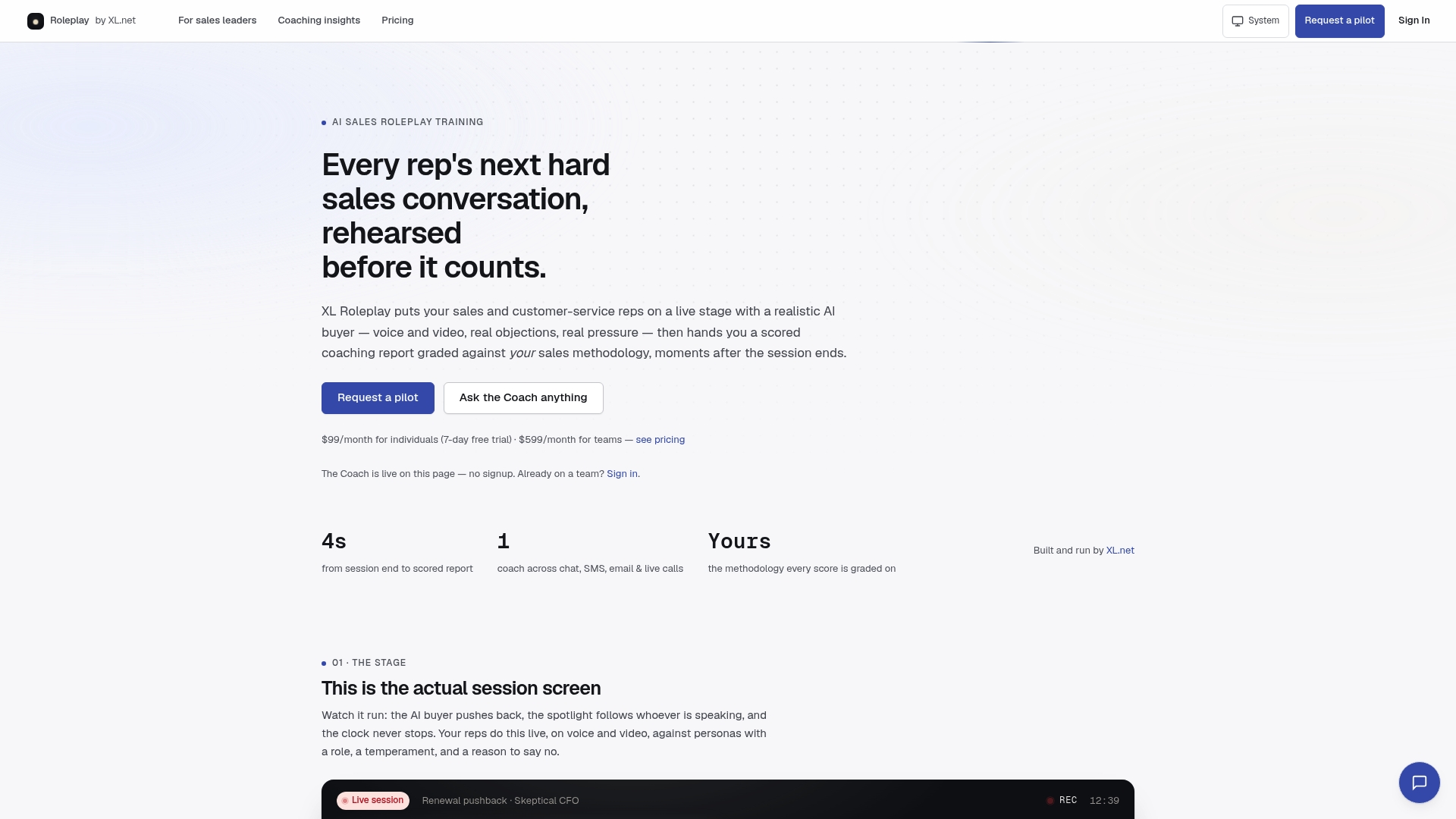
If your goal is communication practice, we built XL Roleplay so your team can practice with realistic AI buyers instead of authoring every branch. Reps get scored coaching feedback and transcripts. Our comparison of simulation training and role play explains when each approach fits.
- Live conversations that respond to what the learner says
- Scored reports tied to your own methodology
- Transcripts managers can review
Start with the XL Roleplay pilot to see how it fits your team.
FAQ
How do you create a branching scenario?
Start with a measurable performance objective and an authentic situation. Write no more than three realistic choices per decision point, map each to a distinct consequence, storyboard the full tree, then build and test every route. The Saskatchewan design guide follows this sequence.
What are the main types of learning?
It depends on the framework you use. A commonly used one is ICAP, which classes learning as passive, active, constructive or interactive, with engagement increasing at each level, as described in this digital learning terms report. No single list of learning types is universally accepted.
What is the difference between synchronous and asynchronous e-learning?
Synchronous learning happens in real time and requires learners to attend together, which supports immediate interaction. Asynchronous learning lets people engage on their own schedule, which supports flexibility and repeated visits, according to the Open University. A blended approach can combine both.
Is linear e-learning still effective?
Yes, for the right objective. When everyone needs the same explanation, demonstration or ordered procedure, linear design is usually more efficient. The randomized virtual-patient trial found both linear and branched designs can improve learning outcomes.