Trainers: Scored Difficult Customer Role Play Scripts and a Rubric
Trainers: Scored Difficult Customer Role Play Scripts and a Rubric

Use these ready-to-run difficult customer role play scripts, along with a five-step facilitation flow and scoring rubric, to rehearse de-escalation and ownership before your next training session. Trainers and team leads can lift any scenario below, assign roles, and run a 30 to 60 minute practice block today. The goal isn’t scripted perfection; it’s building reps who can absorb pressure and still land a clear next step.
TL;DR:
- Most difficult customer moments stem from operational gaps, not hostility, with acknowledgment and clear timelines reducing escalation more effectively than rebuttals.
- Practice sessions should focus on real, relevant scenarios linked to actual policies, with role rotation, structured debriefs, and scoring rubrics to build consistent skills.
- Tailoring scripts to your company’s policies and real customer interactions improves authenticity and helps reps develop practical problem-solving habits.
- Coaching should emphasize acknowledgment, ownership, clear next steps, and vocal control, with recordings providing precise cues for improvement.
- Using AI-driven platforms like XL Roleplay enables scalable, realistic practice with better scoring and scenario customization than traditional live training alone.
Table of Contents
- Difficult Customer Role Play Scenarios With Full Scripts
- How Do You Run A Difficult Customer Role Play Session?
- What Rubric Should You Use To Score Role Play Performance?
- How Do You Customize Scripts To Your Company’s Policies?
- Which Micro-Skills Should You Coach During Role Play Reviews?
- What Do Trainers Get Wrong About Difficult Customer Role Play?
- Try XL Roleplay For Difficult Customer Practice At Scale
- Sources
Difficult Customer Role Play Scenarios With Full Scripts
Generic scripts produce generic reactions. The scenarios below work because they mirror real friction points, slow answers, unclear timelines, inconsistent policy enforcement, rather than inventing melodrama for its own sake. Research on customer escalation backs this up: most difficult customer moments trace back to operational gaps, not innate hostility. Acknowledgment and a clear timeline defuse more tension than any clever rebuttal.
Each scenario below includes a setup, roles, sample dialogue, escalation triggers to watch for, and one learning objective. Assign a facilitator to play the customer using the emotional notes provided, not just the words on the page. Channel and difficulty are tagged so you can build a session that matches your team’s actual call mix.
-
Angry caller, service outage (Phone, Intermediate). Setup: a customer has been without service for six hours and has already called twice. Roles: rep vs. escalated customer, goal is to acknowledge frustration and commit to a real update time.
Customer: “This is the third time I’ve called. Nobody can tell me anything!” Rep: “You’re right to be frustrated, three calls with no resolution is not okay. I’m pulling up your account now.” Customer: “I just want to know when it’ll be fixed.” Rep: “I can’t give you an exact minute, but I can tell you our outage team has this flagged as priority and the average resolution time today is under two hours. I’ll text you the moment it’s back.” Customer: “Fine. But if it’s not fixed by tonight, I’m switching providers.” Rep: “I hear you, and I’ll follow up personally by 6 PM whether it’s resolved or not.”
Escalation trigger: customer threatens to cancel twice in one call. Learning objective: replace vague reassurance with a specific commitment.
-
Refund request outside policy (Chat, Intermediate). Setup: customer wants a refund on a non-refundable service purchased 45 days ago. Roles: rep vs. customer citing “always been able to before.” Goal: hold the line while offering a real alternative.
Customer: “I want my money back, it’s been a week since I asked.” Rep: “I understand the wait has been frustrating. This purchase falls outside our 30-day refund window, so I can’t process a cash refund.” Customer: “That’s ridiculous, you’re just taking my money.” Rep: “I get why that feels unfair. What I can do is apply the full amount as account credit today, no expiration.” Customer: “I guess that’s better than nothing.” Rep: “I’ll process that right now and send confirmation.”
Escalation trigger: customer accuses the company of theft or fraud. Learning objective: pivot from “no” to a concrete alternative in one breath.
-
Billing dispute, unexpected charge (Phone, Advanced). Setup: customer sees a $79 charge they don’t recognize; it’s a legitimate renewal fee buried in fine print. Roles: rep vs. confused, defensive customer. Goal: explain without sounding condescending.
Customer: “You charged me $79 and I never agreed to that.” Rep: “Let’s look at this together. This is your annual renewal, it was included in the terms when you signed up in March.” Customer: “Nobody reads all that fine print.” Rep: “Fair point. I can waive this one as a one-time courtesy and set a reminder email for next year so there’s no surprise.” Customer: “Okay, that works.”
Escalation trigger: customer disputes the charge with their bank mid-call. Learning objective: validate the complaint before explaining the policy.
-
Wrong item delivered (Chat, Beginner). Setup: customer received the wrong size/color and needs it for an event in two days. Roles: rep vs. anxious, time-pressed customer. Goal: solve fast, skip the interrogation.
Customer: “You sent me the wrong item and I need this by Friday!” Rep: “Got it, let’s fix this fast. I’m shipping the correct item overnight at no cost, it’ll arrive Thursday.” Customer: “And the wrong one?” Rep: “Keep it or donate it, no need to return anything.”
Escalation trigger: overnight shipping isn’t available to their zip code. Learning objective: speed matters more than process when the customer has a deadline.
-
Technical failure, product won’t work (Phone, Intermediate). Setup: customer’s device has failed twice after a “fix.” Roles: rep vs. skeptical customer who no longer trusts troubleshooting steps. Goal: own the repeat failure before proposing another fix.
Customer: “You people already ‘fixed’ this last week. It’s broken again.” Rep: “That’s on us, if our fix didn’t hold, we need a different approach, not the same steps again.” Customer: “So what now?” Rep: “I’m escalating this to our hardware specialist team and shipping a replacement unit today rather than another remote fix.”
Escalation trigger: customer says they’ve lost data or missed work because of the failure. Learning objective: don’t repeat a failed solution, name the shift in approach.
-
Repeat unresolved issue (Phone, Advanced). Setup: the same complaint has come in three times across two weeks with no resolution. Roles: rep vs. customer who has lost trust in the brand. Goal: rebuild credibility with a documented action plan.
Customer: “This is my third call. Nobody follows through.” Rep: “You shouldn’t have had to call three times. I’m documenting this ticket right now with a case number and assigning it to a senior specialist who’ll call you directly within 24 hours.” Customer: “That’s what the last person said.” Rep: “I understand the skepticism. I’ll email you this commitment in writing before we hang up.”
Escalation trigger: customer says they’ve already contacted a regulator or filed a complaint elsewhere. Learning objective: written follow-through restores credibility better than a verbal promise.
-
Customer demanding a manager immediately (Phone, Intermediate). Setup: customer refuses to discuss the issue with the rep and wants a manager now. Roles: rep vs. customer who views the rep as powerless. Goal: demonstrate authority without escalating unnecessarily.
Customer: “I don’t want to talk to you. Get me your manager.” Rep: “I can absolutely get you a manager. Before I transfer you, can I try to resolve this myself? I have the authority to issue credits up to $150.” Customer: “Fine, but if you can’t fix it, I want that manager.” Rep: “Deal. Let’s see what I can do first.”
Escalation trigger: customer becomes hostile toward the rep personally rather than the issue. Learning objective: offer real authority before defaulting to escalation.
-
Abusive language (Phone, Advanced, safety-focused). Setup: customer begins swearing and making personal insults. Roles: rep vs. customer who crosses from angry into abusive. Goal: set a boundary calmly, escalate if it continues.
Customer: “You’re all idiots, this is a joke.” Rep: “I want to help you, and I will keep working on this with you. I do need us to keep the conversation respectful so I can focus on solving it.” Customer: (continues insulting) Rep: “I understand you’re upset. If the language continues, I’ll need to transfer this call to a supervisor.”
Escalation trigger: any threat of violence or repeated abuse after one warning, this is a mandatory transfer, no second warning. Learning objective: one clear boundary statement, then action, not repeated warnings.
-
Silent or withdrawn customer follow-up (Chat, Beginner). Setup: customer stopped responding mid-conversation after an unresolved issue three days ago. Roles: rep vs. a customer who reappears cold and short. Goal: re-engage without sounding scripted.
Rep: “Hi, following up on your order issue from Tuesday, has this been resolved on your end?” Customer: “No. I just gave up.” Rep: “I’m sorry that happened, let’s not leave it there. I’m looking at your case now.”
Escalation trigger: customer says they’ve already switched to a competitor. Learning objective: silence isn’t resolution, always close the loop.
-
Churn-threat conversation (Phone, Advanced). Setup: a long-tenured customer says they’re canceling after a service failure. Roles: rep vs. customer citing years of loyalty. Goal: acknowledge the relationship, not just the transaction.
Customer: “I’ve been with you five years and this is how you treat me?” Rep: “Five years matters, and you deserved better than this. I want to make this right, not just for today’s issue, but so this doesn’t happen again.” Customer: “Talk is cheap.” Rep: “Then let me show you: I’m crediting this month in full and flagging your account for priority support going forward.”
Escalation trigger: customer has already requested a cancellation form. Learning objective: loyalty conversations need a relationship response, not a transactional one.
-
High-emotion, panic customer (Phone, Advanced). Setup: customer is distressed, a service failure affected something urgent (a medical delivery, a business deadline). Roles: rep vs. a customer near tears or shouting from panic, not anger. Goal: calm the moment before solving the problem.
Customer: “I need this today, my mother needs this medication, please!” Rep: “I hear you, this is urgent and I’m treating it that way right now. Let me find the fastest option.” Customer: “Please hurry.” Rep: “I’m on it. Same-day courier is available, it’ll arrive by 3 PM.”
Escalation trigger: customer’s distress escalates instead of easing after reassurance, may need a supervisor for a judgment call on exceptions. Learning objective: panic needs speed and calm tone before detail.
-
Confused customer, self-inflicted issue (In-person, Beginner). Setup: customer misused a product and blames the company, mildly irritated rather than hostile. Roles: rep vs. customer resistant to hearing they made an error. Goal: correct gently without blame.
Customer: “This thing is defective, it won’t turn on.” Rep: “Let’s take a look together. Ah, I see, this model needs the battery inserted this direction. Let’s try that.” Customer: “Oh. I didn’t realize that.” Rep: “Happens all the time, the instructions bury that detail. You’re all set now.”
Escalation trigger: customer refuses to accept the explanation and insists on a replacement anyway. Learning objective: correct the mistake without making the customer feel foolish.
How Do You Run A Difficult Customer Role Play Session?
A structured flow beats improvised practice because it forces reps through the full arc, prepare, act, and reflect, instead of just winging a scary conversation once and calling it training. Training providers who build role-play templates consistently recommend timeboxed rounds with a fixed debrief, because it increases how many scenarios a team can practice per session and improves retention over unstructured drills.
The five-step flow:
- Prepare. Pick one or two scenarios tied to a real recurring issue your team faces this month, not a random pick from a list.
- Brief. Assign roles (customer, rep, observer), state the ground rules, and give the “customer” actor emotional notes, not just lines to read.
- Act. Run the scenario timeboxed, five to eight minutes is enough for most scripts above.
- Observe. The observer takes notes against a rubric (covered in the next section) rather than just reacting informally.
- Debrief. Spend more time here than in the role-play itself; this is where the actual learning locks in.
For timing, a 30-minute session fits one scenario with a full debrief. A 60-minute session fits two to three scenarios with role rotation, so every participant plays both customer and rep at least once. A 90-minute session can run four to five scenarios and include a group discussion on patterns observed across the whole team.
Remote sessions work fine with breakout rooms for pairs, followed by a full-group debrief. Recording sessions (with consent) lets you replay a tense moment and point to the exact second tone shifted, something rapid-rotation practice formats rely on heavily for building confidence fast.
- Rotate the “customer” role among trainers or senior reps so junior staff always get to practice the response side first.
- Never let a session end right after the role-play, the debrief is not optional.
- Keep a standing rule: if a scenario simulates abusive language, the facilitator can call “pause” and reset at any point.
Pro Tip: Run the exact same scenario twice in a row with two different reps back to back. The contrast in approach becomes the best teaching moment of the whole session, more useful than any lecture on “best practices.”
What Rubric Should You Use To Score Role Play Performance?
Score every session against four dimensions: empathy, ownership, clarity of next steps, and call control. A simple 4-point scale (1 = missing, 4 = strong) turns a subjective “that went well” into something you can track across a team over a quarter.
- Empathy (1 to 4): did the rep acknowledge the emotion before jumping to a solution?
- Ownership (1 to 4): did the rep take responsibility for the issue instead of deflecting to policy or another department?
- Clarity of next steps (1 to 4): did the customer leave the conversation knowing exactly what happens next and by when?
- Call control (1 to 4): did the rep steer the conversation back on track when it drifted or escalated?
A rep scoring 2 on empathy and 4 on clarity is common; it usually means they’re solution-oriented but skip the acknowledgment step, an easy, specific coaching fix rather than a vague “be more empathetic” note.
Recordings and transcripts matter more than memory here. A supervisor listening back can catch the exact moment a rep’s pace sped up or their tone flattened, cues that are nearly impossible to score accurately from a live observation alone. Some AI-driven coaching platforms provide immediate percentage-based scoring on de-escalation success and ownership, which turns a subjective rubric into a trackable number over time.
Translate scores into action fast: a rep who consistently scores low on call control needs a different coaching plan (interrupting technique, redirect phrases) than one who scores low on ownership (mindset and language coaching). Aggregate scores across a team to spot a group-wide gap, if everyone scores low on “clarity of next steps,” that’s a training priority, not an individual coaching issue.
How Do You Customize Scripts To Your Company’s Policies?
Swap in your actual policy limits before running any scenario above, or the practice teaches the wrong instincts. A refund scenario scripted with a generic “30-day policy” is useless if your real policy is 14 days with store credit only, reps will rehearse the wrong exception and then freeze when a real customer cites the actual rule.
- Replace every dollar amount, time window, and authority level in the scripts with your real numbers before a session.
- Note which reps have discretionary authority (a $50 credit, a one-time waiver) and which need supervisor sign-off, and build that into the scenario.
- Tie each scenario to a specific ticket category from your own support queue, refund disputes, delivery errors, so reps see the connection to their actual workload.
- Rewrite dialogue in your brand’s actual tone; a formal financial services voice and a casual DTC brand voice should not sound the same in role-play.
Training design specialists point out that scenarios built around an organization’s own methodology produce far more authentic responses than generic scripts borrowed wholesale, because reps stop reciting lines and start problem-solving within real constraints. Skipping this step is the single fastest way to make a role-play session feel like theater instead of practice.
Pro Tip: Pull three real (anonymized) transcripts from your own support queue every quarter and rebuild scenarios directly from them. Nothing manufactured will ever feel as real as an actual conversation your team just had.
Which Micro-Skills Should You Coach During Role Play Reviews?
Four things separate a rep who survives a difficult conversation from one who resolves it well: acknowledgment phrasing, ownership language, boundary-setting, and vocal control. Teach the phrasing pattern explicitly: acknowledge the emotion, validate the complaint, own the issue, propose a next step, then confirm the customer heard it.
- Acknowledge: “I can hear how frustrating this has been.”
- Validate: “You’re right to expect better than this.”
- Own: “This is on us to fix, not something you need to chase.”
- Propose: “Here’s exactly what I’m doing right now.”
- Confirm: “Does that work for you, or is there something I’m missing?”
For abusive interactions, teach a single, calm limit-setting line, “I want to keep helping you, and I need the conversation to stay respectful,” followed by a real consequence if it continues. De-escalation training materials consistently recommend a steady voice and one clear boundary statement rather than repeated, escalating warnings, which tend to provoke rather than calm.
Nonverbal cues matter as much as words in live voice practice. Watch for rising pitch, speeding pace, and long silences, all signs a rep is rattled even when their words sound fine. Reviewing a recording lets a coach timestamp the exact second tone shifted and suggest a specific alternate phrase for next time, a far more precise coaching method than a general “stay calm” note.

Pro Tip: If you want a deeper primer on the underlying listening and validation techniques, this guide on brushing up communication skills breaks down the acknowledge-validate-solve sequence in plain terms your newer trainers can use to prep before facilitating their first session.
What Do Trainers Get Wrong About Difficult Customer Role Play?
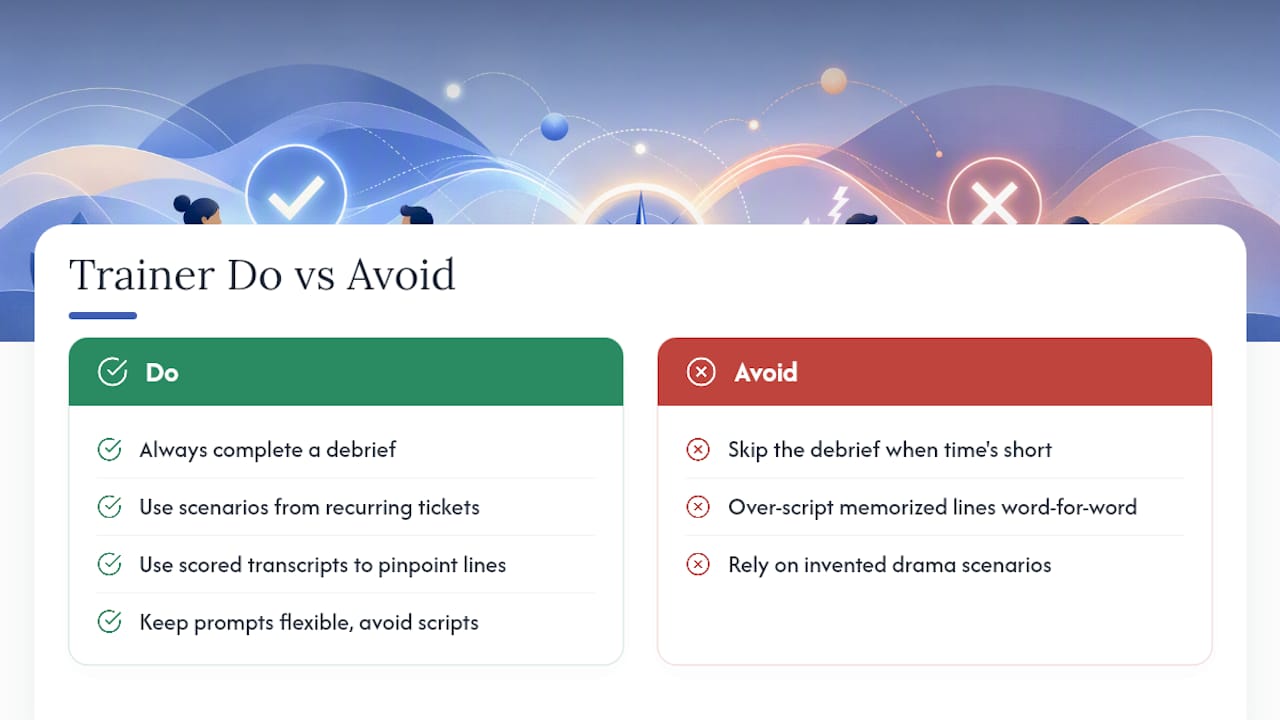
The biggest mistake isn’t a bad script, it’s skipping the debrief because the role-play itself ran long. A scenario without a real debrief teaches reps to survive a scary five minutes, not to internalize a pattern they can repeat under pressure next week. The second mistake is over-scripting: reps who memorize lines word-for-word freeze the moment a real customer says something off-script.
Scenarios pulled from your team’s actual recurring tickets stick far better than invented drama, because reps recognize the shape of the problem and can transfer the practiced response directly. Scored transcripts speed this whole process up considerably; a coach who can point to the exact line where tone shifted teaches faster than one relying on memory of how a live round felt.
— Adam
Try XL Roleplay For Difficult Customer Practice At Scale
Running one live session a month covers maybe two or three reps deep enough to matter. XL Roleplay lets every rep on your team rehearse an unlimited rotation of difficult customer scenarios against a live AI buyer, on their own schedule, without pulling a trainer into the room every time.
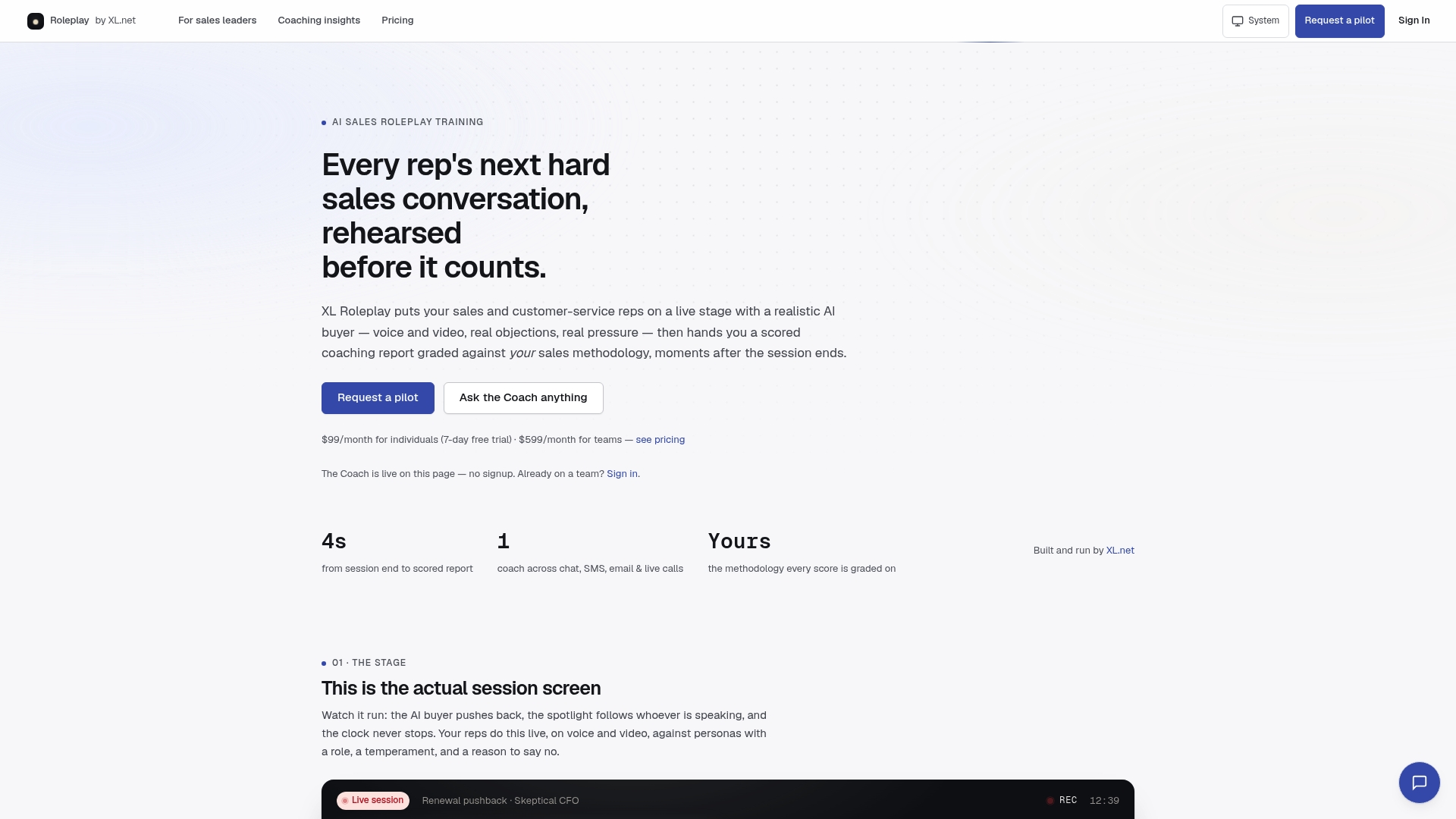
The platform gives you AI-driven buyers that improvise pressure and objections in real time, scored coaching reports mapped to your organization’s own methodology, full session transcripts, and a scenario library you can customize with your actual policy limits. If you’re evaluating it, run one irate-caller scenario and one refund-dispute scenario through a trial, then check three things: does the scoring rubric match how you’d score it manually, does the transcript surface the exact moment tone shifted, and can you edit a scenario’s policy details without rebuilding it from scratch. Start a free trial at XL Roleplay and see the scored report after your first session, or check the features built for team leads scaling coaching across a larger group.
Sources
For deeper facilitation guidance, XL Roleplay’s own customer service roleplay training guide and methodology-specific exercises go further into adapting scenarios to your team. For debrief design, Optio Station’s guide to feedback requests is a useful companion for building better post-session prompts.
- Customer service role play training (HubSpot)
- Angry customers activity (SessionLab)
- Irate caller de-escalation roleplay (Trainio)