Enterprise Rollout of Sales Training: A Phased Plan
Enterprise Rollout of Sales Training: A Phased Plan

An enterprise rollout of sales training works when you treat it as a program with a diagnosis, a phased launch, daily practice, manager follow-up and a measurement plan, not as a single event. Start by finding the skill gaps that cost you revenue, set goals with owners and baselines, pilot with one team, then scale in waves while managers reinforce what reps learn. This guide walks through each step and shows where realistic AI role-play fits.
TL;DR
- Begin with a skills-gap analysis built on CRM data, call recordings and manager interviews, then turn it into SMART goals with owners, baselines and dates.
- Roll out in phases: diagnostic, pilot team, wave-by-wave expansion, then a standing 30-60-90 day path for new hires.
- Training sticks only when reps practice and managers follow up. Build deliberate practice and coaching into the weekly rhythm.
- Treat completion as a reach metric. Judge readiness by assessed practice and judge impact by win rate, conversion and cycle time.
- Expect predictable failure points: unequal manager buy-in, generic content, no reinforcement and no baseline. Plan for each before launch.
Table of Contents
- What an enterprise rollout actually involves
- Step 1: Diagnose before you design
- Step 2: Set goals that can be checked
- Step 3: Anchor content to your own sales process
- Step 4: Phase the launch
- Step 5: Make practice part of the week
- Step 6: Equip managers to reinforce
- Step 7: Measure reach, readiness and results
- Common rollout problems and how to avoid them
- Where XL Roleplay fits in your rollout
- A sample 90-day rollout calendar
- FAQ
- Sources
What an enterprise rollout actually involves
A small team can get by with one workshop and a shared playbook. An enterprise cannot. You have multiple regions, several segments, managers with different coaching habits, and reps who joined at different times with different habits. A rollout has to land the same methodology and standards across all of them without flattening the differences that matter.
That is why the work splits into five jobs:
- Diagnose where performance is actually lost.
- Define goals, owners and the metrics that will prove progress.
- Design content and practice around your own sales process.
- Launch in phases, starting small.
- Reinforce through managers and measure what changed.
Every step below maps to one of these jobs. Skipping the first two is the most common reason programs produce high attendance and no change in results.
Step 1: Diagnose before you design
Start with evidence, not opinions. The guidance on implementing a sales training program from Platform Executive recommends a skills-gap analysis that combines quantitative inputs, such as CRM and performance data, with qualitative ones: call recordings, customer feedback, and interviews with managers and top performers. Findings are then mapped to a competency framework and a skills-gap matrix.
A Cornell eCommons report on sales training best practices makes the same point from an academic angle: conduct a needs analysis, establish goals, and align learning needs with business and organizational objectives. It also suggests asking, for each sales step, what business outcome you expect, what the team must do to reach it and where the gaps are, supported by 360-degree feedback.
What to look at in practice
- Stage conversion in your CRM. Where do deals stall or drop? A weak discovery-to-demo rate points to a different problem than a weak late-stage close rate.
- Call recordings. Pull a sample of calls from your best and weakest reps in the same segment. Differences in how they open, question and handle pushback are your curriculum.
- Manager interviews. Ask what they correct most often in one-on-ones.
- Top-performer interviews. Find out what they do that others skip, and capture it in your own words.
- Customer-facing teams beyond sales. If customer service or success reps handle objections, renewals or escalations, include them in the diagnosis.
The output should be a short matrix: competencies down one side, teams or roles across the top, and a rating of current strength. Rank the gaps by revenue at stake, not by how easy they are to teach.
Step 2: Set goals that can be checked
Translate the business priority into goals with a number, a baseline, an owner and a date. “Improve objection handling” is a wish. “Raise stage-two-to-three conversion in the mid-market segment from the current baseline to a target by the end of next quarter, owned by the regional VP” is a goal.
Write down, before launch:
- The business outcome you expect.
- The behavior that should change to get there.
- The metric that will show the behavior is happening.
- The baseline measured before anyone is trained.
- The person accountable for each target.
Without the baseline you will never be able to say the program worked. Without the owner, nobody will chase the numbers when they stall.
Step 3: Anchor content to your own sales process
Generic sales content teaches generic selling. Enterprise reps need practice on your product, your buyers and your methodology. One approach described in SyncGTM’s guide to building a sales training program is to order modules the way the pipeline flows: knowing the ideal customer, prospecting, discovery, objection handling, then closing. Pairing each stage with exit criteria gives managers a shared definition of “ready to move on.”
For an enterprise rollout, three design rules help:
- Modular, not monolithic. Short modules by stage let regions and roles take what they need and let you update one piece without rebuilding everything.
- Assessment built in. Every module ends with a check: a quiz for knowledge, a scored practice session for skill.
- Rubrics drawn from your methodology. If your organization qualifies with a specific framework, the rubric should score against that framework, in your terms.
Build scenarios from real conversations
The strongest practice scenarios come from your own calls: the objections your buyers actually raise, the pricing pushback you actually hear, the stakeholder who actually goes quiet. We cover how in building sales role-play scenarios from real calls and in our trainer’s playbook of sales role-play scenarios.
Step 4: Phase the launch
A big-bang launch to thousands of reps hides problems until they are expensive. Phasing lets you fix content, tooling and manager habits while the cost of being wrong is small.
| Phase | What happens | What you decide at the end |
|---|---|---|
| 1. Diagnostic | Gap analysis, competency map, SMART goals, baselines | Which gaps get funded first |
| 2. Pilot | One or two teams with engaged managers run the full program | Does content match real calls? Do managers coach? |
| 3. Waves | Expand by region or segment, each wave with a manager briefing first | Which adjustments each segment needs |
| 4. Standing program | Onboarding path for new hires, refresh cycles, quarterly review | What to retire, what to add |
The Platform Executive guidance lists the same building blocks: complete the diagnostic and competency map, set goals with baselines and owners, choose a learning or enablement platform, build a modular curriculum with assessments and role-play rubrics, schedule a manager coaching plan, define the evaluation framework and provide a 30-60-90 day pathway for new hires.
Choosing the pilot team
Pick a team with a manager who will coach, a segment with a clear, measurable gap and enough deal volume to show movement within a quarter. Avoid picking only your best team: you will learn nothing about how the program works for average performers. Avoid picking only your weakest: you will confuse program problems with team problems.
A 30-60-90 day path for new hires
New-hire onboarding is the best permanent home for your program, because every cohort starts from the same point and you can compare them.
- Days 1 to 30: product and buyer fundamentals, methodology basics, first scored practice sessions on discovery and introductions.
- Days 31 to 60: objection handling and multi-stakeholder scenarios, supervised live calls, manager review of recordings.
- Days 61 to 90: full-cycle practice, readiness check against the rubric, then independent calls with a coaching cadence set by the manager.
Step 5: Make practice part of the week
Knowledge fades quickly when it is never used. Distribution Strategy Group describes “training transfer” as the result of deliberate practice and feedback loops, plus a plan to keep content alive after the session. Its suggestions include managers asking questions to confirm understanding and weaving the training principles into regular team meetings.
The practical problem is that live practice is hard to schedule at enterprise scale. Peer role-play is awkward, uneven and rarely scored consistently, and managers cannot sit in on every session. This is where AI role-play earns its place in a rollout. With XL Roleplay, reps hold live voice or video conversations with AI buyers that raise typical objections and pressures. Each session produces a scored coaching report based on your organization’s own sales methodology, plus a transcript and rubric the manager can review.
That gives you three things a rollout needs: practice available whenever a rep has twenty minutes, scoring that follows one standard across regions, and a record managers can coach from instead of guessing.
Practice that matches the conversation
For customer service teams, the same logic applies to escalations, refund pushback and renewals. Reps rehearse the difficult moment before it happens with a customer. Browse our sales training scenarios and AI sales role-play articles for examples of how teams structure it.
Step 6: Equip managers to reinforce
Managers decide whether training survives past week two. If they do not ask about it, inspect it or coach on it, reps conclude it does not matter. Plan manager enablement before you plan rep enablement.
A workable manager routine:
- Weekly: review one practice transcript or report per rep, and pick one behavior to work on.
- In one-on-ones: ask the rep to explain how they would handle a specific objection, then check against the rubric.
- In team meetings: replay one strong example and discuss why it worked.
- Monthly: review practice scores next to pipeline movement for each rep.
Transcript-linked feedback makes this easier, because the manager can point to the exact sentence where a discovery question was missed instead of giving general advice. Our coaching insights go deeper on coaching rhythms.
Our perspective
We built XL Roleplay on one belief: reps should fail in practice, not in front of a buyer. In a large rollout, the hard part is rarely content. It is getting thousands of conversations of practice, scored the same way, tied to the way your company actually sells.
That is why we designed the platform around one persistent AI coach with shared memory across channels, and around scoring and coaching grounded in each organization’s own methodology. Your playbook is the standard, not a generic checklist.
We also think managers deserve better evidence. Transcript-linked reports let a leader see what happened in a session and coach to it, which turns a rollout from a series of events into a habit.
Adam
Step 7: Measure reach, readiness and results
Counting who finished a course is easy. It also tells you the least. Treat completion as a reach metric and add measures that show skill and outcomes.
The Platform Executive article recommends a layered evaluation from reaction (Level 1) through results (Level 4, commercial KPIs), and using control cohorts where possible to isolate the program’s effect. Here is how that translates for a rollout:
| Layer | Question | Example measures |
|---|---|---|
| Reach | Who has been through it? | Completion rate by team and region |
| Reaction | Did reps find it useful? | Short post-session surveys |
| Readiness | Can they do it? | Scored practice sessions against the rubric, certification pass rates |
| Behavior | Are they doing it on real calls? | Manager call reviews, methodology adherence |
| Results | Did the business move? | Stage conversion, win rate, sales cycle length, average deal size |
Use a comparison group when you can. If wave two starts a quarter after wave one, wave two is a natural control for wave one. Measure against the baselines you set in step two, and report to the owners you named there.
Two cautions on interpretation. First, allow time: a change in win rate on long enterprise cycles can lag training by quarters, so lean on leading indicators such as stage conversion and practice scores early. Second, do not credit the program for movement caused by seasonality, pricing changes or territory shifts. A control group guards against that.
Common rollout problems and how to avoid them
Most failed rollouts fail in the same handful of ways. Each one has a straightforward fix if you plan for it.
- Training treated as an event. A workshop followed by silence fades. Schedule practice, manager follow-up and refreshers before launch, not after.
- Uneven manager buy-in. Brief managers first, give them a short coaching routine and make their review of practice data part of their own goals.
- Generic content. Reps tune out scenarios that do not resemble their calls. Build from real conversations and refresh as the market changes.
- No baseline. If nobody measured before launch, results are arguments rather than evidence. Capture baselines in the diagnostic.
- Too many priorities at once. Pick the two or three gaps with the most revenue behind them and sequence the rest.
- Tool sprawl. Reps will not log into five systems. Choose a small stack and connect practice, scoring and reporting.
- Ignoring regional differences. Keep the core methodology fixed and let regions adapt scenarios, language and buyer personas.
- Completion as the success metric. High completion with flat conversion means the content or reinforcement is failing. Look at readiness and behavior data.
Where XL Roleplay fits in your rollout
If your diagnostic points to discovery, objection handling or readiness for high-stakes calls, practice is the piece most programs lack. XL Roleplay gives reps live voice and video role-play with realistic AI buyers, customized scenario libraries, scored coaching reports built on your methodology, session transcripts, readiness scoring and tracking for individuals and teams.
Published plans are simple. The Individual plan is $99 per month. The Business plan is $599 per month. Extra seats are $54.95 per month per seat, and extra video is $16.99 per hour. See current details on the pricing page.
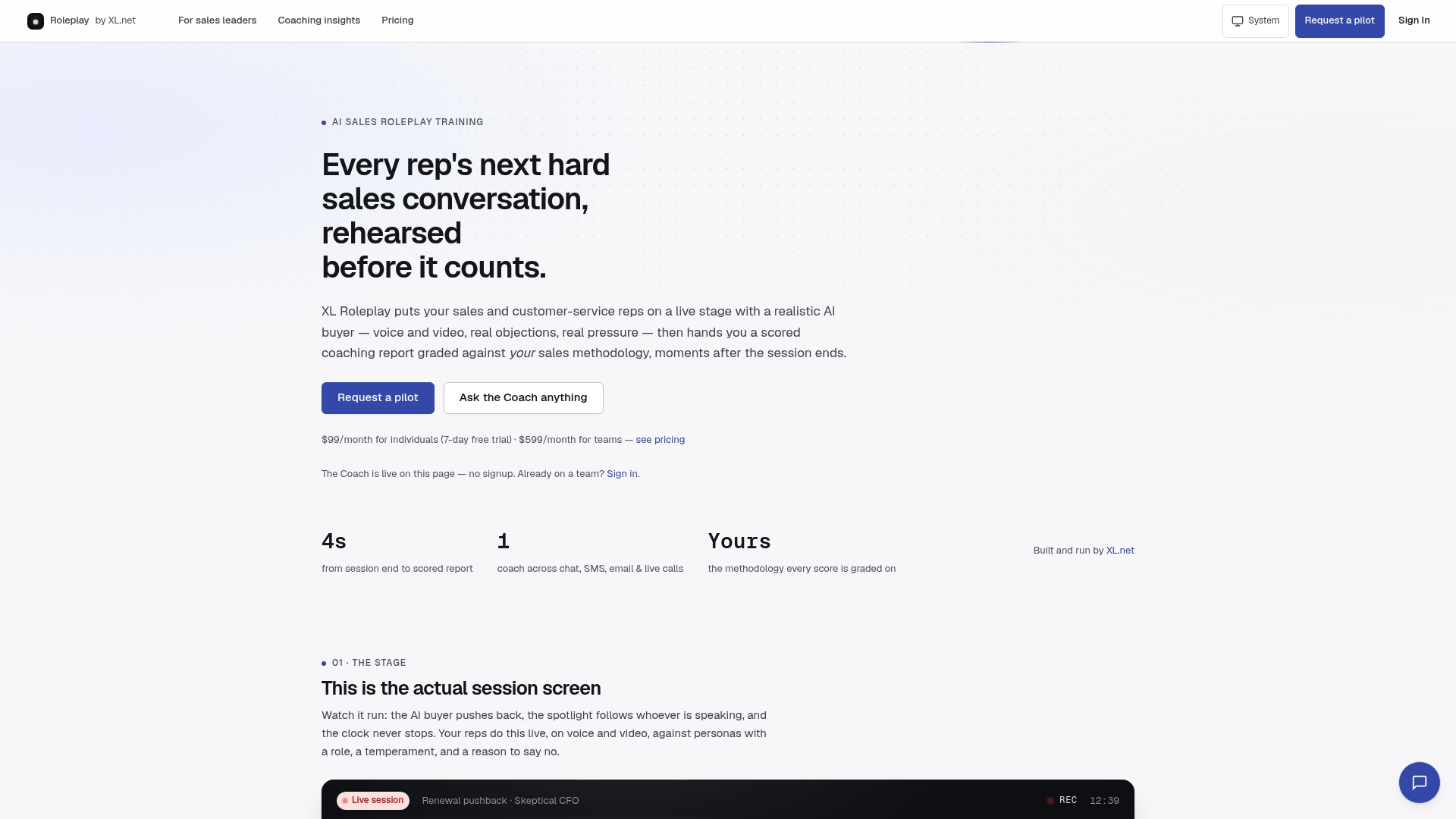
For a phased rollout, the natural first move is a pilot with one team. Learn how that works on the XL Roleplay pilot page, or read what we offer for sales leaders.
A sample 90-day rollout calendar
Here is how the pieces fit together for a mid-sized sales organization. Adjust the timing to your cycle length and size.

Weeks 1 to 3: Diagnose and set goals. Pull CRM stage data, sample recordings from top and weaker reps, interview managers and set two or three SMART goals with baselines and owners.
Weeks 4 to 6: Build and brief. Draft modules and scenarios from real calls, write the rubric from your methodology, and run a manager session on the weekly coaching routine.
Weeks 7 to 10: Pilot. One or two teams run the program. Reps complete scored practice sessions each week, and managers review transcripts and reports in one-on-ones.
Weeks 11 to 12: Review and adjust. Compare pilot teams to baseline and, if possible, to a team not yet trained. Fix weak scenarios, tighten the rubric and decide the order of the next waves.
Quarter two onward: Waves and standing program. Add regions in waves, launch the new-hire path and set a quarterly review of metrics against goals.
FAQ
How long does an enterprise sales training rollout take?
The timeline depends on headcount, regions and how much content exists. A reasonable pattern is a few weeks of diagnostic and design, a pilot of about a quarter, then waves by region or segment. Plan the standing program, including onboarding and refreshers, as ongoing rather than a project with an end date.
Who should own the rollout?
Give one accountable executive ownership of the business outcome, usually the head of sales or revenue. Enablement or sales operations typically runs the logistics. Front-line managers own reinforcement, and each SMART goal should name its own owner.
How do we know the training worked?
Compare results to the baselines you captured before launch, ideally against a group that has not yet been trained. Look at readiness measures first, such as scored practice, then stage conversion, win rate, sales cycle and deal size. Treat completion as a reach measure, not proof of skill.
Can AI role-play replace manager coaching?
No, it gives managers more to coach with. Reps get repeatable practice and a scored report, and the manager uses the transcript and rubric to focus one-on-ones on specific moments. Together they cover volume and judgment.
Should customer service teams be included?
Yes, if they handle objections, renewals or escalations. Their conversations carry revenue and retention risk, and the same practice approach works. Build separate scenarios for their situations while keeping one measurement approach.
Sources
- How to Implement an Effective Sales Training Program, Platform Executive
- Best practices for sales training, Cornell eCommons
- How to Develop a Good Sales Training Program, SyncGTM
- How to Get Business Value from Sales Training, Distribution Strategy Group