Microlearning vs. Role Play: What Each Does for Sales Teams
Microlearning vs. Role Play: What Each Does for Sales Teams

Microlearning and role play do different jobs. Microlearning delivers short pieces of knowledge that reps can review on demand. Role play makes reps use that knowledge out loud, under pressure, and get feedback on how it went. For sales and customer service teams, the question is rarely which one to pick. It is which one belongs at which stage, and how to link them so what reps learn on Monday shows up in their calls on Friday.
TL;DR
- Microlearning is best for refreshers, onboarding support, and just-in-time reminders. Role play is best for turning knowledge into spoken, adaptive behavior.
- Microlearning is not meant to replace longer-form training for complex skill building, and a conversation is a complex skill.
- Run them as a loop: a short lesson on one skill, a practice conversation on that same skill, then scored feedback.
- Judge both by what changes on the job, not by completion rates alone.
- Start with one skill, such as discovery or a single common objection, and measure it before you widen the program.
Table of Contents
- What each approach actually is
- Microlearning vs. role play side by side
- What the research says about microlearning
- What role play adds that content cannot
- When to use which
- How to combine them into one program
- How to tell whether it is working
- Our perspective
- Put practice behind your lessons
- FAQ
- Sources
What each approach actually is
The Association for Talent Development describes microlearning as short pieces of instructional content, usually accessed on demand. Think of a four-minute video on pricing objections, a one-screen card on how to open a discovery call, or a quick quiz after a product update. The unit is small, the focus is narrow, and the rep controls when to use it.
Role play is a different kind of thing. A rep takes a realistic situation, speaks to a buyer or customer, makes decisions in real time, and gets feedback afterward. The buyer can be a manager, a peer, a professional playing a part, or an AI persona. What matters is that the rep has to produce an answer rather than recognize one.
That difference in what the learner does explains almost everything else:
- Microlearning asks the rep to take in information. Watch, read, tap, answer a question.
- Role play asks the rep to perform. Listen, think, speak, adjust, recover when it goes sideways.
Both are useful. They are useful for different parts of the same problem.
Microlearning vs. role play side by side
| Question | Microlearning | Role play |
|---|---|---|
| What does the rep do? | Reads, watches, or answers short prompts | Speaks live with a buyer or customer persona |
| Typical length | A few minutes | A full conversation, plus review |
| Best for | Product facts, talk-track refreshers, policy updates, onboarding support | Discovery, objection handling, negotiation, difficult service calls |
| Feedback | Usually automated, often right or wrong | Specific to what the rep said and how they said it |
| Where it breaks down | Complex skill building when it stands alone | Product knowledge the rep has not yet learned |
| Manager evidence | Completion, quiz scores | Transcripts, rubric scores, recordings |
| Schedule fit | Between calls, on mobile, on demand | A planned block, or an on-demand AI session |
The table shows why the two rarely compete head to head. A rep who cannot recall your pricing tiers has a knowledge gap. A rep who knows the tiers but freezes when a buyer says “that’s too expensive” has a performance gap. Short content closes the first. Practice closes the second.
What the research says about microlearning
The evidence for microlearning is encouraging and worth taking seriously. A systematic review of 40 studies found positive impacts on cognitive, behavioral, and affective learning outcomes, including knowledge retention, task or work performance, engagement, and motivation. A 2025 trial of WhatsApp-based microlearning among healthcare workers in South Africa found a 21% increase in correct patient care. Short, well-targeted content can change what people do.
The same literature points to where the format fits best. ATD notes that organizations often use microlearning to reinforce concepts from longer-form training or give just-in-time support, and that it is not meant to replace longer-form training for complex skill building.
There is also a useful nuance on knowledge versus action. A review of microlearning for self-care found it could improve cognitive capabilities but was largely ineffective at triggering actual behavior change. That was a health setting, not sales, but the pattern is familiar to any sales manager: a rep can pass the quiz and still stumble on the call. Knowing what to say and saying it well to a skeptical person are two separate abilities.
A practical reading for sales and service leaders: microlearning is a strong way to keep knowledge fresh and distributed. It is a weaker stand-alone answer to “can this rep handle a hard conversation?”

What role play adds that content cannot
Role play gives reps something content cannot: a safe place to be wrong. The reasoning from sales education researchers is that experiential practice lets learners experiment with tactics in real time, learn through trial and error, and build critical thinking and confidence.
A few real examples show what good practice looks like:
- University of Nebraska at Omaha. Students prepare likely objections and responses, then make a live appointment-setting call to a professional, then get feedback and a debrief. The activity teaches a four-step approach to objections: clarify, acknowledge, respond, confirm. The 2022 study reports higher actual and perceived objection-response learning for participating students than for the comparison group (source).
- Marquette University. Its 2023 sales combine puts students into realistic client-problem scenarios repeatedly, where they must adapt spontaneously. Participants described it as building confidence and giving them experience they would not otherwise have before a first sales job (Marquette Today).
- University of Tennessee at Chattanooga. Its 2023 Sales Institute uses recorded mock interviews and sales calls with potential buyers, with instructor advice during and after. Recording lets learners review their own performance (UTC).
- Old Dominion University. In 2025 it reported using AI sales-training exercises where students test strategies, refine delivery, get rubric-based feedback, and repeat realistic interactions. The university said students improved their scores after six to seven interactions (ODU).
Notice the shared ingredients: a realistic buyer, repetition, feedback tied to a standard, and a way to look back at what happened. Those four things are what separate practice from a role play that everyone dreads and nobody learns from.
If you want ready-made starting points for scenarios, our guide to sales role play scenarios walks through how trainers structure them, and building scenarios from real calls shows how to make them match what your buyers really say.
When to use which
A simple rule: match the format to the gap.
Reach for microlearning when:
- A product, pricing, or policy change needs to reach everyone quickly.
- New hires need support alongside longer onboarding.
- Reps need a refresher on a framework they already learned.
- You want a reminder to land right before a call, on a phone, in two minutes.
Reach for role play when:
- The skill is spoken and adaptive: discovery questions, objection handling, de-escalation, negotiation.
- Reps know the material but hesitate or ramble in live conversations.
- You are rolling out a new methodology and need to see it used, not just recalled.
- New reps need reps (the repetitions kind) before they talk to real customers.
Use both when the skill matters to revenue or retention and the stakes of a bad call are high. That covers most customer-facing teams.
One more factor is complexity. Content that teaches a single fact fits a micro format well. A conversation with branching paths, emotion, and a buyer who interrupts is complex by nature, which is exactly where longer-form, practice-based training earns its place.
How to combine them into one program
The teams that get the most from both treat them as two halves of a loop. Here is a workable pattern.
- Pick one skill. For example, responding to “we already use another vendor.” Keep it narrow so the lesson and the practice match exactly.
- Teach it in a short lesson. A few minutes: what a good answer sounds like, why it works, one example from a real call.
- Practice it the same day or next. The rep has a full conversation with a buyer persona who raises that objection. Do not stop at one attempt.
- Score it against your rubric. Use the same criteria the lesson taught, so feedback connects directly to the content.
- Review the transcript. The rep and manager look at the exact words used, find the moment the conversation turned, and pick one thing to change.
- Reinforce with a micro refresher. A short reminder a few days later, then another practice session with a harder version of the buyer.
- Repeat with the next skill.
The benefit of this structure is consistency. Because the lesson, the practice, and the scoring all use the same language, reps are not guessing what “good” means. If you also deliver the short lessons through a learning platform, this explainer on LXP versus LMS helps you think through where the micro content should live and how people will find it.
For a team of any size, the biggest practical barrier to role play has always been scheduling and managers’ time. Peer practice depends on everyone’s calendar and on peers who may not know how to play a tough buyer. That is one reason AI-driven practice has grown: reps can run a conversation when they have time, and a manager does not need to be on the other end. Our comparison simulation training vs. role play goes deeper on where each format fits.
How to tell whether it is working
Completion rates tell you people clicked. They do not tell you the calls improved. A sturdier approach borrows from the Kirkpatrick model, which Kirkpatrick Partners describes as a foremost training evaluation methodology with four levels: reaction, learning, behavior, and results.
Applied to a microlearning-plus-practice program:
- Reaction. Do reps find the lessons and sessions worth their time? Research on call center training suggests that improving training satisfaction can positively influence learning and later job performance, so it is worth tracking, not dismissing.
- Learning. Can reps explain the framework (quiz scores) and apply it in a practice conversation (rubric scores)?
- Behavior. Are they using it in real calls? Spot-check recordings against the same rubric.
- Results. Are win rates, conversion at a given stage, or customer satisfaction moving for the skill you trained?
The same call center researchers caution against treating the levels as a strict ladder, since the relationships between satisfaction, learning, and behavior run in several directions. In practice, that means looking at all four together rather than waiting for one to prove the next.
A few habits make the evidence cleaner:
- Score practice sessions and real calls on the same rubric.
- Track the same skill over several sessions, so you can see a rep’s trajectory, not a single snapshot.
- Keep transcripts. A manager can coach from the exact wording instead of from memory.
- Change one thing at a time. If you launch a new lesson, a new rubric, and a new buyer persona in the same week, you will not know what worked.
Our perspective
We built XL Roleplay around a simple observation: most sales teams do not have a knowledge problem, they have a rehearsal problem.
Short lessons are valuable, and we would never tell a team to skip them. But a rep rarely loses a deal because they forgot a definition. They lose it in the moment a buyer pushes back and the prepared answer does not fit. The only way to get good at that moment is to be in it, many times, before it counts.
That is why we focus on live voice and video conversations with realistic AI buyers, scored against your own sales methodology instead of a generic standard. When the feedback uses your playbook’s language, the lesson and the practice become one system. Managers get transcripts and rubrics, so coaching is based on what was actually said.
Our advice to any sales leader weighing microlearning against role play: keep the micro content for knowledge, and give your team a place to turn it into skill. The two work best together, and the practice is where confidence gets built.
Adam
Put practice behind your lessons
If your team already has short training content, the missing piece is usually a place to use it. XL Roleplay lets reps hold realistic conversations with AI buyers that raise typical objections and pressures, then get scored coaching reports based on your organization’s methodology, with transcripts managers can review.
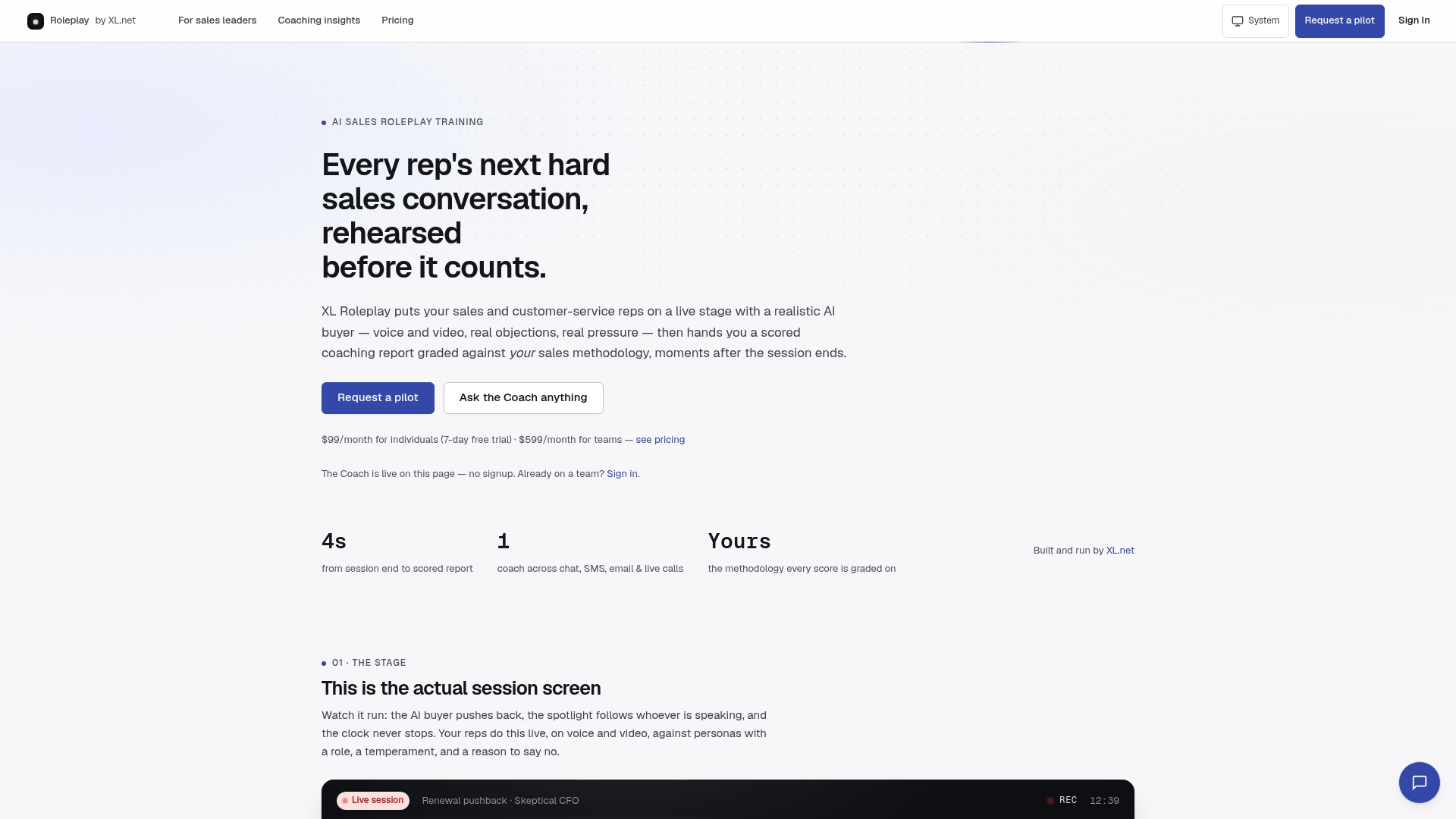
Plans are published on our pricing page: Individual is $99 per month and Business is $599 per month. Extra seats are $54.95 per month per seat, and extra video is $16.99 per hour. If you would like to test it with a team first, ask about the XL Roleplay pilot.
FAQ
Is microlearning actually good?
For the right job, yes. A systematic review of 40 studies found positive effects on knowledge retention, task performance, engagement, and motivation. It works best as reinforcement and just-in-time support, and it is not meant to replace longer-form training for complex skills.
Can microlearning replace role play for sales training?
Not for conversation skills. Short content builds and refreshes knowledge, while role play makes reps produce spoken answers and receive feedback on them. Use microlearning to teach the framework and role play to make it automatic.
How often should reps practice?
Short and frequent beats long and rare. One option is a weekly practice conversation on the skill you most recently taught, with harder buyer personas as reps improve. Old Dominion University reported students improving scores after six to seven AI practice interactions, which suggests repetition matters more than any single session.
What are some examples of role play activities for sales?
Common ones include live appointment-setting calls, recorded mock sales calls with feedback, and exercises where learners write likely objections and responses before practicing them. The University of Nebraska at Omaha activity uses a clarify, acknowledge, respond, confirm approach to handling objections.
Sources
- What Is Microlearning? Definition & Examples, ATD
- Microlearning beyond boundaries: a systematic review
- Effectiveness and uptake of WhatsApp-based microlearning, PubMed
- The efficacy of microlearning in improving self-care, PubMed
- Objection practice using a live appointment-setting call, University of Nebraska at Omaha
- Sales combine gives Marquette students realistic training
- Sales Institute prepares students for a career, UTC
- Strome students close the deal with AI-powered sales training, Old Dominion University
- Kirkpatrick Case Study Guide
- A Study on the Educational Training Evaluation Model
- LXP versus LMS