Sales Enablement vs. Sales Training: What Sets Them Apart
Sales Enablement vs. Sales Training: What Sets Them Apart

Sales training teaches a rep a skill, such as discovery questions or objection handling. Sales enablement is the wider, ongoing effort that gives reps the content, tools, coaching and process to use those skills on real deals. Training is one part of enablement, not a rival to it. Most teams don’t struggle because they chose the wrong one. They struggle because nobody owns the stretch between a workshop and a live call, where a rep has to say the new words to a real buyer for the first time.
That stretch is rehearsal. XL Roleplay is built for it: reps hold live voice and video conversations with realistic AI buyers who raise typical objections, then get a scored coaching report based on your organization’s own sales methodology. The rest of this article explains the two disciplines, when each one is the right lever, and how to measure whether either is working.
TL;DR
- Sales training is a focused intervention that builds a specific selling skill. Sales enablement is the ongoing, cross-functional system that helps reps apply those skills in the field.
- Training is one component of enablement. The Association for Talent Development lists it alongside coaching, content, process improvement and compensation.
- Use training for a skill gap, enablement for a gap in content, tools, onboarding or measurement, and both when you adopt a new methodology.
- The weak spot in most programs is practice and reinforcement after the session, not the session itself.
- Measure behavior first (are reps doing the thing?), then revenue.
Table of Contents
- What sales training is
- What sales enablement is
- Sales enablement vs. sales training, side by side
- Where programs break: the seam between the two
- Which one do you need?
- What the data says about training quality
- How to tell whether it’s working
- The practice layer, and where XL Roleplay fits
- Put practice into your program
- FAQ
- Sources
What sales training is
Sales training develops the skills, behaviors and strategies reps need to find opportunities, build relationships and close deals. Training Industry describes it as equipping sales professionals to engage customers, communicate value and drive revenue growth.
In practice, a sales training program covers topics such as:
- Discovery and questioning
- Objection handling and negotiation
- Product and competitive knowledge
- A sales methodology, the shared framework a team uses to run deals
- Presentation and proposal skills
It can be delivered in a classroom, online, or in a blend. It is usually time-bound (a kickoff, a course, a cohort) and judged by whether the rep can demonstrate the skill afterward. The question training answers is: can the rep do it?
A customer service team has the same need under a different name. Handling a frustrated customer who says the price is too high, or who threatens to cancel, is a skill that has to be taught and rehearsed just like a sales objection.
What sales enablement is
The ATD defines sales enablement as a strategic, cross-functional effort to increase the productivity of market-facing teams by providing ongoing, relevant resources throughout the buyer journey. It spans sales training, coaching, content creation, process improvement, talent development and compensation.
Where training is an event, enablement is an operating system. It typically includes:
- Playbooks that spell out how to run each stage of a deal
- A content library reps can find in the moment
- Onboarding paths for new hires
- Coaching routines for managers
- CRM and learning systems
- Analytics that show which of these things change outcomes
The question enablement answers is not “can the rep do it?” but “does the rep do it, consistently, on real deals?” It is owned by a dedicated enablement or revenue operations function, or, in smaller companies, by the sales leader who wears that hat.
Sales enablement vs. sales training, side by side
| Sales training | Sales enablement | |
|---|---|---|
| Core question | Can the rep do it? | Does the rep do it on real deals? |
| Scope | One skill, framework or product | The whole system around the seller |
| Timing | Time-bound: a course, workshop or cohort | Continuous, from onboarding onward |
| Typical content | Instruction, exercises, role-play | Playbooks, content, tools, coaching routines, analytics |
| Usual owner | Learning and development, sales leadership | Enablement, revenue operations, sales leadership |
| Success measure | Skill demonstrated, assessment passed | Adoption in the field, ramp time, win rate, quota attainment |
| Relationship | One component of enablement | The umbrella that includes training |
A simple way to hold the difference: training changes what the rep knows how to do, and enablement changes what the rep has around them when they do it.
Where programs break: the seam between the two
Most organizations have both pieces and still see no change on calls. The reason is usually that nothing sits between the lesson and the live conversation.
Consider a typical rollout. A team attends a half-day session on a new discovery framework. The enablement team publishes a one-pager and a recording. Two weeks later, a rep meets a skeptical buyer who says, “We’re happy with our current vendor.” The rep has seen the framework once and has never said the words out loud to anyone who pushed back. They fall back on old habits.
That is a practice gap, and it is the cheapest one to close and the most expensive one to ignore. A skill that is only heard or read has not yet been performed. Three things close the gap:
- Repetition against realistic resistance. The rep needs to hear the objection, answer it, hear the follow-up, and try again, many times, before the stakes are real.
- Feedback tied to the exact moment. “Work on your discovery” changes nothing. “At minute four you accepted the first answer instead of asking what happens if they do nothing” changes the next call.
- A shared standard. Feedback only compounds when reps and managers score the same behaviors against the same methodology.
We cover the mechanics of building good practice conversations in our guide to sales role-play scenarios, and our notes on sales coaching versus deal review explain why those two manager routines should stay separate.
Which one do you need?
Start with the problem, not the request. When a leader asks for “objection-handling training,” the first job is to look at the deals behind the request. Do opportunities stall because reps can’t answer pricing pushback, or because they never reach the economic buyer? The answer decides the fix.
A workable rule of thumb:
Choose training when the gap is a skill.
- A new product launches and reps can’t yet explain it.
- One cohort is weak at one thing, such as handling a price objection.
- New hires haven’t learned the fundamentals.
Choose enablement when the skill exists but doesn’t show up.
- Reps know the framework but don’t use it in the CRM or on calls.
- Content is scattered and nobody can find the right case study.
- Onboarding is inconsistent from manager to manager.
- Leaders can’t tell which activities move results.
Choose both when you change methodology. A new methodology has to be taught, and then it has to be built into playbooks, call plans, deal reviews and coaching. Teaching without embedding fades. Embedding without teaching confuses.
If you lead a customer service team
The same logic holds. Training teaches de-escalation and objection handling. Enablement supplies the scripts, knowledge base and QA scorecards, and the coaching rhythm that keeps agents consistent. Agents still need to rehearse a tense call before they take one.
If you are a new rep or an individual practicing on your own
You may not have an enablement team at all. Your job is to build your own small system: learn the framework, then rehearse it until the words feel natural. Practice against realistic buyers is the part you can control from your first week.
What the data says about training quality
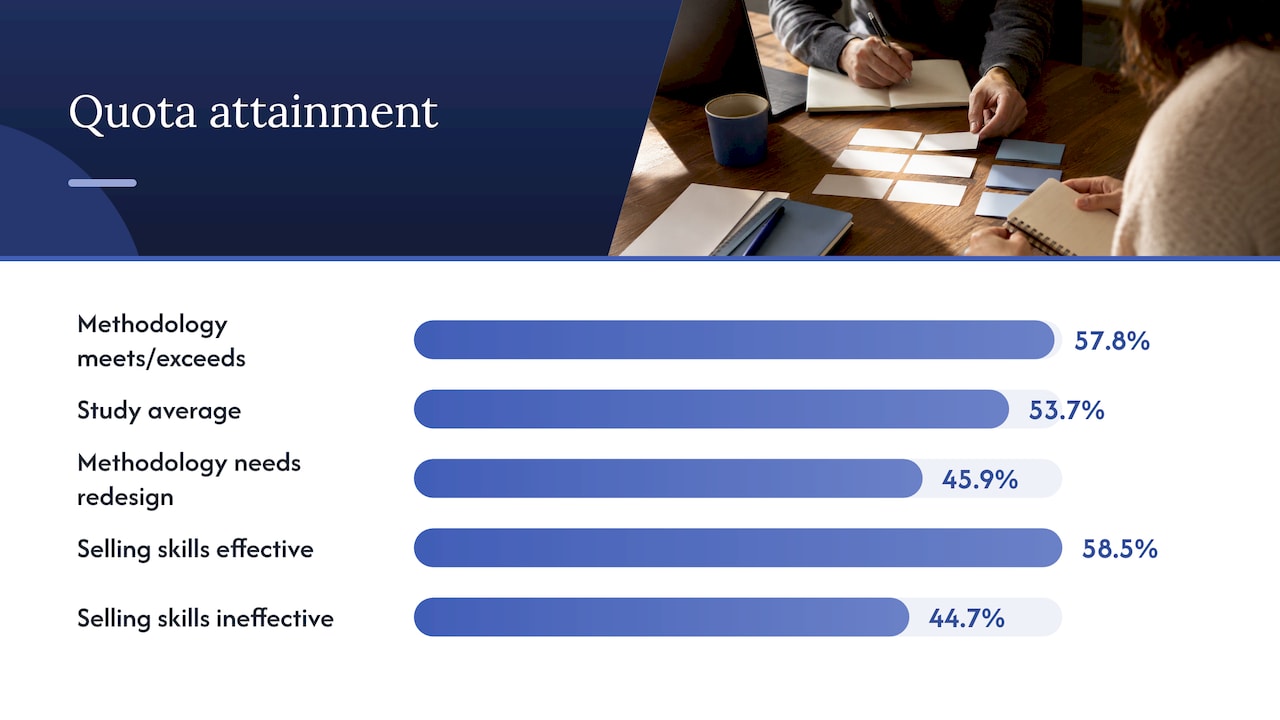
The quality of training and methodology support shows up in results. A 2018 CSO Insights study found that organizations whose sales methodology and process training met or exceeded expectations had quota attainment of 57.8%, against a study average of 53.7%. Where that training needed improvement or redesign, attainment fell to 45.9%. Selling-skills training showed a similar swing: 58.5% versus 44.7%.
Speed to productivity moves too. A 2018 Sales Readiness Group and Training Industry survey of 287 B2B sales professionals found an average of 27 weeks for a new salesperson to reach quota. Companies with effective training got new reps there in 24 weeks, against 31 weeks for those with ineffective training. In the same survey, 51% of reps who received effective training closed more than half of their opportunities, compared with 40% of those who did not.
These are older studies of B2B sales teams in the US market, so use them as direction, not a promise. The pattern is the useful part: the training that moves numbers is the training that reps can actually apply, and applying it takes practice and follow-through.
How to tell whether it’s working
Measure in the order that behavior changes. Revenue lags, so look at leading indicators first.
- Define the baseline before launch. Pick the specific behavior you want to change (for example, “reps confirm the buyer’s decision process before sending a proposal”) and record where it stands today.
- Check practice performance. Scored role-play sessions show whether a rep can demonstrate the skill under pressure, which is the cleanest test of training.
- Observe behavior on real deals. Managers sample calls and opportunities at roughly 30, 60 and 90 days after the program and look for the behavior, not just attendance.
- Connect to outcomes. Only then look at stage conversion, win rate, deal size, ramp time and quota attainment, segmented by manager and tenure.
Completion rates and content downloads tell you motion, not impact. The CSO Insights study cited above also notes that most enablement services take time to show results, because complex B2B sales cycles can run for months, so pair lagging revenue numbers with leading ones such as conversion and follow-up rates.
The practice layer, and where XL Roleplay fits
Whatever you call your program, someone has to own rehearsal. With XL Roleplay, reps practice live voice and video conversations with AI buyers and personas that present typical objections and pressures. Each session ends with a scored coaching report grounded in your own sales methodology, and managers can review the transcript and rubric behind every score. That gives training a place to be performed and gives enablement evidence of readiness, for individuals and for whole teams.
Sales leaders who want the team-level view can start on the page for sales leaders. Customer service managers can use the same approach for the objections their teams hear every day.
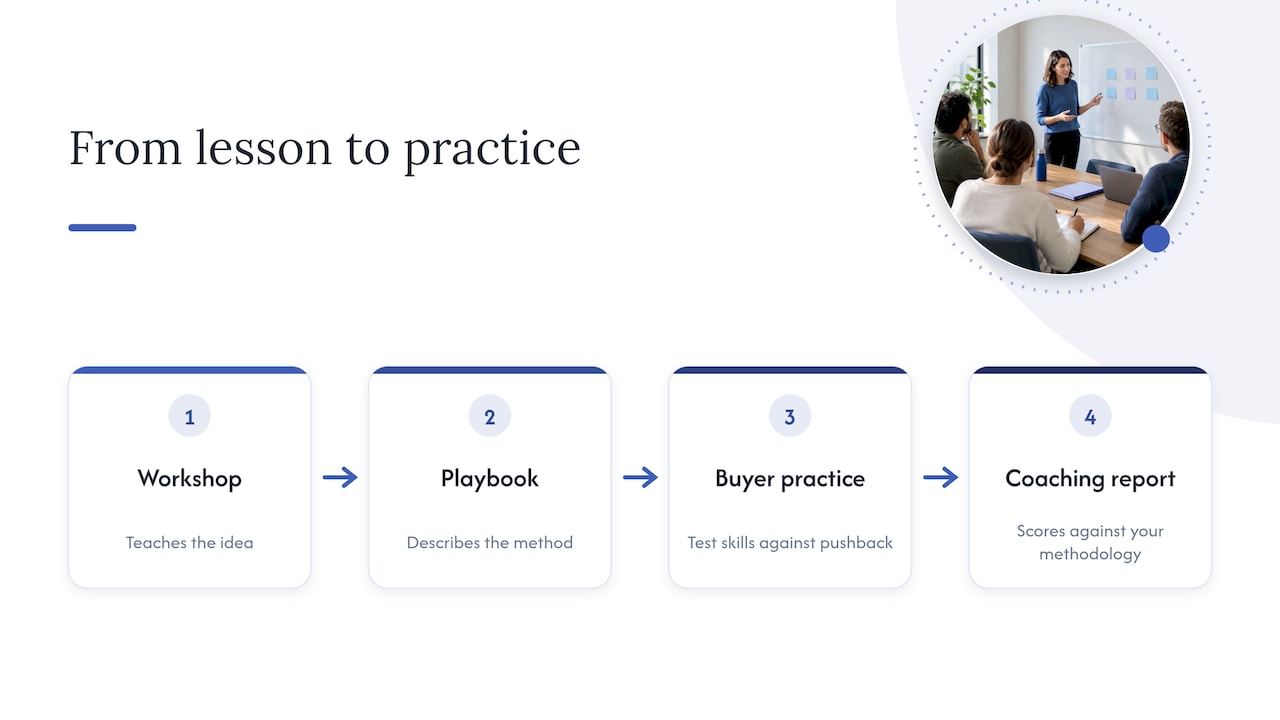
We think of enablement and training as one chain with a weak link in the middle. The workshop teaches the idea. The playbook describes it. But a rep only owns a skill after they have used it against a buyer who pushes back, and most teams give reps no safe place to do that.
That is why we built one persistent AI coach that scores each conversation against your own methodology, not a generic standard. A rep sees exactly where a conversation turned, and a manager sees the same transcript and rubric. Coaching stops being a matter of opinion and becomes something you can point to line by line.
If you are deciding between investing in training or enablement, ask a third question: where do your reps practice? Answer that, and both investments start to pay back.
Adam
Put practice into your program
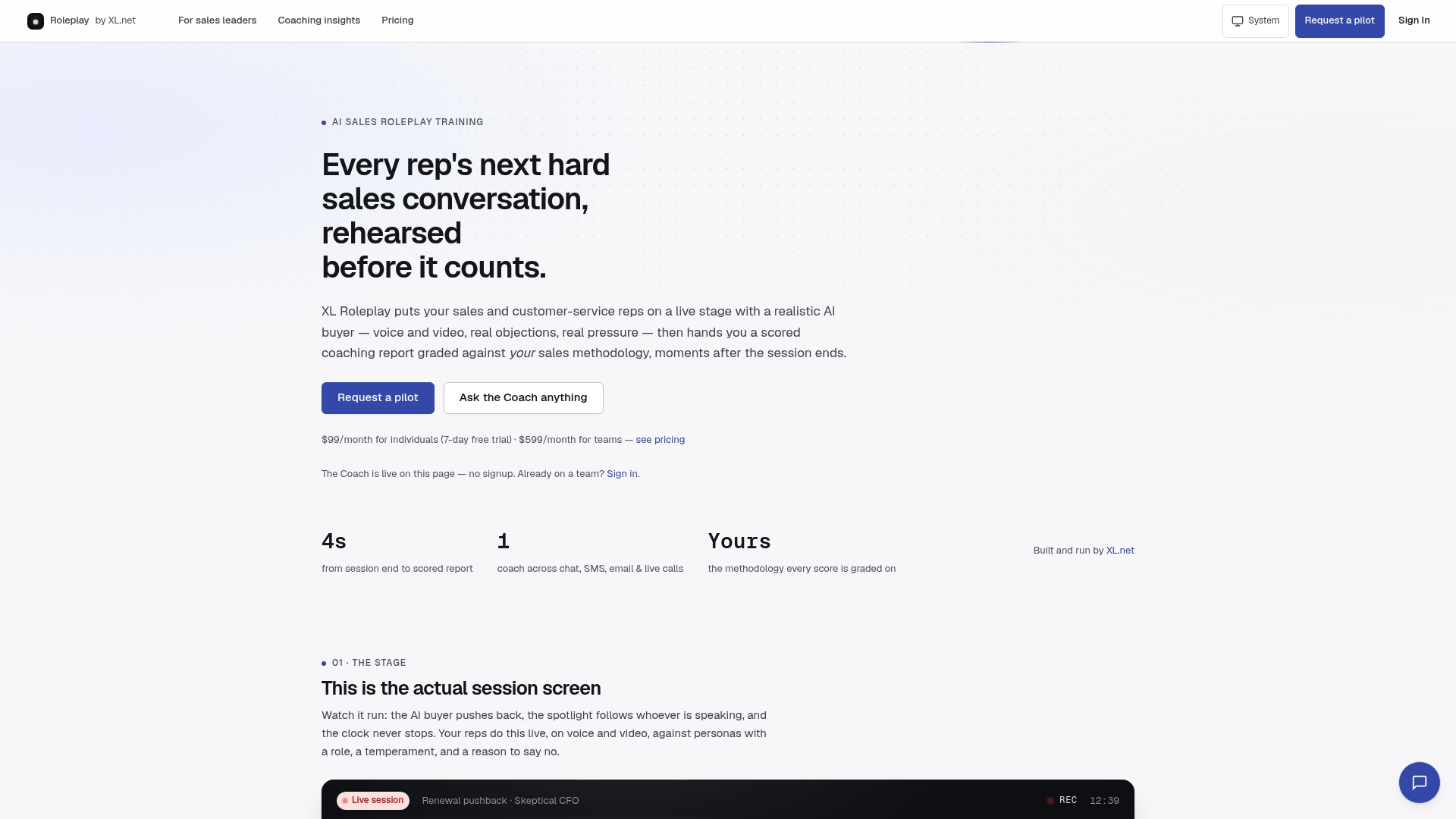
XL Roleplay runs on monthly subscription plans. The Individual plan is $99 per month, and the Business plan is $599 per month. Additional seats are $54.95 per month per seat, and extra video sessions are $16.99 per hour. Free trials are available, and the pricing page lists the current plans. Teams that want to test it on a defined group first can look at the XL Roleplay pilot.
If you want ideas for what reps should rehearse first, our articles on sales training techniques are a good starting point.
FAQ
Are sales training and sales enablement the same thing?
No. Sales training teaches selling skills, while sales enablement is the broader effort to equip sellers across the buyer journey. Training is one part of enablement, alongside coaching, content, process and measurement. Many teams run training as their most visible enablement service, which is why the two get confused.
What does sales training mean?
It is the structured process of developing the skills, behaviors and strategies salespeople need to find opportunities, build relationships and close deals. Typical topics include discovery, objection handling, negotiation, product knowledge and the team’s chosen methodology. Good programs combine instruction with live practice and feedback.
Who owns each one?
Training often sits with learning and development or with sales leadership. Enablement is usually owned by an enablement or revenue operations team. In smaller companies, one sales leader often covers both, which is why a single, simple routine of teach, practice, coach and measure works well there.
Do I need both?
Most growing teams do. Use training to close a specific skill gap and enablement to make sure the skill is used consistently. When you adopt a new methodology, you need both: training to teach it, and enablement to build it into playbooks, coaching and deal reviews.
How do I know if my reps are ready for real conversations?
Watch what they do under realistic pressure. Scored practice conversations against a consistent rubric show whether a rep can handle discovery and objections before they face a real buyer, and give managers evidence to coach from.
Sources
- What is Sales Enablement? | ATD
- What is Sales Training? | Training Industry
- Sales Enablement Grows Up, CSO Insights, 2018
- The Sales Person’s Perspective on the Impact of Sales Training, Training Industry, 2018