Sales Rep Ramp Plan: A 90-Day Framework That Works
Sales Rep Ramp Plan: A 90-Day Framework That Works

A sales rep ramp plan is a staged schedule that takes a new hire from setup and training to independent production. It states what the rep learns, what the rep does, and what evidence earns the next responsibility. The plans that work gate each stage on something observable, and the best evidence is a rep performing the conversation, not finishing a course. That is why we build practice into the plan from week one: with XL Roleplay, new reps run live voice and video sessions against AI buyers and get scored coaching reports before they ever face a real prospect.
TL;DR
- Plan on the clock for the role: about 3 months for an SDR and about 6.2 months for an AE, per one 2026 summary of Bridge Group studies. Never average the two.
- Define “ramped” first. The usual definition is producing the same revenue as experienced peers.
- Use three gates: product knowledge before buyer contact, a scored discovery role-play before independent outreach, and a methodology check on a real call before owning pipeline.
- Track competency in days 1-30, activity in days 31-60 and outcomes in days 61-90.
- Practice is what makes gates real. Simulated calls let reps repeat a conversation until they can do it, at no cost to your accounts.
Table of Contents
- How long a ramp should take
- Principles before the calendar
- The 30-60-90 day plan
- Three readiness gates
- Where practice fits
- Metrics that tell you whether the plan works
- Managers make or break the ramp
- Put the plan into practice
- FAQ
- Sources
How long a ramp should take
Start with a number you can defend. Published figures vary because roles, deal sizes and definitions vary.
- One August 2026 summary of Bridge Group research says to plan on 3.0 months for an SDR and 6.2 months for an AE, and warns against blending them.
- SBI Growth’s survey of 134 U.S. sales organizations found a median ramp of 3 months and a mean of 3.5, while 24% of teams expected 6 months or longer.
- A 2016 CSO Insights study found 60.7% of participants reported seven months or more to full productivity.
Sales motion moves the number most. TRG GTM’s breakdown puts SMB and inside sales at 2 to 4 months, mid-market at 4 to 6, enterprise at 6 to 12 and strategic accounts at 9 to 18.
Build your own estimate
Revcast suggests adding onboarding time, pipeline-building time and average sales cycle length. One month of bootcamp, one month of pipeline building and a three-month cycle means at least five months. It also suggests using the average attainment of ramped reps, not full quota, as your target.
Then check it against your own history. CSO Insights recommends listing every hire from the last two years and plotting monthly revenue against experienced reps, and notes the answer can be as long as 16 months. Your own curve beats any benchmark.
Principles before the calendar
Good beats fast. Forrester’s Peter Ostrow argues that the long-term damage from weak ramping is far worse than the gain from saving a week or two. He also notes that B2B sellers learn by doing, not by watching or reading.
Model a curve. Don’t plan for zero output for six months and then a jump to 100%. Write each stage as an observable action: explain the material at the learning gate, perform the motion at the practice gate, show pipeline at the production gate.
Get the rep in front of buyers on purpose. Forrester found only 7% of companies put new hires in front of buyers on day one, and that a ratio of roughly 3.5x between first customer engagement and formal graduation is ideal. The point is a deliberate lead-in, not a rush.
The 30-60-90 day plan
Before day one
Get tools, CRM access and email working. Pair the rep with a strong peer buddy and hand over the 30/60/90 plan and an ideal customer profile (ICP) primer, which is a description of the buyers you win most often. The Revenue AI Report’s sequence starts here, so day one is not spent on logins.
Days 1-30: learn, then show you can say it
- Week 1: mission, CRM, product and sales methodology modules, plus shadowing two or three live calls.
- Week 2: ICP deep dive, competitive battlecards and a first discovery role-play.
- Weeks 3-4: live calls with the manager listening and debriefing, then a first certification.
The dominant metric in this phase is competency, not activity. The same report warns that measuring activity in month one produces reps who dial before they can speak.
Days 31-60: build activity with coaching
The rep now runs real outreach under coaching. One published 30-60-90 SDR plan sets 50 to 60 dials a day, a 12-18% live conversation rate, 2 to 4 meetings a week and a 70%+ show rate as phase benchmarks. Treat these as SDR starting points and adjust them to your motion. AEs need equivalents such as discovery calls held, opportunities created and proposal quality.

Days 61-90: outcomes
Shift the dominant metric to results: pipeline created, qualified opportunities, and quota attainment for shorter-cycle roles. The same SDR plan expects 75-100% quota attainment by this phase. For longer cycles, expect leading signs (opportunity quality, stage progression) at day 90 and revenue later. A 90-day plan is a first phase for an AE, not the whole ramp.
Three readiness gates
Gates keep a rep from burning accounts that can’t be approached twice. The Revenue AI Report prescribes three certifications:
- Product certification at 85% or higher by day 25. Blocks live buyer contact.
- Discovery role-play, scored on 11 to 14 targeted questions with seller talk time at or below 57%. Blocks independent outreach.
- Methodology certification on a real recorded call by day 60. Blocks solo pipeline ownership.
Forrester adds a caution: reps should execute in front of buyers, not just pass role-play scenarios, judged with objective coaching rubrics. So the role-play gate comes first and the real-call gate confirms it. Let faster learners advance while others get more time.
Where practice fits
Forrester’s continuous learning framework says that for any new skill a rep should be told what to know, shown what good looks like, allowed to repeat it in a safe practice environment until mastered, then reinforced over time. Most ramp plans handle the first two well and fail at the third, because managers can’t run enough live role-plays with every new hire.
This is the step XL Roleplay covers. Reps hold live voice and video conversations with AI buyers who raise typical objections and pressures. Each session produces a scored coaching report based on your organization’s sales methodology, with a transcript and rubric the manager can review. That gives your discovery gate a score and your day-60 methodology check a baseline. Browse our articles on role-play exercises for sales and how to onboard sales reps for scenarios to use in weeks 2 to 4.

Metrics that tell you whether the plan works
Track three kinds of signals, following The Revenue AI Report’s frame:
| Type | Examples | When it moves |
|---|---|---|
| Leading | On-time module completion (90%+ target), day-one kit readiness | Weeks 1-2 |
| Competency | Certification pass rates, simulated-call scores, coaching-cadence compliance | Weeks 2-8 |
| Lagging | Time to first qualified opportunity, ramp time to consistent quota, six-month attrition, pipeline generated | Months 2-6 and beyond |
The Selling Power onboarding research recommends building the program from a competency model tied to the metrics that drive results, and delivering training through simulations, knowledge checks and spaced repetition.
Adapting the plan
- If a rep passes product checks but fails the discovery role-play, add practice reps before any outreach, not more reading.
- If activity is high and conversion low in days 31-60, review recorded calls against your rubric.
- If most hires miss the same gate, fix the plan, not the hires. Quota is hard enough to hit: the Bridge Group’s 2026 AE study found 48% of account executives hit annual quota, and only 60% of SDRs did in its 2025 study.
- One SDR plan treats under 50% of quota at day 90 after full coaching as a possible hiring mismatch.
Managers make or break the ramp
The Selling Power research names four components of effective onboarding: training, support, teamwork and coaching. Respondents at companies with very effective programs were 4.2 times more likely to report that new hires feel supported. It also stresses that the program must be repeatable and consistent with your sales methodology, and that managers need grounding in how to observe and coach.
In practice, set a fixed weekly debrief, review one recorded call or simulated session per rep, and write down the next task and support after each check-in. Checkpoints at day 7, 30, 60 and 90 with a written decision at each keep the plan honest.
What we believe about ramp
Ramp plans fail less from missing content than from missing repetitions. A rep can read the playbook, pass the quiz and still freeze when a buyer says “we’re happy with our current vendor.”
We built XL Roleplay around one persistent AI coach that holds shared memory across channels, so practice builds on itself instead of starting over each session. Scoring and coaching are grounded in your own sales methodology, not a generic standard, and feedback links back to the transcript so managers and reps look at the same evidence.
The result we design for is a ramp where every gate has a score behind it, and where a manager’s limited hours go to the conversations that need a human.
Adam
Put the plan into practice
If you lead a team and want your next hire’s gates backed by scored practice, the XL Roleplay Individual plan is $99 per month and the Business plan is $599 per month. Extra seats are $54.95 per month per seat, and extra video is $16.99 per hour. See current plans on the pricing page, or look at the XL Roleplay pilot for a trial run with your team.
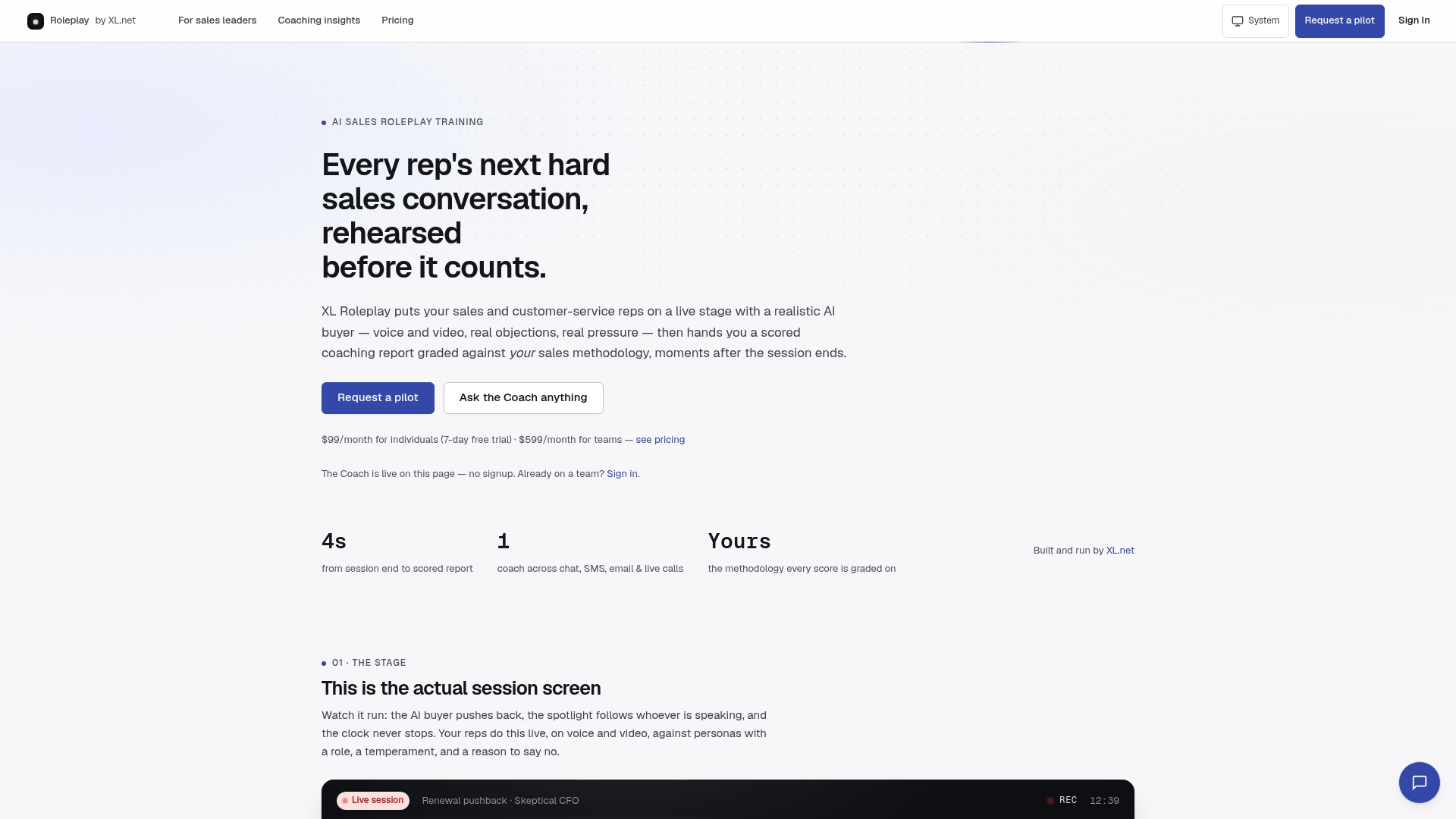
Sales leaders can see how the platform supports readiness on the page for sales leaders.
FAQ
What is a good ramp time for a new sales rep?
It depends on the role and the sales cycle. Published benchmarks run from about 3 months for SDRs to about 6.2 months for AEs, and far longer for enterprise and strategic accounts. Use your own hires’ revenue curve to set the target.
What should a 30-60-90 day sales plan include?
Days 1-30 cover product, ICP, methodology and first role-plays, with competency as the main metric. Days 31-60 add real outreach under coaching, measured by activity. Days 61-90 measure outcomes such as pipeline and quota attainment.
How do I know a rep is ready for live customer calls?
Set gates: a product certification score, then a scored discovery role-play, then a methodology check on a recorded real call. A rep who clears the role-play gate has shown the skill in a controlled setting before any account is at risk.
How do I shorten ramp time without hurting quality?
Remove waiting, not learning. Prepare tools before day one, schedule shadowing early, and add practice reps so skills are mastered sooner. Forrester’s guidance favors good over fast, so shorten ramp by improving the plan rather than skipping gates.
Sources
- How Long to Ramp a Sales Rep in 2026
- Modern Enablement Benchmarks Report, SBI Growth
- CSO Insights 2016 Sales Enablement Optimization Study
- Sales ramp time: how long new AEs take to hit quota
- How to calculate the right ramp up periods, Revcast
- How Quickly Should A Sales Rep Be Onboarded?, Forrester
- Rep ramp plan, Outbound Wiki
- Building Onboarding Ramp Plans, The Revenue AI Report
- 30-60-90 SDR onboarding plan
- What Does Effective Sales Onboarding Look Like, Selling Power
- Sales Hiring Statistics 2026