SPIN vs Challenger: Which Sales Method Fits Your Team?
SPIN vs Challenger: Which Sales Method Fits Your Team?

SPIN Selling and the Challenger Sale answer different questions. SPIN helps a rep draw out a buyer’s problem with a sequence of questions. Challenger helps a rep bring the buyer a new way of seeing that problem and steer the conversation. Choose SPIN when buyers don’t yet grasp the scope of their problem, and Challenger when buyers think they already know it. Either way, the method only pays off once reps can use it live, which takes repetition in realistic conversations. That is why we build practice around the playbook your team has chosen.
TL;DR
- SPIN is question-led discovery: Situation, Problem, Implication, Need-payoff. Challenger is insight-led selling: Teach, Tailor, Take Control.
- SPIN suits buyers who haven’t defined their problem and reps still building domain knowledge. Challenger suits informed, status-quo-biased buyers and reps with real expertise.
- The two stack well: open with problem and implication questions, reframe with an insight, close with a specific next step.
- Standardizing on one framework matters more than which one you pick, and a framework only shows up in calls when reps rehearse it.
- Practice against realistic buyers, scored against your own methodology, turns either method from a slide deck into a habit.
Table of Contents
- What SPIN Selling is
- What the Challenger Sale is
- SPIN vs Challenger side by side
- When SPIN fits your team
- When Challenger fits your team
- Using both: a combined call flow
- What the evidence does and doesn’t prove
- Why practice decides which method works
- Practicing SPIN, Challenger or your own blend with XL Roleplay
- Our perspective
- FAQ
- Sources
What SPIN Selling is
SPIN Selling comes from Neil Rackham’s research program, which analyzed 35,000 sales calls. It is a discovery framework built on four question types asked in a deliberate order:
- Situation: facts about the buyer’s current state. (“How many reps do you have on the team?”)
- Problem: the difficulties and dissatisfactions they live with. (“Where do new hires struggle most?”)
- Implication: what those problems cost if nothing changes. (“What does a slow ramp do to your quarterly number?”)
- Need-payoff: the buyer describing, in their own words, the value of fixing it. (“If ramp time dropped by a month, what would that free up?”)
The sequence moves the buyer from facts to consequences to value. The rep doesn’t pitch the value. The buyer says it out loud.
SPIN also describes the shape of the whole call. A LibreTexts selling chapter lists four components: opening, investigating, demonstrating capability and obtaining commitment. The SPIN questions live in the investigating stage. The commitment stage ends with the prospect agreeing to advance, continue without advancing, or buy.
The research behind it points at a clear behavior. In large, complex deals, closing techniques and feature pitches correlated with failure, while a well-built question sequence correlated with winning. Implication and need-payoff questions separated top performers from average ones more cleanly than any other single behavior measured.
If you want to see the questions in practice, our list of SPIN selling questions for discovery calls gives examples for each stage.
What the Challenger Sale is
The Challenger Sale comes from Matthew Dixon and Brent Adamson’s book, built on CEB research that coded more than 6,000 B2B reps across 90 companies into five profiles. The Challenger profile, the rep who teaches, tailors and takes control, came out ahead of the others.
The three core behaviors, as Salesforce summarizes them:
- Teach: offer a unique, industry-based insight the buyer hasn’t considered.
- Tailor: adapt the message to the buyer’s specific challenges and value drivers.
- Take Control: discuss money comfortably and apply the pressure that guides the buyer toward a decision.
The same source describes a five-step conversation flow: warm-up, reframe, emotional impact, value proposition and solution. The rep first shows knowledge of the prospect’s world, then shifts the buyer’s view toward a bigger problem. Next comes a relatable story of a customer who didn’t solve it, then how a solution would work, and only then the product itself.
Where SPIN sellers ask, Challengers arrive with a point of view. That is the real difference, and the rest of this comparison follows from it.
SPIN vs Challenger side by side
| SPIN Selling | Challenger Sale | |
|---|---|---|
| Core move | Ask questions that surface problem and cost | Teach an insight that reframes the problem |
| Who talks more | The buyer | The rep, at key moments |
| Best buyer | One who hasn’t defined their problem | One who believes they already know it |
| Rep needs | Listening, patience, question craft | Business acumen, original insight, nerve |
| Typical failure | Interrogation without implication | Recycled statistics that teach nothing |
| Committee deals | Weaker: the questions reach one person | Stronger: tailored messages for each stakeholder |
| Loyalty built by | Showing interest in the customer | Showing the rep’s credibility |
These contrasts come from two comparison write-ups: one on decision criteria and one on complex deals. A third explanation of the teaching versus asking divide frames loyalty the same way: investigating builds it through interest, teaching builds it through credibility.
Another useful framing: Rackham later said the real dividing line was never deal size but whether the sale was transactional or consultative. That is a better question to ask about your own pipeline than “how big are our deals?”
When SPIN fits your team
Reach for SPIN when:
- Buyers don’t understand the scope of their problem. They know something hurts but not what it costs. Implication questions make the cost visible.
- Cycles are long and consultative. There is time to ask, listen and build the case with the buyer.
- Reps are still building domain knowledge. The question sequence is easier to coach than an original insight, because a manager can hear whether a rep asked an implication question or skipped it.
That last point matters for new reps. A new hire can’t teach a CFO something new about her industry in week three, but she can learn to ask what a delayed rollout costs. The criteria above are the decision framework most comparisons converge on.
SPIN gets stale when buyers arrive pre-educated and resent basic questions. Situation questions are where that shows first. Do the homework before the call, and spend call time on problem and implication.
When Challenger fits your team
Reach for Challenger when:
- You sell against the status quo. The competitor is “we’ll keep doing what we do,” not another vendor.
- Reps have deep domain knowledge. Teaching needs something real to teach.
- Marketing or enablement produces insight content. A reframe has to be backed by a credible data point or customer pattern.
- Deals involve several stakeholders. A tailored, repeatable reframe is something a champion can carry into a meeting the seller isn’t attending.
The research summarized in one book summary suggests Challengers’ share of star performers rises in high-complexity solution sales, while in simple transactional sales the profiles converge and the gap largely disappears. If your reps sell short, simple deals, Challenger’s edge is smaller.
Challenger fails when reps lack the expertise to deliver a real insight. A reframe built on a statistic the buyer has already seen teaches nothing and costs credibility.
Using both: a combined call flow
Most teams don’t have to pick a side. The two methods stack, and the decision-framework write-up lays out a workable sequence:
- Open with Problem and Implication questions. Get the pain on the table and attach a consequence to it.
- Pivot to a reframe. Once the pain is surfaced, offer an insight that shows the buyer a bigger or different version of the problem.
- Return to Need-payoff. Let the buyer say what solving it is worth.
- Take control of the next step. Propose a specific date and agenda, not “let’s stay in touch.”
The reverse order works too. A rep can open with an insight about the buyer’s operation, then use implication questions to let the buyer work through what that claim means, converting the insight into a cost the buyer states. An insight the buyer says out loud is more persuasive than one the rep announces.
A short example
A rep sells onboarding software to a VP of Customer Success. The VP says retention is fine.
- Problem question: “Where do new accounts tend to stall in their first 90 days?”
- Insight: “In companies your size, we see the stall usually happens at integration handoff, not at kickoff, and it rarely shows up in retention numbers until renewal.”
- Implication question: “If that’s happening here, what does a delayed first-value moment do to your renewal forecast?”
- Take control: “Let’s pull the last two quarters of handoff data together on Thursday at 10 and see.”
One call, four moves, two methods. Notice that the rep never pitched the product.
What the evidence does and doesn’t prove
Both methods rest on research, and both deserve to be used with eyes open.
SPIN’s findings are behavioral correlations from observed calls, not controlled trials. They still hold up in modern data: one analysis reports that top performers ask 11 to 14 questions per discovery call versus 6 to 8 for average performers. The same analysis argues SPIN’s principles are now table stakes, and that SPIN alone is not enough because it was built for a world where sellers held an information advantage. Buyers research before they ever talk to you, so the question sequence works best paired with a point of view.
The Challenger research has drawn methodological criticism. One 2015 review noted that the initial data came from 700 reps during the 2009 recession, and a methodological summary reports that star-performer status was assigned by managers’ judgment rather than sales-versus-quota data. The practical reading for a sales leader: treat the Teach, Tailor, Take Control behaviors as a hypothesis to test with your own reps and your own call data, not as settled law.
The number worth acting on is about consistency. One comparison reports that more than 75% adoption of a single methodology is associated with 21% higher quota attainment, 15% higher win rates and 6% higher revenue attainment against teams with no consistent framework. That is an association, not proof of cause, but it points the same way as common sense: a team that shares a language coaches better.

Why practice decides which method works
Both methods are easy to understand and hard to do. A rep can recite the four SPIN question types and still skip implication questions when a buyer pushes back on price. A rep can memorize a reframe and still freeze when the buyer says, “We already know this.”
That gap closes with repetition under realistic pressure, ideally before a live prospect is on the line. For a team, it also needs three things:
- A shared standard. Everyone knows what a good implication question or a good reframe sounds like in your market.
- Realistic buyers. Skeptical, rushed, pre-educated, multi-threaded. The buyer a rep will actually face.
- Specific feedback. Not “good call,” but “you asked two situation questions you could have researched, and you never asked what the delay costs.”
We’ve written drill guides for both methods: SPIN selling practice drills for implication questions and Challenger roleplay drills for the commercial insight. For scenario ideas that suit either method, see our sales role play scenarios playbook.
Practicing SPIN, Challenger or your own blend with XL Roleplay
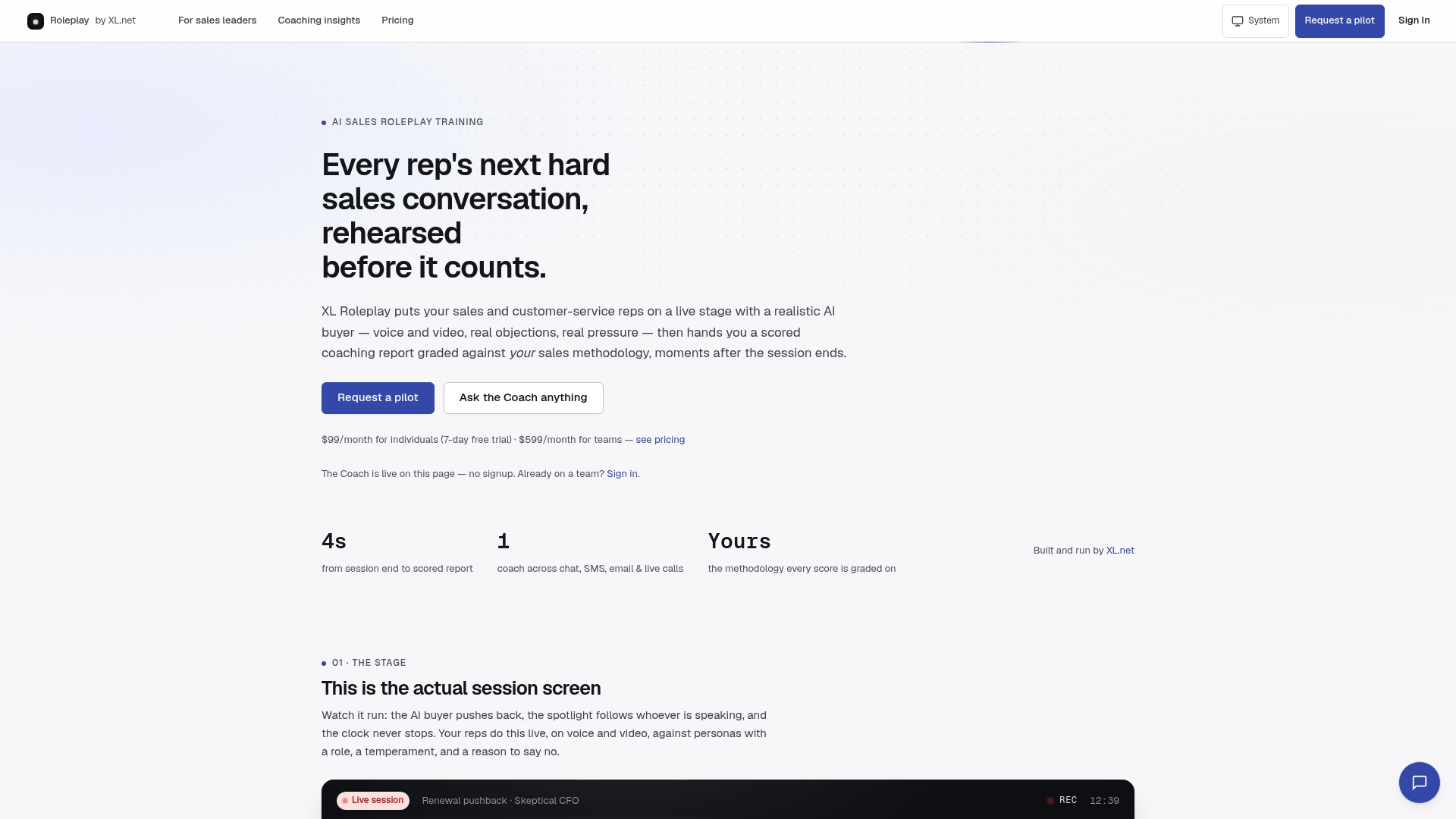
XL Roleplay lets reps run live voice and video sessions with AI buyers that raise the objections and pressures typical of real calls. Each session produces a scored coaching report based on your organization’s own sales methodology, whether that is SPIN, Challenger or a blend of the two. Managers get detailed session transcripts and rubrics, so coaching points to the exact moment in the conversation, not to a general impression.
Plans are published: Individual is $99 per month and Business is $599 per month. Extra seats cost $54.95 per month per seat, and extra video is $16.99 per hour. Teams that want to start smaller can look at the XL Roleplay pilot, and sales leaders can see how it works for sales leaders. Full details are on the pricing page.
Our perspective
The SPIN vs Challenger debate is useful, but it hides the question we hear underneath it: “How do I get my team to actually do this?”
A methodology is only as good as the next call. Reps don’t fail because they’ve never heard of implication questions or the reframe. They fail in the moment, when the buyer pushes back and the old habit takes over. That is a practice problem, not a knowledge problem.
This is why we built XL Roleplay around one persistent AI coach with shared memory across channels, and why scoring and coaching are grounded in your organization’s own methodology instead of a generic standard. If your playbook says implication questions come before the pitch, the report scores that. If it blends a Challenger reframe with SPIN discovery, the report scores that.
The transcript-linked feedback is there for managers as much as reps. A leader can see where a rep skipped a step and coach that moment. That is how a framework becomes a team habit.
Adam
FAQ
Is SPIN Selling outdated?
Its core principles still hold: questions beat pitches, and consequences drive action. One 2025 analysis calls them table stakes today. Because buyers now research before talking to sellers, SPIN works best when the rep also brings a point of view, which is why many teams pair it with Challenger-style insight.
What are the four stages of SPIN Selling?
SPIN describes a call with four components: opening, investigating, demonstrating capability and obtaining commitment, per a LibreTexts chapter. The name SPIN comes from the four question types used while investigating: Situation, Problem, Implication and Need-payoff.
Which is better for new reps?
SPIN is usually easier to start with. Its question sequence is concrete and a manager can hear whether it was followed. Challenger asks reps to deliver original insight, which takes domain knowledge that new hires are still building. Practicing both in realistic scenarios helps new reps grow into the Challenger behaviors.
Can we use SPIN and Challenger together?
Yes. A common pattern is to open with problem and implication questions, reframe once the pain is surfaced, then close with need-payoff and a specific next step. Agree on which stage of the call uses which method so coaching stays consistent across the team.
How do we get reps to apply either method on live calls?
Give them repeated practice against realistic buyers, with feedback tied to the exact moments in the conversation. Scoring against your own playbook keeps the whole team working to the same standard. Our AI sales role play articles cover how to set that up.
Sources
- 12 best sales methodologies and customer-centric selling, HubSpot
- 10.5: How to Use SPIN Selling in Your Sales Call, LibreTexts
- SPIN Selling by Neil Rackham, summary
- The Challenger Sale by Matthew Dixon and Brent Adamson, summary
- SPIN vs Challenger vs MEDDIC Compared, Sendspark
- What is the Challenger Sales Methodology, Salesforce
- SPIN Selling vs Challenger Sale: Decision Framework, Prospeo
- SPIN Selling vs Challenger Sale: Which Wins Complex Deals, ORM Tech
- SPIN Selling vs Challenger Sale Model, Shortform
- Is SPIN Selling Dead? What Still Works, Inversion CRO
- Revisiting The Challenger Sale, 2015 review
- Sales Methodology: 10 Frameworks Compared, GigRadar