How to Standardize Sales Coaching Across Your Team
How to Standardize Sales Coaching Across Your Team

To standardize sales coaching, you need four things: one short rubric of observable behaviors, written definitions for every rating level, regular calibration so managers score the same call the same way, and a place where reps practice against that rubric before a real buyer is on the line. XL Roleplay puts the last two pieces in one place: AI buyers for practice, and scored coaching reports built on your own sales methodology, with transcripts managers can review.
This guide walks through each piece in order, with the numbers and examples a sales leader, a customer service manager or an enablement owner needs to roll it out.
TL;DR
- Standardized coaching means the same expectations, the same rubric and the same rating definitions for every rep and every manager, not the same script for every call.
- Build the rubric from a handful of observable behaviors, each with a 1 to 5 scale and a plain description of what every score looks like.
- Calibrate: have managers score the same calls, compare, and fix the definitions wherever they disagree.
- Use the rubric in practice sessions first, so reps are scored on it long before a live deal is at stake.
- Review results on a schedule and tie them to business outcomes such as win rate.
Table of Contents
- What standardized sales coaching actually means
- Step 1: Build a rubric with observable behaviors
- Step 2: Calibrate your managers
- Step 3: Practice against the rubric before live calls
- Step 4: Run the cadence and name an owner
- Step 5: Measure whether it works
- Where standardization usually breaks
- How XL Roleplay supports a standard
- Our perspective on standardizing coaching
- FAQ
- Sources
What standardized sales coaching actually means
Sales training teaches a skill, framework or process. Coaching is what happens afterward: a manager watches or listens to real behavior and helps the rep change it. Standardizing coaching does not mean every manager recites the same advice. It means every rep is held to the same clearly stated expectations and every manager judges against the same yardstick.
Without that, coaching drifts. The Sales Management Association studied 206 firms employing more than 500,000 sales professionals and found coaching is often reactive and lacks structured objectives, accountability and success measurement. One manager coaches on rapport, another on closing, a third only when a deal is slipping. Reps on different teams get different standards, and nobody can tell whether coaching helps.
The same study recommends a fix that reads like a checklist for a rollout: define coaching expectations, connect coaching to business impact, specify what coaches and coachees each owe the process, and track coaching performance as you would any other major sales initiative.
The prize is measurable. An ATD article reports that the Sales Management Association found companies with formal coaching had a 16.7% higher win rate. Formal means defined, repeatable and tracked, which is exactly what standardization provides.

Step 1: Build a rubric with observable behaviors
The rubric is the heart of standardized coaching. It is also where most programs go wrong, by listing vague traits like “confidence” or “good energy” that two managers will score differently.
Keep it short
Published guidance from sales consultancies lands in a similar range. One guide says to choose five to eight call behaviors and rate each on a 1 to 5 scale, with N/A available when a behavior does not fit the call. Another suggests five to seven observable behaviors. A longer card feels thorough but rarely gets finished, and a card nobody finishes standardizes nothing.

Pick behaviors you can hear or see
A behavior is observable if a second person reading the transcript could point to it. For the conversations most teams care about, a workable starting set looks like this:
| Area | Observable behavior | What a strong rep does |
|---|---|---|
| Opening | Sets purpose and agenda | States why the call matters and gets the buyer’s agreement on what to cover |
| Discovery | Asks open questions about the problem | Uncovers the cause, the business impact and the timeline, not just surface needs |
| Discovery | Listens and follows up | Builds the next question on the buyer’s last answer instead of moving down a list |
| Objection handling | Clarifies before responding | Asks what sits behind the objection before offering a counter |
| Objection handling | Advances the conversation | Ends the exchange with the buyer closer to a decision, not just quieter |
| Customer conversation | Stays composed under pressure | Keeps a steady tone when the buyer or customer pushes back or gets upset |
| Close | Secures a specific next step | Leaves with a named action, owner and date |
For a customer service team, swap in the behaviors your standards demand: acknowledging the issue, confirming understanding, de-escalating, stating what happens next. The method is identical.
Define every rating level
A 1 to 5 scale only standardizes anything when each number has a description. One guide’s anchors run from 1 for a behavior that is absent to 5 for excellent, with the middle scores describing below-average, average and good-but-improvable work. The question to ask of each behavior is the one another consultancy poses: what does a 3 out of 5 look like? If you cannot answer in one sentence, the behavior is not yet observable enough.
Two additions make the rubric far more usable:
- Examples and counterexamples. Guidance on observation rubrics recommends pairing each criterion with examples and counterexamples. Pull one strong and one weak excerpt from real calls for each behavior, so a 5 and a 2 have a face.
- A not-observed option. If the buyer never raised an objection, the rep should not be marked down for not handling one. The same guidance says to score only behaviors the conversation gave the rep a fair chance to show. This keeps scores fair and keeps reps trusting the system.
Tailor it to your methodology
Standardized does not mean generic. The Sales Management Association study advises targeting the behaviors, competencies and objectives that matter for each sales role, including upstream work such as qualification and solution development as well as late-stage selling. Start from the methodology your company already teaches, then translate each of its stages into behaviors on the rubric. A rubric that does not match how your team is told to sell will confuse reps rather than guide them.
Step 2: Calibrate your managers
A rubric on paper is not yet a standard. The standard exists when two managers who listen to the same call give the same score, or close to it.
The method is simple:
- Choose a handful of recorded calls or practice sessions.
- Have every manager score them independently, before any discussion.
- Meet and compare. Reviewing the same calls together and discussing the differences is how managers align on what each rating means.
- Wherever scores diverge, treat it as a signal that the definition is unclear and rewrite it.
One practitioner guide suggests having managers score the same five calls and aim for scores within one point of each other before rollout, then revisit rubric trends at day 90. Treat those as sensible starting targets for your team rather than a universal threshold.
Keep observation apart from advice
Good scoring notes do three separate jobs. Observation, interpretation and coaching advice should stay distinct, and each score should point to the specific call moment behind it. “Discovery: 2. At the 6:40 mark the rep moved to pricing after the buyer mentioned a missed quarter” is something a rep can act on. “Needs better discovery” is not.
This is where transcripts earn their keep. When every score links to a line in the transcript, disagreements between managers become short conversations about evidence rather than arguments about impressions.
Step 3: Practice against the rubric before live calls
Coaching on live calls has a cost: the rep is learning on a real buyer. Practice sessions scored on the same rubric remove that cost and give new hires a way to reach the standard before they carry a quota.
ICMI, the contact center professional body, offers guidance on role-play evaluation that applies to sales and service teams alike. Its advice is to introduce the role-play format and scoring rubric early, with low-stakes self- and peer-evaluation before anything counts as pass or fail. Waiting until the end of training provokes anxiety, and learners should know exactly what passing requires when the result counts. ICMI also suggests crowdsourcing scenarios from tenured employees and writing sample positive and negative scripts, so the rubric has reference points.
A practical sequence for a new rep:
- Week one: run a scenario, score yourself against the rubric, then compare with the manager’s score.
- Weeks two and three: repeat with harder buyers and a focus on the two or three behaviors scored lowest.
- Before live calls: a scored practice session counts as a readiness check, with the passing score known in advance.
For customer service teams, the same loop works for objection handling and de-escalation: a difficult-customer scenario, the same rubric, and a debrief tied to specific moments.
Building scenarios from real conversations keeps practice honest. Our guide on building sales role-play scenarios from real calls shows how, and our trainer’s playbook of role-play scenarios covers the situations most teams rehearse first.
Step 4: Run the cadence and name an owner
Standards decay without a rhythm. The practitioner guide mentioned above recommends a weekly one-to-one, a biweekly deal review, call-recording and CRM evidence, and a named owner of the program. Whatever cadence you choose, write it down and attach one person to it. Coaching that belongs to everyone belongs to no one.
A minimal operating rhythm:
| Cadence | What happens | Evidence used |
|---|---|---|
| Weekly | One-to-one coaching on one or two rubric behaviors | Scored calls or practice sessions, with timestamps |
| Biweekly | Deal review tied to the stage of the sale | Recordings and CRM notes |
| Quarterly | Calibration refresh and rubric edits | Score spread between managers |
Step 5: Measure whether it works
Decide before launch what success looks like. The Sales Management Association’s recommendation to track coaching like any major sales initiative means choosing a few measures and reviewing them on a schedule. Useful ones include:
- Score spread between managers on shared calls, to see whether calibration is holding.
- Rubric trends per rep and per behavior, to see which skills are improving.
- Readiness before first live calls for new hires, using practice scores.
- Win rate and stage conversion over time, the outcomes coaching is meant to move.
A simple way to start is to pilot with one team, compare against a team not yet on the rubric, and widen the rollout once managers agree on scores.
Where standardization usually breaks
- Too many criteria. Cut the rubric until managers can complete it in minutes.
- Adjectives instead of behaviors. If you cannot quote it from a transcript, it is not on the rubric.
- No calibration. Two managers with one form are still two standards.
- Penalizing missing opportunity. Use not-observed so reps are scored only on what the call allowed.
- Practice and live scoring on different forms. Reps should see one standard from day one.
How XL Roleplay supports a standard
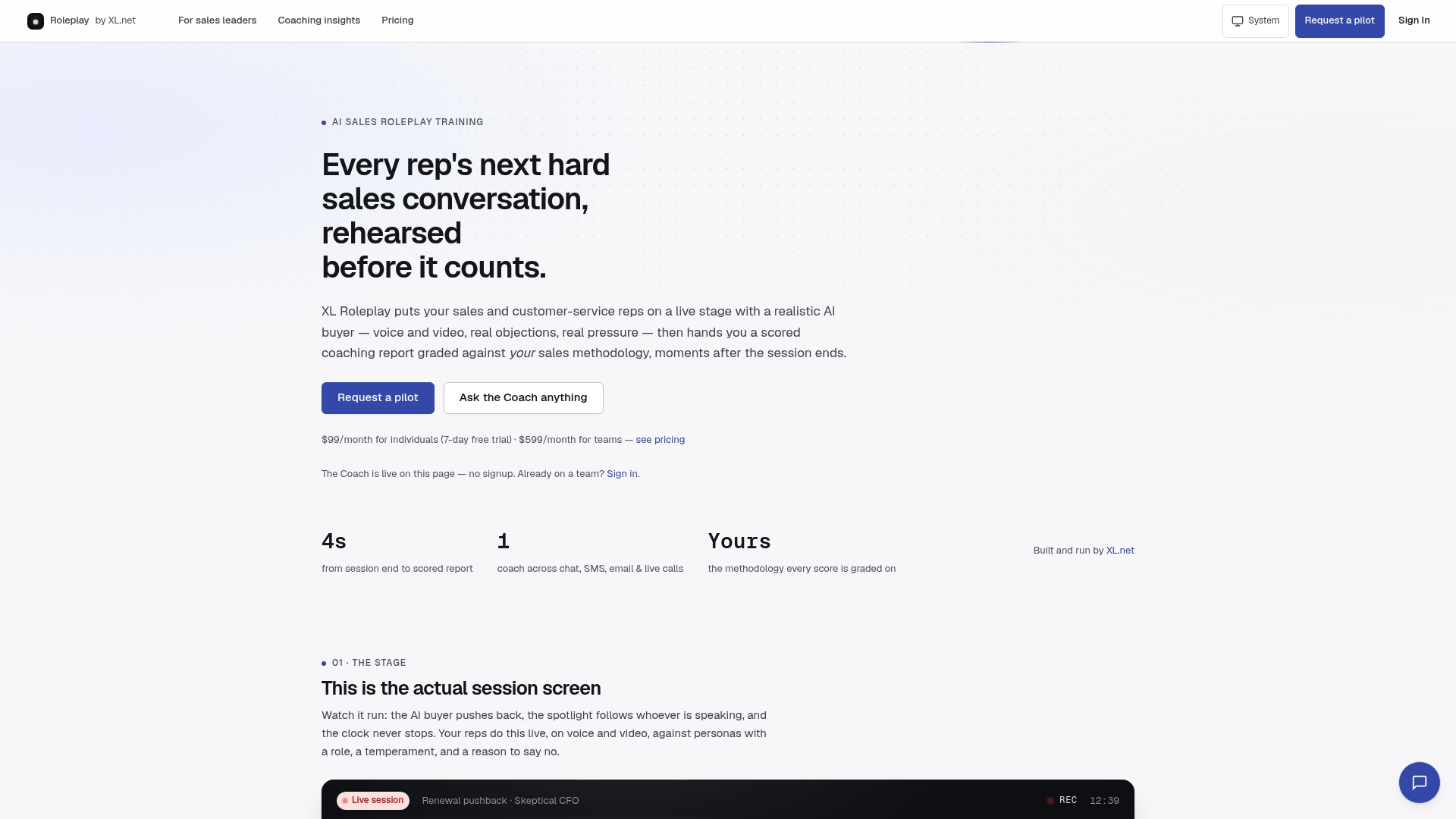
The hardest parts to sustain by hand are scoring every session the same way and giving each rep enough practice. XL Roleplay runs live voice and video role-plays with realistic AI buyers who raise the objections and pressures your reps meet, then produces scored coaching reports based on your organization’s own sales methodology. Managers can review performance through transcripts and rubrics, and each report links feedback back to what was said, so a score always has evidence behind it.
Our approach is designed around one persistent AI coach with shared memory across channels, and sessions and reports tailored to your playbook rather than generic standards. Teams can build customized scenario libraries, use readiness scoring, and run live debriefs.
The Individual plan is $99 per month, and the Business plan is $599 per month. Extra seats are $54.95 per month per seat, and extra video is $16.99 per hour. See the plans on the pricing page or ask about the XL Roleplay pilot to start with one team. Sales leaders can see more on our page for sales leaders.
Our perspective on standardizing coaching
Most coaching programs fail for a boring reason: the standard lives in each manager’s head. A rep who gets a 4 from one manager and a 2 from another learns nothing except whom to avoid.
We built XL Roleplay around the idea that a standard needs two things at once: your own methodology as the yardstick, and enough repetition for reps to reach it. A scored report tied to transcript lines gives a manager and a rep the same evidence to talk about. Practice against realistic buyers lets a new hire make mistakes where they cost nothing.
Our view is that coaching should be operational, not occasional. Define the behaviors, calibrate the scores, practice often, review the transcripts, and let the results show you where your team is ready and where it is not.
Adam
FAQ
How many criteria should a sales coaching rubric have?
Published guidance generally lands between five and eight behaviors, with some going up to ten competencies for broader skills assessments. Fewer criteria get scored consistently and finished on every call. Start small, and add a criterion only when you can describe each rating level for it.
How is a coaching rubric different from a sales training program?
Training teaches the skills, frameworks and processes. The rubric is what coaches use afterward to judge whether those skills show up in real or practiced conversations. Standardized coaching ties the two together: the rubric is written from what you train.
How do I get managers to score the same way?
Have them score the same calls independently, then compare results and discuss every gap. Where they disagree, rewrite the definition of the behavior until the disagreement disappears. Repeat the exercise periodically, especially when a new manager joins.
Can the same rubric work for customer service teams?
Yes. The structure is the same: a few observable behaviors, defined rating levels and calibration. Only the behaviors change, for example acknowledging the issue, de-escalating and stating next steps. Practice sessions with difficult-customer scenarios let new agents reach the standard before handling live contacts.
How soon should new reps be scored on the rubric?
Introduce it in their first practice sessions, with low-stakes self- and peer-evaluation. ICMI’s guidance is to avoid revealing the scoring format only at the end of training, and to make the pass requirement clear when results count.
Sources
- Measuring Sales Management’s Coaching Impact, Sales Management Association
- The Future of Sales Training: Unlocking Performance With AI-Powered Coaching and Sales Readiness, ATD
- Role-Play to Check Training Effectiveness, ICMI
- The Sales Leader’s Guide to Building a Coaching Culture, Edison Partners
- Sales coaching programs: how to build and measure one, Grou Global
- Standardizing sales team skills assessment, SmartMoves Inc
- Create a sales coaching rubric based on observable behavior, GTMStrategyGuide