LMS vs. Coaching Platform: What Sales Teams Need
LMS vs. Coaching Platform: What Sales Teams Need

An LMS (learning management system) gets training content to your people and records who finished it. A coaching platform gets your people to perform in a live conversation. If your reps know the material but stumble on discovery, pricing pushback or objections, you have a practice problem, and that is what a coaching platform such as XL Roleplay is built for: reps rehearse with AI buyers, get scored feedback tied to your own methodology, and managers review the transcript.
TL;DR
- An LMS is built for delivery, administration and reporting of training. A coaching platform is built for practice, feedback and behavior change.
- Finishing a course does not show that a rep can run discovery or handle an objection live.
- Research on sales managers links effective training, a regular coaching rhythm and a strong manager to a much higher chance of top performance. Each part matters.
- The two tools fit together: the LMS carries knowledge, the coaching platform turns it into skill.
- Measure behavior on real conversations, not course completion.
Table of Contents
- What an LMS does
- What a coaching platform does
- Side by side
- Why a completed course is not a skilled rep
- When each one is the right answer
- What the research says about combining them
- Using both together
- How to measure readiness
- Our perspective
- Start with a pilot or a plan
- FAQ
- Sources
What an LMS does
An LMS is central to many employers’ learning programs. According to ATD’s TD magazine, it can deliver training content, track learner progress, maintain resources and generate reports.
For a sales or service team, that means product modules, compliance courses, onboarding checklists, quizzes and completion dashboards. It is the right tool when the problem is getting the same information to everyone and proving they received it.
What it records is exposure: who opened the module, who passed the quiz. That is useful, and it is also where its view of the rep ends.
What a coaching platform does
A coaching platform is built around the conversation itself. Instead of asking a rep what they would say, it puts them in the situation and watches what they do.
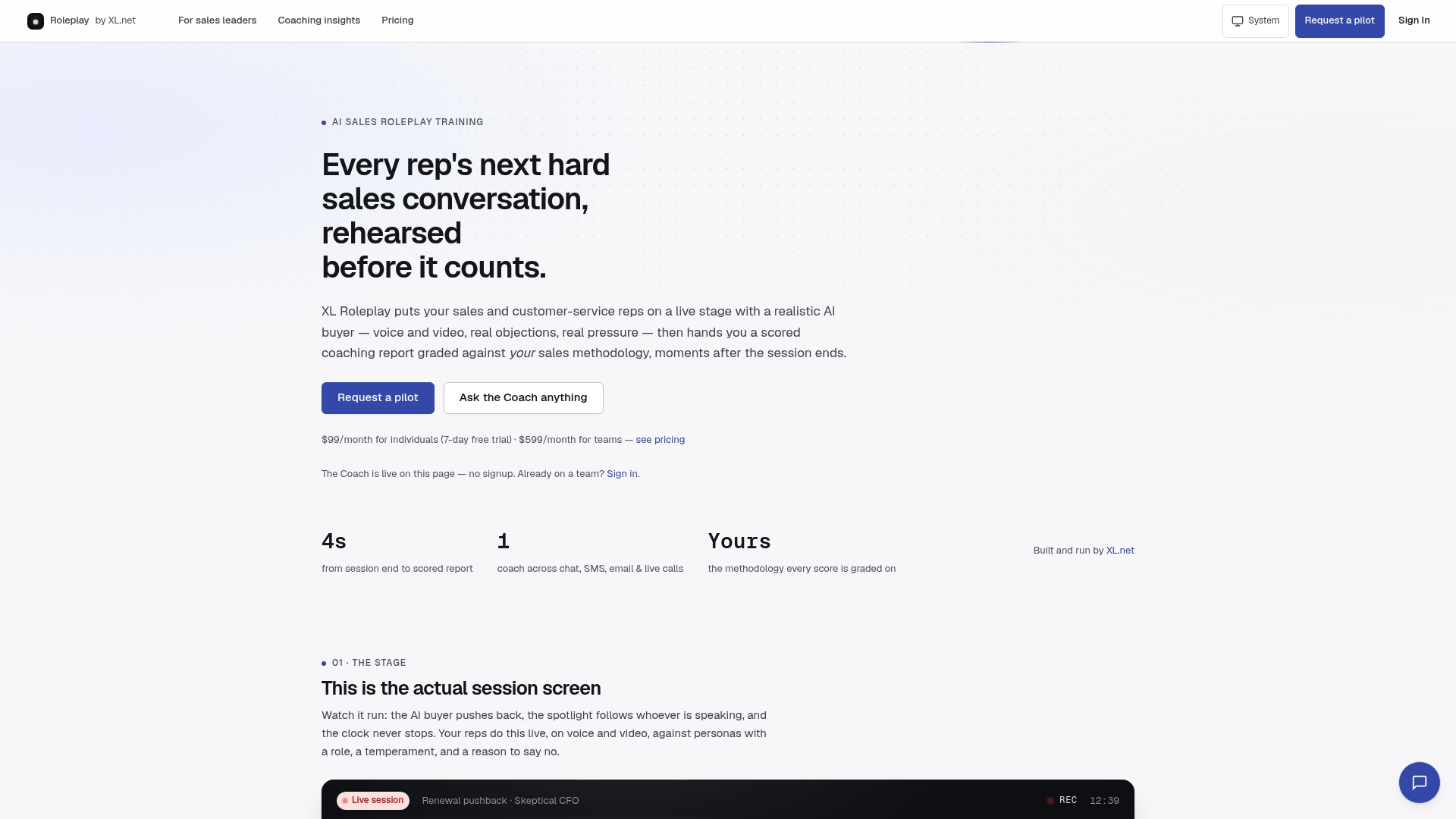
With XL Roleplay, a rep holds a live voice or video conversation with an AI buyer that raises typical objections and pressures. When the session ends, the rep receives a scored coaching report based on the organization’s own sales methodology. Managers can open the transcript and the rubric to see exactly where a conversation went well or off track, and the platform offers readiness scoring and live debriefing tools for the team.
The unit of measurement is a skill in action: how a rep opened discovery, whether they held price, whether they followed the method your company teaches.
Side by side
| LMS | Coaching platform | |
|---|---|---|
| Main job | Deliver, administer and track learning | Build and measure conversation skills |
| Typical content | Courses, documents, quizzes | Role-play scenarios, personas, scored sessions |
| What it shows a manager | Completion and assessment results | Transcripts, rubric scores, readiness |
| Best for | Knowledge, compliance, onboarding content | Discovery, objection handling, methodology adoption |
| Feedback | Quiz results | Scored coaching report after each session |
| Risk it reduces | Missed or undocumented training | Practicing on real customers |
Why a completed course is not a skilled rep
A rep can finish every module and still freeze when a buyer says the price is too high. Knowing the framework and applying it under pressure are different abilities, and a quiz tests the first. Practitioner guides on sales coaching software make the same point: course completion and assessment scores are not coaching, and tools aimed at applied performance are the ones that change behavior.

There is a measurement side to this too. Research from Insights and ATD, reported by Training Industry, found digital learning is often evaluated by completion rates rather than changes in behavior or performance. A dashboard full of green checkmarks can sit beside flat win rates.
When each one is the right answer
Choose an LMS when the gap is knowledge
New hires need product facts, pricing rules, policies and tool training. Everyone needs the same information, once, with a record. This is content delivery, and an LMS handles it well.
Choose a coaching platform when the gap is performance
The signs are familiar to sales leaders and service managers:
- Reps know the discovery questions but skip them on calls.
- Objections get answered with discounts instead of the method you teach.
- New reps are nervous about their first live conversations.
- Each manager coaches differently, so the methodology drifts from team to team.
These are rehearsal problems. A new rep who practices against an AI buyer makes the first mistakes in a session, not in front of a prospect. A service team can run the same difficult objection until the response is steady.
Standardizing a methodology
Training on a methodology in an LMS tells people what it is. Scoring practice sessions against that methodology shows whether they use it. XL Roleplay’s scoring and coaching are grounded in each organization’s own sales methodology and playbooks, so the rubric a rep is held to is yours, not a generic standard.
What the research says about combining them
The RAIN Group’s Top-Performing Sales Manager Benchmark Report, a year-long study of 1,004 sales managers and sellers, found that an effective manager, a regular coaching rhythm and effective sales training together create a 63% increased likelihood that a seller is a top performer. Remove any one of the three and the likelihood drops sharply.
Two takeaways follow. Training content alone is one leg of three. And coaching has to be regular, which is hard when it depends on manager calendars. Frequent practice sessions with consistent scoring give managers material to coach from each week. Our guide to scaling sales coaching with rubrics and AI role-play covers how teams build that rhythm over 90 to 180 days, and six manager coaching skills to practice weekly covers the manager side.

Using both together
You do not have to pick one. TD magazine advises organizations to treat coaching as a tool within the larger learning ecosystem, not as a separate performance experience. A workable split:
- The LMS carries the knowledge: product, process, methodology theory.
- The coaching platform carries the practice: scenarios built from that same methodology.
- Managers use transcripts and scores to run focused one-to-ones.
- Leaders read both: completion for coverage, practice scores for readiness.
The coaching loop works when evidence of how reps perform feeds specific feedback, more practice and progress measurement. That loop is the part an LMS does not supply on its own.
How to measure readiness
Completion rates tell you who sat through training. To know whether reps are ready, track what changes on the job. Training Industry’s piece recommends moving from completion to whether learners reached their development goals and how learning affected on-the-job behavior, using pre- and post-learning assessments and tying outcomes to business indicators such as customer satisfaction and sales performance.
In practice, that means:
- Baseline score: each rep’s first practice session against your rubric.
- Trend: how scores on discovery and objection handling move across sessions.
- Readiness before live calls: a threshold new reps reach before taking real conversations.
- Business outcomes: win rate, deal size, customer satisfaction, compared over time.
XL Roleplay provides evidence-based performance tracking for individuals and teams, with each score linked back to the transcript, so a manager can see why a number moved. For more on this approach, browse our data-driven sales training articles.
Our perspective
We built XL Roleplay on a simple observation: knowing what good looks like is not the same as being able to do it with a buyer on the line.
Most teams already have a place where content lives. What they lack is a safe place to be wrong, repeatedly, before it costs a deal. So we give reps one persistent AI coach with shared memory across channels, realistic buyers who push back, and a scored report grounded in your own methodology after every session.
Managers get what they rarely have time to gather: transcripts and rubrics that show how a rep handled a specific moment. Coaching conversations become specific, and the methodology your company teaches becomes the thing reps are scored on.
That is why we think of practice as the missing layer next to training content, not a replacement for it.
Adam
Start with a pilot or a plan
If your team has the content and needs the practice, XL Roleplay offers an Individual plan at $99 per month and a Business plan at $599 per month. Extra seats are $54.95 per month per seat, and extra video is $16.99 per hour. Details are on the pricing page. Teams that want to test it with a group first can look at the XL Roleplay pilot.
FAQ
Is a coaching platform a replacement for an LMS?
No. They do different jobs. The LMS delivers and records training content, while a coaching platform adds practice, scored feedback and manager review. Most teams get the best result using both.
Can an LMS coach sales reps?
An LMS can support the learning part of coaching, such as goals, resources and action plans. Live conversation practice with scored feedback on specific behaviors is what a coaching platform is designed to add.
Who benefits most from AI role-play practice?
New sales reps preparing for first live calls, customer service teams working on objection handling, and sales leaders who want every rep scored against the same methodology. Individual reps can also practice on their own.
What should I measure after adding a coaching platform?
Track rubric scores by skill, readiness before live calls, and business results such as win rate and customer satisfaction, rather than completion alone.
Sources
- Learning Management Systems, TD magazine (ATD), February 2024
- Sales Coaching Software in 2026: Compare the Best Platforms
- The Top-Performing Sales Manager Benchmark Report, RAIN Group
- Personalized Learning: Why Digital Training Falls Short, Training Industry